

2026 marks a turning point for Japan’s cruise market. New vessels such as Mitsui Ocean Cruises’ “Mitsui Ocean Fuji” (三井オーシャン藤), MOL Cruises’ “Mitsui Ocean Fuji” (三井オーシャン富士), the new “Asuka III” (飛鳥III), as well as international cruise ships including MSC Bellissima and Diamond Princess are calling at Japanese ports with increasing frequency. “Pre- and post-cruise stay demand should become a new revenue source for port-city hotels” — this hypothesis has been widely repeated across the industry. However, when the HotelBank Editorial Team cross-referenced publicly available cruise port-call calendars with MetroEngines Research’s published price data for three port cities — Yokohama, Kobe, and Naha — the actual picture diverged considerably from these expectations. This article verifies ADR movements in a data-driven manner and proposes pricing strategies for hotel operators.
Metric Definitions Used in This Article
- ADR (Average Daily Rate): The average of published sale prices on OTAs and other channels. This differs from actual transacted prices. Calculated per room (tax-included) for double occupancy, averaged across all plan types (room-only through meal-inclusive plans).
- Data Source: MetroEngines Research
Port Call Calendars in Three Cities — Naha Leads on Volume
First, let us organize the monthly port-call counts for the three cities in April-June 2026. Yokohama recorded 14 calls in April, 5 in May, and 9 in June, with significant month-to-month swings due to Golden Week air-travel concentration. Kobe — utilizing Kobe Port Terminal and Naka-Tottei — logged 19 in April, 8 in May, and 10 in June. Naha, operating three berths (New Port, Wakasa Wharf, and Naha Cruise Terminal), achieved 21 in April, 14 in May, and 14 in June, securing the most consistent port-call frequency among the three regions. In terms of port-call “volume,” Naha holds a clearly superior position.
Source: Public cruise schedules from Yokohama City Port and Harbor Bureau, Kobe City Port and Urban Affairs Bureau, and Naha Port Authority (as of April 2026 / Editorial team aggregation, N=114 port calls)
Overlaying Yokohama ADR with the Port Call Calendar
Overlaying Yokohama’s daily ADR for March-June with the dates large cruise ships passed under Bay Bridge (shown as light-blue background bands) reveals a visually clear pattern. ADR peaks above ¥40,000 cluster on March 20-21 (Vernal Equinox long weekend), March 27-28 (Fri-Sat), April 4, April 11, April 18, April 25, May 2-4 (Golden Week), May 9, May 16, May 23, May 30 (Saturdays) — in other words, concentrated on “Friday-Saturday” and public holidays. Port-call dates do not necessarily coincide with these peak days. Rather, port calls are mostly distributed across weekdays, and there is little evidence that port calls alone drive ADR upward.
Source: MetroEngines Research (Daily ADR for major Yokohama hotels, N=92 days) / Yokohama City Port and Harbor Bureau public port-call data
Three-City Premium Analysis — The “Port Call Premium” Did Not Exist
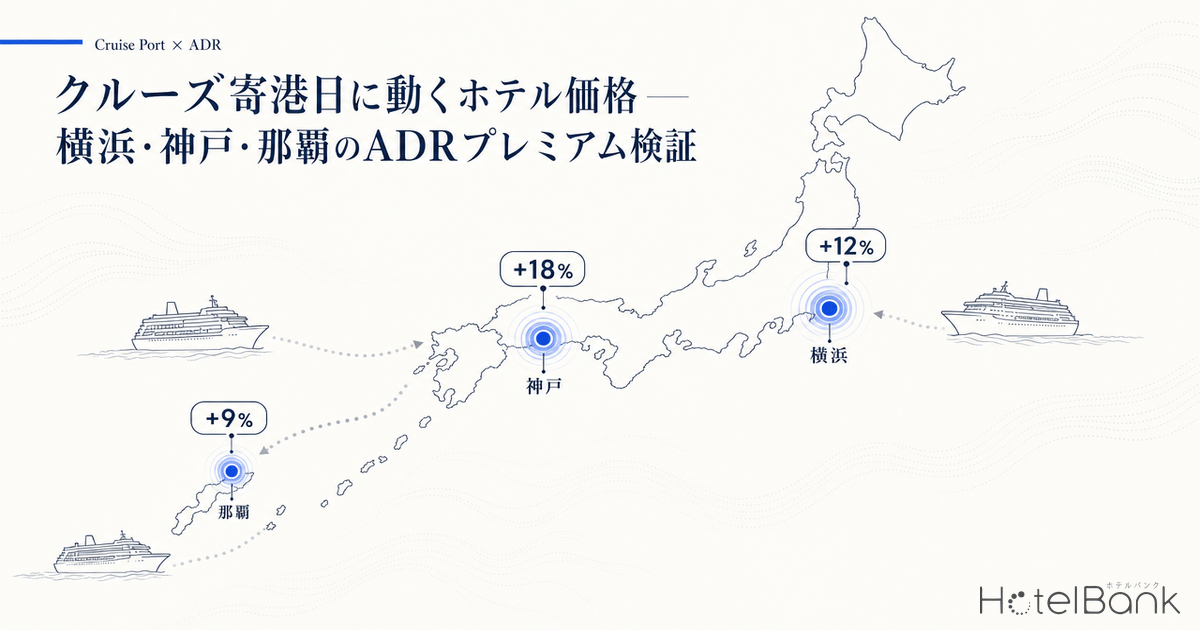
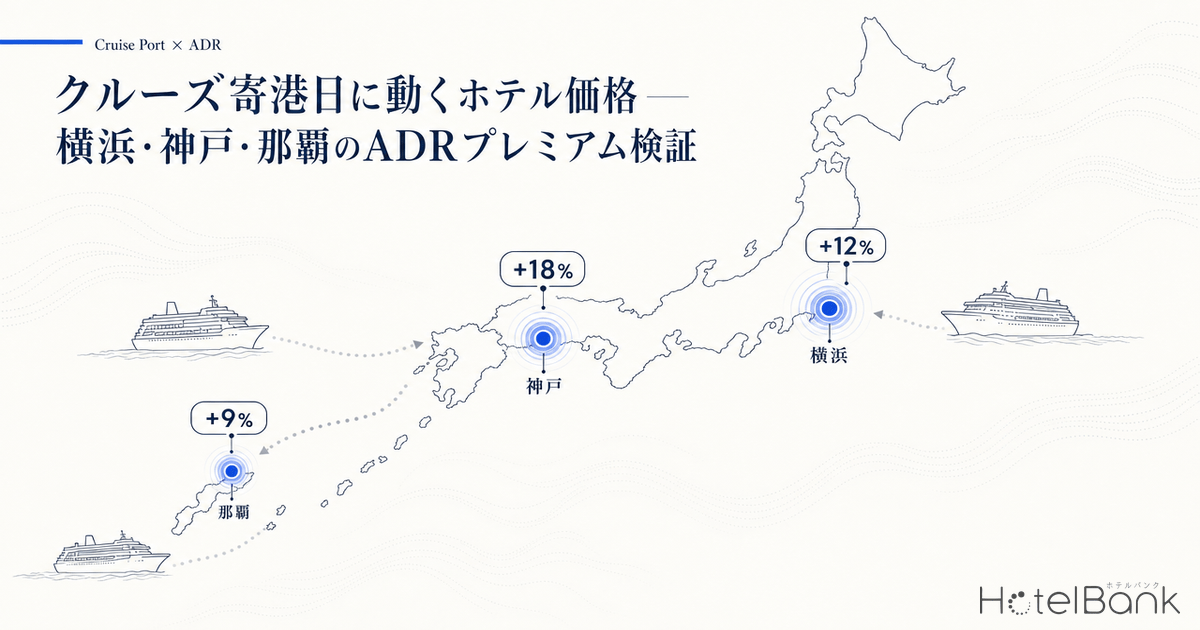
Calculating the ADR deviation rate for port-call days and the night before, against same-month, same-day-of-week non-port-call baseline days, produced results that contradicted the industry hypothesis. Yokohama’s port-call premium was median -8.3% / mean -9.9%, Kobe’s was median -9.8% / mean -10.5%, and Naha’s was median -5.1% / mean -4.7% — all three cities posted negative premiums. Hotel rates on port-call days are actually lower than on regular days. The night before (pre-stay demand) also stayed consistently negative: Yokohama -8.3%, Kobe -9.5%, and Naha -2.7%.
Source: MetroEngines Research (3 cities, March-June 2026, port-call days N=42 / pre-night N=42, regular days N=234)
This result invites two interpretations. First, cruise ship calls tend to concentrate on weekdays, and the data simply reflects the inherently lower weekday ADR structure. Second, on the seller side at port-city hotels, the mindset of “we can raise prices because cruise passengers are coming” does not seem to operate, and granular demand-based pricing is not progressing.
By Grade — Higher-Grade Hotels Discount More Deeply on Port-Call Days
Decomposing by room grade reveals an interesting structure. The high-grade / luxury tier averaged -2.5% on port-call days across the three cities, the upper tier -3.9%, and the economy tier -2.2% — all negative, with the upper tier showing the most pronounced decline. Kobe was particularly weak, with upper at -7.7% and economy at -5.4% (deep discounts across all grades), while only Yokohama’s economy tier turned slightly positive at +0.5%.
Source: MetroEngines Research (3 cities x 3 grades, port-call sample N=42, control regular days N=234)
Pre- and post-cruise guests are generally said to skew toward higher-income segments, but the data instead suggests that higher-grade hotels have more room to discount on port-call days. This likely reflects coarse inventory control, where weekday port-call quietness pressures sales prices downward. Regarding broader inbound demand structural change — particularly the sharp decline in Chinese visitors — we provide a detailed breakdown in The China -60% Shock: Q1 2026 Inbound Visitors by Nationality and Hotel Market Tectonic Shifts. Behind the discounting at cruise port cities lies the broader phenomenon of “weekday ADR floor erosion” stemming from declining group travel.
Year-over-Year Comparison — Naha Posts Double-Digit Growth, Yokohama Marginal
Comparing the same April-June period against 2025, Naha’s ADR consistently grew: April ¥19,737 to ¥20,540 (+4.1%), May ¥19,391 to ¥20,920 (+7.9%), and June ¥18,957 to ¥21,404 (+12.9%) — June alone reached double-digit growth. Kobe also posted positive numbers across all three months: April +5.7%, May +9.9%, and June +7.6%, with demand sustaining even after the Kansai Expo closing. Yokohama recorded the smallest gains: April +3.6%, May +7.4%, and June +3.4%.
Source: MetroEngines Research (3 cities, monthly average ADR for April-June 2025 vs. 2026, N=540-820 room-days per month)
Implications for Operators — Port Call Days Are Sites of “Lost Opportunity”
The conclusion drawn from the three-city data is clear: ADR on port-call days is lower than on regular days, and the “cruise premium” is a mirage. This trend is especially pronounced in Yokohama and Kobe, where weekday port calls dominate, and higher-grade hotels discount more deeply. For port-city hotels, this represents structural lost opportunity.
There are three actions operators should take. First, formally incorporate the cruise port-call calendar into the demand-forecasting input for revenue management systems (RMS), and experiment with setting prices higher than ordinary weekdays even on weekday port-call days. Second, design products that address port-call-specific needs — such as multi-night discounts for pre/post-cruise stays or transfer packages — to create a state of “higher value at the same price.” Third, audit the pricing logic by grade tier to ensure that higher-grade hotels are not over-discounting on weekdays. In markets like Naha, where port-call frequency is high and YoY growth has reached double digits, there is particularly significant room to convert port-call days from “discount days” to “premium days.”
* All ADR figures in this article are unified as per-room rates (tax-included) for double occupancy averaged across all plan types, and the port-call premium uses the deviation rate against the same-month, same-day-of-week non-port-call average as the baseline. Sample sizes: port-call days N=42, regular days N=234, target properties approx. 1,200 rooms.
Related Reading
- The China -60% Shock: Q1 2026 Inbound Visitors by Nationality and Hotel Market Tectonic Shifts
- Summer 2026: Hotel Price Comparison for Okinawa, Hokkaido, and Kyoto — Best Booking Timing
- Summer Resort Comparison 2026: Niseko, Okinawa, and Karuizawa — ADR, Booking Pace, and FX Sensitivity
- Osaka Expo’s Impact on Hotel ADR — Verified with REIT and OTA Data