

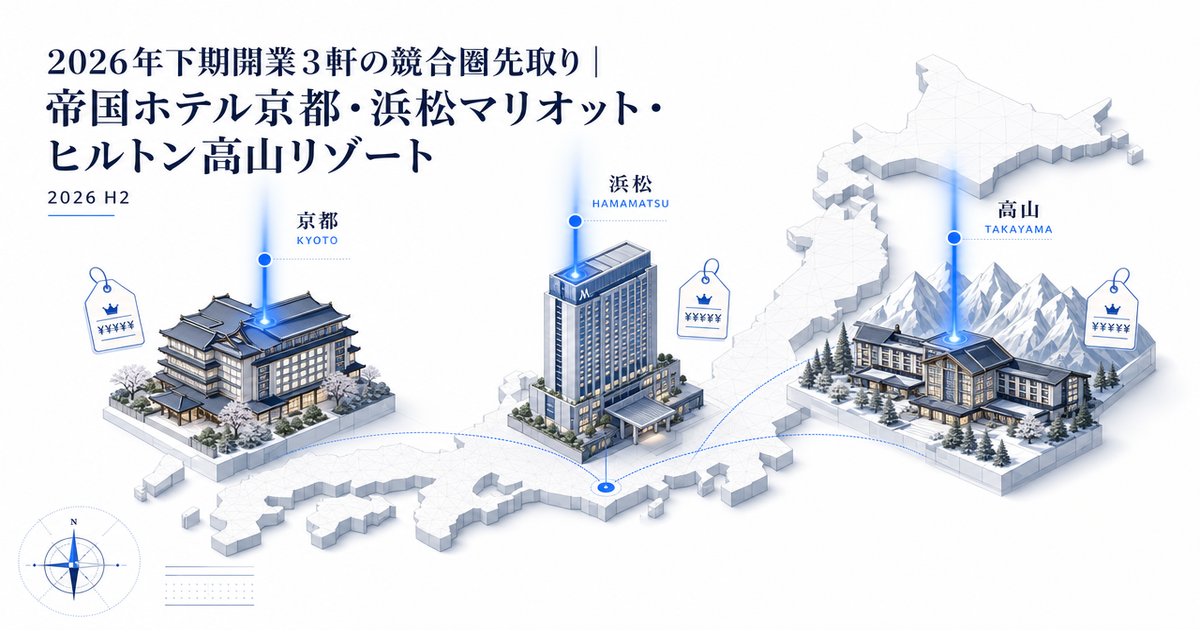
2026 has been a landmark year for Japan’s hotel market, with three high-profile openings in quick succession. Imperial Hotel Kyoto (帝国ホテル京都), the brand’s first new property in 30 years and its fourth overall, opened on March 5 with 55 rooms. Hamamatsu Marriott Hotel (浜松マリオットホテル), the second collaboration between HMI Hotel Group and Marriott, opened on May 1 with 236 rooms. And Hilton Takayama Resort (ヒルトン高山リゾート), a rebrand of Hotel Associa Takayama Resort by JR Central Group and Hilton, is scheduled to open in autumn with 283 rooms. While the three properties differ markedly in location, scale, and target market, they share one key trait: each brings a clear grade redefinition to its existing competitive set. In this article, we combine OTA listed price data compiled by MetroEngines Research with monthly operational data from major hotel REITs to break down the competitive structure and pricing landscape across these three markets.
Metric Definitions Used in This Article
- ADR (Average Daily Rate): The average of publicly listed prices on OTAs. This differs from actual transacted prices (cross-referencing with REIT disclosure data shows OTA-listed ADR tends to be 25-30% higher on average, as unsold higher-priced plans remain listed on OTAs, structurally pushing listed price averages above transacted prices). Rates are per room for double occupancy (tax included), averaged across all plans (room-only through meal-inclusive).
- Sellout Rate: The percentage of plans that had closed for reservations on OTAs at the time of survey. This differs from a property’s overall occupancy rate.
- Data Source: MetroEngines Research (compiled in May 2026 for August and October-November 2026 check-in dates)
Profile of the Three Hotels: Scale, Location & Timing
Let us start by comparing the basic specifications of the three properties. The significant differences in room count, opening format, and target segment serve as the starting point for understanding each property’s competitive set.
| Hotel Name | Opening | Rooms | Format | Location Characteristics |
|---|---|---|---|---|
| Imperial Hotel Kyoto (帝国ホテル京都) | March 5, 2026 | 55 | New build with heritage building preservation | Gion / Hanamikoji |
| Hamamatsu Marriott Hotel (浜松マリオットホテル) | May 1, 2026 | 236 | Rebrand of existing hotel | Adjacent to Hamamatsu Station |
| Hilton Takayama Resort (ヒルトン高山リゾート) | Autumn 2026 (planned) | 283 | Rebrand of existing hotel | 8 min by car from JR Takayama Station |
Source: Press releases from respective companies, compiled by HotelBank Editorial Team
A notable observation is that two of the three properties are not built from scratch but are rebrands or renovations of existing buildings. Even Imperial Hotel Kyoto preserves and repurposes the nationally registered tangible cultural property “Yasaka Kaikan” rather than being a pure new construction. In other words, all three are entering their markets by upgrading existing room inventory rather than adding significant net new supply. If demand remains at similar levels, this structure is more likely to push overall market ADR upward.
Market 1: Kyoto Luxury Segment — Imperial Hotel Challenges the Price Leaders
Imperial Hotel Kyoto’s competitive set (within 2 km radius, 50+ rooms, luxury grade) already contains a powerful cluster of international brands. Looking at OTA listed prices for August 2026 check-in compiled by MetroEngines Research, Four Seasons Hotel Kyoto leads at approximately ¥296,000, followed by The Ritz-Carlton Kyoto at approximately ¥221,400, forming the top tier. Next come The Westin Miyako Kyoto and Hyatt Regency Kyoto in the ¥100,000-¥120,000 range. Imperial Hotel Kyoto’s top-tier Imperial Suite is priced at ¥3 million per night (tax and service charge included, accommodation tax separate), positioning it as a clear outlier at the very top of this competitive set.
Source: MetroEngines Research, compiled by HotelBank Editorial Team (August 2026 check-in, per room for double occupancy, tax included, all-plan average, N=8 properties)
What stands out is the YoY movement (August 2025 to August 2026) across the Kyoto luxury segment. Four Seasons posted +9.1%, The Ritz-Carlton +4.3%, and Hyatt Regency Kyoto a striking +37.2%, with higher-tier brands clearly leading the ADR increases. Meanwhile, The Westin Miyako Kyoto shows a sellout rate of 29.5%, indicating strong inventory absorption, yet its listed average price dropped -10.4% YoY, suggesting a deliberate downward price adjustment. This reflects a market where inbound-driven price upside and mid-luxury repricing are occurring simultaneously. For an investor-focused analysis of the market impact of all six luxury hotels opening in 2026, including this one, see 2026 Luxury Hotel Openings: Market Impact Analysis from an Investor Perspective.
Source: MetroEngines Research, compiled by HotelBank Editorial Team (YoY comparison, August 2025 vs. August 2026 check-in, N=8 properties)
Looking at Kyoto’s broader accommodation market, MetroEngines Research data shows the Kyoto prefecture ADR reached ¥48,300 in April 2026 (N=1,486 properties), up +14.6% from ¥42,100 in the same month of the prior year. Combined with data through March, the Kyoto market in early 2026 has clearly moved a notch above its already robust 2025 levels. Imperial Hotel Kyoto opened at the peak of this upward trend, meaning its launch-phase pricing strategy benefits from a relatively favorable environment. For a separate analysis of the policy-driven factors supporting Kyoto’s uptrend, particularly the impact of the new accommodation tax on pricing shifts, see Kyoto’s New Accommodation Tax After One Month: Kyoto ADR Up +18.6% YoY.
Market 2: Hamamatsu Upper-Midscale Segment — Marriott Fills the Grade Gap
The accommodation market around Hamamatsu Station has a fundamentally different structure from Kyoto. Among properties with 50+ rooms within a 2 km radius surveyed by MetroEngines Research, there is only one luxury-tier hotel: Hotel Okura Act City Hamamatsu (322 rooms, adjacent to the Musical Instrument Museum and concert hall). The rest are predominantly upper, economy, and budget properties. In effect, this is a market with a single dominant luxury brand, leaving a significant grade gap in the “upper-midscale to upper” segment.
Source: MetroEngines Research, compiled by HotelBank Editorial Team (August 2026 check-in, per room for double occupancy, tax included, all-plan average, N=8 properties)
Looking at listed prices for August 2026 check-in, Hotel Okura Act City tops the list at approximately ¥35,300, followed by Grand Hotel Hamamatsu (the pre-rebrand Hamamatsu Marriott) at approximately ¥23,700, with other major hotels clustered in the ¥11,000-¥20,000 range. With 236 rooms, a location adjacent to Hamamatsu Station, and four restaurants, Hamamatsu Marriott is clearly positioned to target the upper-midscale to upper tier alongside Hotel Okura Act City.
One important caveat: Grand Hotel Hamamatsu’s ADR dropped -36.4% YoY for August 2026. This does not indicate declining demand but rather reflects the gradual reduction in available inventory ahead of the May 1 rebrand opening. Similarly, several other upper-tier hotels in the area posted negative YoY figures in the ¥18,000-¥35,000 range, but this should be viewed as a transitional fluctuation. Once the Marriott brand is fully operational, the upper price tier will enter a repricing phase. The May-June 2026 period sees a concentration of 13 openings totaling 1,149 rooms nationwide, including Hamamatsu Marriott. For a detailed breakdown of supply structure changes at regional hubs during this period, see May-June 2026 Hotel Opening Cluster: Geography & Structure of 13 Properties, 1,149 Rooms.
Source: MetroEngines Research, compiled by HotelBank Editorial Team (monthly trend from January 2025 to April 2026, N=6 properties in upper to upper-midscale tier)
The key challenge for the Hamamatsu market, unlike Kyoto, is its limited international tourism appeal. The Marriott opening reportedly aims to attract visitors from India, Europe, and the Americas, representing a customer segment that existing Hamamatsu hotels have not previously targeted. If the Marriott Bonvoy member network effectively drives demand, new guest segments could flow into the entire upper tier including Hotel Okura Act City, potentially shifting the market’s overall ADR range upward. Conversely, if member-driven demand takes longer than expected to materialize, the relatively large inventory of 236 rooms could create short-term ADR pressure.
Market 3: Takayama Resort Segment — Hilton Standardizes Regional Resort Pricing
Hilton Takayama Resort occupies the most unique location of the three. As Gifu Prefecture’s first Hilton-branded property, it will rebrand Hotel Associa Takayama Resort, previously operated by JR Central Group. With 283 rooms, the property will feature new 90 sqm suites in addition to existing 70 sqm suites, along with an executive lounge and expanded fitness facilities.
MetroEngines Research compiled data on major Takayama hotels (30+ rooms) for the October-November 2026 autumn foliage high season. Listed prices show Takayama Green Hotel at approximately ¥74,000, Hida Hotel Plaza at approximately ¥57,600, Hida Takayama Onsen Takayama Ouan at approximately ¥51,500, and Wat Hotel & Spa Hida Takayama at approximately ¥50,300. Three to four properties are clustered in the ¥50,000-¥74,000 range, while practical-tier hotels such as Washington Plaza, Spa Hotel Alpina, and Route Inn form a separate layer at ¥24,000-¥29,000.
Source: MetroEngines Research, compiled by HotelBank Editorial Team (October 1 – November 30, 2026 check-in, per room for double occupancy, tax included, all-plan average, N=7 properties)
What makes this interesting is the sellout rates among the top four properties. Hida Takayama Onsen Takayama Ouan shows 21.0% and Spa Hotel Alpina Hida Takayama 16.4%, indicating strong absorption in the mid-tier during autumn foliage season. Meanwhile, the higher-priced Takayama Green Hotel and Hida Hotel Plaza remain around 10%. This structure suggests that during the autumn foliage period, supply in the mid-tier (around ¥50,000) is running tight while price resistance persists in the top tier (above ¥70,000). Hilton Takayama Resort, with its 283-room scale and brand power, is likely to redefine the ¥45,000-¥65,000 range that sits between these two tiers.
Source: MetroEngines Research, compiled by HotelBank Editorial Team (monthly trend of 8 major Takayama properties, N=8)
REIT Data Confirms the Broader Market Tailwind
To complement the competitive set analysis of the three markets, let us review monthly operational data from major hotel REITs. Hoshino Resorts REIT (星野リゾート・リート投資法人, TSE: 3287), a leading resort-focused REIT, reported portfolio-wide results for February 2026: occupancy 76.5% (+1.9 pt YoY), ADR ¥20,800 (+8.6% YoY), RevPAR ¥15,900 (+10.5% YoY). Japan Hotel REIT (ジャパン・ホテル・リート投資法人, TSE: 8985) reported March 2026 results of occupancy 85.1% (+3.1 pt YoY), ADR ¥20,800 (+5.0% YoY), RevPAR ¥17,700 (+9.0% YoY). Both are sustaining near-double-digit ADR and RevPAR growth.
| REIT | Latest Month | Occupancy | ADR | RevPAR | RevPAR YoY |
|---|---|---|---|---|---|
| Hoshino Resorts REIT (3287) | 2026/02 | 76.5% | ¥20,800 | ¥15,900 | +10.5% |
| Japan Hotel REIT (8985) | 2026/03 | 85.1% | ¥20,800 | ¥17,700 | +9.0% |
| Japan Hotel & Residential REIT (3472) | 2026/03 | 88.7% | ¥30,900 | ¥27,800 | — |
| Invincible Investment (8963) | 2026/03 | 87.6% | ¥14,500 | ¥12,700 | — |
Source: Monthly operational data from respective REITs, compiled by HotelBank Editorial Team (February-March 2026 portfolio-wide, yoy_source: pdf)
REIT-disclosed ADR reflects transacted prices, which differ in nature from the OTA listed price averages used in this article. As a rule of thumb, there is a gap of approximately +25-30% between the two, but the directional YoY trends generally align. The fact that Hoshino Resorts REIT and JHR are sustaining near-double-digit RevPAR growth means that demand remains firm across both resort and urban segments, and that the market continues to absorb price increases. All three new openings are launching into this tailwind.
Cross-Market Comparison: Benchmark ADR, Sellout Rate & Density
Finally, let us compare the competitive density and ADR ranges across the three markets. This provides a more three-dimensional view of the competitive environment each new opening faces.
| Market | Competitors (within criteria) | Top Price Tier | Mid Price Tier | Floor Price Tier | Competition Type |
|---|---|---|---|---|---|
| Kyoto (2km radius, luxury) | 8 properties | ¥220,000-¥296,000 | ¥100,000-¥120,000 | ¥40,000-¥65,000 | Layered / international brand cluster |
| Hamamatsu (2km radius, all grades) | 8 properties | ~¥35,000 (single dominant) | ¥17,000-¥24,000 | ¥11,000-¥17,000 | Grade gap / thin upper-brand presence |
| Takayama (5km radius, 30+ rooms) | 7 properties | ¥58,000-¥74,000 | ¥27,000-¥51,000 | ~¥24,000 | Mid-tier cluster / high brand standardization potential |
Source: MetroEngines Research, compiled by HotelBank Editorial Team (Kyoto and Hamamatsu: August 2026; Takayama: October-November 2026 check-in)
Source: MetroEngines Research, compiled by HotelBank Editorial Team (sellout rate and average ADR for top 3-4 properties in each market, N=8 per market)
The Kyoto luxury segment is a mature market where top-tier brands are already clustered and price layers are well-defined. Imperial Hotel Kyoto enters this market with an extremely limited capacity of 55 rooms, tasked with pushing the ceiling of the highest price layer even further. Hamamatsu, by contrast, has a single dominant luxury brand with a vacant upper-midscale segment, and Hamamatsu Marriott will create a second anchor in that gap. Takayama presents the most distinctive situation: mid-tier properties are densely clustered, and Hilton Takayama Resort will introduce the brand standardization function that international travelers and loyalty program members rely on for consistency.
Implications for Existing Hotels — A Window for Strategic Repositioning
All three markets present revenue opportunities for existing hotels in the wake of the new openings. The key is to shift from a passive stance of “being affected by new entrants” to proactively leveraging the market-wide grade redefinition as an opportunity for repositioning. Below, we outline three strategic directions by market.
Kyoto Luxury Segment: Between the top tier of Four Seasons and Ritz-Carlton and the mid-luxury tier of Hyatt and Westin, there exists a price-elastic “high luxury” range (¥150,000-¥200,000). As Imperial Hotel Kyoto pushes the ceiling higher, the relative positioning of this zone also rises. Properties in this range have an opportunity to revisit their occupancy-rate balance, reprice premium plans, and restructure benefit packages to capture further revenue upside.
Hamamatsu Upper-Midscale Segment: Inbound demand channeled through the Marriott Bonvoy member network is expected to benefit existing hotels as well. Hotel Okura Act City, as well as properties positioned just below the Marriott such as EN HOTEL Hamamatsu and Hotel Villa Kuretake, can consider phased repricing of their premium plans as the Marriott’s reference pricing lifts the upper tier. Whether hoteliers view the member-driven inflow as “the upper market growing” or “being pushed down” will fundamentally shape their strategic response.
Takayama Resort Segment: This market offers the most flexibility for strategic repositioning. While Hilton Takayama Resort will bring a standardized benchmark to the mid-tier cluster (¥45,000-¥60,000), this is also an opportunity for existing properties to sharpen their unique resort appeal. Elements that Hilton does not offer — traditional Japanese experiences, onsen, local cuisine, family-oriented activity programs — can be leveraged to establish premium seasonal plans (¥80,000-¥120,000) for the autumn foliage and New Year periods. Upper-tier properties whose sellout rates currently sit around 10% may find it worthwhile to consider phased price increases before demand peaks.
Conclusion — Three Markets, Three Distinct Competitive Designs
The three hotels opening in 2026 are each entering fundamentally different competitive structures. Imperial Hotel Kyoto pushes the top price layer higher in a mature luxury cluster. Hamamatsu Marriott creates a second upper-tier anchor in a regional city with a grade gap. Hilton Takayama Resort introduces brand standardization to a mid-tier-dense resort market. The shared tailwind is the sustained expansion of inbound demand, underscored by near-double-digit RevPAR growth at major REITs including Hoshino Resorts REIT (星野リゾート・リート投資法人) and JHR.
How ADR ranges are reshaped in each market after these entries will become clearer over the first two quarters post-opening, particularly from H2 2026 through H1 2027. The competitive pricing benchmarks and sellout rates presented in this article serve as baseline reference points for tracking that transformation. In future market updates, we will compare post-opening actual pricing against these benchmarks to quantify the pace of market restructuring.
Note on Forward-Looking ADR: The ADR figures in this article represent the average of prices listed on OTAs at the time of survey (May 2026) for August and October-November 2026 check-in dates. These prices will fluctuate as the actual check-in dates approach. Currently high-listed prices may drop through last-minute discounting, or conversely, averages may rise as lower-priced inventory sells out. Additionally, properties undergoing rebranding may have temporarily reduced OTA inventory, and their figures should be interpreted as transitional data.
Related Articles
- Hyatt Centric Sapporo Opening — Foreign Hotel Brands Expanding into Hokkaido and ADR Trends
- May-June 2026 Hotel Opening Cluster: Geography & Structure of 13 Properties, 1,149 Rooms
- ADR Analysis of Hotels Near Hydrangea Tourism Spots — The Hidden High-Rate Window of Rainy Season
- Will Junglia Okinawa’s Opening Shift the Northern Market to Year-Round? — ADR and Sellout Rate Analysis Across 6 Areas
- Shizuoka Prefecture’s ‘Hidden 31 Openings’ in 2026: Mt. Fuji’s Mandatory ¥4,000 Entry Fee and Structural Changes in Foothill Hotels
- Impact of Kyoto’s Accommodation Tax Reform — Daily ADR Tracking for Hotels Under ¥10,000
External References: Imperial Hotel Kyoto Official Website / Hamamatsu Marriott Hotel Opening Press Release / Hilton Takayama Resort Opening Press Release / Hoshino Resorts REIT IR Library