

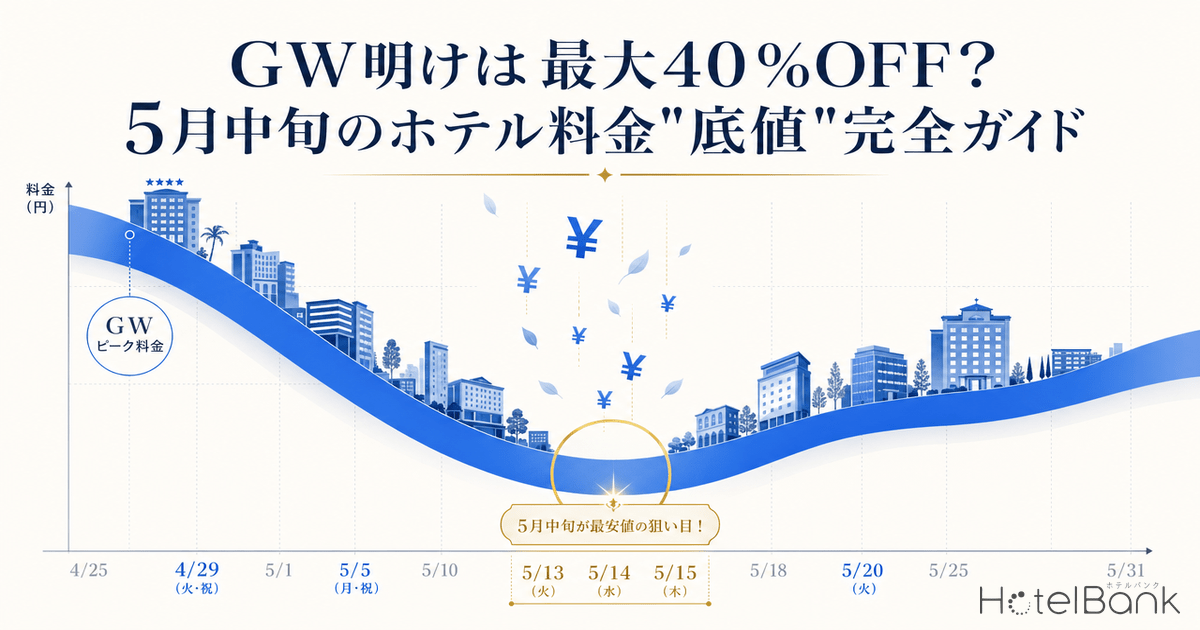

Once Japan’s Golden Week (GW) holiday ends, hotel rates collapse all at once. According to MetroEngines Research, which aggregated public price data from approximately 8,000 properties across six major cities, weekday ADR (Average Daily Rate) in mid-May drops by up to 44% compared to the GW peak. Combined with the comfortable, pre-rainy-season weather, mid-May arguably offers the best price-performance ratio of any travel season in Japan.
This article uses daily pricing data from May 2026 to break down “when, where, and what type of property” delivers the most value. If you are considering a post-GW trip, this guide should help.
Metric Definitions Used in This Article
- ADR (Average Daily Rate): The mean of publicly listed sale prices on OTAs and other channels. Different from the actual transaction price. Per-room rate for double occupancy (tax included), averaged across all plans (room-only through meal-inclusive).
- Sellout Rate: The proportion of plans that had stopped accepting OTA bookings at the time of the survey. Different from the property’s overall room occupancy rate.
- Data Source: MetroEngines Research
May Daily ADR Curve: GW “Peak” vs Weekday “Valley”
Let us first take a panoramic view of price movements across May. The chart below tracks the average daily ADR across six major cities (Tokyo, Osaka, Kyoto, Hokkaido, Okinawa, and Fukuoka).
The GW peak fell on May 2 (Sat) – May 3 (Sun), when the six-city average ADR reached ¥51,700. By Thursday, May 7—immediately after GW—it had plunged to ¥32,000, a roughly 38% drop in just four days.
What is even more striking is the “second valley” that forms between May 10 (Sun) and May 11 (Mon). By this point, the GW afterglow is gone and business demand has not yet fully resumed, creating an air pocket. The six-city average sinks to roughly ¥33,700, the lowest level of the entire month.
Source: MetroEngines Research, compiled by HotelBank Editorial Team (N=7,913 properties, six-city average)
Top 10 Prefectures with the Steepest Price Drops vs GW Peak
By comparing ADR on May 2–3 (Sat/Sun, GW peak) with May 11–12 (Mon/Tue, post-GW), we can see which prefectures see the biggest declines. Of the 20 prefectures covered by MetroEngines Research, the top 10 by drop magnitude are shown below.
| Rank | Prefecture | GW Peak (5/2–3) |
Post-GW (5/11–12) |
Drop % | Properties |
|---|---|---|---|---|---|
| 1 | Ishikawa | ¥66,000 | ¥37,000 | -44.0% | 430 |
| 2 | Fukuoka | ¥53,200 | ¥30,400 | -42.9% | 733 |
| 3 | Aichi | ¥43,000 | ¥24,800 | -42.3% | 606 |
| 4 | Aomori | ¥43,800 | ¥25,500 | -41.8% | 228 |
| 5 | Wakayama | ¥63,900 | ¥37,400 | -41.5% | 455 |
| 6 | Miyagi | ¥46,400 | ¥27,200 | -41.4% | 429 |
| 7 | Hiroshima | ¥50,900 | ¥30,100 | -40.9% | 499 |
| 8 | Okinawa | ¥57,000 | ¥34,600 | -39.3% | 1,754 |
| 9 | Tochigi | ¥62,100 | ¥38,100 | -38.7% | 693 |
| 10 | Nara | ¥57,200 | ¥35,200 | -38.5% | 235 |
Source: MetroEngines Research, compiled by HotelBank Editorial Team (GW peak = avg of 5/2–3, Post-GW = avg of 5/11–12)
Ishikawa registered the steepest drop at -44%. In Kanazawa, the combined effect of the Hokuriku Shinkansen and the fresh-foliage season at Kenrokuen Garden sends GW prices soaring, and weekday rates settle back down sharply—a structurally pronounced swing. Fukuoka (-42.9%) and Aichi (-42.3%) are business-driven cities, where the rebound after GW leisure demand evaporates is correspondingly large.
Equally noteworthy is Okinawa at -39.3%. ADR drops from ¥57,000 at the GW peak to ¥34,600. Weather is also stable just before the rainy season starts, making this the period with the best balance between resort demand and price.
Source: MetroEngines Research, compiled by HotelBank Editorial Team
“Valley Depth” by Category: Business Hotels See the Biggest Decline
The post-GW drop varies substantially by accommodation type. A category-level breakdown of data from the six major cities shows business hotels lead with a -38.0% decline.
| Category | GW Peak (5/2–3) |
Post-GW (5/11–12) |
Drop % | Properties |
|---|---|---|---|---|
| Business Hotel | ¥38,200 | ¥23,700 | -38.0% | 2,691 |
| Glamping | ¥70,000 | ¥42,800 | -38.8% | 41 |
| Resort Hotel | ¥75,000 | ¥47,600 | -36.5% | 455 |
| City Hotel | ¥58,900 | ¥40,900 | -30.5% | 397 |
| Ryokan | ¥66,500 | ¥50,700 | -23.8% | 618 |
| Deluxe Hotel | ¥89,900 | ¥75,200 | -16.4% | 134 |
Source: MetroEngines Research, compiled by HotelBank Editorial Team (six major cities combined, N=4,336 properties)
Business hotels nearly double their normal rates during GW, then snap back to underlying business-demand pricing once leisure travelers depart, producing a wide swing. From ¥38,200 at the GW peak to ¥23,700 post-GW—a gap of about ¥14,500.
Ryokan, on the other hand, decline a relatively modest -23.8%. Their rates frequently include meals, so the cost-driven price floor sits higher. In addition, hot-spring ryokan retain a steady weekday following for therapeutic and refresh stays even after GW.
Deluxe hotels limit their decline to -16.4%. Luxury demand from inbound high-end travelers stays stable year-round, so the rollback of domestic GW leisure demand has a relatively muted impact.
Source: MetroEngines Research, compiled by HotelBank Editorial Team (six major cities combined)
Day-of-Week Pattern: Sunday and Monday at the Bottom, Recovery on Thu–Fri
Analyzing day-of-week ADR for mid-May (May 8–22) reveals a clear weekly cycle. The cheapest nights are Sunday and Monday stays, with six-city averages of ¥34,500–35,100 respectively. The most expensive—naturally—is Saturday at ¥44,300, a roughly ¥9,200 (+26.4%) premium over Sunday.
Source: MetroEngines Research, compiled by HotelBank Editorial Team (six major cities combined, 5/8–5/22)
In other words, a one-night stay checking in Sunday and out Monday is the most price-efficient window. From Wednesday into Thursday, business demand returns and ADR creeps up gradually from ¥36,200 to ¥37,400. By Friday, leisure bookings for the weekend start filtering in, pushing rates higher still.
City-by-city, Osaka’s Monday ADR of ¥25,200 is the cheapest of the six. Tokyo, by contrast, holds at ¥40,300 even on Mondays—reflecting a sturdy business base. Kyoto stays in the ¥45,000 range on weekdays as well, mirroring an inbound-driven structure where day of the week matters less.
Daily ADR Trends in Five Cities: Tokyo, Osaka, Kyoto, Okinawa, Fukuoka
City-level daily curves reveal that the timing and depth of the post-GW “bottom” differ by destination.
Source: MetroEngines Research, compiled by HotelBank Editorial Team
Osaka sees the sharpest post-GW drop, plunging to ¥23,200 on May 6. Mid-May weekdays hover in the ¥24,000–26,000 range, the most affordable of the six cities. Demand for theme parks like USJ concentrates during GW, producing a correspondingly large rebound.
Okinawa records the highest GW peak of the six at ¥57,900, then settles into the ¥34,000–35,000 range in mid-May—a roughly 40% drop from the peak. Even so, ¥34,000 is by no means cheap. Considering that prices push above ¥50,000 in the height of summer (July–August), mid-May represents the “last buying opportunity” for an Okinawa trip.
Kyoto stays elevated even in mid-May at ¥42,000–50,000. With the fresh-greenery season overlapping inbound demand, prices rarely collapse outright after GW. Still, that is roughly 30% below the GW peak of ¥60,800; given that Kyoto’s demand has remained robust even after the new accommodation tax, mid-May weekdays offer one of the few chances to enjoy Kyoto at a relative discount.
Five Scenarios to Book Now: Best Picks by Travel Purpose
Drawing on the data above, here are five purpose-specific scenarios for “the most cost-effective post-GW stay.” In every case, the key is a check-in between Sunday, May 10 and Thursday, May 14.
Scenario 1: A relaxing onsen getaway
→ Ishikawa Prefecture (Kaga Onsen, Wakura Onsen) is the top pick. With the largest drop in the country at -44% vs the GW peak, mid-May ryokan ADR sits around ¥37,000. The Hokuriku Shinkansen connects Tokyo in roughly 2.5 hours, and a stroll through Kenrokuen Garden in fresh foliage delivers a fully off-the-grid experience. Wakayama (Shirahama, Nanki-Katsuura) also drops -41.5% and is conveniently accessible from the Kansai region.
Scenario 2: Urban dining and shopping
→ Osaka wins decisively. Mid-May weekday ADR of ¥24,000–26,000 is roughly 60% of Tokyo’s level. With a -37.2% drop versus the GW peak and business hotels approaching ¥15,000, an extended stay is well within reach. Fukuoka (-42.9%) is also a sweet spot if Hakata cuisine is on the itinerary.
Scenario 3: An island or resort escape
→ Mid-May in Okinawa is the last clear-weather window before the rainy season begins. Resort hotel ADR sits around ¥34,700, roughly 60% of GW levels, while the sellout rate of 23–25% remains low—meaning availability at popular resorts. With beach season already underway, this is prime timing for shoreline relaxation.
Scenario 4: Extending a business trip on the cheap
→ Lean on Sunday or Monday business-hotel stays. The six-city average of ¥23,700 (-38% vs GW) is among the year’s lowest. Aichi business hotels drop -42.3% to roughly ¥24,800—putting the prefecture among Japan’s top tier for business-trip cost performance. Extending a Friday-return business trip through Sunday lets you take in Nagoya weekend cuisine on the back end.
Scenario 5: An out-of-the-ordinary glamping experience
→ Glamping properties drop a substantial -38.8%. ADR falls from ¥70,000 during GW to ¥42,800 in mid-May, putting otherwise out-of-reach luxury glamping within range. Tochigi (Nasu Highlands) is down -38.7% versus GW—ideal for an outdoor stay surrounded by spring greenery.
Conclusion: Mid-May Is the “Best of the Year” Window for Booking
Our analysis of May 2026 public pricing data highlights the following key points.
| Post-GW Mid-May Price-Drop Summary | |
|---|---|
| Cheapest Dates | Stays on Sun May 10 – Mon May 11 |
| Six-City Average Drop | -34.7% vs GW peak (¥51,700 → ¥33,700) |
| Largest Prefectural Drop | Ishikawa -44.0% |
| Largest Category Drops | Glamping -38.8%, Business Hotel -38.0% |
| Cheapest Day of Week | Sunday stay ¥35,100 (six-city average) |
| Best-Value City | Osaka, weekday ADR ¥24,000–26,000 |
Mid-May—immediately after GW—offers a rare convergence of pleasant pre-rainy-season weather, lighter crowds at tourist sites, and a sharp drop in pricing. Sunday-through-Thursday stays from May 10 to 14 are the most attractive on price. Note that the post-GW “valley” tends to recover within a few days, and from the third week of May onward business and MICE demand resume in earnest, pushing rates back up. If you are planning a trip, book early.
A note on future-date ADR: The ADR figures in this article reflect the average of sale prices publicly listed on OTAs at the time of the survey, and they shift as the check-in date approaches. Prices that look high today may decline through last-minute discounting.
*Data in this article is based on the MetroEngines Research survey conducted on April 27, 2026. Prices may change subject to subsequent reservation conditions.
External references: Japan Tourism Agency “Overnight Travel Statistics Survey”, JNTO Inbound Visitor Statistics