

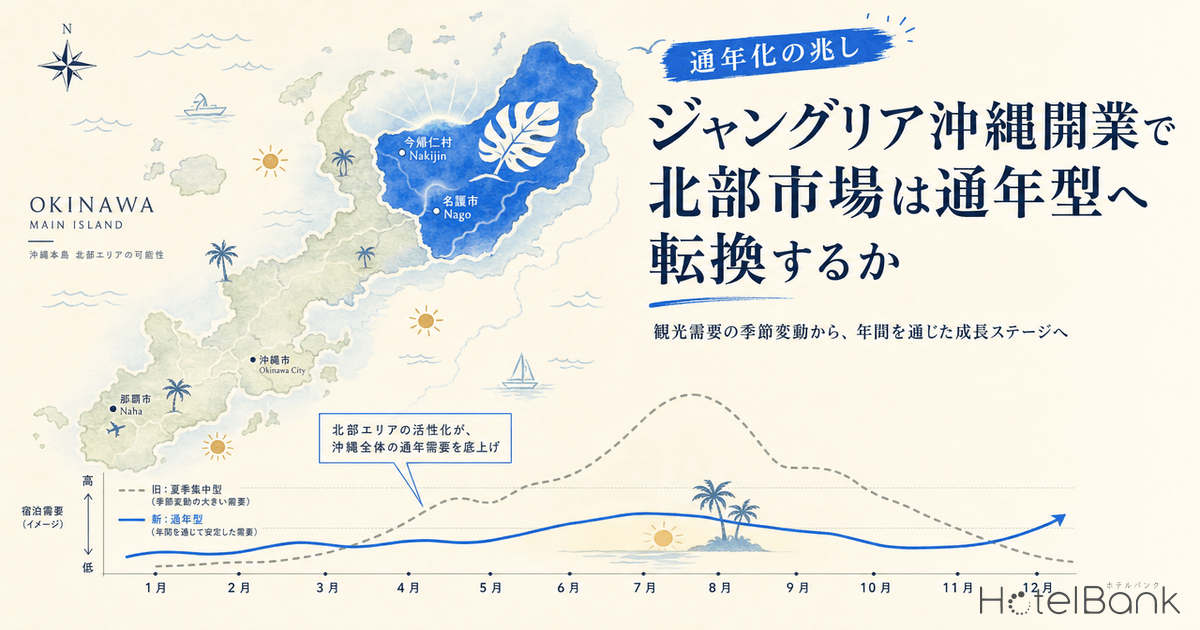
On July 25, 2025, the large-scale theme park “Junglia Okinawa” opened on a vast site straddling Nakijin Village and Nago City in northern Okinawa. The operator projects 1.0 to 1.5 million visitors in the first year, with an estimated annual economic ripple effect of approximately ¥217.8 billion across Okinawa Prefecture (Source: Okinawa Times, estimate by Professor Emeritus Tomikawa). This has drawn attention to a structural hypothesis: will northern Okinawa’s resort market — historically a textbook seasonal market with summer-only concentration — shift to a year-round operating model?
This article aggregates publicly available pricing data from 2024 through September 2026 across northern Okinawa’s six core municipalities (Onna, Nago, Nakijin, Yomitan, Motobu, and Uruma), and examines how monthly ADR (Average Daily Rate) variation patterns changed before and after the opening. The conclusion in advance: the Junglia effect has clearly lifted overall ADR in the northern market, but its first wave appears as “further reinforcement of the summer peak,” and signs of year-round leveling have only begun to surface from early summer 2026 onward.
Metric Definitions Used in This Article
- ADR (Average Daily Rate): Average of listed rates published on OTAs and other channels. Differs from actual transaction prices. Per-room rate for double occupancy (tax included), averaged across all plan types (room-only through meal-inclusive plans).
- Sellout Rate: Share of plans whose OTA reservations had already closed at the time of the survey. Differs from a property’s overall room occupancy rate.
- Data Source: MetroEngines Research (six municipalities in northern Okinawa, January 2024 to September 2026, aggregated from 29,356,644 records).
The traditional northern resort market was a textbook summer-peak market. Looking at the 2024 monthly ADR trends (before the Junglia opening) for the four main areas, all formed peaks in July and August, then dropped 20–30% lower in May–June and October–November — a clear seasonal pattern.
Source: MetroEngines Research, compiled by HotelBank Editorial Team
Onna Village and Yomitan Village were already operating in the high price band of over ¥50,000 ADR in January, rising to around ¥80,000 at the summer peak. Nago City and Motobu Town, by contrast, sit in the mid-price band centered on the ¥30,000s, peaking at around ¥50,000 even in summer. Nakijin Village, which includes many guesthouses and pensions in the Churaumi Aquarium area, sits in the resort-tier ¥50,000–¥70,000 ADR range.
What Happened in Junglia’s First Year of Operation (2025)
Following Junglia Okinawa’s opening on July 25, 2025, ADR in the northern market changed dramatically. Notably in Nakijin Village and Nago City — the geographic core of the theme park — August ADR immediately after the opening rose sharply year-on-year.
Source: MetroEngines Research, compiled by HotelBank Editorial Team
Nakijin Village’s August 2025 ADR reached ¥84,140, a sharp +20.3% YoY surge. Nago City likewise jumped +17.6% (¥53,869 → ¥63,343), the standout gains across all of northern Okinawa. This suggests that within one month of the opening ceremony, Junglia package demand strengthened pricing power at official hotels and surrounding accommodations.
However, what is interesting is that the off-peak May–June period of the same year actually showed YoY declines. Nakijin Village fell -6.7% in May and -9.8% in June, while Yomitan Village fell -8.8% in May and -13.7% in June, with pre-opening off-peak demand undershooting the prior year. This likely reflects a combination of “deferred demand waiting for the Junglia opening” and “rebound from elevated 2024 levels.”
Test 1: Were Off-Peak Month ADRs Lifted?
The core of the year-round hypothesis is “how much ADR rose in months other than summer.” This section narrows in on the four off-peak months specified as test points (May, June, October, November) and compares 2024 → 2025 → 2026 YoY changes.
| Area | May 2024→25 | May 2025→26 | Jun 2024→25 | Jun 2025→26 | Oct 2024→25 | Nov 2024→25 |
|---|---|---|---|---|---|---|
| Nakijin | -6.7% | +15.0% | -9.8% | +19.5% | +14.4% | +5.6% |
| Nago | +0.1% | +7.7% | +1.2% | +4.7% | +25.5% | +13.9% |
| Motobu | +4.6% | +17.0% | +2.3% | +15.8% | +16.8% | +20.9% |
| Onna | +3.4% | +11.9% | +5.1% | +11.8% | +13.4% | +6.4% |
| Yomitan | -8.8% | +9.0% | -13.7% | +10.9% | +2.6% | +1.3% |
| Uruma | -1.4% | +8.6% | -0.4% | +5.1% | -5.3% | -8.8% |
Source: MetroEngines Research, compiled by HotelBank Editorial Team
Two phases emerge from this table. In phase one (2024 → 2025), post-opening October and November ADR gains can be confirmed (Nago October +25.5%, Motobu November +20.9%), while pre-opening May and June showed conspicuous declines in Nakijin and Yomitan. In phase two (2025 → 2026), all four main northern areas turned to double-digit gains in the testable May and June months (Nakijin +15–19%, Motobu +15–17%, Onna +11–12%, Nago +5–8%).
In other words, only by early summer 2026 — nearly a year after the opening — has the phenomenon of “Junglia demand supporting ADR even in non-summer months” become broadly observable. This can be read as evidence that conditionally supports the year-round hypothesis.
Source: MetroEngines Research, compiled by HotelBank Editorial Team
Test 2: Is the Coefficient of Variation (CV) Actually Declining?
If year-round leveling is progressing, monthly ADR dispersion should decrease. The metric that quantifies this is the coefficient of variation (CV = standard deviation / mean). Lower CV indicates ADR is more leveled across the year.
| Area | 2024 CV | 2025 CV | 2026 CV (Jan–Sep) | Trend |
|---|---|---|---|---|
| Nakijin | 9.8% | 17.2% | 20.6% | ↑ Seasonality intensifying |
| Nago | 15.0% | 18.1% | 17.9% | ↑ → Mostly flat |
| Onna | 16.3% | 17.5% | 20.8% | ↑ Seasonality intensifying |
| Yomitan | 15.1% | 15.5% | 18.5% | ↑ Seasonality intensifying |
| Motobu | 19.0% | 18.7% | 19.5% | → Roughly flat |
| Uruma | 12.7% | 14.2% | 18.4% | ↑ Seasonality intensifying |
Source: MetroEngines Research, compiled by HotelBank Editorial Team
The result is the opposite of the hypothesis. CV is rising versus 2024 in all six northern areas, with Nakijin Village roughly doubling from 9.8% to 20.6%. This means that “the summer peak ADR has surged, expanding relative variation” — not that “annual ADR has flattened.”
Put differently, the initial effect of the Junglia opening manifested as “summer peak rate strengthening” rather than “annual demand smoothing.” This is the textbook first wave when a major new attraction opens, with theme park demand overlapping the summer school holiday period to create a synergy effect.
Source: MetroEngines Research, compiled by HotelBank Editorial Team
Test 3: Is the Junglia Premium Spilling Over to Surrounding Areas?
The textbook ripple pattern after a theme park opening is “concentric spillover,” where ADR gains gradually spread outward from the geographic core. In northern Okinawa, the core is Nakijin Village and Nago City; the outer ring is Motobu Town and Onna Village; and further south, Yomitan Village and Uruma City.
Comparing annual average ADR growth from 2024 → 2025 (the first year), Nakijin Village — the geographic core of Junglia — grew only +0.5% (¥59,418 → ¥59,730), while neighboring Nago City rose +9.3% (¥40,068 → ¥43,792) and Motobu Town rose +9.3% (¥33,517 → ¥36,650), nearing double-digit growth. By contrast, Yomitan Village fell -3.8% (¥56,270 → ¥54,105) and Uruma City fell -2.4%, with the more distant areas actually in negative territory.
Entering the 2025 → 2026 (January–September average) phase, the center of growth shifted clearly to Nakijin Village. Nakijin +16.9%, Motobu +15.8%, Onna +12.1%, Nago +5.5%, Yomitan +8.6%, and Uruma +8.7% — all of northern Okinawa moved into positive territory, with the largest growth concentrated in the core areas.
Source: MetroEngines Research, compiled by HotelBank Editorial Team
Worth noting is the movement in the Onna–Nago ADR gap (how much higher Onna is versus Nago). In 2024 the gap held at 29–34% year-round, but during July–November 2025 (immediately post-opening) it narrowed to 24–29%. This was the result of Junglia demand pushing up Nago’s ADR, temporarily reshuffling the price hierarchy within northern Okinawa.
However, in 2026 the gap widened again to 33–36%. This is presumed to be because Onna Village — backed by its own luxury resort cluster demand (Halekulani Okinawa, The Busena Terrace, etc.) — captured Junglia demand while pushing prices even higher. In other words, “theme park demand lifts surrounding-area ADR but lacks the power to invert the price hierarchy itself” appears to be the current state of the market.
Test 4: Will Nago Surpass Onna in Summer 2026?
Test point 4 in this article is to project “whether Nago City’s ADR will surpass Onna Village’s in summer 2026.” The conclusion: the probability of Nago surpassing Onna in summer 2026 is extremely low.
The August 2026 ADR and sellout rates (as of the April 2026 survey) are as follows.
| Area | August 2026 ADR | YoY | August 2026 Sellout Rate |
|---|---|---|---|
| Nakijin | ¥95,600 | +13.6% | 10.4% |
| Onna | ¥94,300 | +9.5% | 19.6% |
| Yomitan | ¥81,300 | +8.9% | 8.9% |
| Nago | ¥62,900 | -0.6% | 38.1% |
| Motobu | ¥59,800 | +10.3% | 9.0% |
Source: MetroEngines Research, compiled by HotelBank Editorial Team
Two points stand out. First, the highest summer 2026 ADR in northern Okinawa is Nakijin Village (¥95,600), surpassing Onna Village (¥94,300) for the first time. This shows the geographic advantage of being in Junglia’s core area is finally beginning to be reflected in price levels.
Second, Nago City’s sellout rate of 38.1% is an unusually high level. This means that, as of April 2026, roughly 40% of pricing plans at Nago City hotels had already closed reservations. While Nago’s ADR itself is roughly flat to slightly down YoY, this is because “rates were held steady but inventory sold out early,” strongly suggesting underlying demand is exceeding 2025.
In other words, in summer 2026 Nago City will likely demonstrate its Junglia-adjacency advantage in the form of “not surpassing Onna in ADR but pulling significantly ahead of all northern areas in sellout rate.” Occupancy is tightening ahead of pricing, reflecting Nago’s hotel supply mix being centered on business and mid-tier properties rather than resort-class facilities.
Implications for Investors and Local Operators
From this analysis, the northern Okinawa resort market can be characterized as having entered the next phase.

Source: MetroEngines Inc., compiled by HotelBank Editorial Team
1. Signs of year-round leveling are visible from early summer 2026 but remain in the early stage. The double-digit ADR gains of +11–19% across the four main northern areas in the testable May–June off-peak months only emerged in 2026, roughly one year after the opening. This suggests it took about a year for “Junglia visits” to take root in OTA search traffic and itinerary planning. October–November year-round progress will need to be re-tested in early 2027 once 2026 data is complete.
2. The coefficient of variation (CV) is actually rising, with summer peak strengthening leading the way. Nakijin Village’s CV doubled from 9.8% in 2024 to 20.6% in 2026. This means “summer peak rate strengthening” came first, not “dissolution of summer-only concentration.” For investment decisions, evaluating northern resort profitability on average ADR alone is dangerous; RevPAR analysis incorporating monthly variability is essential.
3. The Junglia premium is most strongly affecting the core areas. Nakijin Village’s annual average ADR rose 17.6% from ¥59,418 in 2024 to ¥69,853 in 2026 — the largest gain among the six northern areas. Spillover to southern areas like Yomitan and Uruma is limited; Junglia’s ripple effect is concentrated within a 10–15 km radius of the core.
4. Nago City is leading on sellout rate (inventory pressure). Nago’s summer 2026 sellout rate of 38.1% is nearly double that of resort-tier Onna Village (19.6%). This means Junglia demand is concentrating on mid-tier business and tourist hotels, making Nago the area with the largest absorption capacity for new hotel supply. In fact, multiple official hotel openings and renovation plans are already underway in Motobu and Nakijin, and northern Okinawa’s hotel investment momentum is expected to continue for the foreseeable future (Source: Nikkei, “Junglia Effect Drives Hotel Investment Boom in Okinawa”).
Summary
The hypothesis “Junglia Okinawa is shifting the northern market from seasonal dependence to year-round operation” is, at this point, conditionally supported. The double-digit ADR gains in off-peak May–June 2026 across the four main northern areas are important evidence of year-round leveling. However, the coefficient of variation (CV) metric shows that summer peak rate strengthening came first, and full annual flattening has not yet been achieved.
For local operators, the phase has shifted such that “capturing off-peak demand in Motobu and Yomitan” offers more upside than “competing in the high-ADR tier of Nakijin and Nago.” For investors, while land and asset values in the Junglia core area are likely to continue rising, the revenue stability of peripheral areas with lower summer-peak dependence is emerging as a new evaluation axis. The next substantive test will need to wait for early 2027, when October–November 2026 ADR and sellout data are complete — that is, the off-peak figures from the second year of operation.
Note on Future-Date ADRs: The ADRs in this article are averages of listed OTA prices at the time of the survey and will fluctuate as the check-in date approaches. Please note that prices set high at present may decline through last-minute discounts.