

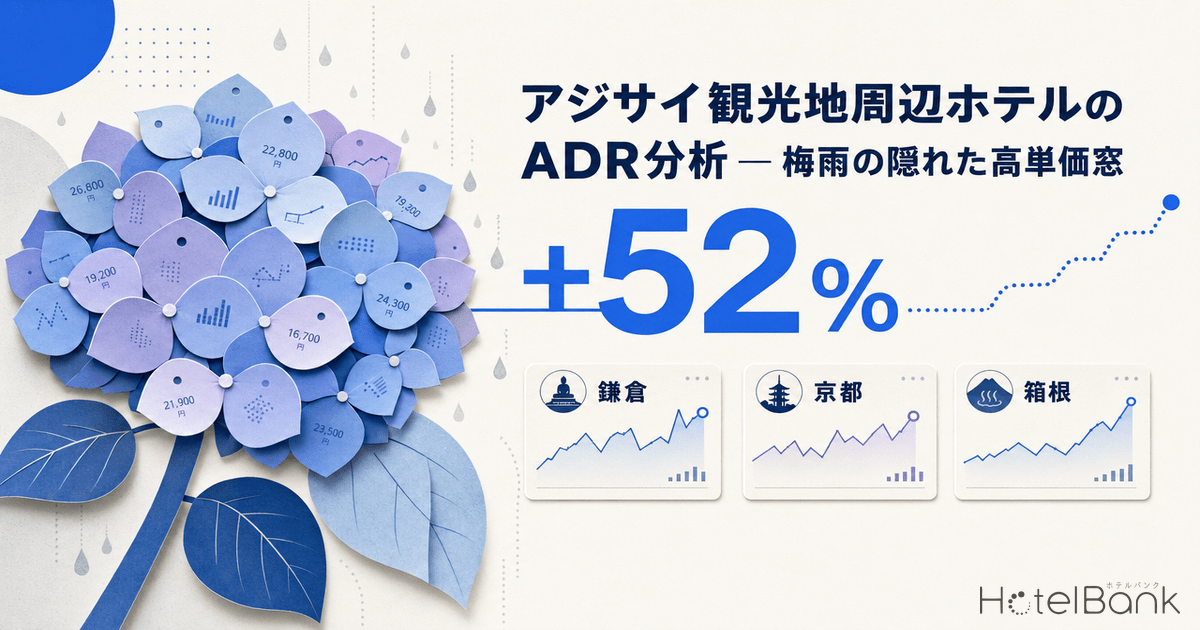
June, the start of Japan’s rainy season (tsuyu), is widely assumed to be a soft month for tourism demand. Yet when we decompose daily pricing data aggregated by MetroEngines Research, a clear “premium window” emerges around hydrangea (ajisai) hotspots. This article unpacks the daily ADR for June 2025 across four areas — Kanagawa Prefecture (Kamakura, Hakone), Kyoto Prefecture (Uji, Fushimi), and Tokyo (Bunkyo Ward) — and reframes them as concrete revenue management opportunities.
Metric Definitions Used in This Article
- ADR (Average Daily Rate): Average of listed prices published on OTAs and other channels. This differs from actual transacted rates. Per-room rate (tax included) for double-occupancy use, averaged across all plans (room-only through meal-included plans).
- Data Source: MetroEngines Research
Decomposing Kanagawa’s June ADR — Four Distinct Areas Hidden Behind the Prefectural Average
We begin with an overview of Kanagawa Prefecture’s June 2025 ADR. Aggregating roughly 2.2 million pricing records across 921 properties prefecture-wide, ADR landed at ¥41,874. Compared with the same month a year earlier (923 properties, ¥40,866), growth was a modest +2.5%. At the prefectural level, it is hard to argue that June hydrangea demand is meaningfully lifting overall ADR.
However, breaking Kanagawa down by city/town reveals four clusters that diverge sharply on both ADR level and YoY trajectory. Hakone Town held flat from 2024 to 2025 (¥68,516 to ¥67,795) in the high-rate zone, and Yugawara Town stayed similarly stable in the same premium band. In contrast, Odawara City rose from ¥46,194 to ¥51,900 (+12.4%) — a double-digit jump — while the Yokohama-Kawasaki area climbed from ¥28,310 to ¥30,480 (+7.7%), a typical urban-hotel pattern. Kamakura City moved from ¥44,619 to ¥46,387 (+4.0%), a steadier rise than urban areas but a clear upward trend nonetheless.
What matters here is that these figures rule out sample-composition shifts caused by newly opened hotels. The comparison is conducted on a same-store basis, isolating hotels with pricing data in both periods. With 71 properties in Kamakura, 251 in Hakone, and 172 in Yokohama-Kawasaki, the dataset reflects only existing properties tracked across both periods. As a result, the changes observed by area capture genuine pricing strategy decisions by incumbent operators, free of noise from openings or exits.
Source: Compiled by HotelBank Editorial Team from MetroEngines Research (Kanagawa Prefecture, June 2024 / June 2025, same-store YoY, N = 923 properties in 2024 / 921 properties in 2025, total of approximately 4.6 million price records)
On a same-store basis, Odawara City raised prices the most (+12.4%). This can be read as the result of Shinkansen accessibility combined with Odawara’s role as the gateway to Hakone and Yugawara, providing a structural justification for repricing room rates upward. Kamakura’s +4.0% appears modest, but given the relatively small sample of 71 properties in a focused tourist destination, it is hardly negligible. Meanwhile, the traditional premium resort towns of Hakone and Yugawara may already be sitting at rates so high that further hikes are constrained.
Daily ADR in Kamakura — What Happens on Rainy-Season Saturdays
Kamakura City is home to a dense cluster of hydrangea attractions including Meigetsu-in (the “Hydrangea Temple”), Hase-dera, and Jojuin. According to the Kamakura City Tourism Association, Meigetsu-in peaks between 9:30 and 11:00 a.m. on weekends and holidays, and in June 2025 visiting hours were extended from 8:30 to 17:00 to absorb expected congestion. The question is: how much of this tourism demand is reflected in room rates?
Plotting the daily ADR for 78 to 85 properties in Kamakura City from May 15 to July 15, 2025 reveals a clear weekly pattern. Weekday ADR generally tracks in a ¥41,000 to ¥45,000 range, while Saturdays jump to ¥55,000 to ¥60,000. The peaks — ¥57,693 on May 24, ¥59,985 on June 7, and ¥56,615 on July 5 — all fall on Saturdays.
Source: Compiled by HotelBank Editorial Team from MetroEngines Research (Kamakura City, May 15 to July 15, 2025, daily ADR, N = 76 to 85 properties)
The key observation is the gap between the 25-day hydrangea peak window (June 6 to 30) and the surrounding off-peak periods (late May, early July). Kamakura’s average ADR during the hydrangea peak was ¥47,099, +4.5% versus late May (¥45,056), and roughly equivalent to early July (¥47,448). In other words, the daily-ADR lift attributable to “hydrangea alone” in Kamakura is limited — but the Saturday spike widens visibly compared with other seasons. The data suggest that hydrangea demand operates by amplifying the existing day-of-week effect.
Mimuroto-ji Season in Uji, Kyoto — A Pricing Spike from June 14 to July 5
Mimuroto-ji in Uji City, Kyoto Prefecture, is famous nationally as a “Hydrangea Temple,” with about 20,000 hydrangea plants on its grounds. According to the Mimuroto-ji official site, the 2025 hydrangea garden was open from May 31 to July 6, with evening illuminations on weekend nights between June 7 and 22 (Saturday and Sunday, 19:00 to 21:00). We test how this tourism event influenced room rates in Uji City and Fushimi Ward.
For the combined 55 properties in Uji City and Fushimi Ward, we split the data from late May through late July 2025 into three windows. The late-May baseline (May 15 to June 13) showed an ADR of ¥35,739, the Mimuroto-ji season (June 14 to July 5) ¥37,103 (+3.8%), and the late-July baseline (July 6 to July 31) ¥39,008. The fact that the Mimuroto-ji season ran 3.8% above the late-May baseline is a clear “counter-cyclical” signal, given that demand normally softens in the rainy season.
| Period | Period ADR | vs. Late-May Baseline | N (Properties) |
|---|---|---|---|
| Late-May Baseline (May 15 to June 13) | ¥35,700 | Baseline | 55 |
| Mimuroto-ji Season (June 14 to July 5) | ¥37,100 | +3.8% | 55 |
| Late-July Baseline (July 6 to July 31) | ¥39,000 | +9.2% | 52 |
Source: Compiled by HotelBank Editorial Team from MetroEngines Research (Uji City and Fushimi Ward, Kyoto Prefecture, May 15 to July 31, 2025)
More important is identifying the peak days. Tracking daily ADR through the Mimuroto-ji season, clear spikes occur on Saturdays. ADR for Uji and Fushimi reached ¥46,559 on Saturday June 14, ¥45,605 on Saturday June 21, ¥45,006 on Saturday June 28, and ¥46,357 on Saturday July 5 — all roughly +25% above the surrounding weekdays (¥35,000 to ¥38,000). Across central Kyoto City as a whole (around 1,280 properties combining Shimogyo, Higashiyama, Nakagyo, Minami, and other major tourist wards), Mimuroto-ji-season ADR came in at ¥35,952, lower than the late-May baseline of ¥39,737. At the city-wide level, weak rainy-season demand dominates. In other words, a hydrangea premium specific to the Uji area shows up at daily granularity.
Four-Area Comparison — Where Is the “Hydrangea Premium” Strongest?
Next, we compare the four areas — Kamakura, Hakone, Kyoto (Uji and Fushimi), and Tokyo (Bunkyo Ward) — measuring the gap between the hydrangea peak (June 6 to 30) and the surrounding off-peak windows. We selected Bunkyo Ward to observe the impact of the Bunkyo Ajisai Festival at Hakusan Shrine, held annually in mid-June.
Source: Compiled by HotelBank Editorial Team from MetroEngines Research (Four areas, May 15 to July 31, 2025, N = 76 to 85 properties in Kamakura, 252 to 273 in Hakone, 52 to 55 in Uji and Fushimi, 21 to 24 in Bunkyo Ward)
The results clearly diverge across the four areas. Kyoto (Uji and Fushimi) rose from a pre-hydrangea average of ¥33,694 (May 15 to June 5) to ¥38,872 in the peak window, a +15.4% lift — the largest premium of the four. Kamakura moved from ¥45,056 to ¥47,099 (+4.5%), Hakone slipped from ¥70,054 to ¥68,295 (-2.5%), and Tokyo (Bunkyo) declined from ¥50,100 to ¥46,652 (-6.9%).
| Area | Pre-Hydrangea ADR | Hydrangea Peak ADR | Premium Rate |
|---|---|---|---|
| Kyoto (Uji, Fushimi) | ¥33,700 | ¥38,900 | +15.4% |
| Kamakura | ¥45,100 | ¥47,100 | +4.5% |
| Hakone | ¥70,100 | ¥68,300 | -2.5% |
| Tokyo (Bunkyo Ward) | ¥50,100 | ¥46,700 | -6.9% |
Source: Compiled by HotelBank Editorial Team from MetroEngines Research
The contrast tells a structural story about hydrangea tourism. In Kyoto (Uji and Fushimi), tourism demand concentrates on a single anchor — Mimuroto-ji — which produces an outsized impact relative to a small market (55 properties). Kamakura, by contrast, has multiple attractions (Meigetsu-in, Hase-dera, Jojuin) distributed across the city, and serves as a year-round destination, so the standalone hydrangea lift is muted. In Hakone and Yugawara, traditional onsen demand cools in the rainy season, and hydrangea alone cannot offset the slack. Tokyo’s Bunkyo Ward is dominated by urban business demand, so June room rates are driven by corporate-travel patterns, leaving the hydrangea festival without enough leverage to push prices higher.
Day-of-Week ADR During the Hydrangea Peak — Saturdays Are the Real Revenue Window
Zooming in further, we compare day-of-week ADR during the hydrangea peak (June 6 to 30) across the four areas, isolating the spread between weekday and Saturday rates.
Source: Compiled by HotelBank Editorial Team from MetroEngines Research (Four areas, June 6 to 30, 2025, average ADR by day of week)
Saturday ADR is the highest in all four areas. Kamakura: weekdays in the ¥43,000s versus Saturday ¥58,488 (+34%). Hakone: weekdays in the ¥65,000s versus Saturday ¥80,153 (+22%). Kyoto (Uji and Fushimi): weekdays in the ¥37,000s versus Saturday ¥47,362 (+28%). Tokyo (Bunkyo): weekdays in the ¥45,000s versus Saturday ¥53,811 (+19%) — a clear Saturday premium across the board. Notably, Kyoto (Uji and Fushimi) hits ¥40,977 on Fridays, +9% above the weekday average. The pull effect of the Mimuroto-ji evening illumination (Saturday and Sunday 19:00 to 21:00) appears to spill over into Friday-night stays.
What is also striking is Kyoto (Uji and Fushimi)’s unusually low Thursday ADR (¥22,442), well below other days. The 25-day peak window contains only four Thursdays, so a sample-size bias is the most likely explanation. That said, weekday excess inventory potentially flowing into discounted plans cannot be ruled out either. From a revenue management perspective, Thursday pricing in this area may have headroom to grow.
Implications for Investors and Operators — The Rainy Season Is a “Hidden Premium Window”
The findings of this article condense into four facts for investors and operators.
First, Kanagawa’s prefecture-level June ADR fully obscures the underlying area structure and is not a useful decision-making metric. Kamakura, Hakone, Yokohama-Kawasaki, and Odawara differ sharply in both ADR level and YoY direction. Pricing strategy must be built at the area-segment level — anchored on the character of each tourism resource — rather than the prefectural average.
Second, on absolute hydrangea premium, Kyoto (Uji and Fushimi) recorded by far the largest lift across the four areas (+15.4%). This reflects how a single, powerful anchor — Mimuroto-ji — concentrates inbound tourism demand within a small market. The same structural pattern is likely to hold for any rural area built around a single botanical attraction (iris gardens, rose gardens, hydrangea temples).
Third, regardless of area, Saturday ADR significantly exceeds weekday ADR. The Saturday spike reaches +34% in Kamakura, +28% in Kyoto (Uji), +22% in Hakone, and +19% in Tokyo (Bunkyo). The data validate the revenue-management discipline that “Saturdays must never sell out too early” — leaving deliberate inventory close-in to capture peak booking flows is what maximizes revenue.
Fourth, June has long been treated as a soft month for the broader tourism industry, but limited to hydrangea hotspots, an unmistakable premium window exists. In Uji and Kamakura especially, peak-Saturday ADR runs well above winter weekday levels. This is precisely the “hidden premium window of the rainy season,” and operators need to design June revenue targets at fine granularity — by day of week and by sub-period. The macro occupancy data published in the Japan Tourism Agency’s Accommodation Travel Statistics Survey cannot capture this micro-level demand structure.
Summary
At the macro level, June hotel demand during the rainy season is genuinely soft. But examining daily data through the narrow lens of hydrangea hotspots reveals a +15.4% lift in Kyoto (Uji and Fushimi), +4.5% in Kamakura, and a +19 to +34% Saturday spike across all four areas. These figures reflect the genuine pricing strategy of incumbent properties on a same-store basis — not sample-composition shifts from new openings. Pricing analysis at prefecture or city averages misses what micro-level analysis grounded in tourism-resource character can show. The hydrangea is, in essence, a flower that — at the right granularity of data — reveals a hidden premium window.
Note on Forward ADR: The ADR figures in this article represent averages of OTA-listed prices at the time of survey, and they fluctuate as the check-in date approaches. Prices currently set high may decline through last-minute discounting, so please interpret accordingly.
Related Articles & Reference Links
Related Categories:
External Links: