

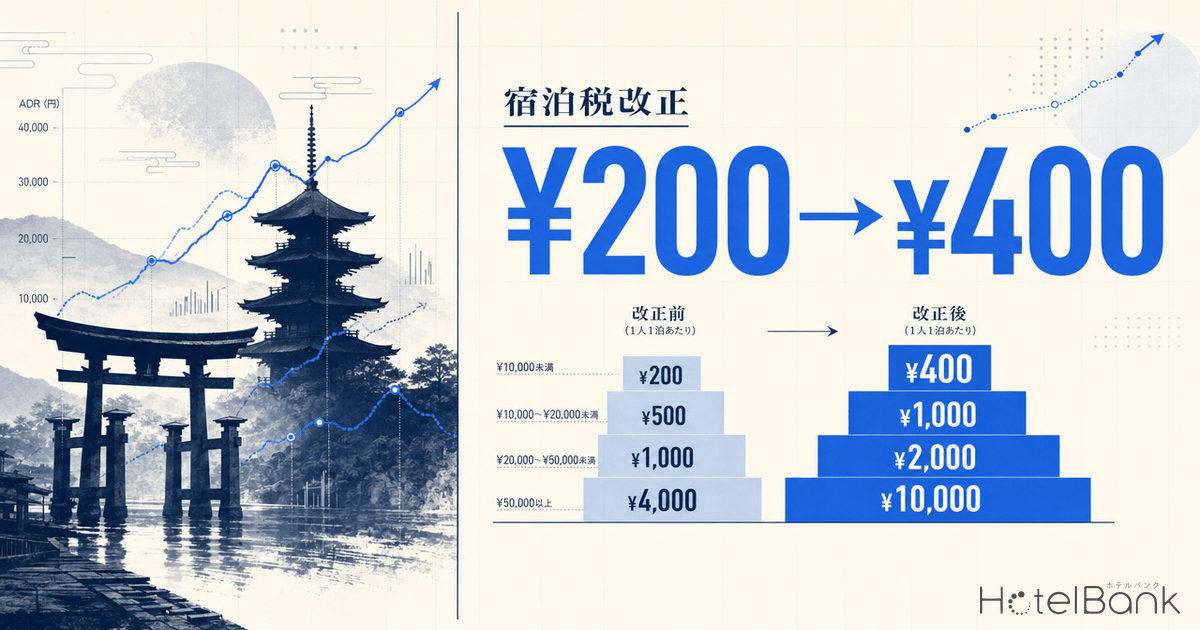
On March 1, 2026, Kyoto City’s accommodation tax was significantly reformed. The previous three-tier system was restructured into a five-tier system, and for the rate band covering accommodation prices from ¥6,000 to under ¥20,000, the tax doubled from ¥200 to ¥400. Annual tax revenue is projected to grow from ¥5.2 billion to ¥12.6 billion, marking a structural shift in lodging costs in the tourism city of Kyoto. So how has this reform actually affected the published prices of business hotels and guesthouses priced under ¥10,000? Using data from MetroEngines Research, we compare daily ADR trends in Kyoto City and three Tokyo wards (Shinjuku, Shibuya, and Taito).
Metric Definitions Used in This Article
- ADR (Average Daily Rate): The average of published sales prices on OTAs and similar channels. This differs from the actual transaction price. Per-room rate for double occupancy (tax included), averaged across all plan types (room-only through plans with meals).
- Sold-out rate: The percentage of plans that had stopped accepting OTA reservations at the time of survey. This differs from the property-wide occupancy rate.
- Data source: MetroEngines Research
Overview of the Tax Reform and Hypothetical Impact on Sub-¥10,000 Hotels
Since its introduction in October 2018, Kyoto City’s accommodation tax has used a three-tier flat-rate system based on the lodging price. The reform of March 1, 2026 subdivided rates into the following five tiers.
| Lodging Price (per person, per night) | Before Reform | After Reform | Change |
|---|---|---|---|
| Under ¥6,000 | ¥200 | ¥200 | ±0 |
| ¥6,000 to under ¥20,000 | ¥200 | ¥400 | +¥200 |
| ¥20,000 to under ¥50,000 | ¥500 | ¥1,000 | +¥500 |
| ¥50,000 to under ¥100,000 | ¥1,000 | ¥4,000 | +¥3,000 |
| ¥100,000 and above | ¥1,000 | ¥10,000 | +¥9,000 |
Source: Kyoto City “About the Accommodation Tax”
The focus of this article is the highlighted “¥6,000 to under ¥20,000” price band. Many business hotels and guesthouses fall within this range, and the per-night accommodation tax rises by ¥200. The amount may seem small, but for plans in the ¥5,000s–¥8,000s, this represents a tax burden of roughly 2.5–8% relative to the tax-inclusive total. Furthermore, whether properties absorb the tax increase or pass it on to prices is closely tied to dynamic pricing settings and revenue management policies, so the impact on published prices is unlikely to be uniform.
Meanwhile, Tokyo’s accommodation tax had not been reformed as of March 2026 (the shift to a flat 3% rate is scheduled for fiscal 2027 or later). Therefore, hotels in the same category within Tokyo function as a “no tax reform” control group. By placing Kyoto and Tokyo side by side, this analysis aims to exclude shared external factors such as seasonality and inbound demand, and to isolate the effect specific to the accommodation tax reform.
Analysis Scope and Methodology
From the published price data collected by MetroEngines Research, we extracted records under the following conditions.
| Item | Kyoto City | Tokyo 3 Wards |
|---|---|---|
| Coverage Area | All 11 wards of Kyoto City | Shinjuku, Shibuya, Taito |
| Property Categories | Business hotels, capsule hotels, guesthouses, hostels, simple lodging facilities | |
| Property Count | N=561 | N=366 |
| Price Filter | Plans for two-person occupancy (single room) priced under ¥10,000 (tax included) | |
| Period | February 22 to April 25, 2026 (daily) | |
Source: MetroEngines Research, compiled by HotelBank Editorial Team
The analysis uses three indicators: the average published price (ADR) of plans under ¥10,000, the number of plans available for sale (N), and the sold-out rate. Using the date of Kyoto City’s tax reform (March 1) as the boundary, we track changes before and after the reform on a daily basis. Since Tokyo has not reformed its accommodation tax, the ADR variations on the Tokyo side can be interpreted as pure supply-demand and seasonal factors.
Kyoto City: Daily ADR Trend for Sub-¥10,000 Hotels
First, we examine the Kyoto City results. After the tax reform on March 1, the ADR of sub-¥10,000 hotels rose by approximately 2.5%, from a pre-reform average of ¥8,100 (last week of February) to ¥8,300 in the first week of March. However, from mid-March onward, supply of sub-¥10,000 plans plummeted as cherry blossom season demand tightened, shrinking to as few as N=10–23 per day by month-end. In other words, the price increase in the latter half of March was likely dominated by seasonal supply-demand tightness rather than the tax reform itself.
Source: MetroEngines Research, compiled by HotelBank Editorial Team (N=561 business hotels, guesthouses, and similar properties in Kyoto City)
Entering April, cherry blossom demand began to subside, and the supply of sub-¥10,000 plans gradually recovered. From mid-April onward, supply ranged from N=200 to 700, with ADR converging into the ¥8,400–¥8,800 range. Compared to the pre-reform level in late February (¥8,100), this represents a sustained price increase of roughly +¥300 to +¥700 (+3.7% to +8.6%). Since this exceeds the tax increase itself (+¥200), it is likely that pass-through of the tax burden combined with inflation, rising labor costs, and other compounding factors are at play.
Comparison with Tokyo 3 Wards: Similar Increases Even Without Tax Reform
Next, we compare the sub-¥10,000 hotel ADR with the three Tokyo wards (Shinjuku, Shibuya, Taito), where no tax reform has occurred. Interestingly, ADR in Tokyo during the first week of March was around ¥8,400, broadly consistent with the last week of February. However, in Tokyo’s case, the supply-demand tightening through late March was not as extreme as in Kyoto, and the supply of sub-¥10,000 plans remained relatively higher.
Source: MetroEngines Research, compiled by HotelBank Editorial Team (N=366 business hotels, guesthouses, and similar properties in Tokyo’s 3 wards)
Looking at the stable period from mid-April onward, Tokyo’s ADR ranged between ¥6,500 and ¥7,900, clearly lower than Kyoto’s ¥8,400–¥8,800. This suggests that, in addition to Kyoto’s tourism-demand premium, the impact of the accommodation tax reform is partially embedded in the gap. That said, fully separating common factors such as inflation and rising inbound demand is difficult across the two cities, and quantifying the effect of the tax reform “alone” requires caution.
Weekly Average ADR Comparison: Kyoto vs Tokyo
To smooth daily fluctuations, we plotted weekly average ADR for both cities. Kyoto traces a gradual upward trend from ¥8,300 in the first week of March to ¥8,700 in the third week of April. Tokyo, on the other hand, fell from ¥8,200 in the first week of March to around ¥7,000 by the third week of April, widening the price gap between the two cities.
Source: MetroEngines Research, compiled by HotelBank Editorial Team
This divergence pattern is noteworthy. Kyoto’s ADR shows resilient movement, while Tokyo exhibits clear downward pressure heading into the off-season. One possible reason for the weak downward pressure in Kyoto is that, having priced in the tax increase, room for further discounting has narrowed. In other words, an indirect effect can be observed whereby the accommodation tax reform increased the “downward stickiness” of ADR.
Trend in Number of Sub-¥10,000 Plans Available
Beyond price, we also examine the supply volume of plans under ¥10,000. In Kyoto City, sub-¥10,000 plans numbered N=4,000 to 5,800 in early March but plunged to around N=15 around March 20 during cherry blossom season. This indicates that as properties raised prices in anticipation of higher demand, large numbers of plans crossed above the ¥10,000 threshold.
Source: MetroEngines Research, compiled by HotelBank Editorial Team
Supply showed a recovery trend in the latter half of April, with Kyoto reaching N=1,007 plans on April 19. However, this remains markedly below the N=4,000–5,800 range of late February. This suggests that price levels following the tax reform have risen on a sustained basis, structurally reducing the number of plans that can be offered under ¥10,000. A similar trend is visible in Tokyo, but with a smaller decline rate, and this difference can be interpreted as an indirect effect of the tax reform.
Sold-Out Rate Trends: Demand Temperature Differences Between Kyoto and Tokyo
The sold-out rate reflects the degree of supply-demand tightness. In Kyoto City, the sold-out rate began rising sharply from mid-March, reaching 64% during the cherry blossom peak in early April. Tokyo also saw demand rise during the fiscal year-end and graduation season, with the peak sold-out rate (69% on April 4) at times exceeding Kyoto’s.
Source: MetroEngines Research, compiled by HotelBank Editorial Team
Particularly noteworthy is how the sold-out rates settled from mid-April onward. Kyoto stabilized in the 30–42% range, while Tokyo fluctuated more widely between 34% and 64%. Kyoto’s relatively stable sold-out rate could be read as a result of the post-reform price increases dampening (or dispersing) part of the demand. However, validating this hypothesis requires additional information such as actual booking volumes and customer segment data; this remains just one possible interpretation.
Structural Change Viewed in Year-on-Year Terms
The first week of March 2025 (before the tax reform) saw Kyoto City sub-¥10,000 hotel ADR at ¥8,200, while the first week of March 2026 was ¥8,300, a YoY increase of +1.2%. In contrast, Tokyo’s 3 wards posted ¥8,500 in the first week of March 2025 and ¥8,200 in 2026, a YoY decline of -3.5%.
| Indicator | Kyoto City | Tokyo 3 Wards |
|---|---|---|
| 2025 March W1 ADR (under ¥10,000) | ¥8,200 | ¥8,500 |
| 2026 March W1 ADR (under ¥10,000) | ¥8,300 | ¥8,200 |
| Year-on-Year | +1.2% | -3.5% |
| 2026 February Last Week ADR (pre-reform baseline) | ¥8,100 | — |
| Pre→Post Reform Change (March W1) | +2.5% | — |
Source: MetroEngines Research, compiled by HotelBank Editorial Team
The asymmetric pattern—Kyoto staying in positive territory while Tokyo turned negative—indirectly supports the possibility that the tax reform is underpinning Kyoto’s ADR levels. That said, March is the start of the cherry blossom season for Kyoto, when demand is strong, so caution is needed regarding the compound effect with seasonal factors.
Summary
Using MetroEngines Research published price data, we examined the impact of Kyoto City’s accommodation tax reform (effective March 1, 2026) on business hotels and guesthouses priced under ¥10,000. The analysis confirmed three points.
First, in the first week immediately after the reform, the ADR of sub-¥10,000 hotels in Kyoto City rose +2.5% versus the pre-reform period (last week of February). The tax increase itself (+¥200) is one of the direct drivers pushing up tax-inclusive prices.
Second, the supply of sub-¥10,000 plans declined structurally. In Kyoto City, supply remained at only around N=500–1,000 even in late April, sharply lower than the N=4,000–5,800 range in late February. The post-reform price floor lift likely caused a sustained increase in plans crossing above the ¥10,000 threshold.
Third, in comparison with Tokyo’s 3 wards (no tax reform), Kyoto’s ADR exhibited “downward stickiness.” While Tokyo trended toward discounting heading into the off-season, Kyoto held firm in the ¥8,400–¥8,800 range, suggesting the embedded tax may have contributed to raising the floor price.
Going forward, Tokyo is also scheduled to shift to a flat 3% accommodation tax in fiscal 2027. Kyoto’s leading example will likely serve as an important reference for hotel operators nationwide, illustrating how tax reform affects dynamic pricing strategies and the supply composition across price tiers.
Note on ADR for future dates: The ADR figures in this article represent the average of sales prices published on OTAs at the time of survey, and they fluctuate as the check-in date approaches. Please note that prices set high at this point may decline due to last-minute discounts.