

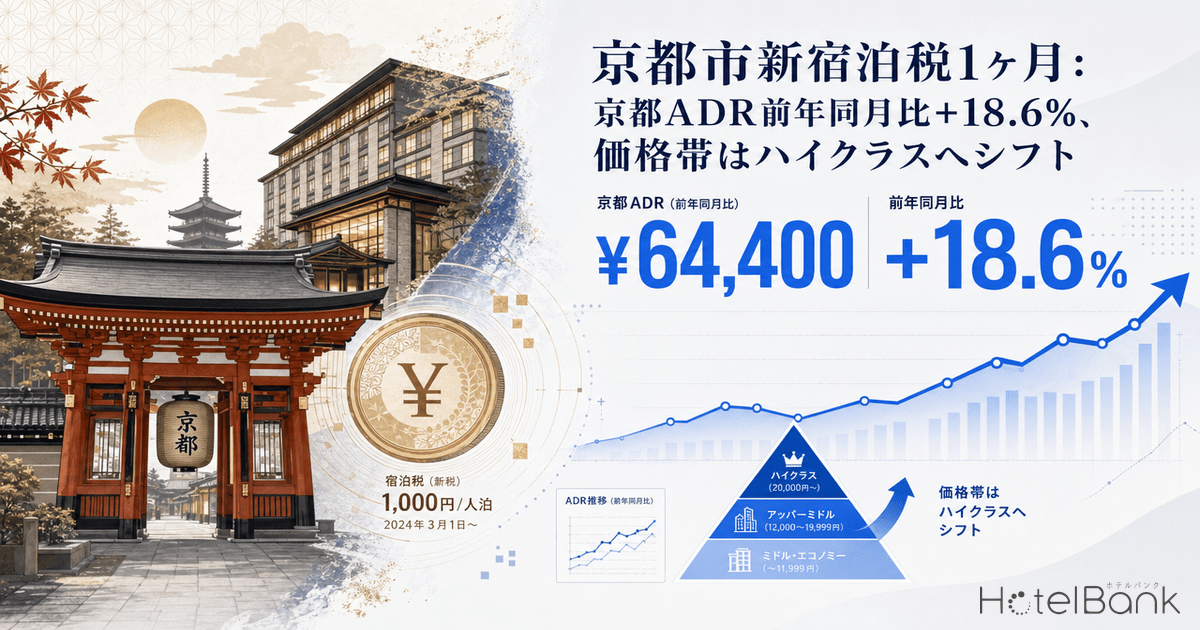
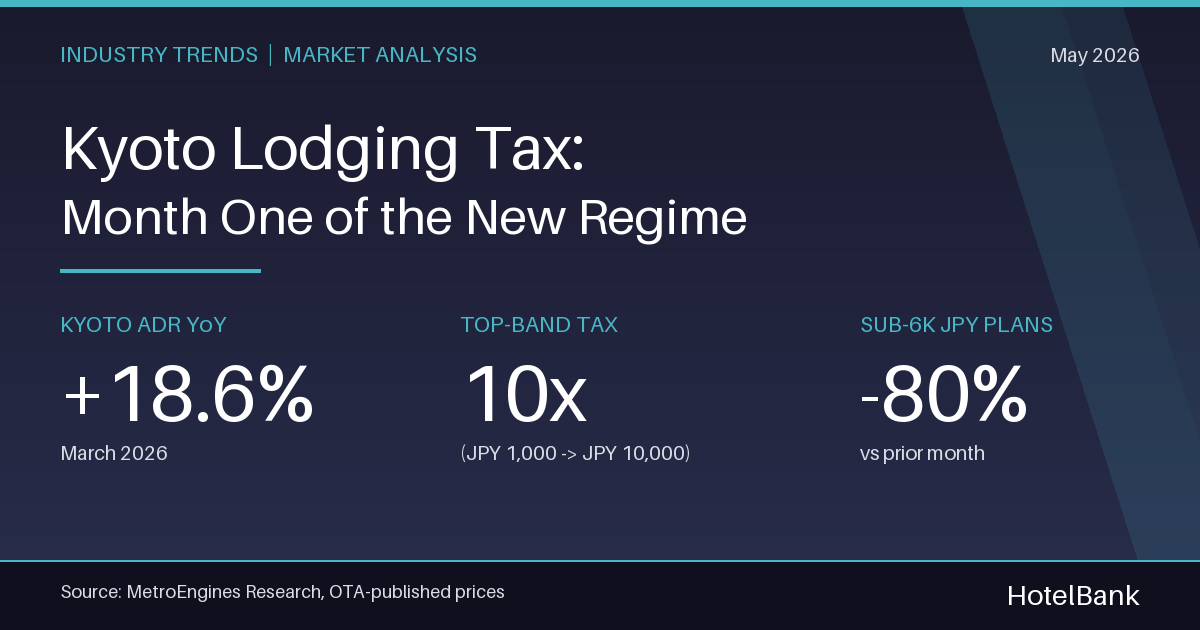
On March 1, 2026, Kyoto City’s revised lodging tax took effect. The top tax bracket jumped from a flat ¥1,000 to as much as ¥10,000 — a tenfold increase at the high end. Aggregating publicly listed prices from OTAs and other sources, Kyoto’s lodging plan mix shifted clearly upmarket around the rollout, lifting market prices by +18.6% year-on-year. Meanwhile, signals of demand spilling over to neighboring Osaka and Nara remain limited at this stage. This article uses OTA-published price data from the month before (February 2026) and the month after (March 2026) the tax change to quantitatively examine the structural shift in the Kyoto market and its ripple effects across the broader Kansai region.
Metric Definitions Used in This Article
- ADR (Average Daily Rate): The average of publicly listed sale prices on OTAs and similar channels. Differs from actual transacted prices. Per-room rate (tax-inclusive) for double occupancy, averaged across all plan types (room-only through meal-inclusive).
- Data Source: MetroEngines Research
All prices are per-room rates (tax-inclusive) for double occupancy. OTA-published pricing data aggregated monthly. Kyoto Prefecture sample: 1,550-1,702 properties (varies by month).
Overview of Kyoto’s New Lodging Tax: A Progressive Structure That Hits High-End Stays Hardest
Effective for stays beginning March 1, 2026, Kyoto City expanded its lodging tax from a 3-tier to a 5-tier progressive structure. The most striking feature is that the tax on stays priced at ¥100,000 or more jumped from a flat ¥1,000 to ¥10,000 — a tenfold increase. At the same time, the ¥50,000-¥100,000 band was raised fourfold from ¥1,000 to ¥4,000. According to Kyoto City, projected annual tax revenue is set to expand 2.2x, from ¥5.9 billion (FY2025 budget) to ¥13.2 billion (FY2026 budget) under the revised rates.
| Lodging Rate (per person per night) | Before | After | Multiple |
|---|---|---|---|
| Under ¥6,000 | ¥200 | ¥200 | Unchanged |
| ¥6,000-¥20,000 | ¥200 | ¥400 | 2.0x |
| ¥20,000-¥50,000 | ¥500 | ¥1,000 | 2.0x |
| ¥50,000-¥100,000 | ¥1,000 | ¥4,000 | 4.0x |
| ¥100,000 or more | ¥1,000 | ¥10,000 | 10.0x |
Source: Compiled by HotelBank Editorial Team from Kyoto City official announcement (effective March 1, 2026).
What stands out is how the tax burden weighs on the lodging rate itself. For a ¥100,000 stay, the ¥10,000 tax represents 10% of the rate; for ¥200,000, it falls to 5%; for a ¥30,000 stay, it works out to 3.3%. In other words, the progressive design ratchets up the burden ratio at the luxury end, but the tax tops out at ¥10,000 even for ultra-premium rooms. Kyoto City describes this design as “burden according to ability to pay.”
Plan Mix by ADR Band Shifted Sharply Around the Rollout
Mapping OTA-published Kyoto Prefecture lodging plans against the 5-tier tax structure, the sales mix changed clearly between February 2026 (pre-rollout) and March 2026 (post-rollout). The most dramatic move was at the bottom: plans priced under ¥6,000 collapsed roughly 80% month-on-month (11,681 to 2,404 plans; N = 2,341,012 plans in February 2026 and 2,557,230 in March). At the same time, the ¥50,000-¥100,000 band — where the tax now hits ¥4,000 — rose 56%, and the over-¥100,000 band climbed 55%. The upmarket shift in the price mix is unmistakable.
Source: Compiled by HotelBank Editorial Team from MetroEngines Research (N=4,897,242 plans, all OTA-published prices in Kyoto Prefecture).
Looking at composition share, the ¥6,000-¥20,000 band shrank from 36% of total plans in February to 20%, while the ¥20,000-¥50,000 band expanded from 38% to 44%, and the ¥50,000-¥100,000 band rose from 17% to 25%. Why this structural shift? The driver is not a sudden swing in demand, but a recalibration of pricing strategy on the operator side.
Put simply, many operators preparing for the new tax appear to have pushed prices up to pass through the burden, leading to deliberate pricing around the tax-bracket thresholds (¥6,000, ¥20,000, ¥50,000, ¥100,000). In fact, the prefecture-wide ADR (average sale price per room) climbed from ¥40,347 in February 2026 to ¥46,504 in March — a roughly ¥6,200 jump, equivalent to +15.3% month-on-month and a sizable +18.6% year-on-year.
Kyoto ADR +18.6% YoY: An Anomalous Jump in the Rollout Month
That said, March is a month with naturally rising ADR seasonality — Kyoto’s cherry blossom demand, graduation trips and spring break travel all overlap. To separate the lodging-tax effect from seasonality, year-on-year comparison is essential. Pulling 18 months of monthly ADR from OTA-published prices and comparing the same months in 2025 and 2026, Kyoto’s March YoY growth came in at +18.6%, accelerating further from February’s +17.3% (¥34,405 to ¥40,347).
Source: Compiled by HotelBank Editorial Team from MetroEngines Research.
Lining up Kyoto’s March YoY against neighboring Kansai prefectures makes the gap obvious at a glance. Osaka rose from ¥22,741 to ¥24,910 (+9.5%), and Nara from ¥36,635 to ¥38,895 (+6.2%). Both are trending up on the back of inbound demand, but Kyoto’s +18.6% is more than double either figure. Kyoto City’s lodging tax revision effectively layered a clear premium on top of market prices the moment it took effect.
| Area | March 2025 ADR | March 2026 ADR | YoY | Sample Size |
|---|---|---|---|---|
| Kyoto | ¥39,200 | ¥46,500 | +18.6% | N=1,550 |
| Osaka | ¥22,700 | ¥24,900 | +9.5% | N=872 |
| Nara | ¥36,600 | ¥38,900 | +6.2% | N=260 |
Source: Compiled by HotelBank Editorial Team from MetroEngines Research.
Tax-to-Rate Burden Ratio: Watch Price Elasticity at the High End
To gauge the new tax burden against per-room rates, consider a typical double-occupancy stay: the lodging tax is the per-person figure multiplied by two. For a ¥100,000 room (i.e., ¥50,000 per person), the tax becomes ¥4,000 × 2 = ¥8,000. That equals 8.0% of the ¥100,000 room rate — four times the prior 2.0% (¥1,000 × 2 = ¥2,000). For a ¥200,000 room (¥100,000 per person), the tax is ¥10,000 × 2 = ¥20,000, or 10% of the room rate.
Source: HotelBank Editorial Team estimates based on Kyoto City’s official tax rates (assumes double occupancy).
Looking at March OTA-published category-level ADR, deluxe hotels averaged ¥161,824, auberges ¥122,428, and resort hotels ¥107,429 — all squarely in the over-¥100,000 range. In these luxury categories, the tax burden reaches 8-10% of the lodging rate, which is a non-trivial impact on price-elastic affluent inbound demand.
Mid-range categories, by contrast, sit on the bracket boundaries — ryokan (¥53,953), private rentals (¥52,267), and machiya townhouses (¥49,398) — where operators face critical pricing decisions around the ¥1,000-to-¥4,000 jump. The data already shows operators avoiding the “exactly ¥50,000” or “exactly ¥100,000” thresholds, opting to price slightly above them, and that choice is showing up in the share-mix shift.
Demand Spillover to Neighboring Areas Is Limited So Far
Has Kyoto’s price increase pushed demand to Osaka or Nara? Comparing ADR trends across the three Kansai prefectures from OTA-published data, all three are trending up through March 2026, but the growth rates diverge sharply. Against Kyoto’s +18.6% YoY, Osaka posted +9.5% and Nara +6.2% — Kyoto’s outsized lead remains intact.
Source: Compiled by HotelBank Editorial Team from MetroEngines Research.
If demand were genuinely shifting, we’d expect to see clear signals in neighboring areas — rising occupancy or a surge in plan supply. Yet total plan counts in Osaka and Nara from February to March came in at +15.4% (2.67M to 3.08M) and +3.1% (460K to 470K) respectively, well within seasonal norms. There is no anomalous outlier suggesting large-scale spillover from Kyoto at this point.
That said, this is only the picture one month after the rollout. Inbound bookings typically run on 3-to-6-month lead times, so any meaningful demand shift from the tax revision will only become observable as booking data builds through summer and fall 2026. Furthermore, Kyoto’s +18.6% in March may include substantial operator-side pricing adjustments specific to the rollout month, and price action from April onward will be the litmus test for the “new normal” ADR level.
Note on data source mixing: This article combines OTA-published price data (sale-price basis) with REIT monthly operating data (transacted-price basis). The two have a structural level gap, so we recommend focusing on YoY change rates rather than direct comparison of absolute figures.
Kansai REIT Operations: Structural Demand Remains Solid
Monthly operating data from major REITs holding Kansai-region properties confirms that broader Kansai hotel demand remains firm. Hoshino Resorts REIT (星野リゾート・リート, 3287), Japan Hotel REIT (8985), and Invincible Investment Corp. (8963) all hold properties in at least one of Kyoto, Osaka, or Nara. Their portfolio-wide KPIs as of February 2026 (the month before the rollout) show occupancy and ADR both improving year-on-year, as shown below.
| REIT | OCC | ADR | RevPAR | OCC YoY | ADR YoY | RevPAR YoY |
|---|---|---|---|---|---|---|
| Hoshino Resorts REIT (3287) | 76.5% | ¥20,800 | ¥15,900 | +1.9pt | +8.6% | +10.5% |
| JHR (8985) | 85.2% | ¥19,400 | ¥16,600 | +2.4pt | +3.1% | +6.1% |
| Invincible (8963) | 86.6% | ¥13,500 | ¥11,700 | +2.0pt | +0.9% | +2.9% |
Source: Compiled by HotelBank Editorial Team from each REIT’s monthly operating data (February 2026 results).
All three REITs improved occupancy by 1.9-2.4 points YoY, with ADR also trending up — strong evidence that the structural tailwind from inbound demand continues. While these figures cover entire portfolios rather than single Kyoto, Osaka, or Nara properties, they offer important corroboration that demand for the Kansai region as a whole has not weakened. As March-onward monthly reports come in with single-month performance for Kansai assets, we will be able to scrutinize the lodging tax’s impact on property-level occupancy and ADR more precisely.
Where the ¥12.6 Billion Will Go: Overtourism Mitigation and Resident Reinvestment
According to Kyoto City’s official announcement, annual lodging tax revenue is projected to grow from ¥5.9 billion in the FY2025 budget to ¥13.2 billion in the FY2026 budget — a ¥7.3 billion increase. Kyoto City has indicated the additional revenue will go primarily to four areas as outlined below.
| Area | Key Initiatives |
|---|---|
| Traffic Congestion Relief | Improving city bus operations, evaluating priority pricing for residents, installing subway platform doors, easing crowding around Kyoto Station |
| Tourism Conduct & Environment | Stronger waste management in Gion and Arashiyama, tourism etiquette outreach, tighter regulation of unlicensed lodgings |
| Cultural Heritage Protection | Expanded subsidies for cultural properties, preserving Kyoto’s distinctive heritage including machiya townhouses |
| Urban Infrastructure | Road maintenance, seismic reinforcement of bridges, river improvements, disaster preparedness (approximately ¥6 billion scale) |
Source: Compiled by HotelBank Editorial Team from Kyoto City official announcement.
Kyoto City has also disclosed plans to set aside a portion of the additional revenue in a newly created “Lodging Tax Fund” to finance long-term tourism solutions. In other words, this revision is designed not as a simple tax hike, but as a scheme that channels visitor-paid tax back into improvements that benefit both tourism infrastructure and the lives of residents.
From operators’ on-the-ground perspective, however, there are real operational headaches: handling the increased administrative burden of tax collection, filings and OTA coordination; reflecting the change in displayed prices; and recalculating tax in overseas booking systems. In particular, how to handle tax-exclusive vs. tax-inclusive display and how to keep displayed nightly rates on OTAs consistent with these rules will be operational flashpoints in the months following rollout.
Summary: Three Takeaways from Month One
One month into Kyoto City’s revised lodging tax (effective March 1, 2026), three findings stand out. First, the OTA-published plan mix in Kyoto Prefecture has shifted clearly upmarket — the lowest band (under ¥6,000) collapsed roughly 80% month-on-month, while bands above ¥50,000 expanded 55-56%. Second, Kyoto’s ADR rose +18.6% YoY, far outpacing other Kansai prefectures (Osaka +9.5%, Nara +6.2%) and confirming that the tax revision effectively layered a premium onto market prices. Third, signals of large-scale demand spillover to neighboring areas remain limited at this point, but a verdict requires several more months of tracking, given typical booking lead times.
For hotel operators, designing pricing around the tax-bracket thresholds will be central to revenue maximization going forward. For investors, whether long-term demand for Kyoto’s luxury segment can absorb the higher tax burden will shape the medium-to-long-term outlook for Kansai REITs and independent operators. For the city itself, how the ¥13.2 billion of generous revenue is steered toward overtourism mitigation and resident reinvestment will be the benchmark by which the Kyoto model is judged.
Note on forward-dated ADR: The ADR figures in this article are averages of OTA-published sale prices at the time of survey and will fluctuate as check-in dates approach. Prices set high today may be marked down close to arrival.