

The 78th Shosoin Exhibition (正倉院展) runs for 17 days, from Saturday, October 24 to Monday, November 9, 2026, at the East and West New Wings of the Nara National Museum (奈良国立博物館). Sixty treasures will be on display, 11 of them for the first time. The exhibition is open every day of the run, from 8:00 to 18:00 (until 20:00 on Fridays, Saturdays, Sundays and public holidays) — a longer schedule than a typical special exhibition. In other words, Nara’s single largest visitor magnet of the year operates for just 17 days.
So how do the rooms fill up across those 17 days? With 67 days remaining until opening day, we aggregated the rates and inventory that Nara City accommodations had already listed on OTAs as of August 18, 2026. The headline: weekdays during the run are already listed at levels 32.0% above pre-run weekdays. And the previous edition — the 77th, in 2025 — showed a move in the same direction (+20.5%) as an actual result. Inventory, on the other hand, is at an early stage: only about 30% of total rooms for November have been released to OTAs so far, too little to read supply and demand.
Metric Definitions Used in This Article
- Lowest listed rate (daily median): For each stay date, we take one figure per property — the rate of the cheapest plan listed on OTAs (double occupancy, per room, tax included) — and take the median across the target property group. Normalizing at the property level first prevents properties with many plans from skewing the result. All daily and day-of-week analysis in this article uses this metric.
- ADR (average daily rate): An estimated settled rate (tax-excluded equivalent) calculated by applying a category-specific adjustment factor to the cheapest-plan level each property publishes on OTAs (double occupancy, per room, tax included). Cross-checked against per-property results disclosed by listed hotel REITs (184 property-months, April-May 2026), the median error is 7.5%. These are estimates and differ from each property’s actual transaction prices or accounting figures. Area-level ADR is the median across target properties (the level of a typical property in the area). This article uses it only for monthly level comparisons.
- OCC (occupancy): Rooms sold as a share of total rooms in the area (an estimate based on OTA-listed inventory).
- LT (lead time): Days remaining until the check-in date. LT0 = same day.
- Data source: MetroEngines Research (based on listing data retrieved as of August 18, 2026)
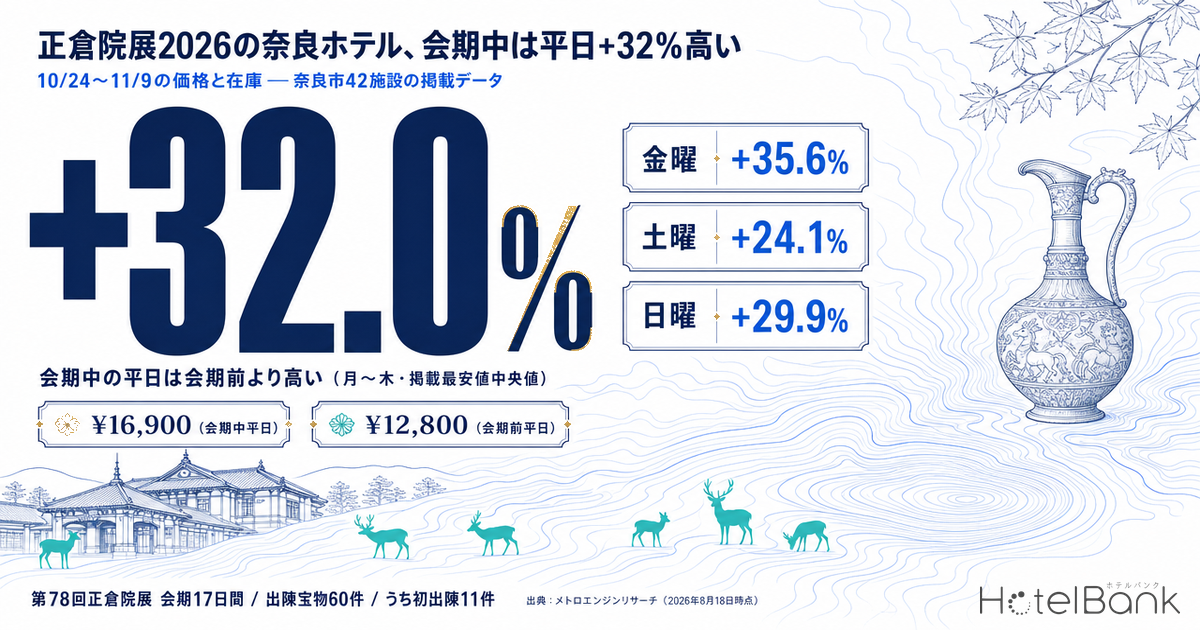
- — Weekdays +32.0%: Weekdays during the run (Oct 24-Nov 9) show a median lowest listed rate of ¥16,900, roughly ¥4,100 above the pre-run ¥12,800 (Nara City, N=42 properties, as of August 18, 2026)
- — The biggest gains are on weekdays and Fridays: Friday +35.6%, weekdays +32.0%, Sunday +29.9%, versus Saturday at +24.1%. What the Shosoin Exhibition moves is primarily the weekday rate
- — The 77th edition showed the same shape: 2025 actuals were weekdays +20.5%, Friday +12.2%, Sunday +14.3%, Saturday +5.0% — matching even in the ranking across day-of-week segments
- — November is the autumn peak: Nara Prefecture’s estimated settled ADR hit ¥16,600 in November 2025, the year’s high (November 2024 was ¥14,300). November 2026 is tracking at ¥17,600, +6.1% year on year
- — Too early to judge inventory: OTA-listed allotment for November stands at just 30.3% of total rooms (daily median), with sell-through of 0-5.9%. It becomes readable only from late September, once observation days accumulate
17 days, 60 treasures, open daily — the shape of the 78th Shosoin Exhibition
According to the press release issued by the Nara National Museum on July 14, 2026, the 78th Shosoin Exhibition runs 17 days, from Saturday, October 24 to Monday, November 9. The venue is the East and West New Wings, with 60 treasures on display, 11 of them shown for the first time. The lacquered ewer (漆胡瓶, shikkohei) featured on the poster is a handled water pitcher of West Asian origin, decorated with thin silver sheets forming plants and deer motifs. Also on display are the stained-ivory go stones (紅牙撥鏤碁子, kogebachiru-no-kishi) treasured by Emperor Shomu, and the Rainbow Dragon (虹龍, koryu), shown for the first time since 2008.
As a gauge of scale, the previous edition — the 77th (October 25 to November 10, 2025, 17 days) — drew roughly 168,000 visitors. The 71st edition (2019), before the pandemic, recorded 277,133 visitors, at a time when attendance had exceeded 200,000 for 15 consecutive years. On a per-day basis, the 77th edition brought some 9,900 people into one corner of Nara Park.
From an accommodation-market perspective, what matters here is the “shape” of the run. Across the 17 days there are three Saturdays (October 24 and 31, and November 7) and three Sundays (October 25, November 1 and 8). On top of that, November 3 (Tuesday) is Culture Day. So three weekend sets fall inside the window, and the weekdays run unbroken through the first week of November. Unlike a one-off fireworks festival or sporting event, the Shosoin Exhibition is the type of event that lifts weekday demand across two and a half weeks. That character shows up directly in how rates are set, as we see below.
Weekdays during the run are +32.0% — the “Shosoin premium” in 42 Nara City properties’ listed rates
Among accommodations in Nara City, we selected the 42 properties for which listed rates could be observed on every date from October 1 to November 20, 2026, and equally for the same period a year earlier, then calculated the daily median of the lowest listed rate. Because the same property group is fixed across all dates, there is no apparent volatility caused by the aggregation set changing from day to day.
Source: MetroEngines Research, compiled by the HotelBank Editorial Team (Nara City, N=42 properties, listing data as of August 18, 2026)
Weekdays in mid-October, before the run begins, sit broadly in a ¥11,800-¥13,800 range. But on opening day, Saturday October 24, the figure jumps to ¥22,500, and weekdays thereafter never fall below ¥15,500. The final week of the run — Wednesday November 4 to Saturday November 7 — is set at ¥18,700-¥24,200, the highest levels anywhere in the run.
To keep differences in day-of-week composition from confounding the picture, the table below splits the data into Monday-Thursday weekdays, Friday, Saturday and Sunday, and treats Sports Day (October 12) and Culture Day (November 3), plus the days preceding them, separately.
| Day-of-week segment | Before the run (Oct 1-Oct 23) |
During the run (Oct 24-Nov 9) |
After the run (Nov 10-Nov 20) |
During / Before |
|---|---|---|---|---|
| Weekdays (Mon-Thu) | ¥12,800 n=12 days | ¥16,900 n=7 days | ¥16,100 n=7 days | +32.0% |
| Friday | ¥14,600 n=4 days | ¥19,700 n=2 days | ¥17,400 n=2 days | +35.6% |
| Saturday | ¥18,600 n=3 days | ¥23,100 n=3 days | ¥25,100 n=1 day | +24.1% |
| Sunday | ¥12,300 n=2 days | ¥16,000 n=3 days | ¥15,900 n=1 day | +29.9% |
Source: MetroEngines Research, compiled by the HotelBank Editorial Team (Nara City, N=42 properties. Public holidays (Oct 12, Nov 3) and their eves are excluded from the table above)
The largest increases are on Friday (+35.6%) and weekdays (+32.0%), while Saturday (+24.1%) is comparatively modest. Saturdays already sit at a high level regardless of the exhibition, so there is less headroom than on weekdays. Put the other way around, what the Shosoin Exhibition moves is primarily the weekday rate. The gap between the pre-run weekday figure of ¥12,800 and the in-run weekday figure of ¥16,900 is about ¥4,100. With 7 weekdays among the 17 days, the weekday lift alone carries a meaningful impact for the area as a whole.
The same shape appeared at the 77th edition — cross-checking against 2025 actuals
The 2026 figures are “rates yet to be sold”; whether they actually transact is a separate question. So for the same 42 properties, we re-ran the identical aggregation on the previous year’s listed rates (October 1 to November 20, 2025), segmented by the 77th edition’s run (October 25 to November 10, 2025). Because that run has finished, these are listing levels for a period that was actually sold.
Source: MetroEngines Research, compiled by the HotelBank Editorial Team (Nara City, N=42 properties. 2025 is segmented by the 77th edition run (Oct 25-Nov 10), 2026 by the 78th edition run (Oct 24-Nov 9))
In 2025: weekdays +20.5%, Friday +12.2%, Saturday +5.0%, Sunday +14.3%. The increases are more restrained than the 2026 listing levels, but the direction is consistent — all four day-of-week segments exceed their pre-run levels. What is more, the ordering matches too: the weekday gain is the largest and Saturday the smallest. The pattern visible in 2026 reads as an extension of a pattern consistent with the previous edition’s actuals.
In addition, 2025 saw weekdays fall back to ¥12,800 from November 11, once the run had ended — essentially the same level as the pre-run ¥12,400. Rates rise only during the run and return to base once it ends; last time, the movement was that clean.
But in 2026 the post-run period is high too — separating out the overlap with autumn foliage season
This part needs to be read carefully. In 2026, weekdays after the run (November 10-20) come in at ¥16,100, barely different from the ¥16,900 during the run (during / after = +4.7%). As for Saturdays, the post-run November 14 is at ¥25,100, above the in-run Saturday average of ¥23,100. That contrasts with 2025, where rates fell back cleanly once the run ended.
There are two ways to read the difference. One is that mid-November in Nara is the peak of the autumn foliage season, so rates are set high regardless of the Shosoin Exhibition. The other is that the post-run dates were still more than 67 days out at the time of the survey, so listed rates have not yet settled. In fact, mid-November dates are still in the middle of having inventory released to OTAs (detailed in the next section).
Therefore, while the elevated level during the run is verifiable against the pre-run comparison, it cannot be concluded that all of it is due to the Shosoin Exhibition. Early-to-mid November in Nara is a window where three demand drivers overlap — the Shosoin Exhibition, autumn foliage and Culture Day — and the listed-rate data in this article alone cannot separate their contributions. Note also that Culture Day 2026 falls on a Tuesday, and the preceding day, Monday November 2, is set at ¥18,400, ¥1,500 above the in-run weekday median of ¥16,900 — suggesting that holiday-eve demand is being priced in. We examine how this holiday placement plays out across seven areas in Culture Day 2026 Falls Tuesday: Demand Peaks on Holiday Eve, +9.3pt.
Inventory is not fully out yet — November allotment is 30% of total rooms
Next, the inventory side. Our population is the 35 properties, totaling 1,241 rooms, in Nara City for which inventory could be observed continuously across every date in the target period. Because we retain only properties whose OTA-listed allotment reaches at least 30% of total rooms (on a median-of-observation-period basis), properties that focus on direct booking and release little inventory to OTAs are not included.
Source: MetroEngines Research, compiled by the HotelBank Editorial Team (Nara City, N=35 properties / 1,241 rooms, as of August 18, 2026. Inventory observation begins at LT90, 90 days before check-in)
The blue line shows “the share of total rooms released to OTAs as allotment (on a maximum-during-observation basis)”, and the navy line shows “how much of that allotment has sold through”. From mid-to-late October, allotment reaches 47-77% of total rooms (daily median 68.1%), whereas from November 4 onward it drops to 23-51% (median 30.3%). At the same time, sell-through is near untouched, at 0-5.9%.
This should be read not as “the second half of the run is empty” but as not yet on sale. Because inventory observation starts 90 days before the check-in date, mid-November dates have only 2-6 observation days as of writing. The combination of a small allotment and sell-through near zero indicates a stage at which properties have not finished releasing their November inventory to OTAs — not weak demand.
| Stay date | OTA-listed allotment (vs. 1,241 total rooms) |
Sell-through vs. allotment | Observation days | Context |
|---|---|---|---|---|
| Saturday, October 10 | 145 rooms (11.7%) | 85.5% | 35 days | First day of a 3-day weekend (before the run) |
| Saturday, October 17 | 961 rooms (77.4%) | 8.2% | 29 days | An ordinary pre-run Saturday |
| Saturday, October 24 | 893 rooms (72.0%) | 13.2% | 22 days | Opening day |
| Saturday, October 31 | 774 rooms (62.4%) | 8.3% | 16 days | A Saturday during the run |
| Tuesday, November 3 (holiday) | 551 rooms (44.4%) | 2.7% | 13 days | Culture Day |
| Saturday, November 7 | 465 rooms (37.5%) | 3.5% | 9 days | Final Saturday of the run |
| Monday, November 9 | 383 rooms (30.9%) | 1.0% | 7 days | Closing day of the run |
Source: MetroEngines Research, compiled by the HotelBank Editorial Team (Nara City, N=35 properties / 1,241 rooms. Limited to properties whose OTA-listed allotment reaches at least 30% of total rooms. As of August 18, 2026)
The one clear outlier is Saturday, October 10. It is the first day of a three-day weekend that includes Sports Day, and by LT90 (July 12) the allotment already released to OTAs had narrowed to 145 rooms, with sell-through against those 145 rooms reaching 85.5%. That is a completely different inventory state from October 17, an ordinary pre-run Saturday (961 rooms, 8.2%). The three Saturdays during the run (October 24 and 31, November 7) were all at an interim 3.5-13.2% as of August 18, and there is nothing at this stage on which to judge tightness of supply and demand.
Note that some dates, such as Thursday October 29 and Monday November 2, show an allotment share that dips below the days around them. A particular property may be holding back inventory on that date alone, or its release timing may be offset — so day-level swings in allotment cannot be read directly as the strength or weakness of demand. This becomes usable as evidence once observation days accumulate at LT60-30, i.e. from late September into early October.
Nara Prefecture’s ADR peaks in November — 2025 was the annual high
Widening the lens to a monthly view: tracking Nara Prefecture’s estimated settled ADR from 2024 makes the structure clear — November is the annual peak.
Source: MetroEngines Research, compiled by the HotelBank Editorial Team (Nara Prefecture; 104-143 properties per month. From August 2026 onward, estimates based on listing levels as of the survey date)
November 2024 was ¥14,300 and November 2025 ¥16,600, up 16.1% year on year. November 2025 was that year’s high, and November 2024 was the second highest of its year, behind April (¥14,700). November 2026 is estimated at ¥17,600 from current listing levels, +6.1% year on year. For October as well, October 2026 is ¥15,300 against ¥14,000 in October 2025, +8.9%. November’s level runs some ¥2,300 above October’s, which shows the distinctive position November holds in Nara’s annual calendar. That said, which month the autumn peak lands in varies by prefecture (for detail, see Japan Autumn ADR 2026: 20 Prefectures Peak in Nov, Kyoto +81.8%).
Incidentally, June 2026 (¥9,800) and July 2026 (¥10,400) came in below the same months a year earlier. Summer is Nara’s weakest period of the year, and the deeper that trough, the greater the gap to the autumn peak. The structure is one in which a substantial share of annual revenue concentrates between late October and November.
One more reference line, on near-term supply and demand. Nara Prefecture’s occupancy (estimated, based on OTA-listed inventory) was 89.5% in May 2026 (N=168 properties / 6,877 rooms), 81.0% in June (N=159 properties / 6,587 rooms) and 80.5% in July (N=154 properties / 6,728 rooms). Even in summer it holds in the 80s, so there is no great slack on the supply side. It is in that state that the rate peak arrives in November. How much of a step up an event run creates in Nara demand is examined from the booking-curve angle in Nara Tokae 2026: 78.3% Estimated OCC 45 Days Out, 14.3pt Above After.
What 17 days mean for a “Nara people don’t stay in”
Nara Prefecture is known for a tourism structure in which visitor numbers and overnight-guest numbers diverge. According to materials from the Nara Prefecture Tourism Strategy Division, foreign overnight guests in fiscal 2024 totaled roughly 400,000, ranking 30th nationwide, while the prefecture ranks 7th nationwide in visitor numbers. The pattern of coming on a day trip from Kyoto or Osaka and heading home without staying has persisted for a long time.
In that context, the Shosoin Exhibition occupies a special position. It opens at 8:00, and stays open until 20:00 on Fridays, Saturdays, Sundays and holidays. Stay the night before and you can be in first thing in the morning; stay the night after and evening viewing becomes possible. The design places value on time slots that are hard to capture on a day trip, making it an event well suited to converting visitors into overnight guests. Indeed, this article’s finding that the rate increase is larger on weekdays than Saturdays is consistent with reading it as “a reason to stay on weekdays is being created”, rather than “a weekend-leisure surcharge”.
Accommodations within Nara City number 223 properties and roughly 6,591 rooms within MetroEngines Research’s coverage. Of those, the inventory we can track in this article covers 35 properties and 1,241 rooms, about 20% of the city’s room count. It is by no means a large market, so when demand concentrates into 17 days, rates move readily. Conversely, for properties this is the period of the year with the greatest freedom in rate design.
Summary — what can and cannot be said as of August 18
To recap. There are three things we can say. First, for the 17 days of the 78th Shosoin Exhibition, listed rates in Nara City are already set above pre-run levels: weekdays +32.0%, Friday +35.6%, Saturday +24.1%, Sunday +29.9%. Second, this direction matches the actuals from the previous edition, the 77th (weekdays +20.5%, Friday +12.2%, Saturday +5.0%, Sunday +14.3%), right down to the ranking of increases by day of week. Third, Nara Prefecture’s ADR peaked in November in 2025, and November 2026 is likewise tracking at +6.1% year on year based on current listings.
What cannot be said should be equally clear. Sell-through during the run is only an interim 8-17% against allotment even in late October, and once into November the observation window itself is insufficient. There is no basis at this stage for determining which dates will fill first. And because mid-November, after the run, is also at a high level, the rate increase cannot be attributed to the Shosoin Exhibition alone. It is a period in which autumn foliage and Culture Day overlap, and separating those contributions goes beyond the scope of this article’s data.
For anyone considering a stay, the practical implication is the unusually large weekday differential. There is a gap of about ¥4,100 between pre-run weekdays and in-run weekdays. If your dates are flexible, choosing a weekday in mid-October carries a clear meaning on price. If you do intend to stay during the run, bear in mind that November inventory is still being released to OTAs — it is worth checking listings again from September into early October.
⚠ Note on rates and inventory for future dates: The listed rates and inventory for October-November 2026 in this article are estimates based on information publicly available on OTAs as of August 18, 2026, and will change as the check-in date approaches. In particular, dates from mid-November onward are still mid-way through inventory release, so both allotment and rates will shift as further listings are added. Please note both the possibility that rates set high at present may fall through last-minute adjustment, and the possibility that dates currently appearing short on inventory may see substantial allotment added.
Related reading
- Culture Day 2026 Falls Tuesday: Demand Peaks on Holiday Eve, +9.3pt
- Sumo Kyushu Basho 2026: Fukuoka Weekday Rates +9.7% Actual, +3.3% Now
- Sendai Tanabata 2026: Aug 8 Starts at 80.8% at T-45, Climbs Fastest
- World Masters Games 2027 Kansai: 164,707 Rooms Across 50 Venue Cities
- Nara Tokae 2026: 78.3% Estimated OCC 45 Days Out, 14.3pt Above After
- Autumn School Trips: Weekday Rate Floors in 5 Areas, Nagasaki +1.6pt
- Japan Autumn ADR 2026: 20 Prefectures Peak in Nov, Kyoto +81.8%
References and Sources
- Nara National Museum, “78th Shosoin Exhibition: Outline — Press Release” (July 14, 2026)
- Nara National Museum, “The 78th Shosoin Exhibition” exhibition page
- Imperial Household Agency, “Announcement of the 78th Shosoin Exhibition at the Nara National Museum”
- Shosoin Exhibition official site, “Principal Treasures on Display, 78th Edition (2026)”
- Nara National Museum, “The 77th Shosoin Exhibition” (October 25-November 10, 2025)
- Historical attendance figures for the Shosoin Exhibition (277,133 at the 71st edition, and others)
- Nara Prefecture Tourism Strategy Division, “Nara Prefecture Tourism Data” (foreign overnight guests ranked 30th nationwide, and others)
- Nara City Tourist Association, “Monthly Report on Accommodation Data in Nara City”
- MetroEngines Research — listed rates in Nara City (N=42 properties), OTA inventory (N=35 properties / 1,241 rooms), and estimated settled ADR and occupancy (estimated, based on OTA-listed inventory) for Nara Prefecture
■ Data sources
Listed rate and inventory data published on OTAs and collected by MetroEngines Research. The daily lowest listed rate for Nara City is aggregated with the population fixed at the 42 properties for which rates could be observed on every date from October 1 to November 20, 2026 and for the same period a year earlier (double occupancy, per room, tax included; a daily median taken after normalizing at the property level). Inventory covers 35 properties totaling 1,241 rooms whose OTA-listed allotment reaches at least 30% of total rooms, with observation starting 90 days before the check-in date. Nara Prefecture’s monthly estimated settled ADR is aggregated across 104-143 properties per month, and occupancy across 154-168 properties per month. The exhibition run, treasures on display and attendance figures come from materials published by the Nara National Museum and the Imperial Household Agency; the nationwide ranking for overnight guests comes from materials of the Nara Prefecture Tourism Strategy Division.
■ Calculation assumptions
Day-of-week segments treat Monday-Thursday as weekdays, with Friday, Saturday and Sunday aggregated separately. Public holidays (October 12, November 3) and their eves are excluded from the day-of-week aggregation. The during/before rate of change compares averages, by run segment, of daily medians for the same property group. Run boundaries are October 24-November 9 for 2026 and October 25-November 10 for the 77th edition in 2025. Inventory “allotment” is the maximum number of listed rooms during the observation period divided by total rooms; “sell-through” is rooms sold as a share of that allotment. The estimated settled ADR for October and November 2026 is an estimate based on listing snapshots, not a confirmed actual.
■ Limitations and caveats
Listed rates are not transaction prices, and they change as the check-in date approaches. Dates from mid-November onward are still mid-way through inventory release and include days with only 2-6 observation days, so swings in allotment cannot be read directly as the strength or weakness of demand. The high level of rates after the run (November 10-20) coincides with autumn foliage season and Culture Day, and the listed-rate data in this article alone cannot isolate the contribution of the Shosoin Exhibition. Estimated settled ADR and occupancy are both estimates based on publicly available OTA information and differ from each property’s actual transaction prices or accounting figures.