

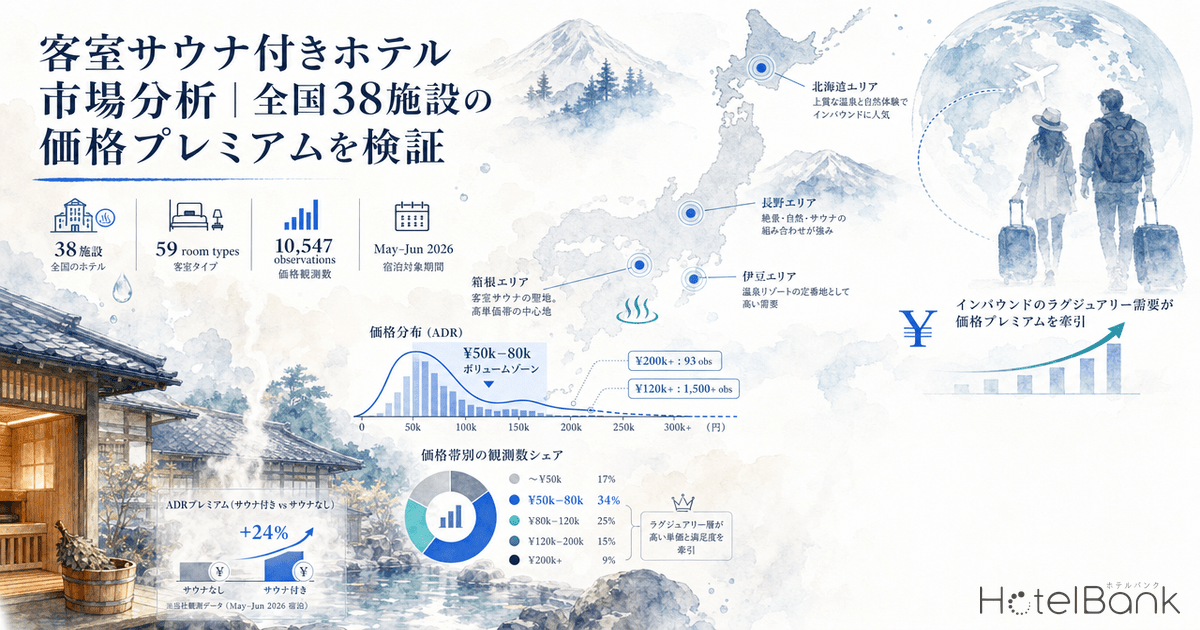
As “totonou” (the meditative bliss of post-sauna recovery) transcends fad status to become a cultural fixture, hotels equipped with in-room saunas are quietly carving out a niche but well-defined market. This article uses publicly available pricing data collected by MetroEngines Research to extract properties featuring in-room saunas, and examines the May-June 2026 nightly rate distribution, the price differential against non-sauna rooms within the same property, and the connection points to inbound luxury travel demand.
*Metric Definitions Used in This Article: ADR (Average Daily Rate) = the average of publicly listed sale prices at surveyed properties, which differs from actual transaction prices. Sold-out rate = the percentage of sale plans whose reservation acceptance had been closed at the time of survey, which differs from the property’s overall room occupancy rate. Prices are per-room rates for double occupancy (tax included).
Sample Selection Methodology and Population
The greatest challenge in statistically analyzing the in-room sauna hotel segment is that no industry database flags this attribute. Many OTA reservation sites list “sauna” as a facility without distinguishing between communal saunas in shared bathing facilities and private saunas inside guest rooms, so a simple sauna-attribute filter returns mostly business hotels with shared saunas.
For this analysis, we applied the following keyword extraction logic to room-type names within the sale plan information collected by MetroEngines Research. First, the room name must contain one of: “sauna-equipped” (サウナ付), “private sauna” (プライベートサウナ), “guestroom sauna” (客室サウナ), “sauna room” (サウナルーム), “sauna suite” (サウナスイート), “totonoi suite” (ととのいスイート), “mist sauna” (ミストサウナ), “far-infrared sauna” (遠赤外線サウナ), “indoor sauna” (室内サウナ), “private cabin sauna” (個室サウナ), or “exclusive sauna” (専用サウナ). Second, the name must NOT simultaneously contain “large bath” (大浴), “bathing area” (浴場), “bathroom” (浴室), “bath hall” (浴殿), or “shared” (共同). The latter exclusion eliminates cases where shared communal sauna facilities are misclassified as in-room features.
This logic yielded a dataset of 38 properties, 59 room types, and 10,547 valid price observations under double-occupancy conditions for May-June 2026 check-ins. The property count is admittedly small, but to MetroEngines Research’s knowledge, this represents the principal “in-room sauna guestroom” market currently visible in publicly available pricing data. The geographic distribution is led by Kanagawa Prefecture (Hakone area) and Hokkaido with 6 properties each, followed by Shizuoka (Izu/Atami) and Nagano with 3 each, confirming a concentration in hot spring and resort areas.
Source: MetroEngines Research, compiled by HotelBank Editorial Team (N=10,547, May-June 2026 check-ins)
Price Distribution: Volume Zone at ¥50-80k, Top Tier Above ¥200k
Tabulating the ADR of in-room sauna rooms by price band, the ¥50,000-80,000 range forms the largest volume zone, followed by ¥30,000-50,000 and ¥80,000-120,000. Considering that typical city and business hotel double-occupancy ADRs hover around ¥20,000, in-room sauna rooms clearly occupy the mid-to-high price segment.
Notably, more than 1,500 observations exist in the upper price band exceeding ¥120,000. This tier is concentrated in experiential luxury properties such as the Hakone ryokan Kitano Kazasaryo (きたの風茶寮), Yamagata’s Meigetsuso (名月荘), and the sauna suite at Imperial Hotel Osaka (帝国ホテル大阪). Furthermore, 93 observations exceed ¥200,000 in the highest band, all originating from the suite category (with cypress open-air sauna) at Fuji-san Onsen Hotel Kaneyamaen (富士山温泉 ホテル鐘山苑) in Fujiyoshida, Yamanashi. The maximum price reaches ¥440,000, exemplifying a case where the in-room sauna is commercialized not as mere equipment but as a “ritualistic experience” combined with Mt. Fuji views.
Regional Premium Rates: Yamanashi +323%, Osaka +57%, Hokkaido +52%
Calculating the price differential against non-sauna rooms within the same property as a “premium rate,” the disparity between regions proved enormous. The maximum is Yamanashi at +323% (sauna room ¥396,800 vs. non-sauna ¥93,800), but this is single-handedly driven by the aforementioned Hotel Kaneyamaen and cannot be extrapolated as a regional indicator. Even when restricted to areas with multiple properties, however, premiums remain pronounced in eastern Japan’s urban and resort markets: Osaka +57%, Hokkaido +52%, and Kanagawa +20%.
By contrast, in regions where traditional hot spring ryokans dominate—such as Nagano, Nagasaki, and Yamaguchi—premiums hover around 0% or turn negative. Yamagata posts -25% and Fukushima -37%, where sauna rooms actually average lower than non-sauna rooms. This seemingly contradictory result reflects the structure of these properties: Japanese-style special suites with private hot spring baths constitute the highest price tier, and sauna-equipped rooms occupy the middle-tier room type. In other words, the sauna itself wields pricing power only at “properties that position the sauna as the central experience,” whereas at hot spring ryokans, the open-air onsen bath remains the dominant premium source.
Source: MetroEngines Research, compiled by HotelBank Editorial Team (sauna vs. non-sauna rooms within the same property, May-June 2026)
Regional ADR Comparison
Source: MetroEngines Research, compiled by HotelBank Editorial Team
Plotting absolute ADR levels for sauna and non-sauna rooms by prefecture, Kanagawa’s (Hakone) in-room sauna ADR of ¥169,200 rivals the luxury hotels of central Tokyo, illustrating how combining in-room saunas with hot-spring resort ryokans sustains a high-rate tier. Hokkaido remains in the mid-price range at ¥46,200, yet still secures a +52% premium over the non-sauna ¥30,300, functioning as effective room-type differentiation within the same property.
Top 20 Properties by Price Band
Among the 38 in-room sauna hotels, the table below ranks the 19 properties with sufficient observation counts (5+) by average ADR. The top 5 are occupied by Fuji-san Onsen Hotel Kaneyamaen, Kitano Kazasaryo, Meigetsuso, Imperial Hotel Osaka, and Umi no Hana (海のはな), all sharing a common pattern of high-value-added sauna offerings paired with experiential context such as hot springs, scenery, or cuisine. The mid-to-lower price tier also includes business and casual sauna plans, confirming that in-room saunas are not exclusive to the luxury segment.
| Rank | Property | Area | Sauna ADR | Non-Sauna ADR | Premium | N |
|---|---|---|---|---|---|---|
| 1 | Fuji-san Onsen Hotel Kaneyamaen (富士山温泉 ホテル鐘山苑) | Yamanashi, Fujiyoshida | ¥396,800 | ¥95,600 | +315% | 93 |
| 2 | Kitano Kazasaryo (きたの風茶寮) | Kanagawa, Hakone | ¥181,600 | ¥147,300 | +23% | 622 |
| 3 | Meigetsuso (名月荘) | Yamagata, Kaminoyama | ¥109,700 | ¥131,400 | -16% | 268 |
| 4 | Imperial Hotel Osaka (帝国ホテル大阪) | Osaka, Kita Ward | ¥105,100 | ¥67,000 | +57% | 850 |
| 5 | Toki o Tabisuru Yado Umi no Hana (時間を旅する宿 海のはな) | Shizuoka, Atami | ¥93,200 | ¥89,900 | +4% | 242 |
| 6 | Fujisan Ryokan Bettei Namari Onsen Kokoro no Toki Jusangatsu (藤三旅館別邸 鉛温泉心の刻 十三月) | Iwate, Hanamaki | ¥87,800 | ¥83,800 | +5% | 948 |
| 7 | Tagawa Ryusenkaku (たがわ 龍泉閣) | Ishikawa, Nomi | ¥78,700 | ¥52,100 | +51% | 505 |
| 8 | Hagi Ichirin (萩一輪) | Yamaguchi, Hagi | ¥66,900 | ¥67,000 | -0% | 1,462 |
| 9 | Utsukushigahara Onsen Hotel Shoho (美ヶ原温泉 ホテル翔峰) | Nagano, Matsumoto | ¥65,500 | ¥65,900 | -1% | 585 |
| 10 | Unzen Fukudaya (雲仙福田屋) | Nagasaki, Unzen | ¥60,900 | ¥63,400 | -4% | 740 |
| 11 | Ikonaso (伊古奈荘) | Shizuoka, Izunokuni | ¥56,700 | ¥49,500 | +15% | 1,026 |
| 12 | Akayu Onsen Ryokan Yamatoya (赤湯温泉旅館 大和屋) | Yamagata, Nanyo | ¥50,700 | ¥44,900 | +13% | 528 |
| 13 | Jasmac Plaza Hotel (ジャスマックプラザホテル) | Hokkaido, Chuo Ward | ¥49,000 | ¥30,900 | +58% | 914 |
| 14 | Kunugi (檪) | Nagano, Hakuba | ¥45,900 | ¥46,600 | -1% | 246 |
| 15 | Healing Inn White Pension (ヒーリングイン ホワイトペンション) | Fukushima, Inawashiro | ¥41,400 | ¥41,100 | +1% | 575 |
| 16 | Hakone Tabi no Yado Umimoto (箱根旅の宿海本) | Kanagawa, Hakone | ¥36,900 | ¥17,400 | +112% | 58 |
| 17 | Minami-Dogo Onsen Hotel Teiregikan (南道後温泉ホテルていれぎ館) | Ehime, Tobe | ¥28,300 | ¥22,400 | +26% | 772 |
| 18 | Hotel Area One Obihiro (ホテルエリアワン帯広) | Hokkaido, Obihiro | ¥15,600 | ¥14,900 | +4% | 84 |
| 19 | Grace Inn Maebashi (グレースイン前橋) | Gunma, Maebashi | ¥13,800 | ¥10,500 | +31% | 29 |
Source: MetroEngines Research, compiled by HotelBank Editorial Team (per-room rates for double occupancy, tax included, rounded to ¥100)
Demand Signals from May vs. June: Inventory Slack and Sustained High Rates
Comparing May and June 2026 data on a monthly basis, the ADR for in-room sauna rooms remains nearly flat at ¥75,000 in May and ¥74,000 in June. Non-sauna rooms within the same properties move from ¥61,500 in May to ¥62,200 in June, indicating that sauna rooms hold pricing without flinching at the post-Golden-Week May lull.
More striking is the gap in sold-out rates. While non-sauna rooms within the same properties show steady inventory absorption at 16.8% in May and 13.6% in June, the sold-out rate for in-room sauna rooms remains near 0% in both months. This is not a sign of weak demand: in-room sauna rooms have extremely limited capacity (most properties have only 1-3 such rooms), and with only 38 properties offering them, demand is likely being absorbed through price increases or distribution shifts toward direct booking and concierge channels. Indeed, top-ranked ryokans frequently set extremely low simultaneous availability for these rooms.
Source: MetroEngines Research, compiled by HotelBank Editorial Team
Connection Points to Inbound Luxury Demand
Placing these price levels in international comparison, it becomes clear that in-room sauna hotels are not solely targeting domestic sauna enthusiasts. The Japan National Tourism Organization (JNTO) defines “high-value-added travelers” as those spending over ¥1 million per visit, estimated at approximately 320,000 people—about 1% of all inbound visitors. Marriott International’s 2025 affluent traveler survey reported that the share citing “wellness experiences” as a key destination factor rose from 80% the previous year to 90%. This segment seeks “stays that center the body and mind” in Japan—zazen meditation, hot springs, yoga, and saunas.
The strategic advantage of installing saunas in guestrooms lies in the simultaneous fulfillment of “privacy,” “photo-friendly settings,” and “self-paced use”—conditions difficult to achieve with shared saunas. The structure naturally generates SNS-worthy content as a uniquely Japanese experience, and as a result, the market sustains luxury suites averaging over ¥300,000. This price level cannot be explained by the marginal cost of sauna equipment alone; it is the completeness of the experience package that determines the price.
→ Hotel Dining for Special Occasions: Tokyo, Osaka, Nagoya Luxury Hotel Restaurant Review Rankings
That said, not all in-room sauna properties connect to inbound luxury demand. Lower-priced business-tier properties cater primarily to domestic business travel and short-haul leisure demand, where the sauna is one differentiating feature but not the centerpiece. The bimodal price distribution shown earlier suggests that even with the same in-room sauna equipment, target audience and price design diverge sharply depending on whether the sauna is commercialized as the “core experience” or positioned as an “amenity upgrade.”
Conclusion: The Intersection of Scarcity and Experiential Value
In-room sauna hotels currently form a small market of 38 properties and 59 room types nationwide, but they wield significant pricing power: an average premium of +20.4% with top properties reaching +50% to over +300%. The source of this premium is not the equipment itself but the integrative capability of weaving the sauna into existing experiential contexts such as “hot springs,” “scenery,” “cuisine,” and “privacy.” Given the limited number of properties and the difficulty of replication, the scarcity-based pricing structure is likely to persist for the foreseeable future.
However, since competition has shifted from the in-room sauna alone to the entire experience package, new entrants face a high completeness bar. Casually adding an in-room sauna does not generate pricing power—as the Yamagata and Fukushima examples above show—and the feature ends up overshadowed by existing premium sources like open-air hot springs or Japanese-style suites. As the inbound luxury market accelerates its shift toward “wellness experiences” beyond 2026, product design centered on in-room saunas must be approached not as a simple addition of room types but as a redefinition of the property’s overall business concept.