

Wedding anniversaries, gratitude for parents, milestone birthdays. For anniversary hotel stays, “dining quality” ranks alongside rooms and location as one of the most critical factors. In this report, the HotelBank Editorial Team compiled review data from luxury and high-grade hotels with on-site restaurants across Tokyo, Osaka, and Nagoya. We extracted actual ratings from guest reviews in the “Breakfast,” “Dining,” “Dinner,” and “Food & Beverage” categories. The analysis visualizes which hotels’ dining experiences are most highly rated by guests in their 40s through 60s — the core demographic for anniversary stays — using review data alone, without delving into pricing information.
Metric Definitions Used in This Article
- Dining Score (FB Score): Simple average of category-specific ratings (on a 5-point scale) from guest reviews across “Breakfast,” “Dining,” “Dinner,” and “Food & Beverage” categories.
- Dining Mention Rate: The proportion of review texts from the past year that contain any of the following keywords: breakfast, dining, cuisine, dinner, restaurant, or similar food-related terms.
- 40s–60s Score: Category-specific averages limited to reviews where the reviewer’s age is confirmed as being in their 40s, 50s, or 60s. This indicates ratings from the core anniversary demographic.
- Analysis Period: Category-level score records from approximately 42,000 reviews spanning January 2023 to April 2026.
- Hotels Analyzed: 49 properties located in Tokyo, Osaka, and Aichi Prefecture classified as “Luxury” or “High-Grade,” categorized as City/Deluxe/Resort hotels, with at least 1,000 cumulative reviews and an overall score of 4.3 or above.
- Data Source: MetroEngines Research / HotelBank Editorial Team
Macro Comparison of Dining Ratings by City and Grade
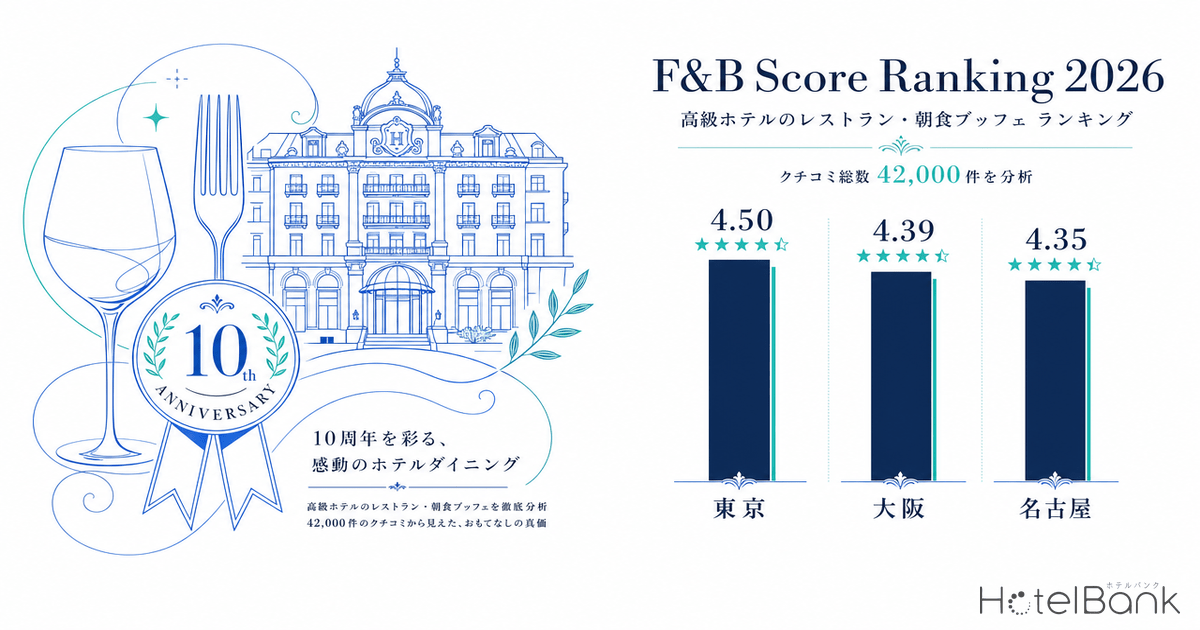
First, let us take a bird’s-eye view of how highly “dining” is rated across each city and grade combination. Tokyo’s luxury class leads with a dining-related score of 4.50 (N=13,858), followed closely by Osaka luxury at 4.39 and Nagoya/Aichi luxury at 4.35. Meanwhile, in the high-grade class, the scores are Tokyo 4.32, Osaka 4.38, and Aichi 4.19 — Tokyo does not necessarily hold the top position. Osaka’s high-grade segment benefits from large-scale properties near Universal City that boost breakfast ratings, revealing a structure that successfully captures family anniversary demand.
Source: MetroEngines Research, compiled by HotelBank Editorial Team (N=48,825 reviews, Jan 2023–Apr 2026)
A noteworthy common trend across all three cities is that “breakfast” scores generally exceed “dining (kaiseki, course meals, etc.)” scores. While full-course dinners and à la carte options might seem like the main attraction for anniversary stays, review data shows that the next morning’s buffet or dining breakfast is actually the primary battleground driving satisfaction. This aligns with the tendency of repeat guests aged 45–60 to “evaluate the entire stay experience.”
Top 15 Dining Rating Rankings (All Ages, All Travel Purposes)
From the 49 properties across three cities, we extracted the top 15 by FB Score (descending) among hotels with 100 or more dining-related category reviews. The leader is Palace Hotel Tokyo (パレスホテル東京) with an FB Score of 4.81 (N=398), followed closely by The Capitol Hotel Tokyu (ザ・キャピトルホテル東急) at 4.80 and Tokyo Station Hotel (東京ステーションホテル) at 4.76. Among Osaka properties, Hotel New Otani Osaka (ホテルニューオータニ大阪) leads the Kansai region at 4.60, while Nagoya Marriott Associa Hotel (名古屋マリオットアソシアホテル) tops the Tokai region at 4.62.
Source: MetroEngines Research, compiled by HotelBank Editorial Team (N=dining-related category reviews, Jan 2023–Apr 2026)
The top-ranked Palace Hotel Tokyo (パレスホテル東京) stands out with a near-perfect breakfast score of 4.93 (N=29). While the sample size is modest, the experiential value of dining at the breakfast venue overlooking Wadakura Fountain Park in Marunouchi significantly boosts review scores. Second-ranked The Capitol Hotel Tokyu (ザ・キャピトルホテル東急) in Nagatacho follows with a breakfast score of 4.84, making the luxury breakfast competition in central Tokyo a fierce battle at the 4.8 level.
| Rank | Hotel | Area | Breakfast | Dining | FB Overall | N |
|---|---|---|---|---|---|---|
| 1 | Palace Hotel Tokyo (パレスホテル東京) | Tokyo | 4.93 | 4.80 | 4.81 | 398 |
| 2 | The Capitol Hotel Tokyu (ザ・キャピトルホテル東急) | Tokyo | 4.84 | 4.79 | 4.80 | 286 |
| 3 | Tokyo Station Hotel (東京ステーションホテル) | Tokyo | 4.83 | 4.74 | 4.76 | 793 |
| 4 | Hotel Gajoen Tokyo (ホテル雅叙園東京) | Tokyo | 4.72 | 4.76 | 4.75 | 157 |
| 5 | Mandarin Oriental Tokyo (マンダリンオリエンタル東京) | Tokyo | 4.88 | 4.65 | 4.68 | 177 |
| 6 | The Okura Tokyo | Tokyo | 4.90 | 4.66 | 4.68 | 555 |
| 7 | Imperial Hotel Tokyo (帝国ホテル東京) | Tokyo | 4.75 | 4.60 | 4.62 | 808 |
| 8 | Nagoya Marriott Associa Hotel (名古屋マリオットアソシアホテル) | Nagoya | 4.71 | 4.57 | 4.62 | 712 |
| 9 | Shangri-La Hotel Tokyo (シャングリ・ラ ホテル 東京) | Tokyo | 4.79 | 4.60 | 4.62 | 221 |
| 10 | Hotel New Otani Osaka (ホテルニューオータニ大阪) | Osaka | 4.57 | 4.60 | 4.60 | 1,462 |
| 11 | Hotel Hankyu International (ホテル阪急インターナショナル) | Osaka | 4.68 | 4.54 | 4.57 | 752 |
| 12 | InterContinental Hotel Osaka (インターコンチネンタルホテル大阪) | Osaka | 4.68 | 4.53 | 4.57 | 174 |
| 13 | Hotel Chinzanso Tokyo (ホテル椿山荘東京) | Tokyo | 4.62 | 4.55 | 4.56 | 935 |
| 14 | The Peninsula Tokyo (ザ・ペニンシュラ東京) | Tokyo | 4.76 | 4.44 | 4.54 | 154 |
| 15 | Imperial Hotel Osaka (帝国ホテル大阪) | Osaka | 4.56 | 4.53 | 4.53 | 612 |
Dining Rating Rankings for the 40s–60s Anniversary Demographic
When narrowing the focus to the 40s–60s age group — the core anniversary demographic — the ranking order shifts in interesting ways. Limiting the analysis to reviews where the reviewer’s age tag is confirmed as “40s,” “50s,” or “60s,” and aggregating dining-related category scores, we obtain the results below. Due to sample size constraints, we filtered for 20 or more reviews, and the top names differ somewhat from the overall ranking.
Source: MetroEngines Research, compiled by HotelBank Editorial Team (limited to reviewers aged 40s–60s)
Taking first place in the 40s–60s category is Tokyo Station Hotel (東京ステーションホテル) at 4.77 (N=74). The sense of extraordinary atmosphere from the historic Marunouchi architecture, refined buffet breakfast, and direct station access wins the hearts of the senior anniversary demographic. Second-ranked Hotel Gajoen Tokyo (ホテル雅叙園東京) at 4.70 likely resonates with this generation through its Japanese-style design and kaiseki dining. Third-place Mitsui Garden Hotel Nihonbashi Premier (三井ガーデンホテル日本橋プレミア) at 4.63 is the only high-grade price tier property to crack the top 3, suggesting it is valued by the anniversary demographic for its cost-performance as well.
Notable is that three Kansai properties — Hotel New Otani Osaka (ホテルニューオータニ大阪) at 4.55, Imperial Hotel Osaka (帝国ホテル大阪) at 4.52, and Hotel Nikko Osaka (ホテル日航大阪) at 4.51 — all ranked within the top 10 for the 40s–60s score. Kansai’s major hotels tend to score higher among the 40s–60s demographic than across all ages, indicating a particularly strong foundation for capturing senior dining ratings. Nagoya Marriott Associa Hotel (名古屋マリオットアソシアホテル) also scored 4.58, placing it at TOP5 level and cementing its position as a go-to anniversary dining destination in the Tokai area.
Review Text “Dining” Mention Rate Rankings
Alongside category-specific scores, another important metric is “how frequently guests spontaneously mention food in the free-text body of their reviews.” Even if scores are high, if guests do not mention dining in their reviews, the property may not be perceived as having “dining as the centerpiece of the stay.” Conversely, a high mention rate can be interpreted as “many guests stay specifically for the food / the food is memorable.”
Source: MetroEngines Research, compiled by HotelBank Editorial Team (past year, dining-related keyword frequency in review text)
The top 3 by mention rate are Palace Hotel Tokyo (パレスホテル東京) at 25.3%, Tokyo Station Hotel (東京ステーションホテル) at 22.3%, and Hotel Chinzanso Tokyo (ホテル椿山荘東京) at 20.5%. Each contains dining-related vocabulary in over 20% of all reviews. This means more than 1 in 5 guests who stayed at these hotels spontaneously wrote about “breakfast…” or “dinner…” in their reviews. This suggests these properties are approaching a level of experiential value closer to “dining-destination hotels” rather than simply “hotels with restaurants.”
Among Osaka properties, Hotel New Otani Osaka (ホテルニューオータニ大阪) maintains the Kansai lead at 17.7%, while Hotel Kintetsu Universal City (ホテル近鉄ユニバーサル・シティ) reaches 21.8%, rivaling luxury properties despite its Universal City location. In Nagoya, Nagoya Kanko Hotel (名古屋観光ホテル) at 16.9% and Nagoya Marriott Associa Hotel (名古屋マリオットアソシアホテル) at 13.5% have established dining as a core strength.
Dining Experience Positioning Map: Score vs. Mention Rate
The dining score and mention rate are independent metrics. A hotel with high scores but low mention rates is a “silently excellent” type. Conversely, hotels with both high scores and high mention rates are the quintessential “anniversary dining” type — places where guests feel compelled to talk about the food. Plotting both axes reveals each hotel’s clear positioning.
Source: MetroEngines Research, compiled by HotelBank Editorial Team
The upper-right quadrant (FB Score 4.6+ x Mention Rate 15%+) contains the group that has established hotel dining as the core of anniversary demand. Palace Hotel Tokyo (パレスホテル東京), Tokyo Station Hotel (東京ステーションホテル), Hotel Gajoen Tokyo (ホテル雅叙園東京), Hotel Chinzanso Tokyo (ホテル椿山荘東京), Hotel New Otani Osaka (ホテルニューオータニ大阪), and Nagoya Marriott Associa Hotel (名古屋マリオットアソシアホテル) fall into this category. These six properties possess the “double asset” of being strong in both score and mention rate.
The upper-left quadrant (high score x low mention rate) includes The Capitol Hotel Tokyu (ザ・キャピトルホテル東急), Shangri-La Hotel Tokyo (シャングリ・ラ ホテル 東京), and Mandarin Oriental Tokyo (マンダリンオリエンタル東京). Their dining quality is top-tier, but reviews tend to devote more space to room and service evaluations — dining is not the center of the stay experience but rather part of a “comprehensively excellent” package.
2026 Mother’s Day / Father’s Day Restaurant Plan Trends
Among anniversary occasions, the second Sunday of May (Mother’s Day) and third Sunday of June (Father’s Day) represent the year’s largest revenue opportunities for hotel restaurants. Based on official information from various hotels, luxury properties in the Tokyo metropolitan area tend to offer packages combining “fixed-price dinner + flower bouquet gift + hotel-branded goods,” while Kansai properties emphasize “special garden-view seating + rose decorations.”
| Hotel | Plan Details (Summarized from Official Information) |
|---|---|
| Imperial Hotel Tokyo (帝国ホテル東京) | At qualifying restaurants including Les Saisons (French), KOJIRO (Japanese black wagyu), Kamon (Cantonese), and San Applause, guests who mention “Mother’s Day” or “Father’s Day” when reserving receive a carnation or original hotel logo goods. Available for limited periods in early May (Mother’s Day) and mid-June (Father’s Day). |
| Hotel New Otani Tokyo (ホテルニューオータニ東京) | Choose from four restaurants — VIEW & DINING THE SKY (revolving observation dining), Bella Vista (Italian), Sekishin-tei (Japanese), and Trader Vic’s (Polynesian) — for dinner-and-stay packages. A lunch plan with access to the Red Rose Garden featuring 30,000 roses is also a Mother’s Day staple. |
| Hotel Gajoen Tokyo (ホテル雅叙園東京) | Kaiseki and Japanese cuisine courses served in Japanese-style spaces adjacent to the nationally registered tangible cultural property “Hyakudan Kaidan” (Hundred Steps Staircase), with views of the Meguro River. Anniversary plans include a private room option. |
| The Ritz-Carlton Osaka (ザ・リッツ・カールトン大阪) | Recipient of the Forbes Travel Guide Five-Star award for four consecutive years as of 2026. Anniversary dinners at French restaurant “La Baie” and Italian restaurant “Splendido” are signature offerings. A special Mother’s Day afternoon tea is also available. |
| Imperial Hotel Osaka (帝国ホテル大阪) | Celebrated its 30th anniversary on March 15, 2026. Offers dinner set packages and cake-accompanied anniversary dinners for Mother’s Day and Father’s Day. |
| Nagoya Marriott Associa Hotel (名古屋マリオットアソシアホテル) | Family anniversary plans leveraging views from the 15th floor and above, directly atop JR Nagoya Station (from ¥15,000 per person, available year-round). The all-day dining restaurant “Pergola” also offers anniversary plans from ¥3,500. |
Comparing the offerings, Tokyo’s established luxury properties favor a “multiple restaurants x choice-based” approach, Kansai properties opt for “signature restaurant x garden/view staging,” and Nagoya properties lean toward “views x year-round anniversary plans” — differentiation aligned with each location’s characteristics. To capture anniversary demand, it is essential for each property to clearly articulate its strengths as a compelling narrative, and review data serves as a primary source providing the raw material for that narrative.
What Resonates with Anniversary Guests: The Diverging Ratings of Breakfast vs. Dinner
A key insight emerging from this analysis is the universal trend across all three cities’ top-tier hotels: “breakfast scores” exceed “dining scores (dinner, course meals, etc.).” While dinner full courses tend to be the showpiece of anniversary plans, it is actually the next morning’s dining experience that drives review satisfaction upward.
Specifically, the average breakfast score across the Top 15 is 4.78, while the average dining score is 4.62 — a gap of 0.16 points. On a 1–5 scale, this is a sufficiently significant difference, indicating that the “afterglow of the next morning” serves as the final determinant of satisfaction for anniversary guests. Put another way, no matter how perfect the dinner course experience, if the next morning’s breakfast buffet or à la carte is merely average, review scores are likely to plateau.
From a hotel operations perspective, this provides a significant implication for rethinking anniversary plan design. Beyond dinner glamour, incorporating elements that enhance the next morning’s breakfast experience — garden-view seat assignments, tableside chef egg service, local ingredient breakfast corners, and similar touches — deserves to be treated as the most important component in anniversary product design.
Conclusion: A Data-Driven Guide to Choosing Anniversary Hotel Dining
Aggregating approximately 42,000 category-level reviews across 49 properties in Tokyo, Osaka, and Nagoya reveals the contours of “hotels with strong dining” that meet anniversary demand. In overall FB Score, Palace Hotel Tokyo (パレスホテル東京), The Capitol Hotel Tokyu (ザ・キャピトルホテル東急), and Tokyo Station Hotel (東京ステーションホテル) lead, while when limited to the 40s–60s demographic, Tokyo Station Hotel (東京ステーションホテル), Hotel Gajoen Tokyo (ホテル雅叙園東京), and Mitsui Garden Hotel Nihonbashi Premier (三井ガーデンホテル日本橋プレミア) take the top spots.
In Kansai, Hotel New Otani Osaka (ホテルニューオータニ大阪), Hotel Hankyu International (ホテル阪急インターナショナル), and Imperial Hotel Osaka (帝国ホテル大阪) consistently achieve FB Scores above 4.5, maintaining a solid support base among the senior anniversary demographic. In Tokai, Nagoya Marriott Associa Hotel (名古屋マリオットアソシアホテル) earned a top-10 position, demonstrating its presence as a dining brand on par with Tokyo and Osaka.
For hospitality operators planning anniversary packages, this report’s data serves as a starting point for “quantitatively understanding your property’s strengths and growth areas by comparing FB Scores and mention rates against competitors.” The importance of breakfast ratings in particular is a perspective that has not been sufficiently discussed in the industry, and it can be leveraged in both product design and review acquisition strategy.
From the guest perspective as well, review scores represent “the aggregate of honest post-stay impressions” and are one of the most reliable guides for hotel selection. We hope this ranking serves as useful reference information for choosing “a night memorable down to the last meal” with someone special on an anniversary occasion.