

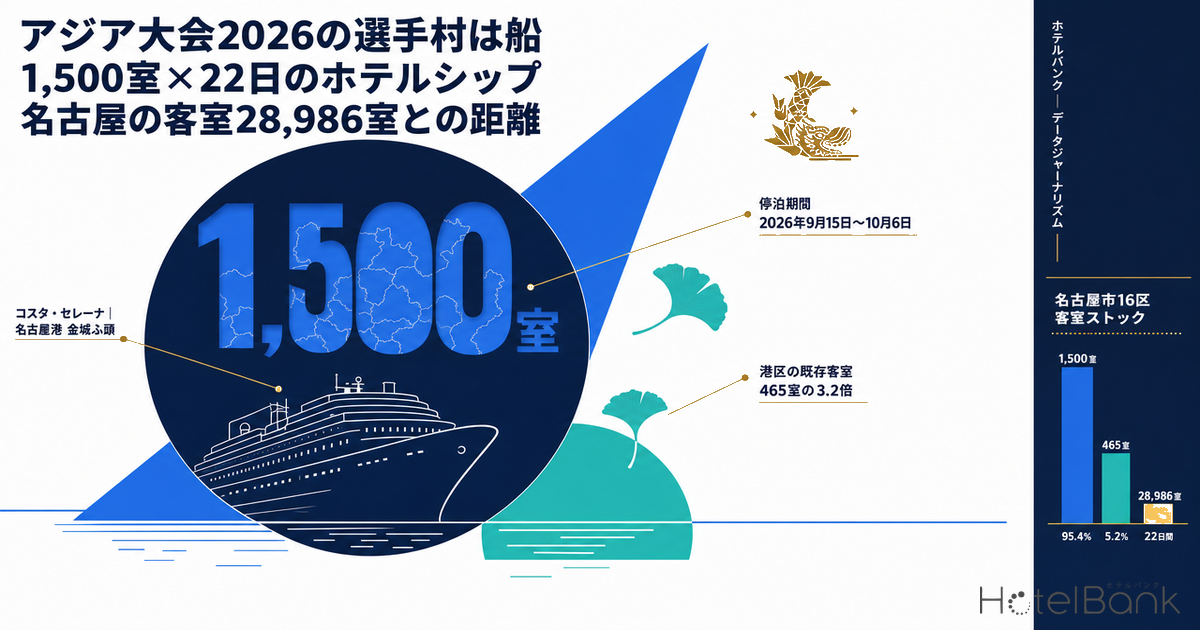
The Aichi-Nagoya 2026 Asian Games will not build a new athlete village. Instead, a cruise ship will be berthed at the Port of Nagoya for 22 days and combined with existing hotels to house the delegations. The ship provides 1,500 rooms — roughly 5.2% of the 28,986-room stock (212 properties) across Nagoya’s 16 wards, a block of capacity that will appear outside the market for the duration of the Games alone. This article works from primary sources — the organising committee’s contract documents and the Ministry of Land, Infrastructure, Transport and Tourism (MLIT) guidelines — to set out what a “hotel ship”, as a temporary form of room supply, actually does to a local room stock.
Metric Definitions Used in This Article
- Listed price: the publicly advertised selling price on OTAs and similar channels. Stated per room for two-person occupancy, tax included. In this article we take each property’s cheapest daily plan price and use the median across all covered properties as the “listed price (median of cheapest daily plans)”. It differs from the price actually transacted.
- OCC (occupancy): sold rooms as a share of total rooms in the area (an estimate based on OTA-listed inventory). Used as a macro aggregate at the prefectural level; it is not treated as the occupancy of any individual property.
- LT (lead time): days remaining until the check-in date. LT0 is the day itself; LT45 is 45 days before check-in.
- Room stock: the total rooms of lodging properties registered as operating, within the scope tracked by MetroEngines Research (as of August 2026). Properties not listed on OTAs are excluded.
- Data source: MetroEngines Research
- — No athlete village will be built. Master Plan Ver.2 states that accommodation will “make use of multiple existing lodging facilities rather than developing new ones”, so the decision to leave no permanent structure behind was locked in at the planning stage.
- — The cruise ship Costa Serena, with 1,500 rooms, will berth at Kinjo Pier in the Port of Nagoya for 22 days (15 September to 6 October 2026). The contract is worth ¥4.48bn (tax included) and was awarded by negotiated (non-competitive) contract.
- — Those 1,500 rooms equal 5.2% of the 28,986-room stock across Nagoya’s 16 wards, and 3.2 times the 465 existing rooms in Minato Ward, where the ship will berth. Temporary capacity appears exactly where supply is thinnest.
- — A hotel ship is not exempt from the Hotel Business Act. The moment it switches to mooring and charging for accommodation, it moves to the side that requires an operating licence (MLIT Guidelines Ver1.0).
- — The two Port of Nagoya sites absorb roughly 6,000 people, equivalent to about 3,000 hotel rooms (about 10.4% of the room stock). Even so, estimated occupancy at LT45 during the Games reaches 95.4% (20 September).
“No athlete village will be built” is written into the plan
Start with what is on the record. The “20th Asian Games (2026/Aichi-Nagoya) Master Plan Ver.2”, published by the organising committee in March 2024, opens section 2.4.1 “Delegation accommodation” as follows.
Delegation accommodation will make use of multiple existing lodging facilities and provide the necessary functions and services, rather than developing new facilities as previous Games have done.
The plan replaces the term “athlete village” with “delegation accommodation” in its definitions (Chapter 1), confirming at the planning stage that no permanent village will be built. On capacity, it states that “delegation accommodation will be appropriately provided for up to 15,000 athletes and team officials”, alongside a minimum of 2,000 rooms for the OCA family, up to 350 rooms for representatives of international and Asian sports federations, and a minimum of 3,000 places for media.
The Games’ own headcount assumptions appear in section 1.2 of the same plan. The event runs from Saturday 19 September to Sunday 4 October 2026. The ceilings are 15,000 delegation members (of whom up to 10,000 are athletes), 2,000 OCA family, 3,300 Games officials, 10,000 media and 28,000 volunteers. Most volunteers are presumably local residents, but even excluding them, accommodation demand on the order of 30,000 people concentrates in a single metropolitan area over 16 days.
What the contract says about the ship — 1,500 rooms, 22 days, ¥4.48bn
The specifics of the cruise ship appear in “Agenda Item 1: Hotel Ship Contract for the Aichi-Nagoya 2026 Asian Games”, released on 3 October 2025 as supplementary material to the organising committee’s 46th board meeting (held 28 July 2025). Transcribed from the original, the particulars are as follows.
| Item | Detail |
|---|---|
| Contract name | Aichi-Nagoya 2026 Asian Games Hotel Ship Contract |
| Vessel | Costa Serena (flag: Italy) |
| Total rooms | 1,500 |
| Gross tonnage / length | Approx. 114,000 tons / 290.2 m |
| Operator | Costa Cruises (headquartered in Italy) |
| Berth | Port of Nagoya, Kinjo Pier |
| Berthing period | 15 September to 6 October 2026 (22 days) |
| Contract value | ¥4,487,256,042 (tax included) |
| Contract method / counterparty | Negotiated contract / JTB Corp., Nagoya Business Division |
Source: Aichi-Nagoya Asian Games and Asian Para Games Organising Committee, “46th Board Meeting Supplementary Material (published 3 October 2025)”
Holding 1,500 rooms for 22 days amounts to 33,000 room-nights secured. Dividing the contract value straight through gives roughly ¥136,000 per room-night, but that figure should be read as covering the charter of the vessel plus onboard operations, crew payroll and food and beverage — the whole of hotel operations — so it is not comparable to a room rate. The reason for the negotiated contract is also stated in the original: JTB’s Nagoya Business Division is “the sole agent designated by the shipowner of the vessel in question”. Securing one specific ship narrows the counterparty to a single firm — a structural feature of this business model.
The ship is not being used on its own. According to the topic release “Establishment of delegation accommodation bases at Garden Pier, Port of Nagoya”, published by the organising committee on 28 January 2025, two bases of different character will be set up at the port.
| Base | Accommodation type | Capacity | Co-located functions |
|---|---|---|---|
| Port of Nagoya, Garden Pier | Mobile lodging units | Approx. 2,000 people | Delegation headquarters, NOC/NPC service centre, etc. |
| Port of Nagoya, Kinjo Pier | Cruise ship | Approx. 4,000 people | Main media centre and competition venues in the same area |
| Total | — | Approx. 6,000 people | For delegations competing at Nagoya city venues |
Source: Aichi-Nagoya Asian Games and Asian Para Games Organising Committee, “Topics (28 January 2025)”
Mobile lodging units are described as “container-sized housing facilities and equipment that can be readily moved by trailer or ship”, and the committee presents their conversion to hotels in normal times, or to emergency temporary housing after a disaster, as a legacy of the Games. Note that the Asian Para Games will use Garden Pier only; the cruise ship is specific to the Asian Games.
A hotel ship is not “outside” the Hotel Business Act — it is on the side that needs a licence
This point is widely misunderstood, so it is worth going back to the source. The “Guidelines on the Use of Cruise Ships as Hotels Ver1.0”, published in October 2019 by the Industrial Ports Division of MLIT’s Ports and Harbours Bureau, defines a hotel ship as “the use of a cruise ship as a hotel over a fixed period”, and describes the treatment under the Hotel Business Act as follows.
Ships, including cruise ships, are originally intended primarily to carry cargo and passengers while moving between ports, with accommodation as an incidental activity, and are therefore not subject to the Hotel Business Act during normal cruise operations. In the case of a hotel ship, however, the cruise ship is moored for a fixed period, serves only non-cruise passengers and operates a business of accommodating people for a fee — so from the standpoint of providing accommodation services, an operating licence under the Hotel Business Act is required.
So it is not that “being a ship places it outside the Hotel Business Act”. While the ship is under way it is out of scope; the moment it moors and switches to a business of accommodating guests for a fee, it moves to the side that requires a licence. The guidelines add that operators “need to consult the relevant public health centre in advance regarding the application of the Hotel Business Act in light of the structure, equipment and crew complement (including qualifications) of the cruise ship during normal cruise operations”.
There is an exception. The same guidelines state explicitly that the Hotel Business Act does not apply where no accommodation charge is received from users — including charges for rest, bedding hire, utilities or room cleaning that are substantively fees for the use of bedding or the room — as in the case of incentive travel. Whether the Act applies turns on who receives what from whom, which means the design of the business scheme itself determines the legal treatment.
The history behind this question can also be traced through primary sources. According to a City of Yokohama press release (17 May 2018), the city proposed in December 2017 that “exemption from the Hotel Business Act for hotel ship operations” be added to the deregulation menu of the National Strategic Special Zones. What was actually issued, however, was not an exemption but a Ministry of Health, Labour and Welfare notice easing the treatment of windowless guest rooms within the framework of the Hotel Business Act (notice Yakusei-Ei-Hatsu 0516 No. 4, dated 16 May 2018). The notice’s conditions are: the vessel must be a passenger ship normally used to carry passengers and cargo; windowless rooms must account for roughly 40% or less of the total; substitute equipment such as lighting and ventilation must be in place; guests must be informed at the time of booking that the room is windowless; and use must be limited to the event period (including a few days either side). A proposal seeking exemption landing instead as a time-limited operational easing captures neatly how this mechanism is not a permanent means of adding room supply.
You cannot berth just anywhere — the six conditions a pier must meet
Having a ship is not sufficient either. MLIT’s “Report on the organisation of issues in using cruise ships as hotels” sets out six considerations when assessing piers that could host a hotel ship. Because long-term mooring is assumed, the requirements differ from those of an ordinary cruise call.
| Consideration | What is required |
|---|---|
| Port facility specifications | Sufficient water depth, quay length and similar specifications for safe mooring |
| Coordination with port stakeholders | Agreement with other vessels and port users so that long-term mooring is possible |
| Transport access | Transfer space and passenger flow lines within the pier, plus access to the nearest station and to competition venues |
| Water supply and waste handling | Water supply, refuse and sewage treatment facilities available on the pier operator’s side |
| Security measures | Access control for the SOLAS-designated restricted area and associated safety measures |
| Emergency and disaster response | Secured evacuation routes and communication arrangements for fire, earthquake, tsunami and similar events |
Source: compiled by the HotelBank Editorial Team from MLIT, “Report on the organisation of issues in using cruise ships as hotels”
The guidelines themselves go further, listing as “basic items to confirm” the physical work needed to open — such as connecting pipelines to discharge sewage — the terminal space required for check-in at embarkation and disembarkation, and securing access to the nearest station and to venues. A hotel ship is better understood not as chartering a ship but as installing temporary hotel infrastructure on a pier. On how cruise calls themselves connect to accommodation demand in port cities, our analysis counting the capacity at Japan’s top 10 ports is a useful reference.
Where do the ship’s 1,500 rooms sit against Nagoya’s 28,986?
From here we measure the scale with our own data. Within the scope tracked by MetroEngines Research, lodging properties located in Nagoya’s 16 wards and registered as operating number 212 properties with 28,986 rooms (as of August 2026). For Aichi Prefecture as a whole the figures are 617 properties and 49,122 rooms. By ward, Naka (91 properties, 15,148 rooms) and Nakamura (69 properties, 9,673 rooms) alone account for 85.6% of Nagoya’s rooms — an extremely concentrated distribution.
Source: MetroEngines Research (Nagoya’s 16 wards, 212 operating properties / 28,986 rooms, as of August 2026) and the organising committee’s hotel ship contract material
Placing the ship’s 1,500 rooms into that distribution makes its position clear. The 1,500 rooms equal 5.2% of Nagoya’s room stock and would rank as the third-largest “ward” behind Naka and Nakamura. That is roughly double the rooms in inner-fringe wards such as Nishi (789 rooms) or Higashi (727 rooms).
The contrast with the berth location is more telling still. Minato Ward, home to both Kinjo Pier and Garden Pier, has just 6 properties and 465 rooms. The ship’s 1,500 rooms are 3.2 times every existing room in the ward combined. In other words, a hotel ship works as a mechanism that makes more than three times the existing stock appear, for 22 days only, in the place where lodging supply is thinnest. Given that competition venues and the main media centre sit in the same Kinjo Pier area, the design reads as bringing venue functions and accommodation functions together into a lodging vacuum.
Source: MetroEngines Research (173 properties with 30 or more rooms, 28,405 rooms, across Nagoya’s 16 wards, plotted)
On the map, existing rooms cluster inland around Nagoya Station and Sakae, while the port side is close to empty. Fill that gap with permanent facilities and rooms with no demand behind them remain after the Games. Fill it with a ship and mobile units and it disappears when the Games end. The decision not to build an athlete village is a cost-containment story, but it is equally a supply-side judgement about not creating post-Games oversupply.
How many rooms would have left the market had the ship not absorbed them?
Treating a hotel ship as an addition to room supply invites misreading. The ship’s 1,500 rooms are not sold to the public; they are closed inventory secured by the organising committee for the delegations. Their effect on the market runs not in the direction of “supply increases” but of “demand leaves the market”.
Here is the arithmetic.
■ Calculation assumptions
- Capacity of the two Port of Nagoya bases: approx. 6,000 people (organising committee figure)
- People per room if shifted to hotels: 2 (assuming two-person occupancy)
- Room stock for comparison: 28,986 rooms across Nagoya’s 16 wards (MetroEngines Research, as of August 2026)
→ 6,000 people ÷ 2 per room = approx. 3,000 rooms, equivalent to about 10.4% of the room stock across Nagoya’s 16 wards.
This is a simple substitution calculation. In practice some sports allocate delegations one person per room as standard, and team officials are roomed differently again. As an order-of-magnitude sense, though, it is worth registering that the two Port of Nagoya bases are handling demand equivalent to roughly a tenth of Nagoya’s rooms outside the market. Had those 6,000 people instead flowed into ordinary lodging properties, rooms in Nagoya during the Games would have been tighter still than current expectations suggest.
And even so, the market is tight. Looking at the booking curve for Aichi Prefecture as a whole, inventory on Games dates is being taken up at levels unlike a normal year.
Source: MetroEngines Research (Aichi Prefecture, estimates at LT45. Observed properties N=483-532)
Comparing on the same cross-section of 45 days before check-in (LT45), Saturday 12 September before the Games sits at 75.7%, while Sunday 20 September during the Games reaches 95.4%, Saturday 26 September 95.1% and Saturday 19 September 93.0%. At LT45 on 20 September, 2,355 rooms remained available across Aichi Prefecture — the ship’s 1,500 rooms are more than 60% of that remaining inventory. Within the Games period there is still spread: Wednesday 23 September (a public holiday) is at 87.7% and Saturday 3 October at 88.8%, so differences by date persist.
Listed price levels point the same way. Taking each property in Nagoya’s 16 wards, deriving its cheapest daily plan price and tracking the median, the outline of the Games period appears directly in price.
Source: MetroEngines Research (Nagoya’s 16 wards, median of cheapest daily plan prices. Properties covered N=93-119 per day; listed prices as of August 2026)
Weekdays before the Games run broadly between ¥9,800 and ¥11,000, while the opening day, Saturday 19 September, is at ¥26,000 and Sunday 20 September at ¥26,400 — more than double. Comparing Saturdays against Saturdays, ¥17,900 on 5 September and ¥17,500 on 12 September before the Games give way to ¥26,000 on 19 September and ¥26,100 on 26 September during the Games, over 40% higher. By Monday 5 October, the day after the closing ceremony, prices are back to ¥11,800, which confirms in outline that the bulge in this price band is driven by Games demand. The ship’s berthing period, 15 September to 6 October, overlaps almost exactly with that bulge.
How this differs from Tokyo 2020 — the planned hotel ships never happened
Hotel ships are not a new idea. MLIT’s guidelines were themselves compiled as the output of a subcommittee established under the “Inter-ministerial Liaison Meeting on Immigration for the Tokyo 2020 Olympic and Paralympic Games”, so the regulatory groundwork advanced with Tokyo 2020 in mind. Yokohama’s National Strategic Special Zone proposal and the Ministry of Health, Labour and Welfare’s notice on windowless rooms belong to the same sequence.
At Tokyo 2020, however, the hotel ships planned at several ports in the greater Tokyo area were never implemented. The Games were postponed to 2021 and held almost entirely without spectators, which removed the very premise of the accommodation demand. The rules were in place and commercialisation had progressed to the point of readiness, yet no track record of implementation remains.
| Item | Tokyo 2020 | Aichi-Nagoya 2026 |
|---|---|---|
| Athlete village | Newly built at Harumi (converted to condominiums after the Games) | Not newly built. Existing lodging facilities used |
| Positioning of the hotel ship | Conceived as a private-sector product for spectators and Games-related visitors | Contracted directly by the organising committee as delegation accommodation |
| Implementation status | Not implemented, owing to postponement and spectator-free staging | Contract terms published in October 2025 |
| Regulatory groundwork | Windowless-room notice (2018), guidelines issued (2019) | Uses the existing regulatory framework |
Source: compiled by the HotelBank Editorial Team from published materials of MLIT, the City of Yokohama, and the Aichi-Nagoya Asian Games and Asian Para Games Organising Committee
The practical implication of the comparison is straightforward. A hotel ship only moves when three independent conditions hold at once — a contract with the shipowner, a pier able to receive the vessel, and the various permits including those under the Hotel Business Act — and it depends further on the format in which the Games themselves are held. That Aichi-Nagoya 2026 resolved the contract at its July 2025 board meeting and published the particulars in October marks meaningful progress for this kind of undertaking.
What lodging operators should take from this
Bringing the hotel ship option back to your own operating environment, there are three points worth holding onto.
First, temporary supply does not add inventory to the market. The ship’s 1,500 rooms are closed inventory secured by the organising committee, not a destination for general accommodation demand. From the market’s side, the meaning is that demand from 6,000 people never reached the open market. Put the other way, supply and demand in Nagoya during the Games is being observed net of those 6,000 people. The fact that only 2,355 rooms remained across Aichi at LT45 on 20 September rests on that premise.
Second, a supply vacuum near a venue is not a case for permanent investment. Minato Ward having only 465 rooms is not a condition that a one-off event corrects. Once the ship and the mobile units are withdrawn after 22 days, the ward’s room stock returns to its original 465. Any decision to add rooms on the strength of an event needs separate verification against normal demand once the event is over. Reading this alongside our analysis of new supply pressure measured against existing stock makes the outline easier to grasp.
Third, demand does not stay inside Nagoya. Against the city’s 28,986 rooms, delegations, Games officials and media alone move around 30,000 people. Even with the two Port of Nagoya bases absorbing roughly 6,000, the remainder disperses to hotels elsewhere in Aichi and in neighbouring prefectures. Indeed, the spread of Games-period demand beyond Nagoya shows up in the occupancy cross-section for Toyohashi, Kuwana and other surrounding cities. The further a property sits from the venues, the more it is now a question of judging from its own booking pace when, and how large, the wave arrives.
⚠ A note on forward-dated data: the listed prices and estimated occupancy for September-October 2026 discussed here are estimates based on selling inventory published on OTAs at the time of research (August 2026), and they shift as the check-in date approaches. Please bear in mind both that prices currently set high may fall through last-minute adjustment, and that inventory may return as new plans are added. The ship’s berthing period and capacity likewise reflect the organising committee’s disclosures as of publication and may change with future operational decisions.
Frequently asked questions
Q. Is a hotel ship exempt from the Hotel Business Act?
A. No. MLIT’s guidelines state that while cruise ships are outside the scope of the Hotel Business Act during normal operations, an operating licence under the Act “is required” where the ship is moored for a fixed period and operates a business of accommodating people for a fee. That said, formats in which no accommodation charge is received (incentive travel, for example) are treated as outside the Act, so the treatment changes with the business scheme.
Q. Can the ship’s 1,500 rooms be booked by the general public?
A. This cruise ship was secured by the organising committee as delegation accommodation and, on the published materials, is not positioned as room supply for the general public.
Q. What happens to the rooms at the port once the Games end?
A. The cruise ship’s berthing period ends on 6 October 2026. For the mobile lodging units, the organising committee presents their use as hotels and similar facilities in normal times, or as emergency temporary housing after a disaster, as a legacy of the Games.
Related Reading
- Asian Games 2026: Toyohashi +18.7pt, Kuwana +14.4pt Beyond Nagoya
- Asian Para Games 2026: Aichi Weekdays Run 12pt Above the Next Week
- Hotel Category Mix Explains Half of City ADR: 34 Municipalities
- Record 3,117 Cruise Calls: Hotel Capacity at Japan’s Top 10 Ports
- World Masters Games 2027 Kansai: 164,707 Rooms Across 50 Venue Cities
- Aichi Settled ADR 18 Months: City Swings 25.0pt, Business 14.0pt
References and Sources
■ Data sources
The Games parameters — the athlete village policy, dates, intake scale, hotel ship contract particulars and the capacity of the accommodation bases — are taken directly from the original text of the organising committee’s Master Plan Ver.2, the supplementary material to its 46th board meeting, and its topic releases. The regulatory summary draws on MLIT’s guidelines and its report on the organisation of issues, together with the City of Yokohama’s press release. Room stock (212 properties / 28,986 rooms across Nagoya’s 16 wards and 617 properties / 49,122 rooms in Aichi Prefecture, as of August 2026), the median of cheapest daily plan prices (N=93-119 properties per day), and estimated occupancy and remaining rooms at LT45 (observed properties N=483-532) are aggregated data from MetroEngines Research. The map plots only the 173 properties with 30 or more rooms, totalling 28,405 rooms.
■ Limitations and caveats
(1) September-October 2026 are future dates, so both listed prices and estimated occupancy are estimates derived from selling inventory published on OTAs at the time of research (August 2026). As check-in approaches, both price adjustment and a return of inventory through newly added plans can occur. (2) Estimated occupancy is a macro estimate based on the take-up of listed inventory, not the realised occupancy of individual properties. Because the number of observed properties varies by date (N=483-532), differences between dates also contain differences in the underlying sample. (3) Room stock is limited to properties listed on OTAs and identifiable as operating; unlisted properties are excluded. (4) The “approx. 3,000 rooms” figure in this article is a simple substitution calculation dividing capacity by two people per room, and does not reflect actual delegation rooming (some sports use one person per room). (5) The ship’s berthing period, capacity and contract terms are as disclosed by the organising committee at the time of publication and may change with future operational decisions.
■ Organising committee publications (primary sources)
- Agenda Item 1: Hotel Ship Contract for the Aichi-Nagoya 2026 Asian Games (Aichi-Nagoya Asian Games and Asian Para Games Organising Committee, 46th board meeting supplementary material, published 3 October 2025)
- 20th Asian Games (2026/Aichi-Nagoya) Master Plan Ver.2 (March 2024)
- Establishment of delegation accommodation bases at Garden Pier, Port of Nagoya, for the 20th Asian Games and 5th Asian Para Games (organising committee topics, 28 January 2025)
- Organising committee meetings (list of board and councillors’ meeting materials)
■ Government and municipal publications
- MLIT, Ports and Harbours Bureau, Industrial Ports Division, “Guidelines on the Use of Cruise Ships as Hotels Ver1.0” (October 2019)
- MLIT, “Report on the organisation of issues in using cruise ships as hotels”
- City of Yokohama press release, “Momentum builds towards realising hotel ships — a notice easing Hotel Business Act regulation has been issued” (17 May 2018)
- Ministry of Health, Labour and Welfare, Pharmaceutical Safety and Environmental Health Bureau, Environmental Health Division Director’s notice, “Treatment of windowless guest rooms in lodging facilities using passenger-cabin vessels” (notice Yakusei-Ei-Hatsu 0516 No. 4, dated 16 May 2018)
■ Market data
- MetroEngines Research — room stock across Nagoya’s 16 wards (212 properties / 28,986 rooms, as of August 2026), room stock in Aichi Prefecture (617 properties / 49,122 rooms), daily listed prices across Nagoya’s 16 wards (N=93-119 properties per day), and estimated occupancy and booking curve for Aichi Prefecture (N=483-532 properties)