

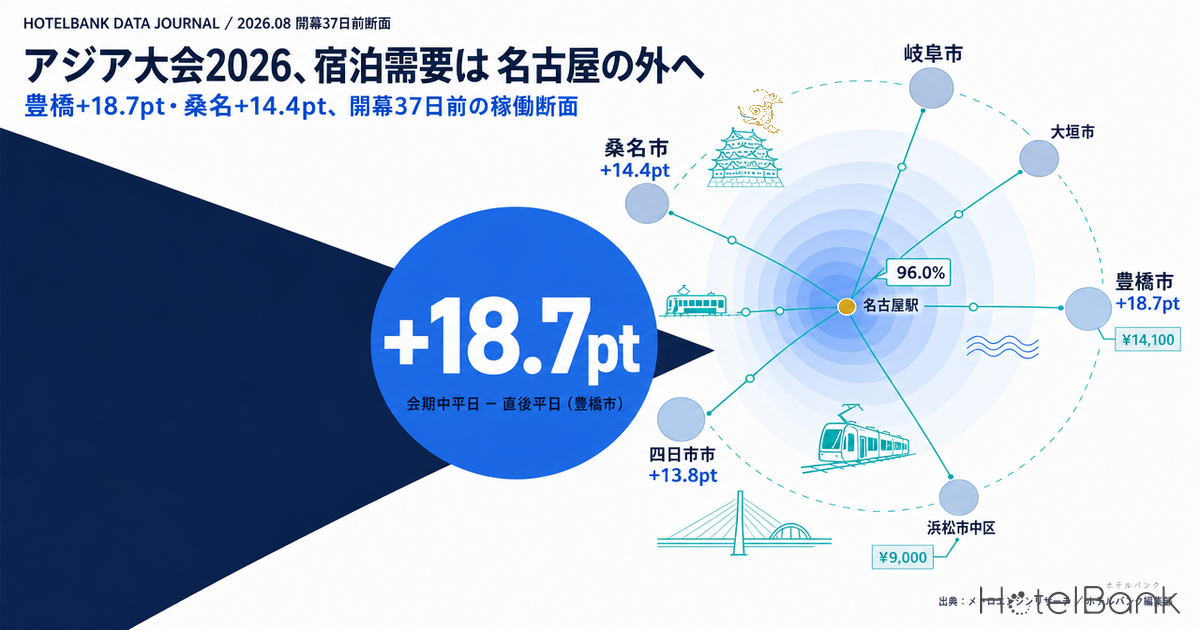
The 20th Asian Games (September 19 – October 4, 2026) brings 45 nations and regions to Japan for the first host in 32 years. Competition is centred on Nagoya but spread across 45 venues in Aichi plus 3 in Gifu, 3 in Shizuoka, 1 in Osaka and 2 in Tokyo. Lodging demand behaves the same way — it does not stop at the Nagoya city line. This article reads inventory data as of mid-August 2026, 37 days before the opening, at municipality granularity, and quantifies what is happening in the seven cities “outside Nagoya”: Gifu, Ogaki, Kakamigahara, Kuwana, Yokkaichi, Toyohashi and Hamamatsu.
Metric Definitions Used in This Article
- ADR (average daily rate): an estimated settled rate (tax-exclusive equivalent) derived by applying category-specific adjustment factors to each property’s lowest published plan level on OTAs and similar channels (2 guests per room, per-room price, tax-included). Cross-checked against per-property results disclosed by listed hotel REITs (91 properties, most recent 3 months), the median error is approximately 7%. These are estimates and differ from each property’s actual transacted prices or accounting figures. Area-level ADR is the median of the properties covered (the level of a typical property in that area).
- OCC (occupancy): the share of rooms sold against total rooms in the area (an estimate based on OTA-published inventory). In this article it is used only as a macro aggregate at municipality level; occupancy for individual properties is not calculated. It is an estimate based on how OTA-published inventory is being taken up, and differs from a property’s true overall occupancy.
- LT (lead time): days remaining until check-in. LT0 = same day. Occupancy in this article is calculated on a snapshot in which every date compared is aligned to the same lead time, 59 days before check-in (LT59). This removes the effect of different dates being at different stages of booking progress.
- Listed price: the average of all plans published on OTAs (2 guests per room, per-room price, tax-included). Because cheaper plans sell out first as inventory is taken up, the average is pushed upward in phases where occupancy is rising.
- Data source: MetroEngines Research
- — Toyohashi +18.7pt, Kuwana +14.4pt — estimated occupancy on weekdays during the Games ran double-digit points above weekdays immediately after the Games, even in the seven cities outside Nagoya (same-lead-time LT59 snapshot).
- — The spillover reaches Mie, which has no venue — Kuwana 78.6%, Yokkaichi 71.5%. This is explained not by a venue effect but by Nagoya-area lodging demand crossing the prefectural border.
- — The boundary is “50 minutes by rail” — Naka Ward, Hamamatsu, 30–45 minutes away by Shinkansen, stopped at +2.0pt. What sets the range of the spillover is the local-line distance a traveller can cover round-trip at no extra fare.
- — Business hotels are what is moving — Kuwana +26.0pt, Ogaki +22.4pt and Gifu +21.8pt all show an uplift wider than their city-wide average.
- — Yokkaichi has room on price — occupancy is up 13.8pt while the listed price is −2.7%. Estimated settled ADR for the Games month runs ¥9,000–¥14,100 across the surrounding cities, ¥4,700–¥9,800 below Nakamura Ward, Nagoya at ¥18,800.
The roughly 6,000 athletes sit outside general room inventory — first, separate the population
Before reading the market data, one premise needs to be settled. The organisers dropped the originally planned dedicated athletes’ village and will instead house delegations at two sites in the Port of Nagoya. Temporary mobile accommodation units (roughly 70 m² × 200 units) are being set up at Garden Pier, and the cruise ship Costa Serena will be berthed at Kinjo Pier. The ship is about 290 metres long with roughly 1,500 cabins and is planned to serve as a lodging base for a cumulative total of about 4,000 people over the 22 days from September 15 to October 6. Together the two sites are expected to accommodate roughly 6,000 people.
In other words, most athletes and team officials sit outside the room inventory sold to the general public on OTAs. The occupancy and price figures discussed here concern supply and demand for rooms that ordinary travellers can book, and the demand is carried mainly by spectators, Games officials, media, sponsors and support staff accompanying pre-Games training camps. Adding the size of the delegations straight onto hotel demand is not a valid reading, and that should be stated up front.
| Site | Type | Scale | Period |
|---|---|---|---|
| Port of Nagoya, Garden Pier | Temporary mobile accommodation units | Approx. 70 m² × 200 units | During the Games |
| Port of Nagoya, Kinjo Pier | Cruise ship Costa Serena | Approx. 1,500 cabins / approx. 4,000 people cumulative | Sep 15 – Oct 6 (22 days) |
| Two sites combined | Delegation lodging bases | Approx. 6,000 people | — |
Source: compiled by the HotelBank Editorial Team from the Aichi-Nagoya Asian Games and Asian Para Games Organising Committee, City of Nagoya public materials and press reports
Venues are spread across five prefectures — mapping the geography “outside Nagoya”
Venue placement is another condition that shapes how demand spreads. Within Aichi, venues are distributed widely beyond Nagoya — Toyohashi, Okazaki, Ichinomiya, Toyota, Kasugai, Tokoname and others. Outside the prefecture there are three venues in Gifu (Gifu City: women’s football, Nagaragawa Stadium; Kakamigahara: hockey, Gifu Prefectural Green Stadium; Kaizu: rowing, Nagaragawa International Regatta Course) and three in Shizuoka (Hamamatsu: artistic swimming, Hamamatsu Municipal Furuhashi Hironoshin Memorial Swimming Pool; Fukuroi; Izu: track cycling).
By contrast, Mie has no competition venue. Kuwana and Yokkaichi sit as pure lodging catchments rather than host cities. That is convenient for telling apart the nature of the demand spillover: it lets us observe separately whether rooms fill because a venue is nearby, or because Nagoya’s lodging demand overflows.
Source: MetroEngines Research; compiled by the HotelBank Editorial Team
Circle size represents the number of rooms visible on OTAs; colour intensity represents the gap in estimated occupancy between weekdays during the Games and weekdays immediately after. Dashed lines mark approximate 30 km and 60 km radii from Nagoya Station.
The occupancy snapshot at T-37 — Games weekdays run up to 20pt above the week just after
This is the core of the analysis. For every check-in date from September 7 to October 10, estimated occupancy was calculated at municipality level on a common lead time (LT59). The purpose is to strip out differences in observation timing between dates so that the Games period and the normal weeks on either side can be compared side by side.
Source: MetroEngines Research; compiled by the HotelBank Editorial Team
Naka Ward, Nagoya (92 properties and 17,257 rooms visible on OTAs) holds consistently above 85% from September 19 to October 3, reaching 96.0% on September 26. Immediately after the Games, October 5–9 falls back to 66.4–73.5%. A step of roughly 20 points separates the Games period from a normal week.
What deserves attention is that this step does not stop at the Nagoya city limits. Toyohashi averages 88.6% on weekdays during the Games, 18.7 points above the 69.9% of weekdays immediately after. Kuwana is 78.6% against 64.2% for 14.4 points, Yokkaichi 71.5% against 57.7% for 13.8 points, Gifu 80.5% against 67.1% for 13.4 points, and Ogaki 67.2% against 50.0% for 17.2 points. Set against 20.2 points in Naka Ward and 19.3 points in Nakamura Ward, the uplift in the surrounding cities is by no means small.
Source: MetroEngines Research; compiled by the HotelBank Editorial Team
| City | Venue | From Nagoya Sta. (rail, approx.) |
On OTAs properties / rooms |
Weekdays before Sep 7–11 |
SW Sep 19–23 |
Games weekdays Sep 24 – Oct 2 |
Weekdays after Oct 5–9 |
Games − after |
|---|---|---|---|---|---|---|---|---|
| Naka Ward, Nagoya(reference) | Yes | — | 92/17,257 | 68.8% | 91.3% | 89.6% | 69.4% | +20.2pt |
| Nakamura Ward, Nagoya(reference) | Yes | — | 69/11,776 | 66.4% | 91.2% | 87.2% | 67.9% | +19.3pt |
| Toyohashi | Yes | Approx. 50 min (Shinkansen approx. 25 min) | 18/2,262 | 59.7% | 91.0% | 88.6% | 69.9% | +18.7pt |
| Ogaki | — | Approx. 30 min | 12/1,080 | 43.1% | 81.2% | 67.2% | 50.0% | +17.2pt |
| Kuwana | — | Approx. 20 min | 20/1,389 | 70.5% | 87.7% | 78.6% | 64.2% | +14.4pt |
| Yokkaichi | — | Approx. 30 min | 26/2,557 | 59.1% | 76.3% | 71.5% | 57.7% | +13.8pt |
| Gifu | Yes | Approx. 20 min | 32/2,626 | 62.2% | 83.4% | 80.5% | 67.1% | +13.4pt |
| Naka Ward, Hamamatsu | Yes | Shinkansen approx. 30–45 min (local lines approx. 2 hr) | 36/4,648 | 61.2% | 67.2% | 64.3% | 62.3% | +2.0pt |
| Kakamigahara(reference) | Yes | Approx. 40 min | 4/339 | 61.3% | 88.2% | 82.1% | 56.2% | +25.9pt |
All periods are calculated on a common LT59 snapshot (59 days before check-in). SW = Silver Week. The seven cities outside Nagoya total 148 properties and 14,901 rooms within the range visible on OTAs. Observed property counts per date range: Naka Ward, Nagoya 70–91; Nakamura Ward, Nagoya 49–65; Toyohashi 15–18; Gifu 22–32; Yokkaichi 19–26; Kuwana 11–20; Naka Ward, Hamamatsu 32–36; Ogaki 7–11; Kakamigahara 2–4. Kakamigahara has few observed properties and is treated as a reference value.
Source: MetroEngines Research; compiled by the HotelBank Editorial Team
Separating the Silver Week overlap from the Games period
There is one awkward condition when reading supply and demand for these Games. The five days from the opening on Saturday September 19 through Wednesday September 23 (Autumnal Equinox Day) coincide exactly with Silver Week. The occupancy rise over that stretch cannot simply be labelled a Games effect.
This article therefore splits the window into four: weekdays just before (Sep 7–11), SW (Sep 19–23), weekdays during the Games (Sep 24–25 and Sep 28 – Oct 2), and weekdays immediately after (Oct 5–9). Comparing Games weekdays with Silver Week excluded against the weekdays right after the Games end reveals the shape of demand with the holiday factor stripped out.
The result is clear. Naka Ward, Nagoya reaches 91.3% during Silver Week, and once the holiday ends the Games weekdays still hold 89.6% — a fall of only 1.7 points. Toyohashi likewise slips just 2.4 points, from 91.0% to 88.6%. Levels holding after the holiday ends shows that the rise cannot be explained by holiday demand alone. Against the weekdays just before (Sep 7–11), meanwhile, the gap is 20.8 points in Naka Ward, Nagoya, 28.9 points in Toyohashi and 24.1 points in Ogaki.
In some cities, conversely, the Silver Week gain does not carry through to Games weekdays. Ogaki climbs to 81.2% during Silver Week but returns to 67.2% on Games weekdays, a 14.0-point drop. The natural reading is that holiday leisure demand and Games-related stays are mixed in different proportions from city to city. On how bookings for the holiday itself were progressing, Silver Week 2026 Back Half at T-47 sets it out on a fixed T-47 snapshot.
Demand is reaching Mie, which has no venue — Kuwana +14.4pt, Yokkaichi +13.8pt
The most telling movement is in the Hokusei area of Mie. As noted, no competition venue is sited in Mie. Even so, Kuwana runs 78.6% on Games weekdays, 14.4 points above the weekdays immediately after, and Yokkaichi 71.5%, up 13.8 points. There is little explanation other than Nagoya-area lodging demand flowing across the prefectural border rather than any venue effect.
Kuwana is roughly 20 minutes from Nagoya Station by rail and Yokkaichi roughly 30. That is little different from travelling between central Nagoya and another ward, which makes both easy to consider as places to stay. Kuwana was already at 70.5% on the weekdays just before, the highest level among the surrounding cities. Adding 14.4 points on top of that reads as event demand landing on a market with underlying strength.
Turn to price and a contrasting picture emerges. Comparing listed price (the average of all plans) on the same lead-time snapshot between Games weekdays and the weekdays immediately after, Naka Ward, Nagoya opens up +103.3%, Nakamura Ward +82.7% and Toyohashi +41.9%, while Kuwana stops at +11.6% and Yokkaichi at −2.7%. Yokkaichi’s listed price is essentially the same as a normal week even though occupancy is 13.8 points higher.
Source: MetroEngines Research; compiled by the HotelBank Editorial Team
For hotels in Yokkaichi this is straightforwardly a revenue opportunity. Inventory being taken up faster than a normal week with 37 days still to go means the remaining inventory beyond that point does not have to be sold at normal-week pricing. Demand of a different character is being layered onto weekdays during the Games — the slots normally filled by business travel. There is ample room to build in staged pricing.
What Hamamatsu’s +2.0pt shows — the spillover follows everyday rail distance, not Shinkansen speed
There is another instructive contrast. Naka Ward, Hamamatsu records 64.3% on Games weekdays against 62.3% immediately after — a gap of only 2.0 points. The listed-price gap of +2.3% is likewise almost unmoved.
Hamamatsu is a host city. Artistic swimming runs September 26–28 at the Hamamatsu Municipal Furuhashi Hironoshin Memorial Swimming Pool. Estimated occupancy on September 26 is indeed 78.1%, higher than surrounding dates, so the venue effect itself is observable. Even so it does not translate into a lift across the whole Games period.
Nagoya to Hamamatsu is 30–45 minutes on the Tokaido Shinkansen, which on time alone is not far off Toyohashi (about 25 minutes by Shinkansen). Yet Toyohashi came in at +18.7 points and Hamamatsu at +2.0. The natural explanation is connectivity on local lines. Toyohashi is about 50 minutes from Nagoya on the JR Special Rapid Service, a trip that can be made back and forth routinely at no extra fare. Hamamatsu on local lines alone takes roughly two hours, and each round trip otherwise means paying a Shinkansen limited-express supplement. For spectators moving between venues during the Games, that difference weighs on where they choose to stay.
Put differently, the spillover of Nagoya-area lodging demand spreads along the rail distance that can be travelled cheaply and repeatedly, not along the shortest journey time. In this data, the range where a clear uplift is observed is the zone reachable round-trip without extra fare — JR Special Rapid, Kintetsu express and the like — roughly up to 50 minutes by rail from Nagoya Station. That boundary is a practical benchmark when designing lodging catchments for future large events.
The price snapshot for the Games — cities around Nagoya line up in a ¥9,000–¥14,100 range
Next, estimated settled ADR for September 2026, which contains the Games, at municipality level. These figures are estimates for a future month derived from the levels published on OTAs at the time of the survey, not confirmed results — worth stating before going further.
Source: MetroEngines Research; compiled by the HotelBank Editorial Team
| City | Sep 2026 est. settled ADR |
Sep 2025 est. settled ADR |
YoY | Sep 2026 listed price |
N (properties) |
|---|---|---|---|---|---|
| Nakamura Ward, Nagoya(reference) | ¥18,800 | ¥9,500 | +97.5% | ¥32,800 | 67 |
| Naka Ward, Nagoya(reference) | ¥17,200 | ¥9,500 | +82.1% | ¥28,400 | 85 |
| Toyohashi | ¥14,100 | ¥7,300 | +93.9% | ¥21,000 | 19 |
| Gifu | ¥12,800 | ¥7,700 | +65.6% | ¥18,200 | 32 |
| Kuwana | ¥10,900 | ¥7,600 | +44.0% | ¥21,100 | 18 |
| Ogaki | ¥10,000 | ¥7,000 | +43.1% | ¥15,800 | 11 |
| Yokkaichi | ¥9,800 | ¥6,700 | +46.5% | ¥20,600 | 24 |
| Naka Ward, Hamamatsu | ¥9,000 | ¥7,200 | +24.8% | ¥15,000 | 34 |
Estimated settled ADR for September 2026 is an estimate for a future month based on published levels at the time of the survey; September 2025 is a settled month. Because the bases differ, the year-on-year figures contain a methodological gap. Listed price is the average of all plans (2 guests per room, per room, tax-included). Kakamigahara is excluded from this table because only 5 properties qualified for calculation.
Source: MetroEngines Research; compiled by the HotelBank Editorial Team
ADR for the Games month across the surrounding cities lines up as Toyohashi ¥14,100, Gifu ¥12,800, Kuwana ¥10,900, Ogaki ¥10,000, Yokkaichi ¥9,800 and Naka Ward, Hamamatsu ¥9,000. Against Nakamura Ward, Nagoya at ¥18,800 and Naka Ward at ¥17,200, the gap to Nakamura Ward runs ¥4,700–¥9,800. That is where the surrounding cities have room to function as a genuine option for spectators wanting to hold lodging costs down.
On year-on-year growth, Toyohashi’s +93.9% exceeds Naka Ward, Nagoya’s +82.1%. The double condition of being a host city and being reachable round-trip from Nagoya on the Special Rapid Service appears to be working. Naka Ward, Hamamatsu, at +24.8%, grows more modestly than the others. How far these event-month rates sit from Aichi’s normal level can be checked in Aichi Settled ADR 18 Months, alongside the swing by category.
Business hotels are what is moving — the breakdown by category
Breaking the city-level aggregates down by category narrows who is carrying the demand. Ten days during the Games (Sep 19, 20, 21, 25, 26, 28, 29 and Oct 1, 2, 3) are compared against five weekdays immediately after (Oct 5–9) on the same lead-time snapshot.
Source: MetroEngines Research; compiled by the HotelBank Editorial Team
| City | Category | Properties / rooms | During the Games | Immediately after | Difference |
|---|---|---|---|---|---|
| Kuwana | Business hotel | 5/563 | 78.9% | 52.9% | +26.0pt |
| Naka Ward, Nagoya(reference) | Business hotel | 73/13,768 | 90.3% | 67.5% | +22.9pt |
| Ogaki | Business hotel | 8/891 | 67.0% | 44.6% | +22.4pt |
| Gifu | Business hotel | 19/1,896 | 81.1% | 59.3% | +21.8pt |
| Toyohashi | Business hotel | 13/1,510 | 94.1% | 75.3% | +18.8pt |
| Yokkaichi | Business hotel | 18/2,220 | 74.8% | 57.0% | +17.7pt |
| Naka Ward, Hamamatsu | Business hotel | 28/3,325 | 60.3% | 54.1% | +6.2pt |
| Kuwana | Ryokan | 8/380 | 83.2% | 69.9% | +13.3pt |
| Gifu | Ryokan | 8/312 | 89.2% | 86.1% | +3.1pt |
Cells with fewer than 3 observed properties are excluded. Same lead-time (LT59) snapshot.
Source: MetroEngines Research; compiled by the HotelBank Editorial Team
In every city the business-hotel uplift exceeds the city-wide average. Kuwana at +26.0 points, Ogaki at +22.4 and Gifu at +21.8 stand level with Naka Ward, Nagoya’s +22.9. Ryokan in Gifu, by contrast, stop at +3.1 points. Ryokan around the Nagara River hold a high 86.1% even on the weekdays immediately after, which suggests they are already filled by different demand.
What this breakdown shows is that what moves in the surrounding cities is the room-only or bed-and-breakfast stay used as a base for travel. Spectators moving between venues, business travel tied to the Games and staff accompanying pre-Games training camps all fit the way a business hotel is used.
Two practical questions for the catchment cities
It is worth organising the data so far from the standpoint of a hotel in one of the surrounding cities.
First, the demand peak is not evenly distributed across the 16 days of the Games. Day by day, Toyohashi forms two humps — September 19–21 (91.4–94.2%) and September 25 – October 3 (86.8–96.3%) — with September 24 dropping a step to 81.0%. Gifu likewise runs 76–77% on September 22–23, below the days on either side. The competition schedule and travel patterns create day-level light and shade. Pricing built uniformly on day of week captures less than pricing adjusted in increments while watching daily inventory take-up.
Second, the drop after the Games is part of the same design problem. October 5–9, immediately after, returns to the level of the weekdays just before: Ogaki 50.0%, Yokkaichi 57.7%, Kuwana 64.2%. Behind demand concentrated into the Games period, the natural assumption is that the following week reverts to a typical weekday market. How to allocate the headroom earned from high Games-period occupancy toward multi-night and early bookings in that week is the practical question. Note too that the 5th Asian Para Games (October 18–24) follows, so October demand falls back once and then rises again. The snapshot for that week is covered in Asian Para Games 2026: Aichi Weekdays Run 12pt Above the Next Week.
For hotels: plan-name cues that work for this theme
Frequent appeal elements in published plan names for Mie × business hotels (N=1,134) ——
Breakfast included 57%Room only 23%Buffet 18%Multi-night discount 13%Near the station 13%Early-bird discount 13%
Examples of actual names (anonymised):
- [30-Day Early-Bird] Better value on 2+ consecutive nights ◆ Eco Stay ◆ Free breakfast buffet ◆ Children up to elementary age sleep free
- [Long Stay ◆ Breakfast Included] 12:00 checkout ◆ Japanese breakfast buffet ◆ Free parking ◆ Children sleep free
* A tendency drawn from an aggregate of published plan names; it does not indicate that naming causes sales.
Summary — the spillover boundary sits at 50 minutes by rail
To draw together what the T-37 snapshot shows. First, the roughly 6,000 delegation members are housed at the two Port of Nagoya sites and belong to a different population from general room supply and demand. The occupancy movement observed here is carried by spectators, Games officials and business travel.
Second, estimated occupancy on Games weekdays runs 20.2 points above the weekdays immediately after in Naka Ward, Nagoya, while outside Nagoya the uplift is also double-digit: Toyohashi 18.7, Ogaki 17.2, Kuwana 14.4, Yokkaichi 13.8 and Gifu 13.4 points. That it reaches as far as the Hokusei area of Mie, which has no competition venue, shows lodging demand spreading on a logic separate from venue placement.
Third, the boundary of the spillover appears to lie not in absolute journey time but in the rail distance a traveller can cover round-trip without extra fare. Toyohashi, Gifu, Kuwana, Yokkaichi and Ogaki — all within roughly 50 minutes of Nagoya Station by rail — showed a clear uplift, while Naka Ward, Hamamatsu, reachable in 30–45 minutes by Shinkansen, stopped at +2.0 points.
Fourth, on price the surrounding cities still have headroom. Estimated settled ADR for the Games month ranges from ¥14,100 in Toyohashi down to ¥9,000 in Naka Ward, Hamamatsu, ¥4,700–¥9,800 below Nakamura Ward, Nagoya at ¥18,800. Yokkaichi in particular holds a listed price close to a normal week even with occupancy up 13.8 points, leaving considerable room to build staged pricing into the time remaining before the opening.
A major international event held in Japan for the first time in 32 years is not a story about the host city alone. This data shows, before the opening, that cities within an hour’s rail journey of the venues genuinely function as catchments.
⚠ Note that this is an in-progress snapshot: the occupancy and price figures in this article are interim readings based on observation as of mid-August 2026 (about 37 days before the opening) and are not confirmed results. Figures will shift with further booking progress, added inventory and price adjustments. ADR for future dates in particular is estimated from selling prices published on OTAs at the time of the survey and will move as check-in approaches. This article does not use categorical expressions such as “sold out” or “fastest sell-out”.
Related Reading
- Asian Para Games 2026: Aichi Weekdays Run 12pt Above the Next Week
- Silver Week 2026 Back Half at T-47: Sep 23 Matches a Normal Wednesday
- Aichi Settled ADR 18 Months: City Swings 25.0pt, Business 14.0pt
- Mie August Booking Curves: Business Hotels Swing 25.5pt, Ryokan 9.7pt
References and Sources
■ Games, venues and lodging bases
- Official site of the 20th Asian Games (2026 / Aichi-Nagoya) — Aichi-Nagoya Asian Games and Asian Para Games Organising Committee
- City of Nagoya, “On lodging bases for athletes and others at the Asian Games and Asian Para Games”
- Gifu Prefecture, “On the 20th Asian Games (2026 / Aichi-Nagoya) and the 5th Asian Para Games” (3 venues and events in the prefecture)
- Shizuoka Prefecture, “The 20th Asian Games and the 5th Asian Para Games”
- City of Hamamatsu, “The 20th Asian Games (2026 / Aichi-Nagoya)” (artistic swimming / Hamamatsu Municipal Furuhashi Hironoshin Memorial Swimming Pool)
- Japan Sports Agency, “The 20th Asian Games (2026 / Aichi-Nagoya) / The 5th Asian Para Games”
- Nikkei, “Asian Games lodging cruise ship unveiled — 4,000 people at the Port of Nagoya instead of an athletes’ village”
■ Market data
- MetroEngines Research — estimated settled ADR and listed price by municipality, estimated occupancy based on OTA-published inventory, and inventory movement by lead time
- HotelBank Editorial Team research — aggregate of appeal elements in published plan names (Mie × business hotels, N=1,134)