

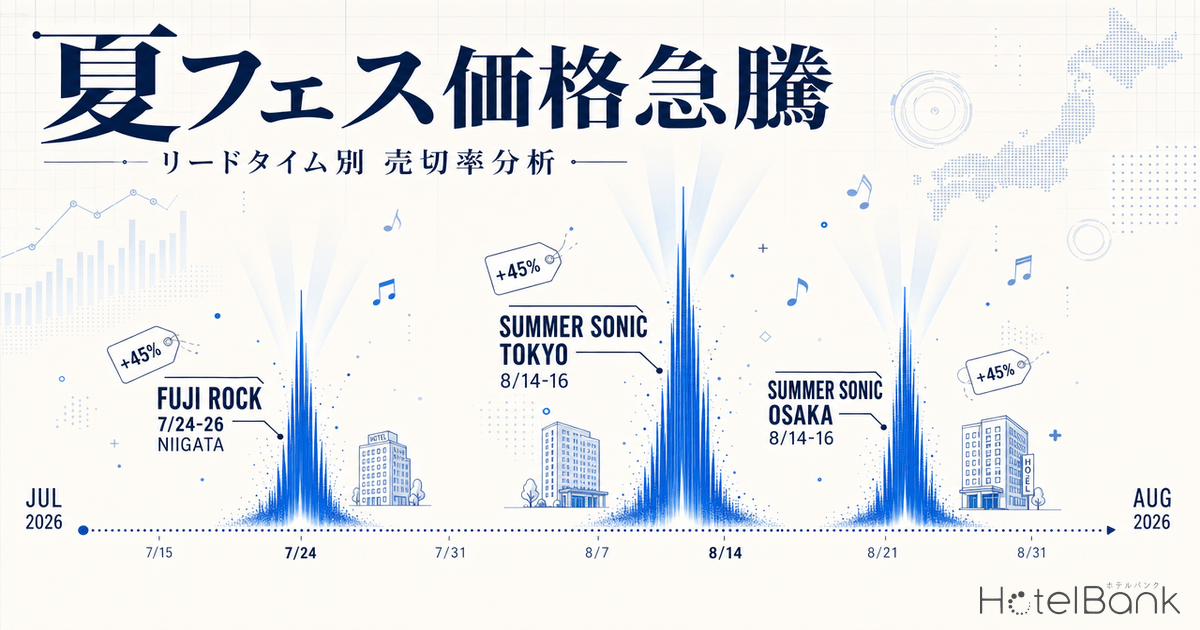

In summer 2026, three of Japan’s most iconic music festivals will take place in succession: FUJI ROCK FESTIVAL ’26 (July 24-26 / Naeba Ski Resort, Yuzawa Town, Niigata), SUMMER SONIC TOKYO 2026 (August 14-16 / Makuhari, Mihama Ward, Chiba City), and SUMMER SONIC OSAKA 2026 (August 14-16 / Expo ’70 Commemorative Park, Suita City). Using publicly available OTA pricing data aggregated by MetroEngines Research (メトロエンジンリサーチ), this article tracks daily ADR and sold-out rate trends across these three host areas and their surrounding regions, drawing out hotel selection strategies for festival-goers and revenue management implications for operators.
Metric Definitions Used in This Article
- ADR (Average Daily Rate): Average of listed prices on OTAs and similar channels. Differs from actual transaction prices. Calculated as the per-room rate (tax included) for double occupancy, averaged across all plan types (room-only to meal-inclusive).
- Sold-Out Rate: Share of plans on OTAs that had stopped accepting bookings at the survey time. Differs from a property’s overall room occupancy rate.
- Data Source: MetroEngines Research (メトロエンジンリサーチ)
Summer 2026: Three Major Festival Schedules
To begin, here is a summary of the three major music festivals scheduled for summer 2026. Each is a large-scale event drawing tens of thousands of attendees, with significant impact on hotel demand in their host regions. Fuji Rock has historically attracted over 100,000 cumulative visitors, while Summer Sonic regularly draws over 200,000 combined attendees across its Tokyo and Osaka venues.
| Festival | Dates | Main Venue | Nearest Lodging Areas |
|---|---|---|---|
| FUJI ROCK FESTIVAL ’26 | July 24 (Fri) – 26 (Sun), 2026 | Naeba Ski Resort (Yuzawa, Niigata) | Yuzawa / Minamiuonuma / Uonuma / Nagaoka |
| SUMMER SONIC TOKYO 2026 | August 14 (Fri) – 16 (Sun), 2026 | ZOZO Marine Stadium / Makuhari Messe | Mihama Ward, Chiba (Makuhari) / Tokyo Bayfront |
| SUMMER SONIC OSAKA 2026 | August 14 (Fri) – 16 (Sun), 2026 | Expo ’70 Commemorative Park (Suita, Osaka) | Suita / Central Osaka City / Konohana Ward (Maishima) |
Source: Compiled by HotelBank Editorial Team based on FUJI ROCK FESTIVAL ’26 and SUMMER SONIC 2026 official websites
Notably, Summer Sonic is held simultaneously in Tokyo and Osaka. This drives up hotel demand in the Tokyo metropolitan and Kansai regions at the same time. Furthermore, Summer Sonic Osaka has relocated from its previous WTC/Maishima venue (Konohana Ward), used through 2025, to Expo ’70 Commemorative Park (Suita) for 2026. This article analyzes both Suita data for the new venue and Konohana Ward (Maishima area), where large hotels cluster and which previously hosted the event.
Daily OTA Pricing in Each Host Area
Now let’s examine daily ADR (average daily rate) movements by check-in date in each area, based on MetroEngines Research data. The chart below shows daily ADR trends in Yuzawa Town during the 10 days before and after Fuji Rock. ADR reaches ¥88,100 on Friday July 24 (the festival opening day) and surges to ¥111,700 on the peak day of Saturday July 25 — a 2.8x to 3.2x jump from the pre-festival weekday baseline (¥35,000-39,000).
Source: MetroEngines Research, compiled by HotelBank Editorial Team (Yuzawa: N=33-50 properties/day, ~500-4,400 plans/day)
This sharp rise reflects not only the festival’s drawing power but also Yuzawa’s inherently limited lodging supply. The number of properties surveyed in Yuzawa is around 45-50, and during the festival days, the count of properties still selling drops to 33 (meaning many are completely sold out). The number of available plans likewise plunges from 3,500-4,300 on weekdays to just 620-730 during the festival — an approximately 80% reduction — confirming that purchasable inventory is extremely thin.
Next, let’s look at the Summer Sonic data for Mihama Ward, Chiba (Makuhari), Suita City, and Konohana Ward in Osaka. The chart below compares daily ADR before and after the festival.
Source: MetroEngines Research, compiled by HotelBank Editorial Team (Mihama N=11-12 / Suita N=10 / Konohana N=24-25)
Mihama Ward (Makuhari) climbs to ¥58,400 on August 14 (the eve-of-festival night) and ¥63,300 on August 15 (the festival’s middle day) — about 1.8-1.9x the surrounding baseline of ¥30,000-34,000. Konohana Ward (Maishima area), despite the Summer Sonic Osaka venue relocation, remains elevated thanks to consistent Universal Studios Japan demand, holding relatively stable at ¥54,000-57,000 during the festival. Suita City — host to the new Expo ’70 Commemorative Park venue — has only 10 surveyed properties; its limited supply produces a milder price climb, reaching ¥25,000 on August 14 and ¥29,000 on August 15.
Year-over-year comparison is also informative. While Fuji Rock 2025’s Yuzawa ADR was ¥71,300 (July 25-27), Fuji Rock 2026 ranges from ¥88,100 (July 24) to ¥111,700 (July 25), with the Saturday peak up roughly +27% YoY — a notably aggressive pricing posture. Summer Sonic Tokyo 2025’s Mihama ADR was ¥51,400 on August 16, while the equivalent day in 2026 (August 15) is ¥63,300 — about +23% YoY. For broader summer resort-area ADR and sold-out year-over-year context, see Summer 2026 Hotel Market: 5-Area ADR & Sold-Out YoY Analysis.
Eve-of-Festival vs Festival-Night Price Gap
For festival-goers, the price gap between the eve-of-festival night (staying the night before and arriving early in the morning) and the festival-night stay (lodging on a festival day and heading home the next day) is a critical cost factor. The table below compares ADR for the eve-of, opening night, middle night, and closing night across the three host areas.
| Area | Eve-of (night before opening) | Opening Night (Friday) | Middle Night (Saturday) | Closing Night (Sunday) |
|---|---|---|---|---|
| Yuzawa (Fuji Rock) | ¥48,200 (7/23) | ¥88,100 (7/24) | ¥111,700 (7/25) | ¥64,300 (7/26) |
| Mihama (Summer Sonic Tokyo) | ¥38,200 (8/13) | ¥58,400 (8/14) | ¥63,300 (8/15) | ¥43,300 (8/16) |
| Suita (Summer Sonic Osaka) | ¥21,600 (8/13) | ¥25,000 (8/14) | ¥29,000 (8/15) | ¥21,400 (8/16) |
| Konohana (Maishima, Osaka) | ¥57,500 (8/13) | ¥56,800 (8/14) | ¥54,700 (8/15) | ¥45,200 (8/16) |
Source: MetroEngines Research, compiled by HotelBank Editorial Team
Yuzawa shows a striking gap of ¥63,500 between the eve-of stay (7/23) and the middle-night stay (7/25) — meaning eve-of staying is roughly 57% cheaper. Mihama Ward for Summer Sonic Tokyo follows a similar pattern: the eve-of stay (8/13) at ¥38,200 vs the middle-night stay (8/15) at ¥63,300 produces a ¥25,100 gap, an approximately 40% eve-of discount. By contrast, Suita City for Summer Sonic Osaka shows a smaller spread of just ¥7,400 between eve-of and middle-night — likely because this is the venue’s first year there, and Suita has a small lodging stock with year-round support from Expo-related demand keeping baseline rates relatively firm.
The cost-saving strategy for festival-goers is clear. In Yuzawa and Mihama, scheduling “eve-of stay → early morning arrival on the day → direct return home” can compress total festival lodging costs by ¥10,000-20,000+. From the operator side, areas with the largest eve-of vs middle-night price lever offer the most room for dynamic pricing. Yuzawa’s market acceptance of festival-day rates at 3x weekday levels is a meaningful revenue management signal.
Lead Time Until Sold-Out Rates Peak
Now let’s examine sold-out rate movements by lead time. As of the survey period (late April 2026) — roughly 3 months out from Fuji Rock and 3.5 months from Summer Sonic — clear sold-out signals are already emerging for festival-day check-ins in each area.
Source: MetroEngines Research, compiled by HotelBank Editorial Team (lead time = days from survey to check-in)
Yuzawa’s sold-out rate on the festival’s middle day (7/25) is a striking 43.9%. With ~90 days lead time (3 months to check-in), more than 40% of plans are already gone. The eve-of-festival night (7/24) is also high at 36.6%. Outside festival days (7/15-23), the rate runs 11.4-18.7%, making the festival period a clear outlier with sold-out rates unmatched anywhere else in the surveyed window.
In Mihama Ward, the middle day of Summer Sonic (8/15) shows 25.5% and the opening day (8/14) shows 24.9% — clearly above other days (13-18%) — confirming festival demand is converting to early sell-outs. Note that 8/15 also coincides with the nationwide Obon peak. Konohana Ward (Maishima) carries year-round Universal Studios Japan demand and runs around 20% sold-out at baseline; even with the Summer Sonic Osaka venue moving to Expo ’70 Commemorative Park, the festival uplift in sold-out rate is limited (21-24%). This suggests that in the Maishima area, “stable theme-park demand” outweighs festival-driven spikes.
The key implication for revenue managers is that strategies must differ between areas where festival-day sold-out rates already exceed 40% at lead time 90 days (Yuzawa) and areas remaining in the 20s (Mihama, Konohana). Yuzawa-type areas can sustain “release-and-instant-sellout” with aggressive opening-price strategies. By contrast, urban-fringe areas like Mihama and Suita benefit more from demand monitoring at the 30-60 day lead-time window with phased rate increases. For sold-out rate movements driven by non-event seasonal factors, see 2026 National Beach-Opening Calendar: How “Beach-Opening Day” Shifts ADR & Sold-Out in Beach Areas, which applies a similar methodology.
Spillover Effects to Outlying Areas
With venue-adjacent areas selling out and prices spiking, some festival-goers shift to surrounding regions. The chart below compares ADR and sold-out rate across four major Niigata areas on Fuji Rock’s middle day (7/25). Against Yuzawa’s ¥111,700, Minamiuonuma posts ¥55,700, Nagaoka ¥44,200, and Uonuma ¥39,300 — showing a stepwise decline with distance from Yuzawa.
Source: MetroEngines Research, compiled by HotelBank Editorial Team (Fuji Rock middle day, July 25, 2026 check-in)
Minamiuonuma (Muikamachi/Urasa area), one Joetsu Shinkansen stop from Echigo-Yuzawa Station — about a 12-minute ride — offers ¥55,700, roughly half of Yuzawa’s price, making it an extremely viable option for festival-goers. Nagaoka (about 30 minutes by Shinkansen) and Uonuma (20-30 minutes by local line) remain at ¥44,200 and ¥39,300 respectively, largely unaffected by festival pricing. Their sold-out rates — Nagaoka 15.0% and Uonuma 9.7% — are dramatically below Yuzawa’s 43.9%, indicating ample remaining inventory.
The relationship between Summer Sonic Osaka’s Expo ’70 Commemorative Park venue (Suita) and the nearby central Osaka and Maishima areas is also revealing. From a venue-access standpoint relative to Suita, Osaka City Kita Ward (Umeda) is ¥52,100, Chuo Ward (Namba/Shinsaibashi) ¥35,200, Nishi Ward ¥29,100, and Naniwa Ward ¥37,700 — all comparable to or slightly above Suita’s ¥29,000. However, the breadth of lodging choices is overwhelmingly larger in central Osaka. By count, Suita has 10 surveyed properties, while Chuo Ward has 225, Kita Ward 84, and Naniwa Ward 67 — a vast difference in selection.
| Area | Properties | 8/15 ADR | Sold-Out Rate | Location Profile |
|---|---|---|---|---|
| Suita City | 10 | ¥29,000 | 10.6% | Adjacent to venue |
| Osaka Chuo Ward | 225 | ¥35,200 | 24.6% | Namba / Shinsaibashi |
| Osaka Kita Ward | 84 | ¥52,100 | 24.1% | Umeda |
| Osaka Naniwa Ward | 67 | ¥37,700 | 22.5% | Namba / Shin-Imamiya |
| Osaka Nishi Ward | 35 | ¥29,100 | 31.6% | Honmachi / Shinmachi |
| Osaka Suminoe Ward | 8 | ¥41,400 | 14.0% | Sakishima / Nanko |
| Konohana Ward (Maishima) | 25 | ¥54,700 | 21.3% | USJ / Maishima |
Source: MetroEngines Research, compiled by HotelBank Editorial Team (August 15, 2026 check-in)
Notable here is Osaka Nishi Ward’s sold-out rate of 31.6%. Honmachi and Shinmachi have easy access to the Expo ’70 Commemorative Park venue and major Osaka stations via the Chuo subway line, and at an ADR of ¥29,100 — comparable to Suita — they appear to be absorbing Summer Sonic Osaka demand. By contrast, Osaka Kita Ward (Umeda), with strong access to Shin-Osaka Station and the airport, sees its summer-vacation inbound and business-travel demand stacked on top of festival demand, making it harder to isolate the festival-specific contribution.
For Summer Sonic Tokyo at Makuhari, Chiba: while venue-adjacent Mihama Ward shows a sold-out rate of 25% and ADR of ¥63,300, spillover is also expected to Tokyo Bayfront areas (Chuo Ward, Minato Ward, etc.) and Chiba City zones one stop back along the Keiyo Line. We will continue to monitor this in future surveys.
Implications for Festival-Goers and Operators
The implications drawn from this analysis can be summarized for both attendees and operators. For festival-goers, the lodging strategy comes down to three points.
First, in venue-adjacent areas like Yuzawa and Makuhari, sold-out rates already exceed 40% at the 90-day lead time, so booking immediately upon deciding to attend is essential. Second, the eve-of vs middle-night ADR gap reaches ¥63,500 in Yuzawa and ¥25,100 in Mihama, so where possible, arriving the night before and entering the venue early on the day can substantially compress total costs. Third, “distributed lodging” in surrounding areas accessible by Shinkansen or subway — Minamiuonuma (¥55,700) or Nagaoka (¥44,200) for Yuzawa, or Osaka Nishi/Naniwa Wards for Summer Sonic Osaka — is rational on both cost and risk grounds.
For operators, the implications are equally clear. In limited-supply areas like Yuzawa, the market accepts festival-day rates at 3x weekday baselines, so aggressive opening prices that capture peak post-release demand are effective. By contrast, in relatively urban-fringe areas like Mihama and Suita, demand materializes around the 60-day lead-time mark, so monitoring and phased rate hikes from that point work well. Finally, in areas like Maishima (Konohana Ward) where festival-independent year-round demand (USJ etc.) dominates, holding firm at the elevated baseline produces more stable revenue than steep festival-driven spikes.
Spillover-area properties (Minamiuonuma, Nagaoka, central Osaka City) have meaningful upside in capturing demand that would otherwise have booked venue-adjacent — by communicating access information (travel time from the nearest station, shuttle bus operations, etc.) targeted at festival-goers. Linking festival schedules into PMS and channel-manager rate calendars and applying a 20-30% premium over baseline would likely keep these spillover areas price-competitive while improving capture rates.
Conclusion
For summer 2026’s three major music festivals: Fuji Rock in Yuzawa shows festival-day ADR of ¥111,700 (over 3x weekday) and a 43.9% sold-out rate; Summer Sonic Tokyo in Mihama Ward shows ¥63,300 ADR and 25.5% sold-out; Summer Sonic Osaka in Suita City shows ¥29,000 ADR; and despite the venue relocation, Maishima (Konohana Ward) holds a high ¥54,700 ADR. These are the key findings from our aggregation.
Sold-out rates in venue-adjacent areas are already elevated at the 90-day lead time, so attendees can optimize cost and risk by combining early booking with eve-of stays and distributed lodging. Operators must apply different pricing tactics depending on area type — limited-supply, urban-fringe, or year-round-demand. Festival demand is a textbook case of short-burst revenue opportunity, and lead-time-segmented inventory and sold-out monitoring is the key to revenue maximization.
Note on Future-Date ADR: The ADR figures in this article are averages of OTA-listed prices at the time of the survey; they will fluctuate as check-in dates approach. Prices currently set high may decline through last-minute discounting closer to the date.
Related Articles
- 2026 National Beach-Opening Calendar: How “Beach-Opening Day” Shifts ADR & Sold-Out in Beach Areas
- Summer 2026 Hotel Market: 5-Area ADR & Sold-Out YoY Analysis
- Will Junglia Okinawa Shift the Northern Market to Year-Round? — 6-Area ADR & Sold-Out Verification
- Osaka Expo’s Impact on Hotel ADR — Verified with REIT and OTA Data
External Links