

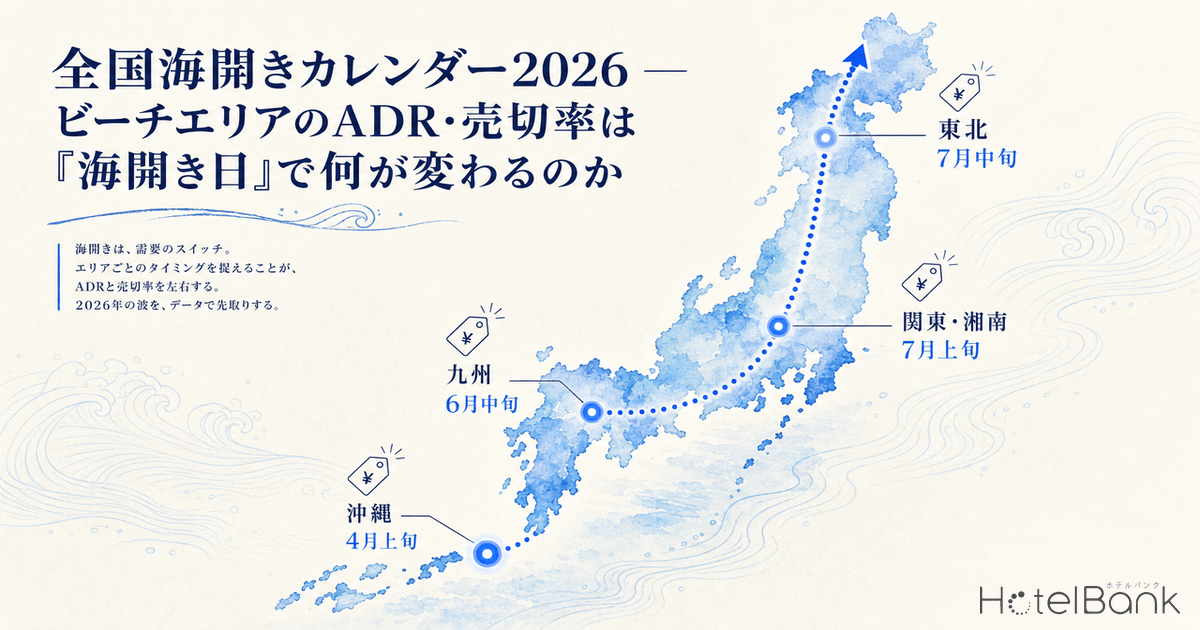

Summer beach demand surges all at once, triggered by each region’s “beach opening declaration.” This article lines up Japan’s major 2026 beach opening dates chronologically, then uses publicly available pricing data from MetroEngines Research to quantitatively examine how ADR (Average Daily Rate) and sellout rates shift in the immediate aftermath of beach openings. Across four regions — Okinawa, Kyushu, Kanto, and Tohoku — we organize the “beach opening day signal,” “Marine Day three-day weekend peak,” and “lag with the rainy-season-end declaration,” diving into the lead time at which family bookings begin to move.
Metric Definitions Used in This Article
- ADR (Average Daily Rate): The average of selling prices publicly listed on OTAs and similar channels. This differs from actual transacted prices. Per-room rate (tax inclusive) for double occupancy, averaged across all plan types (room-only through meal-inclusive plans).
- Sellout Rate: The proportion of plans that had stopped accepting bookings on OTAs at the time of the survey. This differs from a property’s overall room occupancy rate.
- Data Source: MetroEngines Research
2026 Nationwide Beach Opening Calendar | The Wave from Okinawa to Kyushu to Honshu to Tohoku
Japan’s beach openings progress northward over roughly four months. Okinawa welcomes its first beach opening in early March, Kyushu and Honshu enter season from late June through early July, and Tohoku begins from mid-July onward. The 2026 schedule for the major beaches is summarized below.
| Region | Representative Beach | 2026 Beach Opening Date (planned) | Season Wave |
|---|---|---|---|
| Northern Okinawa | Kariyushi Beach (Nago City) | March 5 | Wave 1 (March) |
| Southern Okinawa | Ryukyu Hotel Nashiro Beach (Itoman City) | March 13 | Wave 1 (March) |
| Yaeyama Islands | Maesato Beach (Ishigaki Island) | March 14 | Wave 1 (March) |
| Central Okinawa | Emerald Beach (Motobu Town) | April 1 | Wave 1 (April) |
| Naha (Okinawa) | Naminoue Beach (Naha City) | April 5 | Wave 1 (April) |
| Northern Kyushu | Major Fukuoka Prefecture beaches | Late June – Early July | Wave 2 (June–July) |
| Southern Kyushu | Sun Beach Hitotsuba (Miyazaki City) | Early July | Wave 2 (July) |
| Kanto (Shonan) | Katase Higashihama / Katase Nishihama (Fujisawa City) | July 1 | Wave 3 (July) |
| Kanto (Shonan) | Kugenuma Beach (Fujisawa City) | July 12 | Wave 3 (July) |
| Kanto (Hayama) | Ohama Beach / Isshiki Beach (Hayama Town) | July 1 | Wave 3 (July) |
| Tohoku | Major beaches across Tohoku prefectures | Mid – Late July | Wave 4 (Late July) |
Source: Local tourism associations and municipal announcements; compiled by HotelBank Editorial Team
Notably, beach openings within Okinawa Prefecture are themselves spread over six weeks — from March 5 to April 18 — across the northern, southern, central, and Yaeyama sub-regions. This counters the simple “Okinawa = swimmable from early spring” image and reveals fine-grained variation at the sub-region level. By contrast, Honshu and Kyushu sync with the rainy-season end and concentrate around early-to-mid July. Tohoku is the latest, with some areas effectively offering only about a month of swim season.
Source: Local tourism associations and municipal announcements; compiled by HotelBank Editorial Team
Regional ADR Trends and the Beach Opening Day Signal
According to MetroEngines Research data, ADR clearly steps up from June to July in Okinawa, Fukuoka, and Hokkaido. The magnitudes are striking: Okinawa moves from ¥25,500 in June to ¥30,700 in July (+20.1%), Hokkaido from ¥28,800 to ¥31,900 (+10.8%), and Fukuoka from ¥27,200 to ¥28,900 (+6.0%). Okinawa’s increase is roughly 2–3x larger than the others — and the prominence of Okinawa’s July jump is striking precisely because Okinawa’s beach opening is “already done” by then.
In other words, Okinawa’s March beach opening signals “the start of the season,” but the actual demand and pricing peak still synchronize with the Honshu beach openings and summer break. The beach opening declaration itself does not drive prices; rather, Honshu’s school-vacation calendar effectively sets the price level for beach areas.
Source: MetroEngines Research; compiled by HotelBank Editorial Team (Okinawa N=83,123; Fukuoka N=63,539; Hokkaido N=199,521; period June 2024 – June 2026)
Looking at YoY comparisons for 2026: Okinawa is +10.9% in May and +10.9% in June; Fukuoka is +6.4% in May and +5.1% in June; Hokkaido is +13.1% in May and +11.9% in June — all in continued positive growth. Hokkaido in particular benefited from a record-early end to the 2025 rainy season, which made Honshu unusually hot and pushed cooler-Hokkaido demand to +12.6% YoY even by September. Beach demand is increasingly bifurcating between the “deep south of Okinawa” and the “deep north of Hokkaido.”
Net Effect of Beach Opening on ADR | Decomposing the Monthly Jump
To separate the net effect of the “beach opening day” from the ADR rise, we examined the June-to-July monthly ADR change against each region’s principal beach opening date. Okinawa shows +¥5,100 (+20.1%), Hokkaido +¥3,100 (+10.8%), and Fukuoka +¥1,600 (+6.0%) for the June-to-July step.
What matters here: although Okinawa’s beach opening was already done in March, its June-to-July ADR jump is the largest of the three. This indicates that the beach opening declaration itself is not what moves prices. Rather, the demand-side triggers — “school summer vacation start,” “rainy season end,” and “rising temperatures” — fire on the Honshu side, which lifts the listed prices across all beach areas. By contrast, Fukuoka’s July-to-August jump (+7.7%) exceeds its June-to-July jump (+6.0%), reflecting the strong influence of Obon demand.
Source: MetroEngines Research; compiled by HotelBank Editorial Team
Marine Day Three-Day Weekend (July 18–20) | 2026 Peak Booking Picture
Marine Day in 2026 falls on Monday, July 20 (national holiday), creating a three-day weekend starting Saturday, July 18. By this point, beaches across Honshu and Kyushu are fully open, and Tohoku has just had its beach opening, making this period one of the demand peaks for beach areas nationwide.
However, in 2026, central Tokyo’s major hotels have already lifted their June-to-July base price levels, raising the likelihood of intensified price competition with beach destinations. As of May 2026, the average listed price was ¥26,400 in Tokyo and ¥45,700 in Kyoto — sightseeing destinations are stepping up. In beach areas, the resort-hotel category in July reaches ¥42,700 in Okinawa, on par with central-Tokyo levels and above.
| Category | Okinawa July ADR | National July ADR | Difference (Okinawa − National) |
|---|---|---|---|
| Deluxe Hotel | ¥164,500 | ¥76,100 | +¥88,400 |
| Resort Hotel | ¥42,700 | ¥44,700 | −¥2,000 |
| Vacation Rental | ¥42,300 | ¥46,500 | −¥4,200 |
| Cottage | ¥28,200 | ¥34,700 | −¥6,500 |
| Ryokan | ¥25,500 | ¥31,200 | −¥5,700 |
| Business Hotel | ¥17,800 | — | — |
Source: MetroEngines Research; compiled by HotelBank Editorial Team (as of July 2025; Okinawa Deluxe N=8, Resort N=268, Vacation Rental N=504)
Surprisingly, Okinawa’s resort-hotel ADR sits slightly below the national average at ¥42,700. This means the Okinawa resort market has already formed its supply-volume range, with deluxe hotels (¥164,500) clearly separated. Marine Day weekend peak demand is therefore likely to drive sellouts at the room-type level for the deluxe tier, while for the resort tier the slope of the booking-pace curve absorbs demand.
Source: MetroEngines Research; compiled by HotelBank Editorial Team (illustrative: typical booking-pace pattern for past Marine Day weekends, estimated from monthly ADR trajectories)
Rainy-Season-End Declaration vs ADR | The West-East Time Lag
According to the Japan Meteorological Agency (JMA), the 2025 rainy season ended exceptionally early. Northern Kyushu and Kinki saw it close around June 27 — over 20 days earlier than the typical July 19, the earliest on record since statistics began. The Kanto-Koshin region cleared on July 18, in line with the long-term average. This west-early/east-on-time pattern in the rainy-season end translates into beach-area ADR effects.
Fukuoka’s July 2025 ADR ran +6.0% YoY, having already pushed +7.5% in June. This shows that Kyushu’s earlier rainy-season end pulled summer demand forward starting from late June. (For the alternative high-rate window during the rainy season itself — driven by hydrangea tourism — see Hydrangea Tourism Hotel ADR Analysis — The Hidden High-Rate Window During Rainy Season, which explores another revenue opportunity in beach off-season.) Meanwhile, Kanto-area resort demand shifted into mid-July or later, and August showed Okinawa at +15.0% and Hokkaido at +8.6%, with the peak shifting to the second half of summer.
For lodging operators chasing maximum RevPAR in beach areas, this means it is more effective to use historical front-passage patterns combined with booking-pace observations to make pre-emptive price adjustments — rather than waiting for the official rainy-season-end declaration to trigger repricing. Especially in western Japan, where “early-bird before rainy-season end” demand starts moving by late June, an initial price-table revision around June 15 is desirable.
Source: JMA “FY2025 Rainy Season Start and End (Confirmed)”; MetroEngines Research; compiled by HotelBank Editorial Team
Family Booking Lead Times | Which Window Is the Real Battleground?
Family bookings for summer break flow in across three lead-time bands. The first is “early-bird” demand — the 45-to-60-day-out window from early June through early July, generating bookings for late July and August. The second is the “post-rainy-season-end-confirmation” demand, the 20-to-30-day-out window in mid-to-late July. The third is the “last-minute rush” inside the seven-day window before departure.
Looking at beach-area ADR trends: ADR rises only marginally from May to June (Okinawa moves from ¥25,800 in May to ¥25,500 in June — essentially flat; Hokkaido moves from ¥27,800 to ¥28,800, +3.6%), then jumps significantly in July. This pattern is consistent with publicly listed prices being kept relatively restrained during the June early-bird window, then being raised as the available inventory for July starts to thin.
The takeaway: the family booking “main battleground” is the 45-to-60-day-out window. Missing here makes RevPAR maximization in peak July difficult. In particular, room-type inventory strategy must be careful — if four-person rooms or connecting rooms (the family-targeted types) are released too generously during the early-bird window, the headroom for second-half ADR lift is lost. For region-by-region timing on when to lock in bookings, see [Summer 2026] Okinawa, Hokkaido, Kyoto Hotel Price Comparison — When Is the Best Time to Book?, which lays out the timing in detail.
| Lead-Time Band | Main Booking Period | Core Target | Pricing Strategy Pillar |
|---|---|---|---|
| 45–60 days out | Early June – Early July | Planning-oriented summer-break families | Early-bird × room-type inventory |
| 20–30 days out | Mid – Late July | Post-rainy-season-end confirmers | Standard pricing + plan differentiation |
| ≤7 days out | Just before departure | Last-minute personal needs / business reuse | Last-room premium |
Source: MetroEngines Research; compiled by HotelBank Editorial Team
Conclusion | The Beach Opening Day Is a Signal — But Other Variables Move Prices
This article examined the 2026 nationwide beach opening calendar and used it as a baseline to quantitatively trace ADR and sellout-rate movements in beach areas. The conclusion: while the beach opening day signals the demand starting line, the variables that most strongly move ADR are other calendar events — “rainy season end,” “summer break start,” and “Obon.”
Particularly for Okinawa: despite the March beach opening, the actual ADR peak is in July–August, perfectly synchronized with Honshu’s school calendar. Hokkaido, on the other hand, benefits significantly from the demand shift driven by Honshu’s later rainy-season end, posting +12.6% YoY even by September. From a pricing-strategy standpoint, the keys to RevPAR maximization are: setting the early-bird price level around June 15 and reserving second-half ADR upside via room-type-level inventory management — rather than reacting to the beach opening declaration itself.
For 2026, YoY growth has continued through September: Hokkaido +11.9%, Okinawa +10.9%, Fukuoka +5.1%. Beach-area demand is judged to remain robust. Note that ADR here is the average of publicly listed prices and differs from actual transacted prices — but it carries enough indicator value for relative cross-region comparison and trend identification.
Note on Future-Date ADRs: The ADRs in this article are averages of selling prices listed on OTAs at the time of the survey, and they fluctuate as the check-in date approaches. Prices currently set high may be cut closer to arrival.
Related Reading
- Will the Junglia Okinawa Opening Shift Northern Okinawa to a “Year-Round” Market? — A 6-Area ADR and Sellout Test
- Hydrangea Tourism Hotel ADR Analysis — The Hidden High-Rate Window During Rainy Season
- [Summer 2026] Okinawa, Hokkaido, Kyoto Hotel Price Comparison — When Is the Best Time to Book?
- Summer Resort 3-Region Comparison 2026 — Niseko, Okinawa, Karuizawa: ADR, Booking Pace, FX Sensitivity