

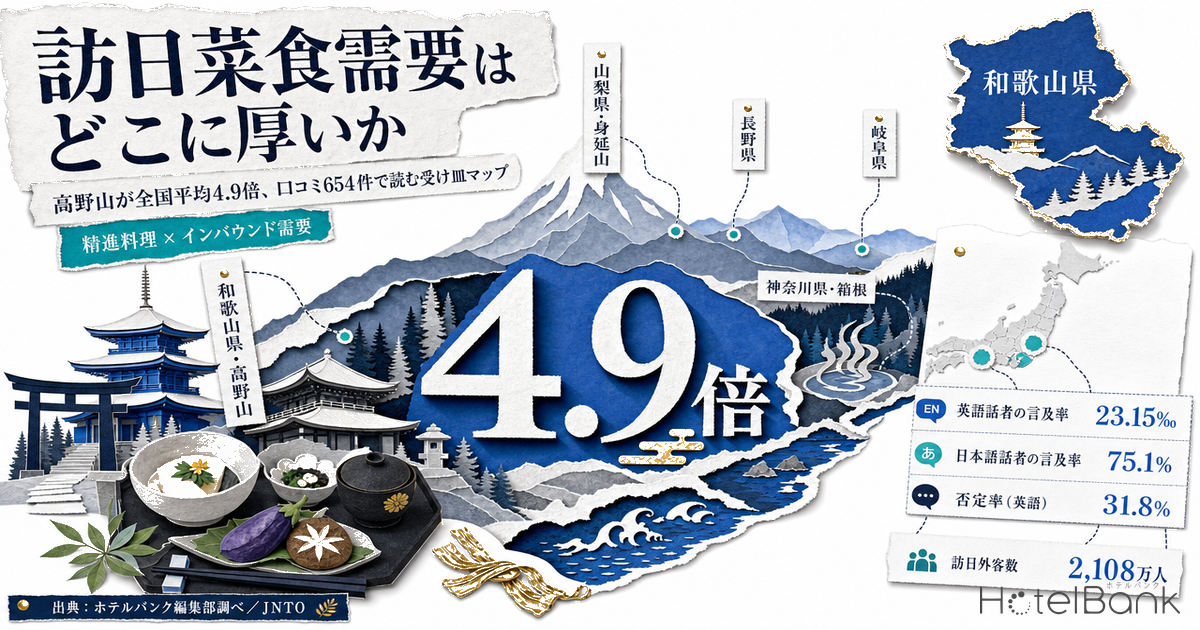
Inbound arrivals to Japan reached 21.08 million in the first half of 2026. Broken down by market, 15 markets — including Taiwan, South Korea, the United States and India — set new records for the month of June. Many of these markets have a far higher share of vegetarians and vegans than Japan does, driven by religion, personal conviction and health consciousness. So where in Japan’s lodging market is that demand actually being met, and where is it not? The HotelBank Editorial Team used tag data derived from NLP analysis of guest reviews, extracting only mentions of vegetarian and vegan catering, to analyse the structure. The result maps out a very different picture from the one most people would assume.
Metric Definitions Used in This Article
- Mention of vegetarian catering: A passage in the body of a guest review that NLP analysis has classified as referring to vegetarian or vegan meal accommodation. Halal catering, allergy accommodation and children’s menus are counted separately under their own tags and are not included in the “vegetarian” figures in this article.
- Mention rate (‰): The number of vegetarian mentions per 1,000 reviews for which meal-related tag analysis has been completed. Numerator and denominator both use the same analysed population. The mention rate is a measure of how often a topic is raised, not a satisfaction score.
- Language: The language the review was written in — not the reviewer’s nationality. English-language reviewers include travellers from Europe, North America, India and Southeast Asia. A country-level breakdown cannot be derived from this data.
- Period covered: The most recent 24 months (July 2024 to 15 July 2026).
- Data sources: HotelBank Editorial Team research (NLP analysis of guest reviews); inbound arrival figures from JNTO (Japan National Tourism Organization) press releases.
- — Of 654 vegetarian mentions, 75.1% are in English. Allergy accommodation is 81.3% Japanese and children’s menus 93.7% Japanese — domestic concerns. Only vegetarian and halal catering are inbound-driven demand.
- — Wakayama leads at 23.15‰, 4.9 times the national English average of 4.71‰. The temple lodgings of Koyasan drive the figure: 1,200 years of shojin ryori cuisine function as vegetarian catering with no adaptation required.
- — Kyoto sits below the national average at 4.13‰ (0.88x). Tokyo (2.66‰) and Osaka (3.13‰) tell the same story: the gateway cities for inbound travel are where vegetarian catering comes up least.
- — 31.8% of English-language vegetarian mentions are negative in tone. That is far above allergy accommodation (16.0%), and the gap between expectation and delivery is where the largest remaining upside sits.
Start with the premise: June 2026 held both “record high” and “year-on-year decline” at once
According to JNTO press releases, inbound arrivals in June 2026 totalled 3,148,600, down 6.8% year on year. The cumulative January–June figure was 21,084,800. Taken in isolation the numbers look like a downturn, but the composition is anything but uniform. The same release states explicitly that 15 markets, including Taiwan, South Korea, the United States and India, recorded their highest ever figures for the month of June. In other words, the overall decline reflects a pullback in specific markets, while Europe, North America, Australia, India and Southeast Asia have continued to set records.
That two-tier structure matters for the subject of this article, because the markets with the highest share of vegetarians are precisely the ones on the record-setting side. India, with Hinduism and Jainism in the background, has an exceptionally high vegetarian share by global standards, and vegan populations are expanding across the UK, Italy, Spain and the Nordic countries. The 15 markets JNTO cited as setting June records include India, the UK, France, Italy, Spain and the Nordic region. Even as total arrivals fall below the previous year, the segment that requires vegetarian catering is in all likelihood growing. The growth of these non-Chinese markets — and the case for distributing halal and vegetarian capability into Japan’s regions rather than concentrating it in the gateway cities — is a strategic question we have examined separately.
Vegetarian catering is a different demand from allergy accommodation — the language mix makes the split obvious
Dietary requirements are often discussed as a single bundle called “special meal accommodation.” But split the review data into four tags and look at the language composition, and it is immediately clear these are entirely separate demands.
Source: HotelBank Editorial Team research (NLP analysis of guest reviews, most recent 24 months)
Of the 654 vegetarian mentions, 491 (75.1%) are in English, with Japanese accounting for just 158 (24.2%). Halal catering is likewise inbound-driven, at 63.0% English. Allergy accommodation, by contrast, is 81.3% Japanese (625 of 769), and children’s menus reach 93.7% Japanese (991 of 1,058). In short, allergy accommodation and children’s meals are overwhelmingly a domestic concern, while vegetarian and halal catering are inbound concerns. Both get filed under the same phrase — “dietary requirements” — yet the demand originates from opposite directions.
That difference means the operator’s response has to differ too. Allergy information can largely be handled within the Japanese-language booking path and on-site operations, whereas vegetarian catering will not even enter a traveller’s consideration set without multilingual advance disclosure. The same kitchen effort requires a completely different delivery design. Reviews also show how scarce genuine language support remains, and how unevenly the properties that offer it are distributed across regions — which reinforces the same point: capability that is not communicated in the guest’s language does not register as capability at all.
The sheer frequency of mentions differs sharply as well. Per 1,000 reviews with completed meal-tag analysis, the vegetarian mention rate is 4.71‰ in English (491 of 104,207) versus 0.24‰ in Japanese (158 of 648,282). English-language reviewers raise the topic roughly 19 times more often than Japanese-language reviewers. The numbers confirm that vegetarian catering is a textbook case of a theme that is nearly invisible in domestic demand and surfaces only in inbound demand.
The limits of the data, stated up front: Taiwan and India cannot be isolated
Let us be honest about the reach of this analysis. What the review data identifies is the language of writing, not nationality. Most travellers from India write their reviews in English, so they are presumably inside the 491 English mentions — but there is no way to extract the Indian share from that total. The same applies to Europe and North America, all dissolved into “English.”
There is a further fact worth noting. There are 1,600 traditional-Chinese reviews (the script used mainly in Taiwan and Hong Kong) with completed meal-tag analysis, and among them vegetarian mentions number zero. Korean-language reviews are also zero, out of 9,468. Taiwan is well known as a market with its own established vegetarian food culture (su shi, 素食), yet at least in reviews of Japanese lodging properties, vegetarian catering is not surfacing as a topic. This should not be read as “there is no vegetarian demand from Taiwan,” but rather that it is not observable through the medium of reviews. The much smaller base population compared with English (104,207) may also be a factor.
This article therefore maps the geography of vegetarian demand through a single proxy indicator: mentions by English-language reviewers. Completing a country-by-country map of where that demand is met would require more than this one measure. Please read the area analysis below with that limitation in mind.
The capacity sits in the mountains, not the cities — Koyasan at 4.9x the national average
Ranked by absolute number of vegetarian mentions, the leaders are Kanagawa with 103, Tokyo with 77, Nagano with 56 and Kyoto with 50. That merely reflects which areas have the most reviews. To make a meaningful comparison, the counts have to be divided by the English review base and converted into a mention rate. Do that, and the landscape changes completely.
Source: HotelBank Editorial Team research (normalised against the English-language review population with completed meal-tag analysis, most recent 24 months)
At the top is Wakayama Prefecture at 23.15‰ — 4.91 times the national English average of 4.71‰, a genuinely exceptional level. The count itself is not large, at 30 mentions across 15 properties, but given an English review base of only 1,296, the density is overwhelming. Look at which Wakayama properties are being discussed, and the list is dominated by the temple lodgings (shukubo) of Koyasan: Ekoin (25 rooms), Sojiin (14 rooms), Saizenin (15 rooms) and Bekkaku Honzan Sainanin (35 rooms).
The explanation is straightforward: shojin ryori. Japan’s traditional Buddhist culinary system, which uses no meat, no fish and none of the five pungent roots, functions as vegetarian catering exactly as it is. The temple lodgings of Koyasan did not develop vegetarian catering as a new service aimed at inbound guests. A 1,200-year-old food culture simply turned out to be a fully formed answer to global vegetarian demand. The same logic applies to Yamanashi Prefecture (8.66‰), where the leading property for vegetarian mentions is Kakurinbo (20 rooms), a temple lodging at Mount Minobu.
The rest of the ranking is equally instructive: Gunma at 11.10‰ (led by Takaragawa Onsen Osenkaku and others), Kanagawa at 9.69‰ (Mount View Hakone, Hakone Ashinoko Hanaori and others, across 42 properties), Gifu at 8.34‰, Nara at 7.59‰ and Nagano at 7.57‰. Every one of them is an onsen or mountain destination rather than a major city. In Kanagawa the mentions are spread across 42 properties, suggesting the Hakone area as a whole is absorbing vegetarian travellers. Areas built around longer stays where guests take dinner at the property — the Japanese “stay-and-dine” model — are structurally more likely to have vegetarian catering come up in reviews.
Vegetarian mention rate map — darker circles mark the areas where it comes up
Source: HotelBank Editorial Team research. Circle size and depth of colour represent vegetarian mentions per 1,000 English reviews.
Plotted on a map, it becomes visually obvious that vegetarian capacity is concentrated in the interior and the peninsulas — the Kii Peninsula, the Central Japan mountains and Hakone. The metropolitan corridor along the Pacific coast is the entry point for inbound travellers, yet it is thin ground for the vegetarian conversation.
Kyoto below the national average — where the biggest upside lies
Here is the most surprising result. Kyoto’s vegetarian mention rate is 4.13‰, below the national English average of 4.71‰ (0.88x the national figure). That runs directly counter to Kyoto’s image as the home of shojin ryori. Our rarity analysis bears it out: in Kyoto Prefecture the vegetarian tag accounts for just 0.027% of all reviews (50 mentions across 43 properties), placing it among the least-discussed topic groups in the prefecture.
Kyoto has 11,384 English reviews, one of the largest bases in the country. Travellers who need vegetarian options are certainly visiting — yet vegetarian catering is not becoming part of the lodging experience people write about. A structural explanation is plausible: in Kyoto the dominant pattern is to stay and dine separately, with guests eating at restaurants in the city, so the meal experience at the property is unlikely to become the subject of a review.
The same pattern is sharper still across the major metros. Tokyo is at 2.66‰ (0.56x national), Osaka 3.13‰ (0.66x), Chiba 1.83‰ (0.39x) and Fukuoka 2.18‰ (0.46x). The larger the gateway city for inbound travel, the less vegetarian catering comes up. Tokyo ranks second nationally by raw count, with 66 mentions across 60 properties, but that is thin against an English review base of 24,837.
Source: HotelBank Editorial Team research (NLP analysis of guest reviews, most recent 24 months)
This is better read as headroom. Of the 654 vegetarian mentions, 64.8% (424) appear in a positive context, 28.1% (184) in a negative one and 7.0% (46) are neutral. Set against the other dietary tags, that negative share stands out. Allergy accommodation has a 16.0% negative rate and children’s menus 11.4%, whereas vegetarian catering is at 28.1% and halal at 27.7%. By language, the vegetarian negative rate is 31.8% in English (156 of 491) versus 16.5% in Japanese (26 of 158) — distinctly higher on the English-speaking side.
Put differently, a gap remains between what is expected and what is delivered. Which also means there is unclaimed revenue opportunity here. If roughly one in three English reviews that raise vegetarian catering is going unsatisfied, properties that get it right remain disproportionately likely to be chosen. And vegetarian catering does not necessarily carry the certification costs that halal does. Switch the dashi to kombu and shiitake; make sure one solidly vegetable-centred dish is always on the menu; and state it clearly in English, in advance. As the temple lodgings of Koyasan demonstrate, Japanese food culture already holds the assets this demand is asking for. Halal and vegan capability is steadily becoming a baseline requirement for differentiation rather than an optional extra.
Area data table
| Prefecture | Vegetarian mentions (English) | Properties mentioned | English review base | Mention rate (‰) | vs national |
|---|
Source: HotelBank Editorial Team research (most recent 24 months; prefectures with an English review base of 600 or more are listed). The national English average is 4.71‰ (491 of 104,207).
Conclusion — communicating it comes before creating it
Three things emerge from this analysis. First, vegetarian catering and allergy accommodation originate from different sources of demand: the former is an inbound axis at 75.1% English, the latter a domestic axis at 81.3% Japanese, and designing them as a single “special meals” bundle leads to the wrong response. Second, capacity is concentrated not in the major cities but in Koyasan, Mount Minobu, Hakone and the Central Japan mountains, where an existing food culture — shojin ryori — functions unintentionally as world-class vegetarian catering. Third, Kyoto, Tokyo and Osaka, the very centres of inbound travel, show the lowest mention rates, while the negative rate reaches 31.8% in English. That is where the greatest room to grow sits.
As JNTO’s figures show, the markets with high vegetarian orientation — India, the UK, France, Italy, Spain and the Nordic countries — kept setting June records even as total arrivals fell below the previous year. Vegetarian catering is not a matter of developing new dishes from scratch. It is closer to a question of whether the vegetable dishes already in the kitchen are being communicated reliably, in English, before the booking is made. The reason the temple lodgings of Koyasan post 4.9 times the national average is not a feat of marketing: what they offer and what is being asked for were aligned from the start. Whether that alignment can be engineered in other areas is the next question.
Note: The mention rates in this article reflect how often a topic was raised in reviews. They are not a comprehensive indication of whether a property offers vegetarian catering or of its quality. Accommodation that was not written about does not appear in the figures, so the actual number of properties offering it is likely to be higher. Language also does not indicate the reviewer’s nationality.
Related Reading
References and Sources
■ Data sources
The body text of guest reviews was analysed with NLP to classify tags relating to dietary requirements (vegetarian / halal / allergy / children’s menu), after which only vegetarian-tag mentions were extracted and aggregated. The scope is the most recent 24 months (July 2024 to 15 July 2026), covering 654 vegetarian mentions across 496 properties. Inbound arrival figures are taken as published in JNTO press releases.
■ Calculation assumptions
This article uses no forecasting or financial modelling; it is built solely on measured mention counts. The mention rate (‰) uses the same analysed population as numerator and denominator, calculated as vegetarian mentions ÷ reviews with completed meal-tag analysis × 1,000. To remove bias from language composition, area comparisons are normalised against the English review base, and only prefectures with a base of 600 or more are listed.
■ Limitations and caveats
The mention rate measures how often a topic was raised; it is not a comprehensive indicator of whether a property offers vegetarian catering or of its quality. Accommodation that was not written about does not appear in the figures, so the actual number of properties offering it is likely to be higher. What can be identified is the language of writing, not the reviewer’s nationality — English-language reviewers include Europe, North America, India and Southeast Asia, so a country-level breakdown cannot be determined. The fact that traditional-Chinese and Korean vegetarian mentions are zero must likewise be interpreted as an observational constraint, including base population size, rather than an absence of demand.
■ Government and official statistics
- JNTO (Japan National Tourism Organization), “Inbound Visitor Arrivals (June 2026 estimate),” press release, 15 July 2026 — June: 3,148,600, down 6.8% year on year; January–June cumulative: 21,084,800; 15 markets including Taiwan, South Korea, the United States and India set June records
- JNTO, “Japan Tourism Statistics — Inbound Visitor Arrivals”
■ Review analysis data
- HotelBank Editorial Team research — aggregation of mentions of vegetarian and vegan catering derived from NLP analysis of guest reviews. Most recent 24 months; 654 vegetarian mentions across 496 properties. The population with completed meal-tag analysis comprises 104,207 English, 648,282 Japanese, 9,468 Korean and 1,600 traditional-Chinese reviews.
- HotelBank Editorial Team research — comparison of language composition and negative-mention rates by dietary tag (halal 119, allergy 769, children’s menu 1,058).
- HotelBank Editorial Team research — prefecture-level rarity analysis (the vegetarian tag in Kyoto Prefecture accounts for 0.027% of all reviews; 50 mentions across 43 properties).