


How much do guests value being able to use the large communal bath “any time”? HotelBank Editorial Team analysis of guest reviews found that reviews mentioning bathing hours positively totaled 10,461 across 1,054 properties — about 9.4 times the negative mentions (1,118 reviews across 133 properties) (past 24 months, properties with 5+ mentions, tallied November 15, 2026). This article breaks the positive and negative mentions down by property type and prefecture, then looks in turn at the bathing hours the top properties publish on their official websites, how they schedule cleaning, the labor-saving options available, and the link to room rates.
• ADR (Average Daily Rate) = estimated transacted rate (tax-excluded equivalent) calculated by applying a property-type correction factor to the lowest-plan level each property publishes on OTAs (per-room rate for 2 guests, tax included). Checked against property-level results disclosed by listed hotel REITs (91 properties, most recent 3 months), the median error is about 7%. These are estimates and differ from each property’s actual transacted prices and accounting figures.
• Area-level (prefecture / municipality) ADR is the median of the estimated transacted rates of the properties covered (the level of a typical property in the area).
• Where listed prices are mentioned, they are per-room rates for 2 guests (tax included).
• OCC (occupancy) = rooms sold as a share of total rooms in the area (estimate based on OTA sales inventory).
• Source: MetroEngines Research (continuously tracking OTA public prices for approximately 168,000 properties in Japan, of which approximately 27,000 are confirmed operating)
The review tally covers guest reviews that mention bathing hours, 24-hour bathing, or whether the bath can be used late at night or early in the morning. The period is the 24 months from November 2024 to November 2026, and we counted properties with at least 5 mentions on the positive side and on the negative side respectively. Mention rate is the share of each property’s total reviews and is a separate metric from review scores. Survey date: November 15, 2026. MetroEngines Research tracks approximately 168,000 properties in Japan and analyzes the approximately 27,000 properties (about 1.26 million rooms) confirmed operating on OTAs.
- — Positive mentions are about 9.4x negative: Reviews mentioning bathing hours positively totaled 10,461 across 1,054 properties, versus 1,118 negative reviews across 133 properties (November 2024–November 2026, properties with 5+ mentions).
- — Praise goes to ryokan, complaints to large business hotels: 55.4% of positive mentions are for ryokan, with a median of 31.5 rooms; 58.7% of negative mentions are for business hotels, with a median of 105 rooms.
- — Top 5 properties open 19+ hours: Cleaning is staggered by bath and by day of the week to avoid closing every bath at once. Praised business hotels show an estimated transacted ADR 1.16x the median of same-type hotels in their municipality (N=76, correlation).
1,054 Properties and 10,461 Positive Reviews — 9.4x the Negatives, Led by Ryokan
First, the overall picture. Reviews mentioning bathing hours positively came to 10,461 across 1,054 properties, while negative mentions totaled 1,118 across 133 properties. That is a gap of about 7.9x by number of properties and about 9.4x by number of reviews, making bathing hours an item that is mostly praised when guests bring it up. Fourteen properties had 5 or more mentions on both the positive and the negative side.
By property type, ryokan (traditional Japanese inns) lead the positive side. Ryokan account for 597 properties and 5,798 reviews, or 55.4% of all positive mentions, followed by business hotels with 239 properties and 2,556 reviews (24.4%) and pensions / minshuku (guesthouses) with 114 properties and 1,025 reviews (9.8%). The mention rate relative to total reviews at these properties was also higher for ryokan at 2.38% and pensions / minshuku at 3.09% than for business hotels (0.95%) or city hotels (0.40%). It suggests that the smaller the onsen inn, the more being able to soak through the night stays in guests’ memories of their stay.
The negative side looks completely different. Of the 133 properties, business hotels account for 73 properties and 656 reviews (58.7%), resort hotels for 20 properties and 194 reviews (17.4%), and ryokan for only 25 properties and 168 reviews (15.0%). By size, 504 properties (47.8%) on the positive side have 29 rooms or fewer, with a median of 31.5 rooms, whereas on the negative side 78 properties (58.6%) have 100 rooms or more, with a median of 105 rooms. The most common combination on the negative side is business hotels with 100–299 rooms (43 properties). Where a single bath is split between men and women by time slot, or bathing is limited to set hours, the time guests want to bathe and the time the bath is open are likely to diverge. Put the other way, this is a segment with large upside, where revising bathing hours is likely to show up in reviews. Reviews about crowding in large baths and the capacity design of washing stations are analyzed in detail inBath Crowding Complaints 1.8x Praise: 9–13 Wash Stations per 100 Rooms.
Source: HotelBank Editorial Team research (NLP analysis of guest reviews). Positive N=1,054 properties / 10,461 reviews; negative N=133 properties / 1,118 reviews (November 2024–November 2026, properties with 5+ mentions)
| Property type | Positive: properties | Positive: mentions | Positive: share | Negative: properties | Negative: mentions | Negative: share |
|---|---|---|---|---|---|---|
| Ryokan | 597 | 5,798 | 55.4% | 25 | 168 | 15.0% |
| Business hotel | 239 | 2,556 | 24.4% | 73 | 656 | 58.7% |
| Pension / minshuku | 114 | 1,025 | 9.8% | 3 | 17 | 1.5% |
| Resort hotel | 49 | 551 | 5.3% | 20 | 194 | 17.4% |
| Capsule hotel | 31 | 304 | 2.9% | 1 | 5 | 0.4% |
| City hotel | 24 | 227 | 2.2% | 11 | 78 | 7.0% |
| Total | 1,054 | 10,461 | 100% | 133 | 1,118 | 100% |
Source: HotelBank Editorial Team research (NLP analysis of guest reviews). Shares are based on number of mentions
By Prefecture: Gunma, Nagano and Shizuoka — Concentrated in Prefectures with Onsen Towns
The 1,054 properties on the positive side are spread across 46 prefectures. Gunma had the most mentions at 881 (82 properties), followed by Nagano with 708 (85), Shizuoka with 682 (69), Hokkaido with 604 (67) and Oita with 538 (51). The top 10 prefectures total 5,451 mentions, 52.1% of the whole. The list is lined with prefectures that are home to onsen towns — Kusatsu, Manza and Ikaho; Beppu and Yufuin; Hakone; Shiobara and Kinugawa — suggesting that all-night bathing is easier to offer in areas with many inns running free-flowing (kakenagashi) hot-spring water.
It is not only about onsen towns, however. Tokyo ranks 9th with 37 properties and 372 mentions, and Osaka counts 28 properties and 285 mentions. In cities, business hotels and capsule hotels with large baths or saunas appear on the positive side, and for business travelers arriving late at night or tourists leaving early in the morning, long bathing hours have practical value.
Source: HotelBank Editorial Team research (NLP analysis of guest reviews). Top 10 prefectures out of positive-side N=1,054 properties / 10,461 reviews
10 Properties with the Most Positive Mentions — All Sizes and Types
Next, let us look at specific properties with the most positive mentions. Ranking the top 10 operating properties shows a wide range of sizes and types, from a 613-room business hotel to a 19-room small inn. By count, properties with more rooms tend to rank higher, but by mention rate small onsen inns stand out: Resort Inn Yunogo at 12.90%, Kokumin Shukusha Sanshien at 12.28% and Noji Onsen Hotel at 7.23%. That works out to roughly 1 in every 8–14 reviewers mentioning bathing hours.
| Property | Prefecture | Property type | Rooms | Positive mentions | Mention rate |
|---|---|---|---|---|---|
| Nagoya Crown Hotel (名古屋クラウンホテル) | Aichi | Business hotel | 613 | 108 | 2.47% |
| Hotel Ohruri, Shiobara Onsen (塩原温泉 ホテルおおるり) | Tochigi | Ryokan | 120 | 74 | 6.61% |
| Tenseien (天成園) | Kanagawa | Ryokan | 198 | 72 | 2.37% |
| Resort Inn Yunogo (リゾートイン湯郷) | Okayama | Pension / minshuku | 19 | 64 | 12.90% |
| Hotel Kusakabe Armeria (ホテルくさかべアルメリア) | Gifu | Resort hotel | 125 | 62 | 2.47% |
| Villa Fontaine Grand Haneda Airport (ヴィラフォンテーヌグランド羽田空港) | Tokyo | City hotel | 1,557 | 57 | 0.43% |
| Kokumin Shukusha Sanshien (国民宿舎 山紫苑) | Tottori | Ryokan | 35 | 56 | 12.28% |
| Noji Onsen Hotel (野地温泉ホテル) | Fukushima | Ryokan | 61 | 53 | 7.23% |
| Yumura Hotel B&B (自家源泉かけ流し天然温泉の宿 湯村ホテルB&B) | Yamanashi | Business hotel | 99 | 49 | 5.80% |
| Zekkei no Yado Sakuratei (絶景の宿さくら亭) | Oita | Ryokan | 20 | 43 | 6.95% |
Source: HotelBank Editorial Team research (NLP analysis of guest reviews). November 2024–November 2026, operating properties; ties ordered by mention rate
5 Properties Confirmed on Official Websites — The Common Thread Is “19+ Hours”
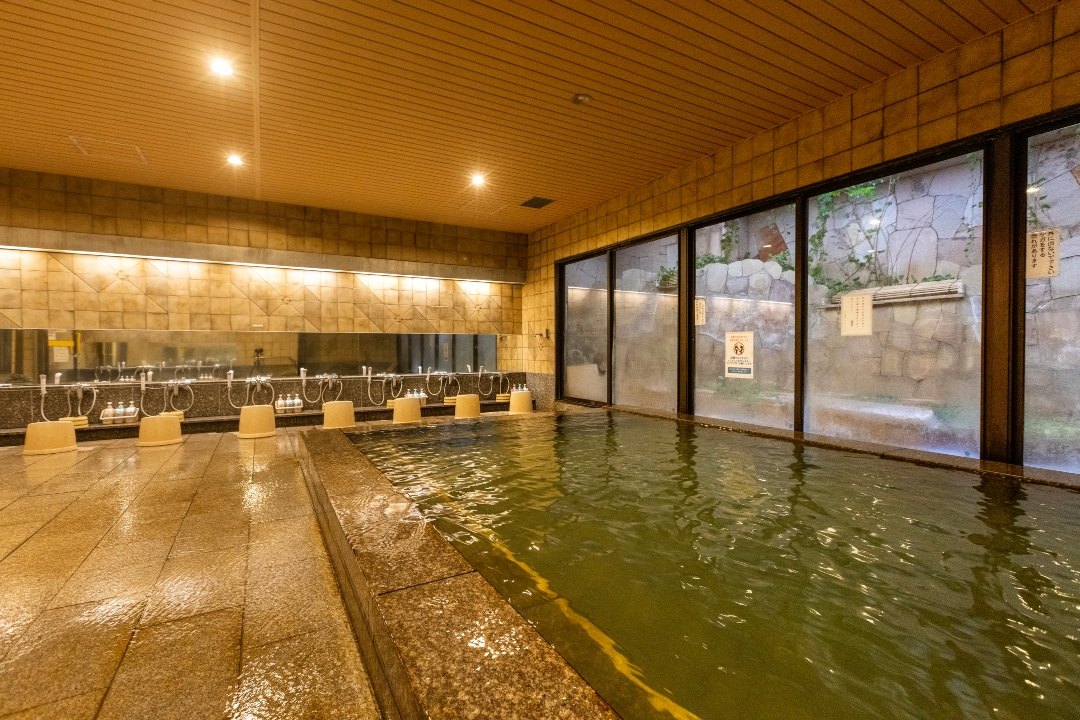
So how many hours do the top properties actually keep their baths open? We checked the official websites of the top 10 properties and compiled the 5 that clearly state bathing hours for overnight guests. Even the shortest, Nagoya Crown Hotel, offers 19 hours from 15:00 to 10:00 the next morning; Tenseien’s large bath is open 23 hours from 10:00 to 9:00 the next morning; and the remaining 3 properties keep at least one of their baths available 24 hours a day.
| Property | Rooms | Official website information | Bathing window | Positive mentions (count, rate) |
|---|---|---|---|---|
| Nagoya Crown Hotel (名古屋クラウンホテル) | 613 | Overnight guests 15:00–10:00 next day | 19 hours | 108 / 2.47% |
| Tenseien (天成園) | 198 | Large bath 10:00–9:00 next morning | 23 hours | 72 / 2.37% |
| Hotel Kusakabe Armeria (ホテルくさかべアルメリア) | 125 | Both baths open 24 hours (2-hour cleaning each) | 24 hours across the property | 62 / 2.47% |
| Kokumin Shukusha Sanshien (国民宿舎 山紫苑) | 35 | Overnight guests can use one of the baths 24 hours a day | 24 hours across the property | 56 / 12.28% |
| Noji Onsen Hotel (野地温泉ホテル) | 61 | Open all day, with men’s and women’s baths swapped every 3 hours | 24 hours across the property | 53 / 7.23% |
Source: Each property’s official website (checked November 15, 2026), HotelBank Editorial Team research. Bathing hours are subject to change
Looking at the relationship between bathing-hour length and mention rate — within the limited range of 5 properties — the mention rate is tied more closely to property size than to the length of hours itself. The 2 properties with mention rates above 7% are both ryokan with 61 rooms or fewer offering 24-hour bathing, while the 3 properties with 125–613 rooms converged at 2.4–2.5% despite differing hours of 19, 23 and 24. Beyond roughly 19 hours, what seems to separate the ratings is not an extra hour but whether guests get the experience of being able to bathe in the middle of the night or in the morning. Note also that at large properties review topics are spread across breakfast and rooms as well, so mention rates tend to come out lower.
How to Schedule Cleaning — 5 Published Models
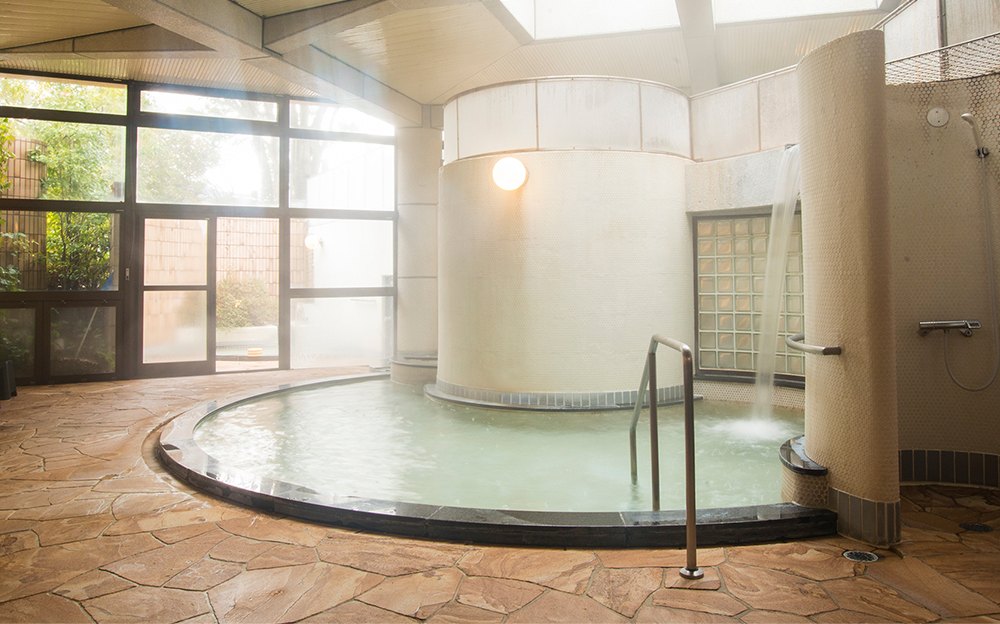
The key to long bathing hours is when, and in which bath, cleaning takes place. Among properties that publish their cleaning or men’s/women’s swap times on their official websites, a common feature is avoiding any time slot in which every bath is closed at once.
| Model | Published example | How it works | Best suited to |
|---|---|---|---|
| Stagger cleaning times by bath | Hotel Kusakabe Armeria (Gifu) | The 8th-floor open-air view bath is cleaned 10:00–12:00 and the 2nd-floor large bath 13:00–15:00, so one bath is always open | Properties with 2 or more baths |
| Rotate which bath is cleaned by day of the week | Gero Onsen Suimeikan (Gifu) | Publishes a weekly schedule dedicating 8:00–17:00 on each weekday (Mon–Fri) to cleaning one bath | Large ryokan with 3 or more baths |
| Take one bath out for cleaning each day and rotate the rest between men and women | Noji Onsen Hotel (Fukushima) | Swaps men’s and women’s baths every 3 hours and notes that “one bath is closed each day for cleaning” | Onsen ryokan with several baths of different character |
| Fix the swap to once a day | Kokumin Shukusha Sanshien (Tottori) | Swaps the men’s and women’s baths on the main building’s 1st floor at 23:00 every night, so overnight guests can use one of the baths 24 hours a day | Small ryokan with 2–3 baths |
| No closure for swaps | Nagoya Crown Hotel (Aichi) | States that the 24:00–24:30 late-night swap is suspended for the time being, keeping the bath open continuously from 15:00 to 10:00 the next day | Urban hotels with multiple baths |
Source: Compiled by HotelBank Editorial Team from each property’s official website (checked November 15, 2026)
Hotel Kusakabe Armeria states that it cleans the 8th-floor open-air view bath from 10:00 to 12:00 and the 2nd-floor large bath from 13:00 to 15:00. By not overlapping cleaning times, one bath stays open even in the window between check-out and check-in. Gero Onsen Suimeikan goes a step further, publishing a weekly schedule that rotates which bath is cleaned each day from Monday to Friday. Limiting deep cleaning to one bath per day also evens out the cleaning staff’s workload across the week.
Even properties with a single bath have options. One is to split cleaning into 30 minutes to 1 hour late at night and about 2 hours in the daytime — a quick clean of floors and changing rooms at night, and cleaning that includes draining the bath during the day. An approach like Nagoya Crown Hotel’s, with no closure for swaps, is a useful reference for securing continuous bathing hours without adding late-night staff. Whichever model is used, clearly stating cleaning times on the official website and inside the property reduces the gap with guest expectations.
Operating Under Labor Constraints — Outsourcing and Robots
Deciding to extend bathing hours goes hand in hand with securing staff for cleaning and patrols. According to Teikoku Databank’s “Survey of Corporate Trends on Labor Shortages (April 2026)”, the share of companies feeling a labor shortage was 50.6% for full-time employees and 28.3% for non-regular employees. For “ryokan and hotels”, the figure for non-regular employees was 38.5%, back in the 30% range for the first time in 4 years and 2 months; the company cites productivity gains from the spread of DX and spot work among the factors. Compared with January 2023, when the same survey showed 77.8% for full-time and 81.1% for non-regular employees at ryokan and hotels, the situation has eased. The background to this improvement is explored inJapan Hotel Staff Shortage Falls to 38.5%, Exits Top-10 Industry List.
Conditions on the ground remain tough, however. In a survey of accommodation facilities cited in the Japan Tourism Agency’s 2026 White Paper on Tourism (December 2025–January 2026, n=522), 72.2% of facilities said they were short-staffed. Of those, 79.3% cited a heavier load on existing employees at specific times or periods, such as peak seasons. The white paper’s charts show that, among measures effective in securing staff, 19.4% cited using outside personnel such as outsourcing or sharing staff between facilities, and 7.4% cited introducing robots capable of guest service, serving or cleaning — leaving room for labor-saving investment to spread.
Applied to large-bath operations, the options fall into three broad groups. The first is to entrust periodic cleaning involving draining and water-quality management to specialist contractors, letting in-house staff focus on patrols and light cleaning. The second is to hand floor cleaning in changing rooms and corridors to robots, reducing late-night work. The third is multi-tasking, with front desk and night staff combining patrols and restocking of amenities. The Japan Tourism Agency runs the “Labor-Saving Investment Subsidy Program for Tourist Destinations and the Tourism Industry”, which supports capital investment by lodging operators; the call for applications under the FY2025 supplementary budget ran from March 27 to May 29, 2026. With future rounds in mind, operators would do well to settle their cleaning workflows and time slots first.
Link to Room Rates — Business Hotels at 1.16x Their Municipality’s Same-Type Median
Finally, we look at the relationship between bathing-hour praise and room rates. Of the 334 properties with 10 or more positive mentions, we calculated a ratio for the 266 whose estimated transacted ADR could be compared with the median for the same property type in their municipality, using the 12-month average from November 2025 to October 2026. The overall median was 1.01x, essentially in line with the typical level of their municipality.
Differences emerge by property type. Business hotels (N=76) had a median of 1.16x, and 72.4% of them exceeded the median for business hotels in the same municipality. Business hotels that have a large bath whose hours are praised in reviews tend to sit in a higher rate band than nearby peers of the same type. Resort hotels (N=13) were at 1.00x and ryokan (N=173) at 0.95x, broadly in line with local norms. The remaining 4 properties are city hotels and other types, not shown separately because of the small count. The rate premium attributable to having a large bath at all is quantified inBusiness Hotel Baths: Onsen + Sauna Add 9.3% to ADR — Capex Ceiling.
Splitting by mention rate into three groups, the tier at 1.70% or below (N=88) was at 1.24x, the 1.72–4.59% tier (N=89) at 0.99x, and the 4.62%-and-above tier (N=89) at 0.78x. The high-mention tier includes many small, reasonably priced inns that put “onsen you can enter any time” front and center, suggesting that the freedom to bathe at any hour is described as satisfaction beyond the price paid. This comparison shows only a correlation and does not mean that extending bathing hours will raise rates. Even so, a strength that reviewers mention again and again is a sales asset, and stating bathing hours clearly in plan names and on the official website can open revenue opportunities by capturing late-arrival and early-departure demand.
Source: Compiled from MetroEngines Research and HotelBank Editorial Team. N=266 properties out of those with 10+ positive mentions; estimated transacted ADR for November 2025–October 2026 (12-month average) ÷ median for the same property type in the municipality (only months with 5+ properties)
Summary — Design the Hours You Don’t Close
To sum up, there are three key points. First, bathing hours are an item that tends to be praised, with 10,461 positive mentions against 1,118 negative. Second, there is a sharp contrast: the positive side centers on ryokan and small inns with 29 rooms or fewer, while the negative side centers on business hotels with 100 rooms or more. Third, the top properties whose bathing hours could be confirmed on their official websites all secure 19 hours or more, splitting cleaning by bath and by day of the week to avoid closing everything at once.
The implication for operators is not to think of extending bathing hours only in terms of adding staff. There is broad scope to shorten closed time through scheduling — staggering cleaning slots, splitting cleaning between late night and daytime, and combining outsourcing with robots. Even properties with a single bath can start with small changes, such as extending the morning closing time by 30 minutes to 1 hour or fixing and clearly stating the swap time. Bathing hours are one of the few elements that can be revised without capital investment, and are worth exploring for upside in both reviews and rates.
References and Sources
■ Data Sources
NLP analysis of guest reviews (mentions of bathing hours, 24-hour bathing, or late-night / early-morning availability; the 24 months from November 2024 to November 2026; properties with 5+ positive and 5+ negative mentions respectively), MetroEngines Research estimated transacted ADR (by property and municipality, November 2025–October 2026), each property’s official website (checked November 15, 2026), and published materials from Teikoku Databank and the Japan Tourism Agency.
■ Calculation Assumptions
The rate ratio was calculated for the 266 of the 334 properties with 10+ positive mentions that had at least 6 comparable months, as the property’s estimated transacted ADR (period average) ÷ the median for the same property type in its municipality (only months with 5+ properties), and the median for each group is shown. The breakdown by type is 76 business hotels, 173 ryokan, 13 resort hotels and 4 others; the mention-rate tertiles contain 88, 89 and 89 properties. Mention rate is the share of relevant reviews in each property’s total reviews.
■ Limitations and Caveats
Mention counts tend to be larger for large properties with more reviews in total, and mention rate is a separate metric from review scores. The comparison of bathing-hour length and mention rate is limited to the 5 properties whose bathing hours could be confirmed on their official websites. The rate ratio shows only a correlation and does not show that extending bathing hours pushes up rates. Estimated transacted ADR is an estimate and differs from each property’s actual transacted prices. Bathing and cleaning hours are subject to change.
Related Articles
- Bath Crowding Complaints 1.8x Praise: 9–13 Wash Stations per 100 Rooms
- Business Hotel Baths: Onsen + Sauna Add 9.3% to ADR — Capex Ceiling
- Japan Hotel Staff Shortage Falls to 38.5%, Exits Top-10 Industry List
- Onsen Ryokan Bath Capex: ¥21k–¥90k per Room-Year and ADR Payback
- Free-Flowing Onsen by Prefecture 2026: 1,254 Inns, 426 Under-Marketed
- Sauna Business Hotels in Japan: 15:00–10:00 Hours & Day-Use Options
- 23.5% of Japan’s Urban Hotels Have a Bath — Onsen-Named Earn +54% ADR
- Hotel Self Check-In Kiosks: ¥1.38M–1.78M Each, ¥14K–27K per Room
- In-Room Dining 584 Ryokan vs Private Dining 359: Only 8% Offer Both
- English Staff Reviews: 43 of Top 100 in Tokyo; Osaka Tops Multilingual
- Wagyu Inns by Reviews: Top 100 Led by Mie 19, Yamagata 12, Hyogo 11
- BOJ Tankan Sep 2026: Accommodation & Food DI +38 at Large Firms, −8pt