

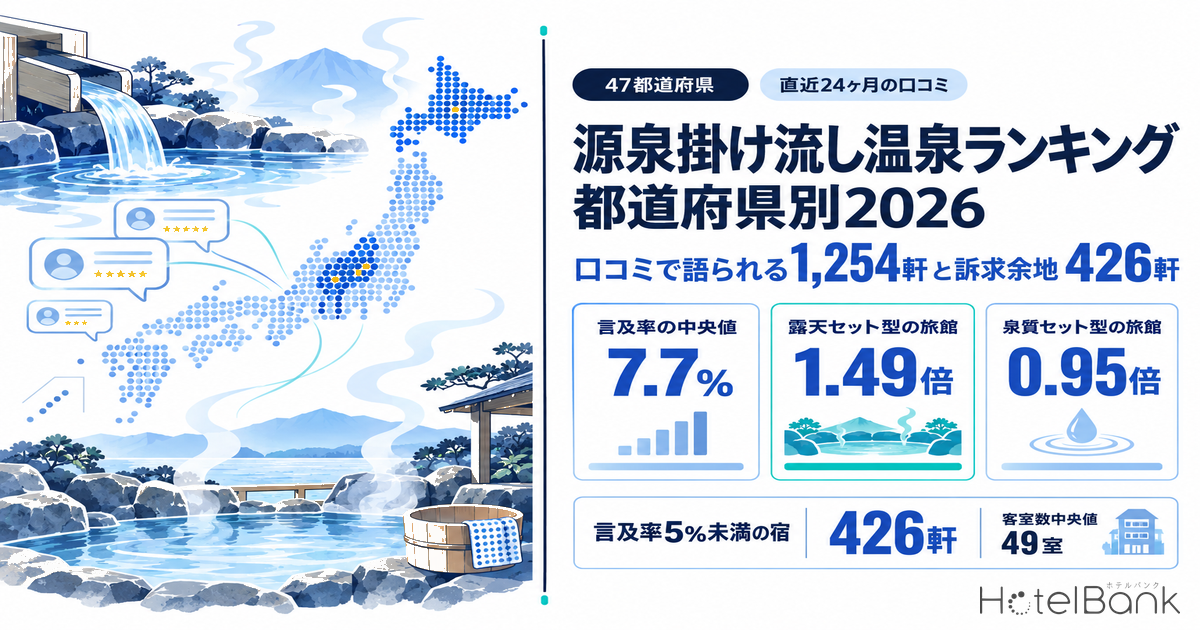
How much do guests actually talk about free-flowing hot spring baths (gensen kakenagashi — spring water fed straight into the tub and allowed to overflow rather than being recirculated)? The HotelBank Editorial Team tallied guest reviews across all 47 prefectures for the most recent 24 months and found 1,254 properties where kakenagashi was mentioned favorably in 10 or more reviews, for a total of 28,913 mentions. The largest mention count nationwide belongs to Fukui Hotel (ふく井ホテル) in Obihiro, Hokkaido, with 274 mentions; the highest mention rates (share of all of a property’s reviews) are at Miyuki Onsen (深雪温泉) in Isawa, Yamanashi (36.0%) and Yamagatakan (山県館) at Kawaura Onsen (30.8%).
For operators, two further points matter. First, the level of estimated settled ADR differs according to what kakenagashi is mentioned together with. Ryokan where it appears in the same review as the open-air bath sit at 1.49x their prefecture’s ryokan benchmark, while ryokan where it is paired only with water quality sit at 0.95x. Second, there are 426 properties where kakenagashi is mentioned in 10 or more reviews yet the mention rate stays below 5%. Most are mid-sized to large properties with many rooms: they have free-flowing baths, but those baths have not become the lead story in their reviews. This article sets out the distribution by prefecture, breaks down how kakenagashi is talked about, examines the relationship with rates, and counts the untapped messaging potential prefecture by prefecture.
Metric Definitions Used in This Article
- Population: properties with 20 or more guest reviews in the most recent 24 months (September 2024 – September 2026) and 10 or more favorable mentions of free-flowing hot spring baths (gensen kakenagashi). Qualifying properties exist in all 47 prefectures, 1,254 in total.
- Mention rate: the share of a property’s total reviews that refer favorably to kakenagashi. It is a mention frequency, not a rating score.
- Co-mention rate: of the reviews that mention kakenagashi, the share that also refer favorably, within the same review, to water quality (skin-beautifying water, milky water, etc.), the open-air bath, or bath-hopping (yumeguri).
- Four mention-pattern types: classified by which elements have a co-mention rate of 10% or more. “Water quality + open-air” = both water quality and open-air bath at 10% or more / “Water-quality paired” = only water quality at 10% or more / “Open-air paired” = only open-air bath at 10% or more / “Standalone” = both below 10%.
- ADR (average daily rate): an estimated settled rate (tax-exclusive equivalent), derived by applying a category-specific adjustment factor to the lowest plan rate each property publishes on OTAs (two guests per room, per-room rate, tax-inclusive). Cross-checked against per-property results disclosed by listed hotel REITs (184 property-months, April–May 2026), the median error is about 7.5%; for the ryokan category, the focus of this article, it is about 16% (34 property-months). These are estimates and differ from each property’s actual transacted rates and accounting figures. In this article, a property’s level is the monthly average for properties with estimates for six or more months between September 2025 and August 2026, and group-level figures use the median.
- Prefectural ryokan benchmark: the monthly average, over the same 12 months, of estimated settled ADR for the ryokan category by prefecture (the level of a typical property in the area = the median of the properties covered).
- Data source: MetroEngines Research (estimated settled ADR) / HotelBank Editorial Team research (NLP analysis)
Source: HotelBank Editorial Team research (NLP analysis, most recent 24 months) / MetroEngines Research (estimated settled ADR)
- — 1,254 properties, 28,913 mentions — properties where kakenagashi is mentioned favorably in 10 or more reviews (47 prefectures, most recent 24 months). Shizuoka (135), Nagano (99), Gunma (97) and Hokkaido (93) lead.
- — Water quality 21.1%, open-air bath 17.3% — the share of kakenagashi reviews that also mention water quality or the open-air bath in the same review. Bath-hopping is just 1.2%: kakenagashi is talked about together with “the water itself” and “the scenery of the bath.”
- — 1.23x — estimated settled ADR of ryokan in the population (N=958) is 1.23x the prefectural ryokan benchmark (median). They exceeded the benchmark in 23 of the 26 comparable prefectures.
- — Open-air paired 1.49x / Water-quality paired 0.95x — what tracks rates is how kakenagashi is talked about, not how high the mention rate is. The top third by mention rate is mainly small properties with a median of 13.5 rooms, at 0.96x the benchmark.
- — 426 properties — mentioned for kakenagashi in 10 or more reviews but with a mention rate below 5%. Median 49 rooms; ryokan rates at 1.46x the prefectural benchmark. Among properties with 81+ rooms, 83.8% are in this band, leaving room to disclose water handling tub by tub.
Free-Flowing Onsen Ranking — Top 20 Properties by Review Mentions
We start with the national line-up. The table below lists the top 20 properties in descending order of favorable kakenagashi mentions. First-placed Fukui Hotel (Obihiro, Hokkaido) has 274 of its 1,319 reviews touching on kakenagashi, with comments such as “100% free-flowing moor hot spring.” That a business-hotel-style property in front of a station takes first place shows that kakenagashi is not a value reserved for ryokan in hot spring resorts. Second is Yumura Hotel B&B (自家源泉かけ流し天然温泉の宿 湯村ホテルB&B) at Yumura Onsen, Yamanashi (199 mentions), where many reviews go as far as spelling out the water handling: “no heating, no added water, no recirculation…”
The upper ranks also include Yubel Hotel Matsumasa (ユウベルホテル松政) at Yuda Onsen, Yamaguchi (165 mentions), Hotel Oruri (ホテルおおるり) in Shiobara, Tochigi (154), and Bankokuya (萬国屋) at Atsumi Onsen, Yamagata (142) — mid-sized to large properties with a deep base of reviews. Hinoki no Yado Minakami Sanso (檜の宿 水上山荘) in Minakami, Gunma (106 mentions, 18.2%) and Ishizaka Ryokan (石坂旅館) at Ikaho Onsen (102 mentions, 29.3%) score high on both count and rate despite having around 30 rooms or fewer. Because mention counts rise in proportion to total reviews, reading this table alongside the “top mention rate” table below makes it easier to tell the property types apart.
Table 1: Top 20 Properties by Kakenagashi Mention Count (from the population of N=1,254)
| Rank | Property | Prefecture | Mentions | Reviews | Mention rate | Co-mention: water quality | Co-mention: open-air bath |
|---|---|---|---|---|---|---|---|
| 1 | Fukui Hotel (ふく井ホテル) | Hokkaido | 274 | 1,319 | 20.8% | 24.5% | 0.0% |
| 2 | Yumura Hotel B&B (自家源泉かけ流し天然温泉の宿 湯村ホテルB&B) | Yamanashi | 199 | 811 | 24.5% | 18.1% | 15.6% |
| 3 | Yubel Hotel Matsumasa (ユウベルホテル松政) | Yamaguchi | 165 | 1,110 | 14.9% | 15.2% | 50.9% |
| 4 | Shiobara Onsen Hotel Oruri (塩原温泉 ホテルおおるり) | Tochigi | 154 | 1,084 | 14.2% | 18.8% | 24.0% |
| 5 | Bankokuya (萬国屋) | Yamagata | 142 | 1,454 | 9.8% | 6.3% | 16.9% |
| 6 | Izu Ito Onsen Daitokan (伊豆・伊東温泉 大東館) | Shizuoka | 136 | 719 | 18.9% | 14.7% | 19.1% |
| 7 | Yamagatakan (山県館) | Yamanashi | 135 | 439 | 30.8% | 23.0% | 17.0% |
| 8 | Hanayagi no Sho Keizan (華やぎの章 慶山) | Yamanashi | 129 | 1,295 | 10.0% | 22.5% | 14.0% |
| 9 | Kobe Bay Sheraton Hotel & Towers (神戸ベイシェラトン ホテル&タワーズ) | Hyogo | 113 | 2,020 | 5.6% | 8.8% | 15.0% |
| 10 | Hotel Aoki (ホテルアオキ) | Tochigi | 112 | 489 | 22.9% | 38.4% | 37.5% |
| 11 | Fujinoya Yutei (富士野屋夕亭) | Yamanashi | 110 | 990 | 11.1% | 12.7% | 10.0% |
| 12 | Hotel Shion (ホテル紫苑) | Iwate | 109 | 1,157 | 9.4% | 25.7% | 13.8% |
| 13 | Silk Inn Kagoshima (シルクイン鹿児島) | Kagoshima | 107 | 743 | 14.4% | 26.2% | 7.5% |
| 14 | Hinoki no Yado Minakami Sanso (檜の宿 水上山荘) | Gunma | 106 | 581 | 18.2% | 11.3% | 19.8% |
| 15 | Ishizaka Ryokan (石坂旅館) | Gunma | 102 | 348 | 29.3% | 10.8% | 0.0% |
| 16 | Misasa Onsen Seiryuso (三朝温泉 清流荘) | Tottori | 98 | 705 | 13.9% | 16.3% | 20.4% |
| 17 | Kutsurogijuku Shintaki (くつろぎ宿 新滝) | Fukushima | 97 | 1,458 | 6.7% | 4.1% | 9.3% |
| 18 | Ryokan & Kazokuyu Imamura (旅館・家族湯 いまむら) | Kumamoto | 94 | 793 | 11.9% | 38.3% | 23.4% |
| 19 | Atami Club Geihinkan (熱海倶楽部 迎賓館) | Shizuoka | 93 | 442 | 21.0% | 9.7% | 11.8% |
| 20 | Oe Honke (大江本家) | Hokkaido | 91 | 958 | 9.5% | 34.1% | 15.4% |
Source: HotelBank Editorial Team research (NLP analysis of guest reviews, most recent 24 months, September 2024 – September 2026; properties with 20+ reviews and 10+ positive kakenagashi mentions). Co-mentions are shown as a share of kakenagashi mentions (lower-bound values)
Ranked by mention rate, Miyuki Onsen in Isawa, Yamanashi (36.0%), Guesthouse Yamatoso (ゲストハウス倭荘) in Ito, Shizuoka (32.5%) and Yamagatakan at Kawaura Onsen, Yamanashi (30.8%) come out on top. One review of Yamagatakan describes how “the sight of hot water spilling over the edge of the tub is spectacular,” and roughly one guest in three refers to the way the water is handled. Thirteen of the top 15 have 40 rooms or fewer; these are properties where the water itself is the reason guests choose them.
Table 2: Top 15 Properties by Kakenagashi Mention Rate (properties with 150+ reviews only)
| Rank | Property | Prefecture | Mention rate | Mentions | Reviews | Rooms |
|---|---|---|---|---|---|---|
| 1 | Miyuki Onsen (深雪温泉) | Yamanashi | 36.0% | 85 | 236 | 15 |
| 2 | Guesthouse Yamatoso (ゲストハウス倭荘) | Shizuoka | 32.5% | 49 | 151 | 9 |
| 3 | Yamagatakan (山県館) | Yamanashi | 30.8% | 135 | 439 | 34 |
| 4 | Hotel Kawachiya (ホテル河内屋) | Shizuoka | 29.4% | 57 | 194 | 22 |
| 5 | Ishizaka Ryokan (石坂旅館) | Gunma | 29.3% | 102 | 348 | 33 |
| 6 | Nasu Palace Hotel (那須パレスホテル) | Tochigi | 28.7% | 72 | 251 | 44 |
| 7 | Hakuto (白兎) | Fukuoka | 28.4% | 50 | 176 | 15 |
| 8 | Shiki no Yado Koyomi (四季の宿こよみ) | Tochigi | 25.1% | 44 | 175 | 4 |
| 9 | Nanki-Katsuura Onsen Umi no Hotel Ichinotaki (南紀勝浦温泉 海のホテル一の滝) | Wakayama | 24.9% | 50 | 201 | 21 |
| 10 | Shiosai no Yado Tsukizaki (汐彩の宿 月崎) | Wakayama | 24.7% | 49 | 198 | 4 |
| 11 | Yumura Hotel B&B (自家源泉かけ流し天然温泉の宿 湯村ホテルB&B) | Yamanashi | 24.5% | 199 | 811 | 99 |
| 12 | Ryu Resort & Spa (龍リゾート アンド スパ) | Gifu | 23.5% | 79 | 336 | 23 |
| 13 | Hotel Aoki (ホテルアオキ) | Tochigi | 22.9% | 112 | 489 | 24 |
| 14 | Izu-Nagaoka Onsen Keikyu Hotel (伊豆長岡温泉京急ホテル) | Shizuoka | 21.6% | 46 | 213 | 31 |
| 15 | Atami Club Geihinkan (熱海倶楽部 迎賓館) | Shizuoka | 21.0% | 93 | 442 | 20 |
Source: HotelBank Editorial Team research (NLP analysis of guest reviews, most recent 24 months, September 2024 – September 2026; properties with 20+ reviews and 10+ positive kakenagashi mentions). Room counts are from the MetroEngines Research property master
By Prefecture — Shizuoka 135, Nagano 99, Gunma 97; Present in All 47 Prefectures
Counting the 1,254-property population by prefecture, Shizuoka — home to Izu and Atami — has the most at 135, followed by Nagano (99), Gunma (97), Hokkaido (93), Tochigi (81) and Fukushima (75). The top six prefectures account for 46% of the total, yet urban prefectures such as Tokyo, Osaka, Kyoto and Aichi each have a few qualifying properties as well: every one of the 47 prefectures has properties where kakenagashi is talked about.
The bar colors show the four mention-pattern types explained below. In most of the leading prefectures the “Water quality + open-air” type is the largest block, but the “Water-quality paired” type exceeds 30% in Kanagawa, Yamagata and Fukushima, and the “Open-air paired” type exceeds 20% in Shizuoka and Oita. Even for the same kakenagashi, hot spring areas divide into those talked about for the character of their water and those talked about together with open-air baths and sea views.
Source: HotelBank Editorial Team research (NLP analysis of guest reviews, most recent 24 months, September 2024 – September 2026; properties with 20+ reviews and 10+ positive kakenagashi mentions). Top 25 prefectures
Table 3: Population by Prefecture (47 prefectures, N=1,254)
| Prefecture | Qualifying properties | Mentions | Median mention rate | Mention rate below 5% | Property with most mentions in prefecture (mentions) |
|---|---|---|---|---|---|
| Shizuoka | 135 | 3,594 | 7.7% | 44 | Izu Ito Onsen Daitokan (伊豆・伊東温泉 大東館) (136) |
| Nagano | 99 | 2,004 | 9.2% | 28 | Hotel Kameya Honten (ホテル亀屋本店) (73) |
| Gunma | 97 | 2,167 | 6.5% | 41 | Hinoki no Yado Minakami Sanso (檜の宿 水上山荘) (106) |
| Hokkaido | 93 | 2,180 | 5.3% | 43 | Fukui Hotel (ふく井ホテル) (274) |
| Tochigi | 81 | 1,976 | 7.7% | 19 | Shiobara Onsen Hotel Oruri (塩原温泉 ホテルおおるり) (154) |
| Fukushima | 75 | 1,634 | 10.7% | 16 | Kutsurogijuku Shintaki (くつろぎ宿 新滝) (97) |
| Yamagata | 62 | 1,276 | 8.1% | 21 | Bankokuya (萬国屋) (142) |
| Kanagawa | 61 | 1,309 | 7.7% | 21 | Albergo Yuraku (源泉かけ流しと創作イタリアンの宿 Albergo湯楽) (71) |
| Oita | 54 | 1,025 | 5.7% | 25 | Beppu Station Hotel (別府ステーションホテル) (57) |
| Kumamoto | 45 | 910 | 9.6% | 15 | Ryokan & Kazokuyu Imamura (旅館・家族湯 いまむら) (94) |
| Niigata | 39 | 672 | 10.5% | 8 | Yamatoya Ryokan (大和屋旅館) (38) |
| Wakayama | 35 | 797 | 7.2% | 12 | Hotel Tenzankaku Kaiyutei (ホテル天山閣 海ゆぅ庭) (74) |
| Gifu | 34 | 840 | 10.1% | 12 | Ryu Resort & Spa (龍リゾート アンド スパ) (79) |
| Kagoshima | 31 | 720 | 9.5% | 7 | Silk Inn Kagoshima (シルクイン鹿児島) (107) |
| Iwate | 29 | 732 | 8.2% | 6 | Hotel Shion (ホテル紫苑) (109) |
| Yamanashi | 29 | 1,373 | 11.0% | 7 | Yumura Hotel B&B (自家源泉かけ流し天然温泉の宿 湯村ホテルB&B) (199) |
| Tottori | 21 | 558 | 5.5% | 10 | Misasa Onsen Seiryuso (三朝温泉 清流荘) (98) |
| Akita | 20 | 379 | 7.1% | 8 | Kamenoi Hotel Tazawako (亀の井ホテル 田沢湖) (53) |
| Miyagi | 19 | 332 | 5.3% | 9 | Hoshiakari no Yado Mahoroba (星灯りの宿 まほろば) (34) |
| Shimane | 17 | 420 | 11.0% | 2 | Yujin Chiyonoyu (湯陣 千代の湯) (81) |
| Ishikawa | 17 | 398 | 6.4% | 8 | Chirihama Hotel Yuka (ちりはま ホテルゆ華) (57) |
| Hyogo | 16 | 392 | 3.3% | 12 | Kobe Bay Sheraton Hotel & Towers (神戸ベイシェラトン ホテル&タワーズ) (113) |
| Aomori | 15 | 227 | 6.7% | 6 | Yamada Onsen (山田温泉) (23) |
| Nagasaki | 15 | 283 | 7.9% | 4 | Unzen Kojigoku Onsen Seiunso (雲仙小地獄温泉 白濁源泉掛け流し美肌露天風呂 青雲荘) (46) |
| Fukuoka | 14 | 344 | 8.2% | 3 | Hakuto (白兎) (50) |
| Toyama | 10 | 222 | 5.7% | 4 | Hotel Ogawa (ホテルおがわ) (38) |
| Okayama | 10 | 164 | 17.3% | 2 | Yubara Onsen Ryokan Kajikaso (湯原温泉 旅館 かじか荘) (22) |
| Fukui | 8 | 174 | 11.3% | 1 | Takasuso (鷹巣荘) (33) |
| Ehime | 8 | 188 | 5.8% | 4 | Takanoko no Hotel (たかのこのホテル) (45) |
| Saga | 7 | 191 | 8.4% | 2 | Ureshino Yadoya (嬉野八十八) (77) |
| Nara | 7 | 162 | 24.3% | 0 | Seikyo no Yado Sansui (静響の宿 山水) (49) |
| Yamaguchi | 7 | 249 | 9.0% | 2 | Yubel Hotel Matsumasa (ユウベルホテル松政) (165) |
| Chiba | 6 | 164 | 3.1% | 5 | Narita Airport Onsen Sora no Yu (成田空港温泉 空の湯) (33) |
| Kyoto | 5 | 86 | 6.1% | 1 | Ippen-an (いっぺん庵) (21) |
| Mie | 4 | 152 | 9.8% | 0 | Yunoyama Onsen Yumoto Green Hotel (湯の山温泉 湯元 グリーンホテル) (76) |
| Okinawa | 4 | 59 | 1.3% | 3 | Yuinchi Hotel Nanjo (ユインチホテル南城) (27) |
| Miyazaki | 3 | 39 | 12.8% | 0 | Kitago Onsen Marushinso (北郷温泉旅館 べっぴんの湯の宿 丸新荘) (16) |
| Hiroshima | 3 | 69 | 3.4% | 3 | Livemax Resort Miyahama Onsen Ocean (リブマックスリゾート宮浜温泉 Ocean) (34) |
| Ibaraki | 3 | 70 | 3.4% | 2 | Fukuroda Onsen Omoide Romankan (袋田温泉 思い出浪漫館) (34) |
| Tokyo | 3 | 58 | 4.2% | 2 | SPA&HOTEL Nagomi (SPA&HOTEL 和) (28) |
| Aichi | 3 | 77 | 5.4% | 1 | Nagoya Crown Hotel (名古屋クラウンホテル) (42) |
| Shiga | 3 | 59 | 3.5% | 3 | Happu no Yu (八風の湯) (24) |
| Tokushima | 2 | 59 | 4.2% | 1 | — |
| Saitama | 2 | 73 | 10.1% | 0 | — |
| Kochi | 1 | 14 | 4.2% | 1 | — |
| Kagawa | 1 | 31 | 3.7% | 1 | — |
| Osaka | 1 | 11 | 0.3% | 1 | — |
Source: HotelBank Editorial Team research (NLP analysis of guest reviews, most recent 24 months, September 2024 – September 2026; properties with 20+ reviews and 10+ positive kakenagashi mentions). Property names are omitted for prefectures with two or fewer qualifying properties
Is Kakenagashi Mentioned on Its Own? — 21.1% Share a Review with Water Quality, 17.3% with Open-Air Baths
Next, we break down the context in which kakenagashi is mentioned. Of the 28,913 kakenagashi mentions in the population, 21.1% also referred favorably to water quality (skin-beautifying water, milky or cloudy water, a silky texture and so on) in the same review, and 17.3% also referred to the open-air bath. By contrast, only 1.2% were mentioned together with bath-hopping (yumeguri, the experience of touring several baths). Guests write about kakenagashi in connection with “the quality of the water” and “the experience in the open-air bath,” and much less in connection with the number of different baths. The properties rated for water quality itself are analyzed in detail in Chosen for the Water: Japan’s Top 30 Onsen Inns by Review Mentions.
Source: HotelBank Editorial Team research (NLP analysis of guest reviews, most recent 24 months, September 2024 – September 2026; properties with 20+ reviews and 10+ positive kakenagashi mentions). N = 28,913 kakenagashi mentions. Co-mention figures are lower bounds, because up to three co-mentions per property may be missed for lower-ranked properties in the prefecture-level tabulation
At the property level, the four types — defined by a co-mention rate of 10% or more — break down into 568 “Water quality + open-air,” 331 “Water-quality paired,” 180 “Standalone” and 175 “Open-air paired” properties. Properties where kakenagashi is talked about on its own make up just 14% of the total; at most properties it is remembered together with either the quality of the water or the scenery of the bath. The way reviews are written is also distinctive. Minakami Sanso draws comments such as “no added water, no heating and no chlorine disinfection,” and Yumura Hotel B&B “no heating, no added water, no recirculation…” — guests are putting into their own words the water-handling information the property has posted and explained.
Japan’s Hot Springs Act requires bathing facilities to post whether water is added, heated, recirculated and filtered, or treated with bath additives or disinfectant, together with the reasons (Article 18 of the Hot Springs Act; Article 10 of its Enforcement Regulations). The scope of these notices differs by property — “all tubs,” “open-air bath only,” “private baths only” — so properties that spell out, on their official website and on site, which tub uses which kind of water handling are likely the ones whose guests find it easiest to put into words.
Relationship with Rates — Ryokan in the Population at 1.23x the Prefectural Benchmark, Open-Air Paired Type at 1.49x
From here we look at the relationship with estimated settled ADR. Narrowing to the ryokan category to hold property type constant, there are 958 ryokan in the population with an estimated settled ADR, with a median of ¥17,600. Compared with the ryokan benchmark of the prefecture where each is located, the median ratio is 1.23x, and the population exceeded the prefectural benchmark in 23 of the 26 prefectures that have eight or more qualifying ryokan. Ryokan where kakenagashi is talked about generally sit in the upper price band among ryokan in their prefecture.
However, a higher mention rate does not mean a higher rate. Splitting the ryokan into thirds by mention rate, the bottom third (0.4–5.2%) is at 1.45x the prefectural benchmark, the middle third at 1.27x and the top third (10.9% and above) at 0.96x — the order is, if anything, reversed. Median room counts are 42 for the bottom third and 13.5 for the top third: the high-mention-rate group consists mainly of small properties that make the water itself their signature, while the low group consists mainly of mid-sized to large properties with many other things to talk about, such as cuisine, views and in-house facilities. Mention rate is best read as a yardstick of “how far the water is the star of the property,” which is a different thing from a yardstick of rates.
Where the difference in rates shows up clearly is in the mention-pattern type. Ryokan of the “Open-air paired” type, where kakenagashi is mentioned together with the open-air bath, are at 1.49x the prefectural benchmark (N=129); the “Water quality + open-air” type is at 1.30x (N=462), the “Standalone” type at 1.22x (N=117) and the “Water-quality paired” type at 0.95x (N=250). The Water-quality paired type has a median of 17 rooms and a median mention rate of 11.1%, and includes many small inns with a tradition of toji (therapeutic bathing stays). Properties where kakenagashi is paired with the open-air bath are selling it as “time spent within the scenery,” and that experience is likely easier to reflect in the rate. How open-air bath views are rated in reviews is explored region by region in Review NLP Maps Japan’s Top Scenic Open-Air Bath Regions.
Source: MetroEngines Research (estimated settled ADR, September 2025 – August 2026) / HotelBank Editorial Team research (NLP analysis). 958 ryokan-category properties with an estimated settled ADR. Prefectural ryokan benchmark = monthly average of estimated settled ADR for ryokan by prefecture over the same period
Table 4: Estimated Settled ADR by Mention Pattern and Mention Rate (ryokan, N=958)
| Group | Properties | Estimated settled ADR (median) | vs. prefectural ryokan benchmark | Median rooms | Median mention rate |
|---|---|---|---|---|---|
| Open-air paired | 129 | ¥20,900 | 1.49x | 23 | 5.2% |
| Water quality + open-air | 462 | ¥18,000 | 1.30x | 25 | 7.1% |
| Standalone | 117 | ¥19,600 | 1.22x | 17 | 7.5% |
| Water-quality paired | 250 | ¥14,500 | 0.95x | 17 | 11.1% |
| Mention rate: bottom third (0.4–5.2%) | 319 | ¥20,500 | 1.45x | 42 | — |
| Middle third (5.2–10.9%) | 319 | ¥18,900 | 1.27x | 20 | — |
| Top third (10.9–46.8%) | 320 | ¥14,500 | 0.96x | 14 | — |
Source: MetroEngines Research (estimated settled ADR, September 2025 – August 2026) / HotelBank Editorial Team research (NLP analysis)
This comparison is a descriptive association; it does not show how much kakenagashi or an open-air bath in itself lifts the rate. Location, room size, cuisine and whether rooms have private open-air baths are all at work at the same time. Isolating the premium of a single facility requires a different method — comparing room types within the same property — which is outside the scope of this article.
Prefectures Where Kakenagashi Is Rare — Under 0.1% of Local Reviews, and a Differentiator for Properties That Earn It
At the prefecture-wide level, there are regions where mentions of kakenagashi are extremely scarce. Kakenagashi mentions as a share of all reviews in the prefecture come to 0.010% in Osaka, 0.012% in Tokyo, 0.029% in Okinawa, 0.054% in Kyoto, 0.065% in Aichi, 0.072% in Hiroshima and 0.090% in Kochi — all below 0.1%. In these regions most accommodation demand is urban sightseeing or business travel, and because hot spring options are themselves few, a property where kakenagashi is talked about stands out within its prefecture.
Table 5: Prefectures Where Kakenagashi Mentions Are Rare, and Examples of Properties Mentioned
| Prefecture | Mention share of reviews in prefecture | Qualifying properties in population | Examples of properties mentioned for kakenagashi (mentions) |
|---|---|---|---|
| Tokyo | 0.012% | 3 | SPA&HOTEL Nagomi (SPA&HOTEL 和), a black-water hot spring in Kamata (28); Akigawa Keikoku Seoto no Yu (秋川渓谷 瀬音の湯) in Akiruno (17) |
| Okinawa | 0.029% | 4 | Yuinchi Hotel Nanjo (ユインチホテル南城) in Nanjo (27) |
| Kyoto | 0.054% | 5 | Kumihama Onsen Yumotokan (久美浜温泉 湯元館) in Kyotango (18; mention rate 15.8%); Oku-Ine Onsen Aburaya Bekkan Nagomitei (奥伊根温泉 油屋別館 和亭) in Ine (20) |
| Aichi | 0.065% | 3 | Yu no Kaze HAZU (湯の風 HAZU) at Yuya Onsen (18); Hazu Bekkan (はづ別館) (17) |
| Hiroshima | 0.072% | 3 | Livemax Resort Miyahama Onsen Ocean (リブマックスリゾート宮浜温泉 Ocean) in Hatsukaichi (34); Etajimaso (江田島荘) (19) |
| Kochi | 0.090% | 1 | Sodayama Onsen Yawaragi (そうだ山温泉 和) in Susaki (14) |
Source: HotelBank Editorial Team research (NLP analysis, most recent 24 months). Mention share is the share of all reviews in the prefecture. Osaka (0.010%, one qualifying property) is omitted from the table
For properties in metropolitan areas, kakenagashi works not as “a weapon for competing on the same ground as inns in hot spring resorts” but as “a feature with no substitute inside the prefecture.” In cases such as the black-water (kuroyu) hot spring in Kamata, it is mentioned together with proximity to the station, making it a feature that can appeal to both business and leisure demand.
Untapped Messaging Potential — 426 Properties Have Kakenagashi but a Mention Rate Below 5%
Finally, the main point for operators. Every property in the population has 10 or more reviews speaking favorably of kakenagashi — in other words, guests have actually experienced and rated its free-flowing baths. Of these, 426 properties (34% of the total) have a mention rate below 5%, and together they account for 336,445 reviews, or 63% of all reviews in the population. Their median mention rate is 2.9%, which works out to only about one guest in 35 referring to kakenagashi.
These 426 properties have a median of 49 rooms, about three times the size of properties with a mention rate of 5% or more (16 rooms), and their ryokan sit in a high price band, with estimated settled ADR at 1.46x the prefectural benchmark (median ¥20,600, N=310). By room count, properties with 10 rooms or fewer have a median mention rate of 14.5% and only 8.6% fall below 5%, whereas for properties with 81 rooms or more the median mention rate is 2.1% and 83.8% fall in the below-5% band. The larger the property, the more there is to talk about — cuisine, views, in-house facilities — and the pattern suggests that free-flowing baths are relatively easily buried within the reviews.
Source: HotelBank Editorial Team research (NLP analysis of guest reviews, most recent 24 months, September 2024 – September 2026; properties with 20+ reviews and 10+ positive kakenagashi mentions). 1,253 properties with a known room count
By prefecture, properties with a mention rate below 5% are most numerous in Shizuoka (44), Hokkaido (43), Gunma (41), Nagano (28), Oita (25), Yamagata and Kanagawa (21 each) and Tochigi (19), in that order. In Hokkaido, Gunma and Oita, 40–50% of the population falls into this band; the more a hot spring area is home to large onsen ryokan and resort hotels, the greater the untapped potential.
Source: HotelBank Editorial Team research (NLP analysis of guest reviews, most recent 24 months, September 2024 – September 2026; properties with 20+ reviews and 10+ positive kakenagashi mentions). Top 15 prefectures by number of properties with a mention rate below 5%
The moves for capturing this potential can be grouped into three. First, state the water handling specifically, tub by tub. At large properties it is common for only part of the main bath to be free-flowing; describing “which tubs are free-flowing from the source, and whether water is added or heated” separately on the bath page of the official website and in plan descriptions makes it easier for guests to put it into words. Second, present it together with the open-air bath and the water quality. As the previous section showed, properties where kakenagashi is paired with the open-air bath have higher rate levels, and positioning kakenagashi as “time with the scenery and the water” fits well with sustaining rates. Third, offer stay plans built around the baths. Check-in and check-out times that leave a long stretch after bathing, and clear guidance on baths that are open through the night, are things guests do pick up on in reviews, with phrases such as “free-flowing baths you can use 24 hours a day” and “all through the night…”
Note that a low mention rate does not mean the water is poorly rated. Of the kakenagashi mentions in the population, 99.5% were in a favorable context (1,120 properties and 26,657 mentions for which a breakdown was available). When guests do mention kakenagashi, they speak of it favorably almost without exception. There is room for more frequent mentions to translate directly into a deeper base of positive ratings for the property.
On the Map — Distribution of the 1,253 Properties Where Kakenagashi Is Talked About
Plotting the population on a map, dense bands appear on the Izu Peninsula, in Hakone, in northern Gunma (Kusatsu, Ikaho and Shima), in Nasu and Shiobara, in Shinshu (Nagano), along the Ou Mountains in Tohoku, in Beppu and Yufuin, and in southern Kyushu. Dot color shows the mention-pattern type and size shows the mention rate (property names are shown only for properties with a mention rate of 5% or more; names appear in Japanese).
Source: HotelBank Editorial Team research (NLP analysis, most recent 24 months), MetroEngines Research
Summary
There are 1,254 properties nationwide where free-flowing hot spring baths are mentioned in 10 or more guest reviews, spread across all 47 prefectures. Kakenagashi is often mentioned in the same review as water quality (21.1%) and open-air baths (17.3%), and ryokan where it is paired with the open-air bath have an estimated settled ADR of 1.49x their prefecture’s ryokan benchmark. The mention rate itself is higher at small, toji-style inns and runs in the opposite order to rates, so it is best read as “the degree to which the water is the star of the property.”
The untapped potential for operators lies in the 426 properties that have free-flowing baths and are rated for them by guests, yet where the share of reviews mentioning them stays below 5%. Most are mid-sized to large properties with many rooms, priced above their prefecture’s ryokan benchmark. Disclosing water handling tub by tub, presenting kakenagashi together with the open-air bath and water quality, and designing plans around the baths are three moves that can be taken with existing facilities.
Frequently Asked Questions
Q. How many properties nationwide have free-flowing hot spring baths that guests mention in reviews?
There are 1,254 properties across the 47 prefectures with 20 or more reviews in the most recent 24 months (September 2024 – September 2026) and 10 or more favorable mentions of kakenagashi, for a total of 28,913 mentions. By prefecture, Shizuoka (135), Nagano (99), Gunma (97) and Hokkaido (93) have the most, and urban prefectures such as Tokyo, Osaka, Kyoto and Aichi each have a few qualifying properties.
Q. Should I look at mention count or mention rate?
It depends on the purpose. Mention count rises in proportion to total reviews, so it is a metric on which mid-sized to large properties with many reviews tend to rank high. Mention rate is the share of all reviews that touch on kakenagashi; the population median is 7.7% (interquartile range 3.9–13.7%). The top of the mention-rate ranking consists mainly of small properties with 40 rooms or fewer, which makes it suited to finding properties where the water itself is the reason guests choose them.
Q. Do ryokan where kakenagashi is talked about command higher rates?
The 958 ryokan in the population with an estimated settled ADR were at a median of 1.23x the ryokan benchmark of their prefecture. However, a higher mention rate does not mean a higher rate: the top third by mention rate is at 0.96x. The clear difference lies in how kakenagashi is talked about — the Open-air paired type, mentioned together with the open-air bath, was at 1.49x (N=129), while the Water-quality paired type, mentioned only with water quality, was at 0.95x (N=250). This is a descriptive association and does not show how much kakenagashi or an open-air bath in itself lifts the rate.
Q. What kind of properties are the 426 with “untapped messaging potential”?
They are properties with 10 or more reviews speaking favorably of kakenagashi but a mention rate below 5%. They are mainly mid-sized to large, with a median of 49 rooms, and their ryokan have an estimated settled ADR of 1.46x the prefectural benchmark (N=310). Among properties with 81 rooms or more, 83.8% fall into this band. By prefecture, Shizuoka (44), Hokkaido (43) and Gunma (41) have the most.
Q. Where should a property start if it wants kakenagashi to be mentioned in reviews?
There are three moves that can be taken with existing facilities: state the water handling tub by tub (whether water is added, heated, or recirculated and filtered) on the bath page of the official website and in plan descriptions; present kakenagashi together with the open-air bath and the water quality; and offer stay plans built around the baths. The Hot Springs Act requires water handling to be posted at the bath (Article 18; Article 10 of its Enforcement Regulations), and surfacing that information at pre-booking touchpoints as well makes it easier for guests to put into words.
Methodology and Sources
- Guest reviews use data for the most recent 24 months (September 2024 – September 2026) that the HotelBank Editorial Team has classified into 79 evaluation items through natural language analysis. Favorable mentions of free-flowing hot spring baths were tallied prefecture by prefecture, and properties with 20 or more reviews and 10 or more mentions form the population (1,254 properties).
- Co-mentions count, for each property, the reviews that refer favorably to both kakenagashi and water quality, the open-air bath or bath-hopping within the same review, divided by the number of kakenagashi mentions. Because up to three co-mentions may be missed for lower-ranked properties in the prefecture-level tabulation, the figures are treated as lower bounds.
- Estimated settled ADR is the monthly average for properties with estimates for six or more months between September 2025 and August 2026 (1,117 properties, of which 958 are ryokan). The prefectural ryokan benchmark is the monthly average of estimated settled ADR for the ryokan category by prefecture over the same period.
- Kakenagashi mentions as a share of reviews in the prefecture are measured against all reviews in the prefecture (including properties with few reviews), and are reported for prefectures where kakenagashi appeared in a tabulation of evaluation items ordered from the rarest.
- Review quotations are partial quotations, and reviewer attributes are not used.
Related Articles
| Chosen for the Water: Japan’s Top 30 Onsen Inns by Review Mentions |
| Review NLP Maps Japan’s Top Scenic Open-Air Bath Regions: Shizuoka 25.3%, Tokyo 6.6% |
References and Sources
■ Data sources
Guest review data classified into 79 evaluation items by the HotelBank Editorial Team through natural language analysis (most recent 24 months, September 2024 – September 2026), and estimated settled ADR from MetroEngines Research (September 2025 – August 2026, by property and by prefecture × ryokan category).
■ Calculation assumptions
The population is the 1,254 properties with 20 or more reviews and 10 or more favorable mentions of kakenagashi. The four mention-pattern types are classified using a co-mention rate threshold of 10%. Rate comparisons use the median of the ratio obtained by dividing the monthly average of each of the 958 ryokan-category properties with estimates for six or more months by the ryokan benchmark of its prefecture (monthly average over the same period).
■ Limitations and caveats
Co-mention rates are lower bounds, because up to three co-mentions may be missed within the scope of the prefecture-level tabulation. Estimated settled ADR is an estimate derived from OTA published prices and differs from each property’s actual transacted rates and accounting figures. The relationship with rates is a descriptive association and does not show causation — how much kakenagashi or an open-air bath lifts the rate. A low mention rate does not mean the water is poorly rated.
- HotelBank Editorial Team research — NLP analysis of guest reviews (most recent 24 months, September 2024 – September 2026)
- MetroEngines Research — estimated settled ADR (September 2025 – August 2026, by property and by prefecture × ryokan)
- Hot Springs Act (e-Gov Laws and Regulations Search, in Japanese)
- Enforcement Regulations of the Hot Springs Act (e-Gov Laws and Regulations Search, in Japanese)
- Ministry of the Environment, “Protection and Use of Hot Springs” (in Japanese)
- Ministry of the Environment, “Definition of Hot Springs” (in Japanese)