

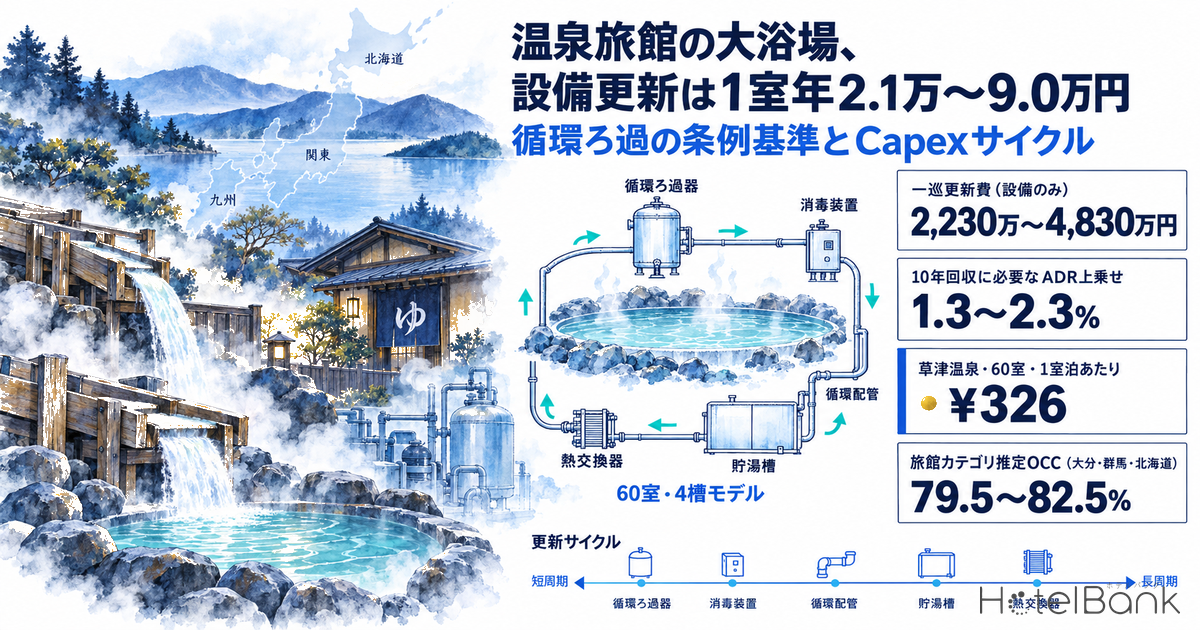
When people talk about capital spending at onsen inns, the discussion usually stops at guest rooms and dining. Yet among the assets that actually justify the room rate, the bath facility is the second engine alongside the rooms. And unlike rooms, this engine has a legal minimum imposed from outside. Once a property runs a recirculating filtration system, the disinfectant concentration in the bath water, the backwash frequency and the number of water-quality tests are set by ordinance, not left to the operator’s discretion.
This article narrows its focus to the equipment downstream of the bathtub — recirculating filters, disinfection units, circulation piping, hot-water storage tanks and heat exchangers — and sets out the standards the law requires, the replacement cycles, and the capital expenditure (Capex) built up for standard 30-, 60- and 120-room models. It then quantifies the payback hurdle for a bath upgrade using the estimated settled ADR tiers of six onsen towns in Oita, Gunma and Hokkaido.
How this article differs from earlier pieces
We covered the water rights behind onsen supply in “Who Owns the Hot Spring? Water Rights and Ryokan Valuation”, and have separately examined the cost of drilling, piping or buying hot-spring water and listed hotel REITs’ disclosed Capex, which runs to ¥130,000–¥620,000 per room per year. This article does not overlap with any of those; it is limited to the equipment downstream of the bathtub.
Metric Definitions Used in This Article
- ADR (estimated settled average daily rate): An estimated settled rate (tax-exclusive equivalent), calculated by applying a segment-specific correction factor to the lowest plan price each property publishes on major booking sites (two guests, one room, per-room rate, tax-inclusive). Checked against property-level results disclosed by listed hotel REITs (91 properties, latest three months), the median error is about 7%. These are estimates and differ from each property’s actual transaction prices and accounting figures. Area-level ADR is the median of the properties covered (the level of a typical property in the area).
- OCC (occupancy): The share of rooms sold out of total rooms in the area (an estimate based on OTA sales inventory). It differs from a property’s actual occupancy.
- Capex (capital expenditure): In this article, the construction cost of installing or replacing the bath’s mechanical equipment (recirculating filters, disinfection units, circulation piping, hot-water storage tanks, heat exchangers, heat sources and control panels). Bathroom interiors and waterproofing/tiling of the tubs themselves are shown separately.
- Data sources: MetroEngines Research & Consulting / Ministry of Health, Labour and Welfare / Ministry of Land, Infrastructure, Transport and Tourism
- — What actually binds bath hygiene standards is not the national guidelines but each prefecture’s ordinances under the Public Bathhouse Act and the Inns and Hotels Act. Until you read the ordinance where the target property sits, neither the required specification nor the annual cost is settled.
- — Bath-water testing is required once, twice or four times a year depending on how the bath is operated, so two four-bath inns can face a 4x gap in annual testing cost. Annual compliance cost for a 60-room, four-bath inn is ¥280,000–¥860,000.
- — One full replacement cycle for the 60-room, four-bath model costs ¥22.3M–¥48.3M. The annual reserve per room is ¥32,000–¥90,000 at 30 rooms and ¥21,000–¥59,000 at 120 rooms: quadrupling the scale cuts the burden by only 30–40%.
- — Whether free-flowing (kakenagashi) operation makes sense is decided by three variables: water volume, source temperature and wastewater tariff. Where sewerage charges are ¥100 per cubic metre or more, wastewater alone opens a gap of ¥4M+ a year, and keeping recirculation wins.
- — Working back from the estimated settled ADR tiers of six onsen towns, the rate uplift needed for a 10-year payback is 1.3–2.3% of the median — just 2.5–8.2% of the median-to-upper-quartile gap (+19.7% to +89.7%).
Where the obligation lies — national guidelines advise, prefectural ordinances bind
First, the regulatory hierarchy. The Ministry of Health, Labour and Welfare documents most often cited on bath hygiene — the “Hygiene Management Guidelines for Public Bathhouses”, the “Hygiene Management Guidelines for Inns and Hotels” and the “Guidelines on Water Quality Standards for Public Bathhouses” — are all technical guidelines, not laws that directly bind operators. As the guidelines themselves state at the outset, they are provided as a reference for prefectural governors when setting, by ordinance, standards for bath structure, equipment and hygiene measures.
The standards operators must actually meet are therefore in the ordinances enforcing the Public Bathhouse Act and the Inns and Hotels Act — that is, each prefecture’s own ordinances. Shimane Prefecture’s summary of its ordinance amendments, published in December 2020, explains this structure clearly: following the revision of the national technical guidelines on September 19, 2019, the prefecture amended the corresponding provisions in both ordinances. The same content also sits in the Inns and Hotels Act ordinance because ryokan with large communal baths are high-risk facilities; Shimane added Legionnaires’ disease provisions to the inn-side ordinance in 2005.
This two-tier structure — national guidelines, then prefectural ordinances — has two practical implications for investment decisions. First, until you read the ordinance of the prefecture where the acquisition target sits, neither the required equipment specification nor the annual testing cost is settled. Second, because ordinances are amended to follow revisions of the national guidelines, specifications that complied at acquisition may later require additional work. The Japan Building Maintenance and Management Education Center (a public interest foundation) publishes a “Database of Ordinances and Guidelines on Legionnaires’ Disease Control” that lists, for 66 jurisdictions — the 47 prefectures and 19 designated cities — the year each rule was enacted and revised, in three groups: building-hygiene law, bath facilities (public bathhouses, inns and hotels), and other. It is a practical starting point for due diligence.
Standards set by the national guidelines (as revised September 2019)
Start with the baseline: the national guidelines, narrowed to the items that feed directly into capital spending and operating cost.
| Item | Standard in the national guidelines | Effect on investment and operations |
|---|---|---|
| Free residual chlorine in bath water | Normally keep around 0.4 mg/L and try not to exceed 1 mg/L. For combined chlorine (monochloramine), around 3 mg/L. Keep measurement records for three years | Permanent automatic dosing equipment and record-keeping |
| High-pH spring water | Verify disinfection efficacy with Legionella testing and set free residual chlorine somewhat higher at about 0.5–1 mg/L, or use monochloramine disinfection | Disinfection method depends on water chemistry |
| Bath-water quality testing | At least once a year for water not filtered or fully replaced daily; at least twice a year for water used on consecutive days; at least four times a year where chlorine is not the disinfectant. Keep results for three years | Annual testing cost moves 3–4x with the method |
| Bath-water quality standards | Legionella below 10 cfu/100 mL, coliform bacteria no more than 1 per mL, turbidity no more than 5 degrees, organic matter (TOC) no more than 8 mg/L | Design values for filtration capacity and refill frequency |
| Bath-water replacement | Fully replace and clean daily; where this is difficult, fully replace and clean at least once a week | Floor on water volume and wastewater cost |
| Filters and circulation piping | Backwash filters thoroughly at least once a week, and remove and disinfect biofilm in filters and circulation piping by suitable methods. Map piping on drawings and remove redundant runs | Assumes a structure that can be backwashed |
| Filter configuration | Preferably one per bath. Filtration capacity of at least the bath volume per hour. Hair catcher upstream of the filter | Number of baths can equal number of filtration systems |
| Hair catcher | Clean and disinfect daily | Fixes a daily labour requirement |
| Hot-water storage tank | Keep at 60°C or above, and at least 55°C even at peak use. Where this is difficult, install a disinfection unit and monitor biofilm | Floor on heat-source capacity and fuel cost |
| Showers | Run water at least weekly. Inspect heads and hoses at least every six months, and clean and disinfect internal dirt and scale at least once a year | Annual cleaning budget |
| Collection tank | Avoid underground placement; use a location and structure that is easy to clean, with equipment to disinfect the tank water | Layout constraint during renovation |
| Overhead-fall baths and showers | Must not be structured to use recirculated bath water | Design requirement for separate systems |
| Drainage and waste-heat exchangers | Clean as needed and disinfect at least monthly | Heat-recovery equipment is also covered |
Source: Compiled by MetroEngines Research & Consulting from the Ministry of Health, Labour and Welfare’s “Hygiene Management Guidelines for Public Bathhouses” and “Guidelines on Water Quality Standards for Public Bathhouses” (revised September 19, 2019)
The first figure investors should look at is in the third row of the table: the required frequency of bath-water testing splits into once, twice or four times a year depending on how the bath is operated. A free-flowing bath fully replaced daily needs one test a year; a filtered bath used on consecutive days needs two; a bath disinfected by something other than chlorine needs four. Two inns with the same four baths can see a fourfold gap in annual testing cost simply because they operate differently.
Prefectural add-ons — the Shimane and Kanagawa examples
Prefectures build on the national guidelines but add or tighten items of their own. Here are the latest amendments in two prefectures whose primary documents are available.
| Jurisdiction | Amendment timing | Key changes |
|---|---|---|
| Shimane | December 2020 (effective on promulgation) | 1. For water that is filtered or not fully replaced within 24 hours, the residual chlorine target for chlorine-based disinfectants changed from “about 0.2–0.4 mg/L” to “about 0.4 mg/L”; a 3 mg/L monochloramine standard was added 2. Whenever a recirculating bath holds water, the filter and disinfection unit must run at all times(new) 3. Where a hair catcher is installed, clean and disinfect it daily 4. Run shower water at least weekly, inspect heads and hoses at least every six months, and clean and disinfect internal dirt and scale at least once a year (new) 5. Clean and disinfect bubble generators regularly so biofilm does not form (new) 6. Clean and disinfect the inside of collection tanks at least weekly, and disinfect tank water with chlorine-based agents or similar |
| Kanagawa | Effective April 1, 2025 | The bath-water test item changed from “coliform bacteria” to “E. coli”. Amended bath-water standards: turbidity no more than 5 degrees, organic matter (total organic carbon) no more than 8 mg/L, E. coli no more than 1 per mL, Legionella below 10 cfu/100 mL. Source and make-up water: colour no more than 5 degrees, turbidity no more than 2 degrees, pH 5.8–8.6, E. coli not detected, Legionella below 10 cfu/100 mL. Where chlorinated isocyanurates are used as the disinfectant, test potassium permanganate consumption instead of total organic carbon |
Source: Compiled by MetroEngines Research & Consulting from Shimane Prefecture, “Summary of Amendments to the Public Bathhouse Act and Inns and Hotels Act Enforcement Ordinances” (December 2020, Pharmaceutical Affairs and Hygiene Division) and Kanagawa Prefecture, “Revision of Water Quality Standards for Inns, Hotels and Public Bathhouses”
Shimane’s item 2 weighs especially heavily on capital spending. The provision “whenever the bath holds water, the filter and disinfection unit must run at all times” rules out stopping pumps overnight to save power. Circulation pumps and disinfection units must therefore be sized and specified for 24-hour operation, and it is safer to assume an effective equipment life shorter than the catalogue figure. Item 6, weekly cleaning of collection tanks, can itself trigger a renovation at inns with old underground tanks. The national guidelines call for “a location and structure that avoids underground placement and is easy to clean” precisely to make this work practicable.
In Kanagawa’s amendment, what matters in practice is less the numbers than the change in test method. At inns using chlorinated isocyanurates, the organic-matter indicator becomes potassium permanganate consumption rather than total organic carbon. The choice of disinfectant changes the test items, and the test items change the testing price. This “chemical → test → record” chain is what owners taking over an inn through succession most easily overlook.
Turning testing, records and daily upkeep into an annual cost
Now convert what the rules require into operating cost. The standard model is 60 rooms with separate men’s and women’s baths — one indoor and one outdoor bath each, four baths in total — and six samples: the four baths plus two of source and make-up water. Legionella testing is priced at ¥5,500–¥8,800 per sample (tax-inclusive) based on laboratories’ published fees, and general water-quality items such as turbidity, E. coli and organic matter at ¥5,000–¥10,000 per sample.
| Testing frequency (bath water) | Applicable operating method | Legionella | General water quality | Annual total |
|---|---|---|---|---|
| At least once a year | No filter / fully replaced daily | ¥33,000–¥53,000 | ¥30,000–¥60,000 | ¥63,000–¥113,000 |
| At least twice a year | Filtered, used on consecutive days (chlorine disinfection) | ¥66,000–¥106,000 | ¥60,000–¥120,000 | ¥126,000–¥226,000 |
| At least four times a year | Non-chlorine disinfection (ozone, silver ions, etc.) | ¥132,000–¥211,000 | ¥120,000–¥240,000 | ¥252,000–¥451,000 |
Source: Estimated by MetroEngines Research & Consulting from the testing frequencies in the Ministry of Health, Labour and Welfare’s “Guidelines on Water Quality Standards for Public Bathhouses” and laboratories’ published fees (¥5,500–¥8,800 per sample). Assumes 60 rooms and six samples: four baths plus two of source/make-up water
Testing alone costs ¥60,000 to ¥450,000 a year — small next to Capex. What really bites is the labour of daily upkeep: daily cleaning and disinfection of hair catchers, frequent free-chlorine measurement with three years of records, weekly filter backwashing, weekly biofilm removal from circulation and level-gauge piping, and weekly cleaning of collection tanks. Added up, this is 30–45 minutes of dedicated work a day — 183–274 hours a year, or ¥220,000–¥410,000 a year at ¥1,200–¥1,500 an hour. It grows roughly in line with the number of baths.
Testing plus daily-upkeep labour therefore puts annual compliance cost for a 60-room, four-bath inn at roughly ¥280,000–¥860,000 a year. Chemical costs vary widely with water chemistry and volume, so they are shown separately; the free-flowing vs. recirculation comparison below assumes ¥300,000–¥600,000 a year. Statutory inspection and reporting beyond the baths — periodic building inspections under Article 12 of the Building Standards Act, fire-safety inspections and building-hygiene law — adds a further cost layer of its own.
Component replacement cycles — 3-year and 30-year cycles in one system
What makes bath equipment tricky is that components with very different replacement cycles are connected in series in one system. Filter media are swapped every 3–5 years, the tanks holding them last 12–15 years, and the circulation piping linking those tanks lasts 20–30 years. For tax purposes, the statutory useful life is a flat 15 years for water supply, drainage, sanitary and gas equipment, and boiler equipment installed in a building (output of 22 kW or less) is also classed at 15 years — but, as shown, actual physical lives vary by component.
The table below shows, for a standard 60-room, four-bath, two-system model, the replacement cycle and cost range by component and the resulting annual reserve.
| Component | Replacement cycle | Replacement cost (60-room model) | Annual reserve |
|---|---|---|---|
| Filter media (sand, cartridge, diatomaceous earth) | 3–5 years | ¥300,000–¥800,000 | ¥60,000–¥270,000 |
| Recirculating filter unit (filter tank, circulation pump) | 12–15 years | ¥7M–¥12M | ¥0.47M–¥1M |
| Disinfection unit (automatic chlorine dosing + ozone / silver ions) | 8–12 years | ¥1.5M–¥3.5M | ¥130,000–¥440,000 |
| Circulation piping replacement | 20–30 years | ¥4M–¥9M | ¥130,000–¥450,000 |
| High-pressure / chemical cleaning of circulation piping | 1 year | ¥150,000–¥400,000 | ¥150,000–¥400,000 |
| Hot-water storage tank | 15–20 years | ¥2.5M–¥6M | ¥130,000–¥400,000 |
| Heat exchanger | 12–15 years | ¥2M–¥4.5M | ¥130,000–¥380,000 |
| Heat source (boiler / heat pump) | 15 years | ¥3M–¥8M | ¥200,000–¥530,000 |
| Control panel and inverter-driven pumps | 15–20 years | ¥2M–¥4.5M | ¥100,000–¥300,000 |
| Total (one full replacement cycle, excluding annual cleaning) | — | ¥22.3M–¥48.3M | ¥1.49M–¥4.16M |
Source: Compiled by MetroEngines Research & Consulting from published construction cost ranges, manufacturer materials, case studies in the Ministry of the Environment’s “Guide to Promoting High-Efficiency Retrofits of Hot-Spring Equipment” and the National Tax Agency’s useful-life tables (estimates for a standard model of 60 rooms with separate men’s and women’s baths, one indoor and one outdoor bath each — four baths, two systems)
Source: MetroEngines Research & Consulting (estimate for the standard 60-room, four-bath, two-system model)
Two points stand out. First, the filter unit and circulation piping are the big-ticket items, together accounting for about half of a full replacement cycle. Second, because the cycles are staggered, this is not “one big project every 20 years” but continuous spending, with something coming due every few years. Owners who have just taken over an inn often run into cash-flow trouble precisely because this continuity was not built into the annual budget. Japan’s Financial Statements Statistics of Corporations also show that the lodging industry as a whole spends well above its depreciation charge on capital investment.
The Ministry of the Environment’s “Guide to Promoting High-Efficiency Retrofits of Hot-Spring Equipment” notes that much centralised hot-spring supply equipment is 30–40 years old and due for renewal, and that continuing to run equipment that needs replacing leads to leaks and breakdowns. Among the guide’s case studies, Yugawara Onsen renovated control panels and installed inverters at five sites over five years, at a project cost of about ¥15M–¥25M per site, cutting annual electricity bills by about ¥0.5M–¥1.2M per site. At Shin-Nasu Onsen, insulating the supply pipes raised the delivery temperature by 9°C, from 49°C to 58°C, saving about 124,101 litres of kerosene-equivalent a year. A replacement is a cost, but it is also a permanent fuel-saving device — a point that cannot be ignored when discussing payback periods.
30, 60 and 120 rooms — ¥21,000 to ¥90,000 per room per year
Bath facilities do not grow in proportion to room count. A 30-room inn still needs separate large baths for men and women, and a 120-room inn’s baths are rarely four times the size of a 30-room inn’s. We therefore took the 60-room model as the base and applied scale factors of 0.65x for 30 rooms and 1.70x for 120 rooms.
| Size | Full-cycle replacement cost (equipment only) | Full cycle per room | Annual reserve per room |
|---|---|---|---|
| 30 rooms | ¥14.5M–¥31.4M | ¥0.48M–¥1.05M | ¥32,000–¥90,000 |
| 60 rooms | ¥22.3M–¥48.3M | ¥370,000–¥810,000 | ¥25,000–¥69,000 |
| 120 rooms | ¥37.9M–¥82.1M | ¥320,000–¥690,000 | ¥21,000–¥59,000 |
Source: MetroEngines Research & Consulting (estimates scaled from the 60-room model with scale factors of 0.65 / 1.00 / 1.70; excludes bathroom interiors and waterproofing/tiling of the tubs)
Source: MetroEngines Research & Consulting (estimates for bath mechanical equipment only) / total Capex levels disclosed by listed REITs from an earlier HotelBank article
Now compare this with the Capex disclosed by listed hotel REITs, which ranges from ¥130,000 to ¥620,000 per room per year. The annual reserve for bath mechanical equipment in this article is ¥21,000–¥90,000 per room, so the bath system alone can account for roughly 5% to 35% of total disclosed Capex. Within a total that covers rooms, common areas, exteriors and fire safety, the equipment downstream of the bathtub carries that much weight. When pricing the acquisition of a property with hot springs, ignoring the remaining life of this one system is a serious risk.
The scale effect is just as clear. The annual reserve per room is ¥32,000–¥90,000 at 30 rooms and ¥21,000–¥59,000 at 120 rooms: even at four times the scale, per-room Capex falls by only 30–40%. Bath equipment is a classic fixed-cost asset, and the smaller the inn, the heavier the per-room burden. Put the other way, if a small inn keeps its baths but cannot raise its rates, this asset ends up squeezing profits — which leads to the payback question in the second half of this article.
Total cost including bathroom interiors
In practice, mechanical equipment replacement and bathroom interior renovation are often done together. Published construction-cost guides put waterproofing and re-tiling around the tubs alone at the ¥10M level, filter replacement from ¥5M and heat-source replacement from ¥3M, with full renovations quoted anywhere from ¥20M to ¥100M. Adding ¥10M–¥20M of interior work to this article’s equipment model (¥22.3M–¥48.3M for 60 rooms) puts a full 60-room renewal at roughly ¥32M–¥68M, consistent with the published range.
Subsidies can sometimes be applied to large-bath renovations. They centre on renewable energy and energy-saving equipment: renewable systems such as solar thermal and ground-source heat, energy-efficient heat sources such as high-efficiency boilers and heat pumps, and heat-recovery and hot-water storage systems are the most likely to qualify. Subsidy rates of about one-third to one-half of construction cost are said to be typical, and the Ministry of the Environment also publicises a subsidy programme for high-efficiency retrofits of hot-spring equipment. Filters and piping themselves rarely qualify, while heat sources, storage tanks and heat exchangers qualify more easily — an asymmetry that affects how replacements should be sequenced.
Free-flowing or recirculating: which wins on total cost?
Inns with ample hot-spring flow can drop recirculating filtration and switch to free-flowing (kakenagashi) baths. The replacement burden for filters, disinfection units and filter media disappears, and bath-water testing drops from at least twice a year to at least once. The national guidelines themselves cite, as one example of a case where chlorine-based disinfectants cannot be used, a bath without circulation piping whose source/make-up water flow is large relative to bath volume, making it hard to maintain free residual chlorine (while still requiring that the bath water be fully replaced daily and that tubs, filters and circulation piping be thoroughly cleaned and disinfected).
Free-flowing baths, however, keep discharging water and fuel. Which option wins on total cost is decided by water volume, source temperature and the cost of treating wastewater. We modelled a 60-room inn with four baths holding 24 cubic metres in total. The free-flowing case runs 100 litres a minute (generally regarded as the threshold for free-flowing operation, enough for roughly 100 bathers a day); the recirculating case takes 20 litres a minute of make-up water. Assumptions: kerosene at ¥140 per litre, 85% boiler efficiency and electricity at ¥25 per kWh.
| Annual running cost (60 rooms, 4 baths) | Free-flowing (100 L/min) | Recirculating (20 L/min make-up) |
|---|---|---|
| Heating fuel (5°C gap between source and bath) | ¥4.94M | ¥3.46M |
| Heating fuel (7°C gap) | ¥6.92M | ¥3.85M |
| Heating fuel (10°C gap) | ¥9.88M | ¥4.45M |
| Circulation pump electricity | — | ¥720,000 |
| Chemicals | — | ¥300,000–¥600,000 |
| Bath-water quality testing | ¥63,000–¥113,000 (at least once a year) | ¥126,000–¥226,000 (at least twice a year) |
| Annual reserve for filtration equipment (filter, disinfection unit, filter media) | — | ¥0.65M–¥1.7M |
| Subtotal excluding wastewater (7°C gap) | ¥6.98M–¥7.03M | ¥5.65M–¥7.1M |
Source: Estimated by MetroEngines Research & Consulting (60 rooms, four baths totalling 24 m³; kerosene ¥140/L, boiler efficiency 85%, electricity ¥25/kWh. Free-flowing at 100 L/min; recirculating at 20 L/min make-up plus compensation for bath heat loss)
Excluding wastewater, the two options are almost evenly matched. Wastewater decides it.
| Sewerage tariff | Free-flowing: annual wastewater cost | Recirculating: annual wastewater cost | Difference |
|---|---|---|---|
| ¥0 per m³ (river discharge, special treatment for hot-spring effluent, etc.) | ¥0 | ¥0 | ¥0 |
| ¥50 per m³ | ¥2.63M | ¥530,000 | ¥2.1M |
| ¥100 per m³ | ¥5.26M | ¥1.05M | ¥4.21M |
| ¥200 per m³ | ¥10.51M | ¥2.1M | ¥8.41M |
Source: Estimated by MetroEngines Research & Consulting (free-flowing 52,560 m³ a year; recirculating 10,512 m³)
Source: Estimated by MetroEngines Research & Consulting (7°C gap between source and bath; 60-room, four-bath model)
The conclusion: where wastewater is not connected to the sewer, or the tariff for hot-spring effluent is close to zero, going free-flowing can pay off, because it eliminates ¥0.65M–¥1.7M a year of filtration Capex along with the testing and upkeep labour. Conversely, where sewerage charges are ¥100 per cubic metre or more, wastewater alone opens a gap of ¥4M+ a year and keeping recirculation wins. Source temperature then comes in: if the source is close to bath temperature, a free-flowing bath’s fuel burden is light, but an inn drawing water 10°C below bath temperature sees free-flowing fuel costs swell to ¥9.88M a year. Sewerage tariffs themselves differ by more than 2x between municipalities, so this variable should be pinned down at the site-selection stage (Hotel Water and Sewer Costs Differ 2.1x by Municipality estimates the annual gap per 100 rooms).
In short, the free-flowing decision rests on three variables — water volume, source temperature and wastewater tariff — and if any one of them is unfavourable, lighter Capex cannot make up for it. It is worth weighing these alongside the cost of sourcing piped-in hot-spring water and the inn’s heating-fuel bill.
Assessing payback — rate tiers in six onsen towns and the uplift required
The spending side is now fixed. Next comes recovery. We checked, against actual market data, the rate bands a bath upgrade could target. For six onsen towns — Oita (Beppu Onsen, Yufuin), Gunma (Kusatsu Onsen, Minakami Onsen) and Hokkaido (Noboribetsu Onsen, Lake Toya Onsen) — we aggregated the estimated settled ADR of properties with 10 or more rooms within a 4–8 km radius of each town centre, property by property, and grouped them into quartile tiers.
Source: MetroEngines Research & Consulting / circle size = rooms in radius; colour = estimated settled ADR median
Rate tiers by onsen town
| Onsen town (radius) | Properties / rooms in radius | Sample N | Lower quartile | Median | Upper quartile | Top 10% | Median → upper quartile |
|---|---|---|---|---|---|---|---|
| Beppu Onsen (6 km) | 349 properties / 9,078 rooms | 92 | ¥10,000 | ¥16,300 | ¥20,800 | ¥31,500 | +¥4,500 (+27.8%) |
| Yufuin (5 km) | 332 properties / 2,548 rooms | 64 | ¥17,700 | ¥25,800 | ¥36,100 | ¥47,100 | +¥10,400 (+40.3%) |
| Kusatsu Onsen (4 km) | 220 properties / 3,832 rooms | 60 | ¥13,700 | ¥19,600 | ¥25,900 | ¥34,800 | +¥6,300 (+32.1%) |
| Minakami Onsen (8 km) | 121 properties / 1,903 rooms | 21 | ¥13,900 | ¥20,100 | ¥24,100 | ¥32,900 | +¥4,000 (+19.7%) |
| Noboribetsu Onsen (6 km) | 32 properties / 2,170 rooms | 16 | ¥15,300 | ¥18,300 | ¥22,400 | ¥24,800 | +¥4,100 (+22.2%) |
| Lake Toya Onsen (6 km) | 66 properties / 2,117 rooms | 16 | ¥10,300 | ¥14,300 | ¥27,100 | ¥42,100 | +¥12,800 (+89.7%) |
Source: MetroEngines Research & Consulting (estimated settled ADR for October 2025–September 2026, averaged over 12 months per property and split into quartiles. Covers properties with 10+ rooms within 4–8 km of each onsen town centre and estimated settled ADR available for at least six months; based on listings on major booking sites; N=269 properties)
Source: MetroEngines Research & Consulting (N=269 properties in six onsen towns; based on listings on major booking sites)
Tier depth varies enormously between towns. Lake Toya Onsen has the deepest gap from median to upper quartile at +89.7%, followed by Yufuin at +40.3%. Minakami Onsen (+19.7%) and Noboribetsu Onsen (+22.2%) are shallow. In deep towns there is plenty of room to reach the upper band; in shallow towns, even reaching it offers limited rate upside. This part of the upside structure is determined by location itself.
Beppu Onsen’s lower quartile, at ¥10,000, is the lowest of the six because simple lodgings and small properties make up a large share of its 9,078 rooms in radius — while the top 10% in the same radius reaches ¥31,500. A threefold rate spread within a single onsen town is invisible if you look only at averages.
Recover through occupancy or through rate?
To decide how an upgrade will pay for itself, first check how much room there is on occupancy. Estimated OCC for the ryokan category in the three prefectures is as follows.
| Prefecture | May 2026 | Jun | Jul | Aug | Average | Properties / rooms covered |
|---|---|---|---|---|---|---|
| Oita | 83.3% | 76.7% | 76.7% | 81.1% | 79.5% | 144–215 properties / 2,737–3,519 rooms |
| Gunma | 81.4% | 79.6% | 81.2% | 87.6% | 82.5% | 129–162 properties / 4,304–4,996 rooms |
| Hokkaido | 76.6% | 81.9% | 85.2% | 86.4% | 82.5% | 152–165 properties / 6,714–7,213 rooms |
Source: MetroEngines Research & Consulting (ryokan category, estimated OCC, based on listings on major booking sites. Coverage: Oita N=144–215 properties, Gunma N=129–162, Hokkaido N=152–165. Shown as ranges because the number of properties varies by month)
In all three prefectures, estimated ryokan OCC in the peak season is 79.5–82.5%, so there is no large slack on the occupancy side. Gunma reached 87.6% in August and Hokkaido 86.4%, meaning peak demand is nearly fully absorbed. At these levels, a plan to “recover the bath upgrade by lifting occupancy” is hard to make work. Recovery has to come through rate — the common answer across all three prefectures.
A 10-year payback needs a rate uplift of just 1.3–2.3%
So how much must rates rise for the capital spending to pay off? Assuming one full replacement cycle for the 60-room model (midpoint ¥35.3M) is recovered over 10 years, with 60% of incremental revenue retained as profit, the required uplift per occupied room-night is as follows.
| Onsen town | Median ADR | Uplift needed 30 rooms | Uplift needed 60 rooms | Uplift needed 120 rooms | 60 rooms: % of median | 60 rooms: share of tier gap |
|---|---|---|---|---|---|---|
| Beppu Onsen | ¥16,300 | ¥439 | ¥338 | ¥287 | 2.1% | 7.5% |
| Yufuin | ¥25,800 | ¥439 | ¥338 | ¥287 | 1.3% | 3.3% |
| Kusatsu Onsen | ¥19,600 | ¥423 | ¥326 | ¥277 | 1.7% | 5.2% |
| Minakami Onsen | ¥20,100 | ¥423 | ¥326 | ¥277 | 1.6% | 8.2% |
| Noboribetsu Onsen | ¥18,300 | ¥423 | ¥326 | ¥277 | 1.8% | 8.0% |
| Lake Toya Onsen | ¥14,300 | ¥423 | ¥326 | ¥277 | 2.3% | 2.5% |
Source: Estimated by MetroEngines Research & Consulting (midpoint full-cycle replacement cost recovered over 10 years at a 60% incremental margin; occupancy set at each prefecture’s estimated ryokan OCC of 79.5–82.5%)
Source: Estimated by MetroEngines Research & Consulting (60-room model, 10-year payback, 60% incremental margin)
This table holds the most important figures in the article. The rate uplift needed to recover a full bath-equipment replacement cycle over 10 years is only 1.3–2.3% of median ADR. For a 60-room inn in Kusatsu Onsen, that is ¥326 per occupied room-night — a 1.7% uplift on the ¥19,600 median. And because the median-to-upper-quartile gap runs from +19.7% to +89.7% across the towns, the required uplift closes just 2.5% to 8.2% of that gap.
Changing the assumptions does not change the conclusion. Varying the payback period and incremental margin for the 60-room Kusatsu Onsen model keeps the required uplift within 1.2% to 2.5% of the median.
| Assumption | 50% incremental margin | 60% incremental margin | 70% incremental margin |
|---|---|---|---|
| 8-year payback | ¥488 (2.5%) | ¥407 (2.1%) | ¥349 (1.8%) |
| 10-year payback | ¥391 (2.0%) | ¥326 (1.7%) | ¥279 (1.4%) |
| 12-year payback | ¥326 (1.7%) | ¥271 (1.4%) | ¥233 (1.2%) |
Source: Estimated by MetroEngines Research & Consulting (Kusatsu Onsen, 60-room model, estimated OCC of 82.5% for May–August 2026 (ryokan category aggregate, estimate, N=129–162 properties); figures in parentheses are ratios to the ¥19,600 median ADR)
The total cost of a full replacement cycle itself spans ¥22.3M–¥48.3M. Recasting that spread as optimistic, mid and pessimistic scenarios gives the following required uplift (Kusatsu Onsen, 60-room model, 10-year payback, 60% incremental margin, with estimated OCC fixed at 82.5% for May–August 2026 (ryokan category aggregate, estimate, N=129–162 properties) = 18,068 occupied room-nights a year).
| Scenario | Full-cycle replacement cost (60 rooms) | Uplift needed per room-night | vs. median ADR of ¥19,600 | Share of median-to-upper-quartile gap (+¥6,300) |
|---|---|---|---|---|
| Optimistic (low end) | ¥22.3M | ¥206 | 1.1% | 3.3% |
| Mid | ¥35.3M | ¥326 | 1.7% | 5.2% |
| Pessimistic (high end) | ¥48.3M | ¥446 | 2.3% | 7.1% |
Source: Estimated by MetroEngines Research & Consulting (this article’s component cost ranges mapped to optimistic / mid / pessimistic totals, recovered over 10 years at a 60% incremental margin and divided by 18,068 room-nights a year)
Even in the pessimistic scenario — replacement costs at the ¥48.3M upper bound — the required uplift is only 2.3% of median ADR and 7.1% of the tier gap. Uncertainty on the cost side does not reverse the conclusion. What decides payback is a single question: whether the upgraded bath is recognised as an upper-tier product.
The same holds if occupancy falls. Even with estimated OCC cut to 65%, the 60-room model needs an uplift of only ¥413 — 2.1% of Kusatsu Onsen’s median. The arithmetic is not the constraint.
The question therefore comes down not to the size of the investment or interest rates but to whether the upgrade actually moves the property up a rate tier. How to capture that upside depends on each town’s tier structure. Lake Toya Onsen and Yufuin have deep tier gaps (+89.7% and +40.3%), and the required uplift is a small share of them (2.5% and 3.3%), so edging closer to the upper band is enough to make payback credible. Minakami Onsen (8.2%) and Noboribetsu Onsen (8.0%), with shallower gaps, see the same ¥326 uplift take up 8% of the gap. In shallow towns, it is better to move up a tier through an integrated product that combines baths with dining and rooms, rather than with the bath alone.
Three side benefits that support payback
A rate uplift is not the only source of recovery. An upgrade also works on the operating-cost side.
| Benefit | What it involves and evidence |
|---|---|
| Permanent fuel savings | In one case, insulating supply pipes raised delivery temperature by 9°C and saved about 124,101 litres of kerosene-equivalent a year (Shin-Nasu Onsen supply, in the Ministry of the Environment guide). With storage tanks required to stay at 60°C or above, insulation performance feeds straight through to fuel costs |
| Lower electricity costs | Renovating control panels and fitting inverter-driven pumps cut consumption by 18,609 kWh a month across five sites. Annual electricity bills fell by about ¥0.5M–¥1.2M per site (Yugawara Onsen, in the Ministry of the Environment guide). Project cost was about ¥15M–¥25M per site |
| Using subsidies | Renewable systems, high-efficiency boilers, heat pumps and heat-recovery / hot-water storage systems tend to qualify for subsidies, with rates of about one-third to one-half of construction cost typical. The Ministry of the Environment also publicises a subsidy programme for high-efficiency retrofits of hot-spring equipment |
Source: Compiled by MetroEngines Research & Consulting from the Ministry of the Environment’s “Guide to Promoting High-Efficiency Retrofits of Hot-Spring Equipment” (March 2019)
If the 60-room model could cut annual fuel and electricity costs by 10%, the recirculating case would save ¥400,000–¥500,000 a year. That equals 7–8% of the ¥5.89M a year raised by the required uplift (¥326 × 18,068 room-nights). On its own it does not decide payback, but in towns with shallow tier gaps it is a support that cannot be ignored.
Seven items to check in due diligence
Whether you are acquiring, taking over or lending, these are the minimum items to check on bath equipment. All follow directly from the rules and replacement cycles covered in this article.
| Item to check | What to look for | |
|---|---|---|
| 1 | Ordinance text for the prefecture | The relevant provisions of the Public Bathhouse Act and Inns and Hotels Act enforcement ordinances. Differences from the national guidelines (residual chlorine levels, testing frequency, upkeep frequency for collection tanks, hair catchers and showers). Check enactment and revision years in the Japan Building Maintenance and Management Education Center’s ordinance database, and confirm the latest amendments have been addressed |
| 2 | Bath-water test records | Three years of retained records. Whether testing falls under once, twice or four times a year, and whether results have stayed within standards. Free residual chlorine records must also be kept for three years |
| 3 | Filter installation year and backwash records | If more than 12–15 years have passed since installation, a replacement reserve is needed. Whether filtration capacity meets “at least the bath volume per hour”. Whether weekly backwash records exist |
| 4 | Circulation piping drawings and routing | The national guidelines require operators to map piping accurately on drawings and remove redundant runs. An inn without drawings faces added renovation cost for that reason alone. Age-deterioration surveys can run to several million yen depending on scale (about ¥5M in the Izu-Nagaoka Onsen case) |
| 5 | Storage-tank temperature record | Whether 60°C or above (55°C or above at peak use) is maintained. If not, and a disinfection unit is used instead, that unit’s installation year and maintenance records |
| 6 | Water volume, source temperature and wastewater tariff | The three variables that decide whether free-flowing operation is viable: flow per minute, the gap between source and bath temperature, and whether the property is on the sewer and at what tariff |
| 7 | Collection-tank location and structure | Whether it is underground. Underground collection tanks are physically hard to clean and disinfect weekly and are prime renovation candidates |
Source: Compiled by MetroEngines Research & Consulting from the Ministry of Health, Labour and Welfare’s “Hygiene Management Guidelines for Public Bathhouses” and the Ministry of the Environment’s “Guide to Promoting High-Efficiency Retrofits of Hot-Spring Equipment”
Summary
Treating the bath facility as “the inn’s second engine” and putting it into numbers yields six points.
| Issue | Conclusion |
|---|---|
| Where the obligation lies | The Ministry of Health, Labour and Welfare’s management guidelines and water-quality guidelines are technical guidance; the actual obligations sit in each prefecture’s Public Bathhouse Act and Inns and Hotels Act enforcement ordinances. Until you read the ordinance where the target sits, neither the required specification nor the annual cost is settled |
| Prefectural add-ons | Shimane added a requirement to run filters and disinfection units continuously whenever a recirculating bath holds water, and specified weekly cleaning of collection tanks. Kanagawa changed the bath-water test item from coliform bacteria to E. coli from April 2025. Enactment and revision years for 66 jurisdictions can be tracked in the Japan Building Maintenance and Management Education Center’s database |
| Scale of Capex | One full replacement cycle for the 60-room, four-bath model costs ¥22.3M–¥48.3M. The annual reserve per room is ¥32,000–¥90,000 at 30 rooms, ¥25,000–¥69,000 at 60 rooms and ¥21,000–¥59,000 at 120 rooms. The bath system alone can account for roughly 5–35% of the total Capex disclosed by listed REITs (¥130,000–¥620,000 per room per year) |
| Replacement cycles | Filter media 3–5 years, filter units 12–15 years, disinfection units 8–12 years, circulation piping 20–30 years, storage tanks 15–20 years, heat exchangers 12–15 years. Staggered cycles make this continuous spending rather than a one-off project, so it must be built into annual budgets |
| Free-flowing or recirculating | Decided by three variables: water volume, source temperature and wastewater tariff. If the tariff is near zero, going free-flowing eliminates a ¥0.65M–¥1.7M annual filtration reserve; where sewerage charges are ¥100 per cubic metre or more, wastewater alone opens a gap of ¥4M+ a year and recirculation wins |
| Payback | Estimated ryokan OCC in the three prefectures is 79.5–82.5% in peak season, leaving little room on occupancy, so recovery has to come through rate. The uplift needed for a 10-year payback is 1.3–2.3% of median ADR (60-room model) — just 2.5–8.2% of each town’s median-to-upper-quartile gap (+19.7% to +89.7%) |
Bath equipment upgrades tend to be framed as defensive spending to meet a legal minimum. Laid out in numbers, however, the picture is that the rate uplift required is less than a tenth of the tier gap. The constraint lies not in the size of the investment but in whether the upgraded bath is actually recognised as an upper-tier product. The deeper a town’s tier gap, the greater the upside this one system holds.
About the estimates: Capex and running costs in this article are estimates from a standard model built on published construction-cost ranges, manufacturer materials and case studies from public bodies, and differ from quotes for individual properties. Actual amounts vary widely with the number of baths, water chemistry, the condition of existing piping and local labour rates. Estimated settled ADR and estimated OCC are estimates based on inventory listed on major booking sites and differ from each property’s actual transaction prices and occupancy. The payback estimates are simplified calculations assuming a constant incremental margin; actual investment decisions require a property-specific feasibility study.
Related Reading
- Who Owns the Hot Spring? Water Rights and Ryokan Valuation
- Urban Hotel Bath Facilities and ADR 2026
- Hotel Water and Sewer Costs Differ 2.1x by Municipality — Impact on NOI
References and Sources
■ Data sources
Estimated settled ADR is an estimated settled rate (tax-exclusive equivalent), calculated by applying a segment-specific correction factor to the lowest plan price each property publishes on major booking sites (two guests, one room, per-room rate, tax-inclusive). The 12 months from October 2025 to September 2026 were averaged per property, and the 269 properties with 10+ rooms within 4–8 km of each onsen town centre and data for at least 6 of the 12 months were split into quartiles. Estimated OCC is the listed-inventory sell-through rate for the ryokan category (May–August 2026; Oita N=144–215 properties / Gunma N=129–162 / Hokkaido N=152–165). Regulatory material: the Ministry of Health, Labour and Welfare’s management and water-quality guidelines, the Shimane and Kanagawa ordinance amendment documents, and the Japan Building Maintenance and Management Education Center’s ordinance database. Equipment costs: case studies in the Ministry of the Environment’s “Guide to Promoting High-Efficiency Retrofits of Hot-Spring Equipment”, the National Tax Agency’s useful-life tables, and published fee ranges from laboratories and contractors.
■ Modelling assumptions
The standard model is 60 rooms with separate men’s and women’s baths — one indoor and one outdoor bath each, four baths and two systems in total. 30 rooms and 120 rooms were scaled by factors of 0.65x and 1.70x. The running-cost comparison assumes baths totalling 24 cubic metres, kerosene at ¥140 per litre, 85% boiler efficiency, electricity at ¥25 per kWh, and flows of 100 litres a minute (free-flowing) / 20 litres a minute of make-up (recirculating). The payback estimate recovers the midpoint full-cycle cost of ¥35.3M over 10 years, assumes 60% of incremental revenue is retained as profit, applies each prefecture’s estimated ryokan OCC (79.5–82.5%), and divides by annual occupied room-nights (60 rooms × 365 days × 82.5% = 18,068). Daily upkeep labour is 30–45 minutes a day at ¥1,200–¥1,500 an hour.
■ Limitations
Capex and running costs are estimates from a standard model built on published ranges, manufacturer materials and public case studies, and differ from quotes for individual properties. Actual amounts swing widely with the number of baths, water chemistry, the condition of existing piping and local labour rates. Estimated settled ADR and estimated OCC are both estimates based on inventory listed on major booking sites and differ from each property’s actual transaction prices and occupancy. Because this article’s ADR quartiles are limited to properties with 10+ rooms and at least six months of data, they run a few percent above municipality-wide levels that include simple lodgings and small properties (4–10% higher than municipality-level aggregates for Beppu City, Kusatsu Town, Minakami Town and Yufu City). The payback estimates are simplified calculations assuming a constant incremental margin; actual investment decisions require a property-specific feasibility study. Ordinances can be amended, so check the latest text for the relevant municipality at the time of any investment review.
■ Market data
- MetroEngines Research & Consulting — estimated settled ADR (October 2025–September 2026, 269 properties in six onsen towns), estimated OCC (ryokan category, May–August 2026), properties and rooms in radius
■ Regulations and laws (primary sources)
- Ministry of Health, Labour and Welfare, “On the Hygiene Management Guidelines for Public Bathhouses” (Seiei-hatsu No. 1811, December 15, 2000; revised September 19, 2019) (Japanese)
- Ministry of Health, Labour and Welfare, “Hygiene Management Guidelines for Public Bathhouses” (Legionella control page) (Japanese)
- Ministry of Health, Labour and Welfare, “Handbook on Hygiene Management of Bathing Facilities” (Health and Labour Sciences Research Grant, Health Security and Crisis Management Research Program) (Japanese)
- Shimane Prefecture, “Summary of Amendments to the Public Bathhouse Act and Inns and Hotels Act Enforcement Ordinances” (December 2020, Pharmaceutical Affairs and Hygiene Division) (Japanese)
- Kanagawa Prefecture, “Revision of Water Quality Standards for Inns, Hotels and Public Bathhouses” (effective April 1, 2025) (Japanese)
- Japan Building Maintenance and Management Education Center, “Database of Ordinances and Guidelines on Legionnaires’ Disease Control” (47 prefectures + 19 designated cities = 66 jurisdictions) (Japanese)
- Japan Building Maintenance and Management Education Center, “Guidelines for the Prevention of Legionnaires’ Disease, 5th Edition” (Japanese)
- Shizuoka City, “Partial Revision of the Guidelines on Water Quality Standards for Public Bathhouses” (Japanese)
- Osaka Prefecture, “Manual for Preventing Legionnaires’ Disease in Bathing Facilities at Social Welfare Facilities” (April 2025) (Japanese)
■ Equipment and cost references
- Ministry of the Environment, “Guide to Promoting High-Efficiency Retrofits of Hot-Spring Equipment” (March 2019, Hot Spring Area Conservation and Utilization Office) (Japanese) — Yugawara Onsen control-panel and inverter retrofit case, Shin-Nasu Onsen supply piping retrofit case, Izu-Nagaoka Onsen age-deterioration survey cost
- Ministry of the Environment, “Conservation and Use of Hot Springs — Subsidies for High-Efficiency Retrofits of Hot-Spring Equipment” (Japanese)
- National Tax Agency, “Useful-Life Table for Depreciable Assets, Appended Table 1 (Building Fixtures)” (Japanese) — water supply, drainage, sanitary and gas equipment 15 years; boiler equipment 15 years
- Shokukanken (Food and Environment Hygiene Research Institute), “Legionella Testing Fees” (Japanese) / Saitama Food Hygiene Inspection Center, “Bath-Water Quality Testing: Items and Fees” (Japanese) / Tetlas Co., Ltd., “Periodic Legionella Testing” (Japanese) — prevailing per-sample prices
- Operating costs of large communal baths explained (Japanese) / Subsidies available for large-bath renovations (Japanese) — indicative construction-cost ranges and subsidy rates
- Case studies and pros and cons of recirculating filtration for hot springs (Japanese) / Replacing filter media (large-bath filtration maintenance) (Japanese) — filter-media replacement cycles and initial investment ranges for circulation equipment