

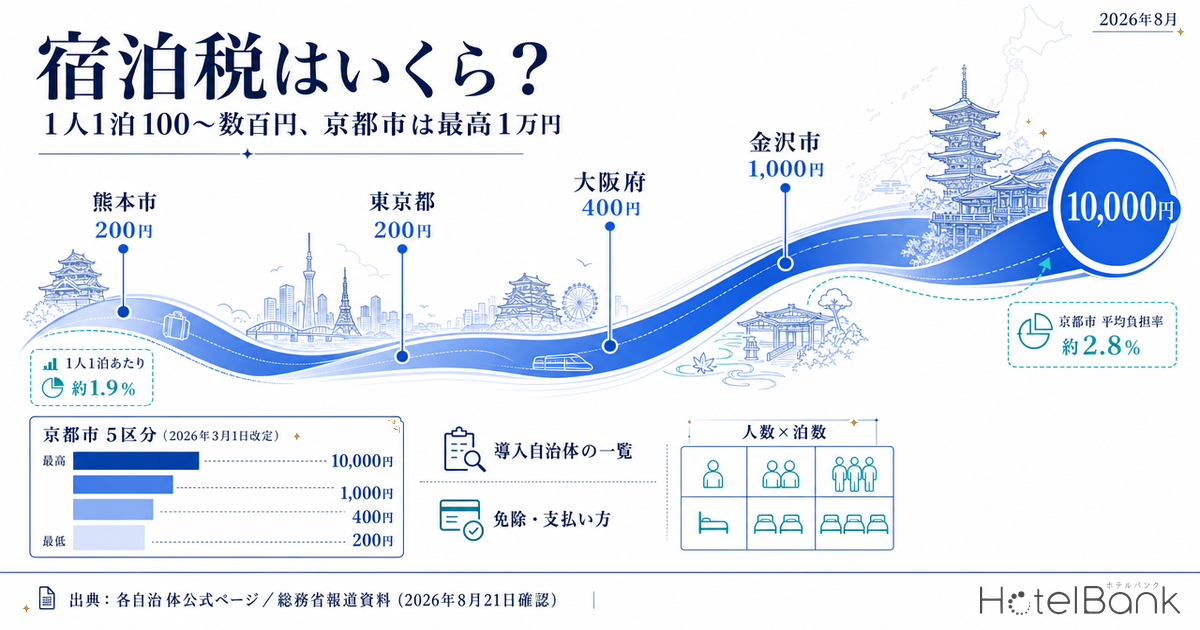
The lodging tax (shukuhaku-zei) is a local tax paid per person, per night by anyone staying at a hotel or ryokan in Japan — legally a non-statutory earmarked tax, and the amount depends on where you stay. Most municipalities charge a flat ¥100–several hundred per person per night, stepping up in bands as the room rate rises. Kyoto City is the exception: since the revision took effect on March 1, 2026, it runs five bands from ¥200 up to ¥10,000 per person per night. The tax is usually not included in the price shown on booking sites, and is typically paid separately at the property in cash or by card at check-in or check-out. This article answers the question “how much will my booking actually cost me” with a municipality-by-municipality table and worked examples calculated from real listed prices (tax amounts were verified against each municipality’s official page as of August 21, 2026).
• Tax amounts, exemption thresholds and effective dates were verified on August 21, 2026 against each municipality’s official pages and Ministry of Internal Affairs and Communications press releases. These systems are amended from time to time, so check the relevant municipality’s official page for the latest details before you book.
• Where listed prices are cited, they are per-room rates for two guests sharing one room (tax included). The per-person figure is that same price divided by two, given for reference only; it does not equal the room-only, tax-exclusive lodging charge used to determine the tax band.
• Source: HotelBank Editorial Team research (aggregated publicly listed OTA prices, as of August 16, 2026).
- — It is charged per person, per night. Two people for two nights means four charges. It is not per room, so multiply headcount by nights and add it to your budget.
- — Kyoto City has had five bands since March 1, 2026 (¥200 / ¥400 / ¥1,000 / ¥4,000 / ¥10,000). The top ¥10,000 band applies from ¥100,000 per person per night, which almost never comes up on an ordinary trip.
- — Cheaper stays are exempt in many places. It is ¥0 in Tokyo below ¥10,000 per person per night, in Osaka below ¥5,000, and in Hiroshima, Nagano and Miyagi below ¥6,000.
- — On a typical night the tax runs 2–3% of the room rate. In Kyoto City that is ¥400 on roughly ¥14,300 per person (about 2.8%); in Kumamoto City, ¥200 on roughly ¥10,300 (about 1.9%).
- — It is usually not included in the price shown on booking sites. You pay at the property at check-in or check-out. At an onsen property, the bathing tax (standard ¥150) is charged on top.
The short answer: around ¥200 per person per night in most cities, up to ¥10,000 only in Kyoto
Here is the overall picture first.
- The tax is levied per person, per night. Two people for two nights means four charges. It is not per room.
- The band is determined by the room-only charge (room rate plus service charge). Most municipalities — Kyoto City, Nagano Prefecture and Nasu Town among them — state officially that meals, consumption tax and the bathing tax are excluded. Even on a plan with breakfast, the band is read off the amount net of the meal.
- Cheaper stays are exempt in many places. It is ¥0 in Tokyo below ¥10,000 per person per night, in Osaka below ¥5,000, and in Hiroshima, Nagano and Miyagi below ¥6,000.
- Kyoto City has had five bands since March 1, 2026. On the room-only charge per person per night: under ¥6,000 → ¥200; ¥6,000 to under ¥20,000 → ¥400; ¥20,000 to under ¥50,000 → ¥1,000; ¥50,000 to under ¥100,000 → ¥4,000; ¥100,000 and above → ¥10,000.
- More are coming. Nasu Town (October 1, 2026; six bands from ¥100 to ¥3,000) and Morioka City (October 1, 2026; ¥200) are scheduled to start. Tokyo switches to a flat 3% of the room rate on April 1, 2027.
Kyoto City’s lodging tax (after the March 1, 2026 revision)
Kyoto City’s official page (“About the lodging tax”) states the revised rates and gives the effective date as March 1, 2026 (Reiwa 8). There are five bands, and the “lodging charge” used to determine the band is the room-only charge (room rate and service charge); meals and consumption tax are excluded.
| Lodging charge per person per night (room only, tax excl.) | Lodging tax (per person per night) | Before the revision (through February 28, 2026) |
|---|---|---|
| Under ¥6,000 | ¥200 | ¥200 |
| ¥6,000 to under ¥20,000 | ¥400 | ¥200 |
| ¥20,000 to under ¥50,000 | ¥1,000 | ¥500 |
| ¥50,000 to under ¥100,000 | ¥4,000 | ¥1,000 |
| ¥100,000 and above | ¥10,000 | ¥1,000 |
For example, two people in one room at ¥40,000 (¥20,000 per person) pay ¥1,000 × 2 = ¥2,000 for the night, separately from the room rate. At ¥19,000 per person per night it would be ¥400, so crossing the ¥20,000 line costs an extra ¥600 per person. Kyoto’s listed prices and bookings did move after the revision, but working out how much of that was the tax itself is a separate question from the one this article answers.
Municipalities that levy a lodging tax (as of August 2026)
All amounts are per person, per night. Bands are determined on a room-only, tax-exclusive basis as a rule, and the details are on each municipality’s official page. Where both a prefecture and a city levy the tax, the combined amount is shown.
| Municipality | Lodging tax (per person per night) | Exempt below | Effective / revised |
|---|---|---|---|
| Tokyo | ¥10,000 to under ¥15,000: ¥100 / ¥15,000 and above: ¥200 | Under ¥10,000 | October 2002 (changes to a flat 3% with a ¥13,000 exemption threshold from April 1, 2027) |
| Osaka | ¥5,000 to under ¥15,000: ¥200 / ¥15,000 to under ¥20,000: ¥400 / ¥20,000 and above: ¥500 | Under ¥5,000 | Revised September 1, 2025 |
| Kyoto City | Five bands: ¥200 / ¥400 / ¥1,000 / ¥4,000 / ¥10,000 (table above) | None | Revised March 1, 2026 |
| Kanazawa City | Under ¥20,000: ¥200 / ¥20,000 and above: ¥500 | Under ¥5,000 | April 2019 (exemption threshold added October 2024) |
| Hokkaido (prefectural tax) | Under ¥20,000: ¥100 / ¥20,000 to under ¥50,000: ¥200 / ¥50,000 and above: ¥500 | None | April 1, 2026 |
| Sapporo City (combined with the prefectural tax) | Under ¥20,000: ¥300 / ¥20,000 to under ¥50,000: ¥400 / ¥50,000 and above: ¥1,000 | None | April 1, 2026 |
| Kutchan Town (Niseko) | 3% of the lodging charge (flat rate, prefectural portion included) | None | Revised April 1, 2026 (2% → 3%) |
| Miyagi Prefecture + Sendai City | Within Sendai City ¥300 (prefecture ¥100 + city ¥200) / elsewhere in the prefecture ¥100 | Under ¥6,000 | January 13, 2026 |
| Nagano Prefecture | ¥200 (transitional measure through May 2029; ¥300 thereafter). Matsumoto City, Karuizawa Town, Hakuba Village and others add a municipal portion on top | Under ¥6,000 | June 1, 2026 |
| Hiroshima Prefecture | Flat ¥200 | Under ¥6,000 | April 1, 2026 |
| Fukuoka Prefecture, Fukuoka City, Kitakyushu City | Fukuoka City: under ¥20,000 ¥200 / ¥20,000 and above ¥500 (prefectural ¥50 included). Kitakyushu City: ¥200 (prefecture ¥50 + city ¥150). Elsewhere in the prefecture: ¥200 | None | April 1, 2020 |
| Nagasaki City | Under ¥10,000: ¥100 / ¥10,000 to under ¥20,000: ¥200 / ¥20,000 and above: ¥500 | None | April 1, 2023 |
| Kumamoto City | Flat ¥200 | None (children sharing a bed with no charge are out of scope) | July 1, 2026 |
| Miyazaki City | Flat ¥200 | None | July 1, 2026 |
The municipalities about to start or change are worth noting too. Nasu Town starts on October 1, 2026 with six bands from ¥100 (under ¥10,000) to ¥3,000 (¥100,000 and above), with under-12s exempt (town official page). Morioka City starts on October 1, 2026 at ¥200 per person per night (city official page; the Minister for Internal Affairs and Communications gave consent on March 27, 2026). These two are contrasting designs — banded versus flat — and our comparison of Nasu Town and Morioka City puts numbers on what percentage each actually adds to real room rates. Tokyo drops its flat-amount system on April 1, 2027 and switches to 3% of the lodging charge (exempt below ¥13,000). Okinawa Prefecture and municipalities within it — Nago, Ishigaki and Miyakojima among them — have obtained the Minister’s consent to introduce percentage-based systems (2% at the prefectural level, capped at ¥2,000); check each municipality’s official announcements for effective dates. If you are travelling for work, this rundown of tax levels and start dates across nine major prefectures and cities from a corporate-contract perspective (Innippon, in Japanese) is also useful.
What the tax costs on an average night — worked examples from Kyoto and Kumamoto
A table of rates alone makes it hard to see “what my own booking will cost,” so we took listed OTA prices (as of August 2026, per room for two guests, tax included), divided them per person, and applied the bands. Listed prices are aggregated by ward within each city and then weighted by the number of properties. Because the lodging tax band is properly determined on a room-only, tax-exclusive charge, the ratios below are, if anything, slightly conservative.
| Area and period | Listed price (per room, two guests, tax incl.) | Per person | Lodging tax (per person per night) | Share of the room rate |
|---|---|---|---|---|
| Kyoto City (weighted average of 11 wards), August 2026 | ¥28,533 (N=1,888 properties) | approx. ¥14,300 | ¥400 | approx. 2.8% |
| Kyoto City, Shimogyo Ward (around Kyoto Station), August 2026 | ¥27,411 (N=543 properties) | approx. ¥13,700 | ¥400 | approx. 2.9% |
| Kyoto City, Higashiyama Ward (autumn foliage season), October 2026 | ¥57,821 (N=362 properties) | approx. ¥28,900 | ¥1,000 | approx. 3.5% |
| Kumamoto City (weighted average of 5 wards), August 2026 | ¥20,534 (N=129 properties) | approx. ¥10,300 | ¥200 | approx. 1.9% |
| Kumamoto City, Chuo Ward, August 2026 | ¥18,077 (N=87 properties) | approx. ¥9,000 | ¥200 | approx. 2.2% |
Read it like this. If you stay in Kyoto City at the typical price band — roughly ¥13,000–15,000 per person — the lodging tax is ¥400 per person per night, or ¥800 for two. That is just under 3% of the room rate, small next to the 10% consumption tax. But when the per-person figure passes ¥20,000, as in Higashiyama Ward during the foliage season, you move into the ¥1,000 band: two people for two nights comes to ¥4,000. Kumamoto City is a flat ¥200, so it is easy to work out at any price point — ¥400 for two people for one night. The top ¥10,000 band in Kyoto City applies from ¥100,000 per person per night, meaning rooms above ¥200,000 for two sharing, which essentially never comes up on an ordinary trip.
What you will pay by headcount and nights — a quick-reference table
The lodging tax is simply “the per-person, per-night amount × number of people × number of nights.” Once you have found your municipality’s amount in the table above, you can read your total straight off this one. Every figure here is paid at the property, separately from the room rate.
| Tax per person per night | 1 person, 1 night | 2 people, 1 night | 2 people, 2 nights | 2 people, 3 nights | 4 people, 2 nights | Main municipalities and bands at this amount |
|---|---|---|---|---|---|---|
| ¥100 | ¥100 | ¥200 | ¥400 | ¥600 | ¥800 | Hokkaido (under ¥20,000), Nagasaki City (under ¥10,000), Miyagi Prefecture outside Sendai |
| ¥200 | ¥200 | ¥400 | ¥800 | ¥1,200 | ¥1,600 | Kumamoto City, Miyazaki City, Hiroshima Prefecture, Nagano Prefecture, Morioka City (from Oct 1), Kyoto City (under ¥6,000) and others |
| ¥300 | ¥300 | ¥600 | ¥1,200 | ¥1,800 | ¥2,400 | Sendai City (prefecture ¥100 + city ¥200) |
| ¥400 | ¥400 | ¥800 | ¥1,600 | ¥2,400 | ¥3,200 | Kyoto City (¥6,000 to under ¥20,000), Osaka (¥15,000 to under ¥20,000), Sapporo City (¥20,000 to under ¥50,000) |
| ¥500 | ¥500 | ¥1,000 | ¥2,000 | ¥3,000 | ¥4,000 | Kanazawa City, Nagasaki City, Fukuoka City, Hokkaido (top band in each case) |
| ¥1,000 | ¥1,000 | ¥2,000 | ¥4,000 | ¥6,000 | ¥8,000 | Kyoto City (¥20,000 to under ¥50,000), Sapporo City (¥50,000 and above) |
For example, two adults staying two nights in Kyoto City in a room at ¥6,000 to under ¥20,000 per person per night read the “2 people, 2 nights” cell on the ¥400 row: ¥1,600. Four people for two nights in Kumamoto City is the ¥200 row: ¥1,600. At an onsen property, the bathing tax (standard ¥150 × people × nights) is charged on top of that.
FAQ — the five points guests most often get stuck on
Are school excursions exempt? In most municipalities, pupils and students taking part in a school excursion or school event organised by a school (universities excluded), together with their supervising teachers, are exempt. Kyoto City, Nasu Town and Miyagi Prefecture / Sendai City all set out the exemption explicitly on their official pages. Whether club-activity training camps count varies by municipality, so the surest route is for the school to check with the property.
Do children pay? There is generally no blanket exemption by age. Kyoto City’s official FAQ states that the tax applies “regardless of the guest’s age, where a lodging charge arises.” Conversely, an infant sharing a bed with no lodging charge is not taxable, because no lodging charge arises (Kumamoto City states this explicitly). Some municipalities, such as Nasu Town, do exempt under-12s.
Does the tax change between room-only and half-board plans? As a rule the band is determined on the room-only charge (room rate plus service charge), excluding meals, consumption tax and the bathing tax. Even on a ¥21,000-per-person plan with breakfast, if the room-only charge net of breakfast is under ¥20,000 it falls in Kyoto City’s ¥400 band. Property receipts itemise the lodging charge, consumption tax and lodging tax separately.
How does it differ from the bathing tax? The bathing tax (nyuto-zei) is a separate municipal tax on people using hot springs, with a standard rate of ¥150 per person per day. At a property with an onsen, both the lodging tax and the bathing tax are charged outside the room rate. Stay at an onsen ryokan in Kyoto City at ¥15,000 per person per night and you will owe ¥400 lodging tax plus ¥150 bathing tax, or ¥550 extra. How the bathing tax feeds through to market room rates is covered in our piece on bathing-tax surcharges and room rates, so we leave it aside here.
Is it included in the price shown on booking sites, or paid on arrival? The lodging tax works by the property (as the designated collecting agent) receiving it from the guest and remitting it to the municipality, and it is frequently not included in the price shown on an OTA or in a prepaid amount. In that case you pay it at the property at check-in or check-out. Check the price breakdown and the notes on the booking screen for wording such as “lodging tax payable locally”; if you cannot find it, the quickest route is to ask the property. For two people over three nights, adding “tax × 2 people × 3 nights” to your budget in advance saves any surprise at checkout.
Looking further
For choosing a specific property in a city that levies the tax, these articles go into detail (both in Japanese).
Tabulates the tax amounts and exemption thresholds for Tokyo, Osaka, Kyoto, Fukuoka, Hokkaido, Kumamoto, Miyagi, Aichi and Hiroshima, then works out which tax band the expected rates of three new openings — Hyatt Centric Sapporo (216 rooms), Solaria Nishitetsu Hotel Osaka Honmachi (202 rooms) and Bouncy by Riga Fukuoka Hakata (117 rooms) — would fall into. It also carries an FAQ on handling the lodging tax in business-trip expense claims.
Lines up five properties on a map with walking times from the nearest station and indicative prices (roughly ¥21,000–65,000 per night for two sharing a room) — among them Kyoto Arashiyama Onsen Kadensho, with its private-bath circuit right by Hankyu Arashiyama Station; Hotel Binario Saga Arashiyama, a one-minute walk from JR Saga-Arashiyama Station; and Kyoto Arashiyama Hana no Ie, on the north side of Togetsukyo Bridge, where the garden turns into a foliage walk. Since Kyoto City’s lodging tax is charged per person per night, it is a useful reference when adding up the family headcount for your budget.
Related Reading
- Nasu vs Morioka Lodging Tax Oct 1: Tiered 1.0-3.0% vs Flat ¥200
- Nagano Accommodation Tax June 1: 2nd Prefecture, ADR Impact & Pass-Through Scenarios
- Onsen Bathing Tax Rises: ¥350 Aizuwakamatsu, ¥300 Izu, 1.1–1.6% of ADR
- Iwate Hotel Market 2026: 2.2x ADR Gap, Morioka ¥200 Lodging Tax
- Kyoto Lodging Tax Month 1: Kyoto ADR +18.6% YoY, Mix Shifts Upmarket
References and Sources
■ Data Sources
Tax amounts, exemption thresholds and effective dates were verified on August 21, 2026 against each municipality’s official pages and the Ministry of Internal Affairs and Communications press releases “Creation and amendment of lodging taxes” (February 13 and June 30, 2026). Listed prices are HotelBank Editorial Team research (aggregated publicly listed OTA prices, as of August 16, 2026): per-room rates for two guests, tax included, across all plans, aggregated at municipality and ward level and weighted by the number of properties (Kyoto City, 11 wards, N=1,888 properties; Kumamoto City, 5 wards, N=129 properties).
■ Calculation Assumptions
The “share of the room rate” is calculated with the listed price (per room, two guests, tax included) divided by two as the denominator, and the tax for the band that per-person figure falls into as the numerator. Each cell of the quick-reference table is a simple product of “per-person nightly amount × people × nights,” with no discounts, exemptions or probability weighting. Because the lodging tax band is properly determined on the room-only, tax-exclusive lodging charge (room rate plus service charge), the ratios in the text are slightly conservative relative to reality.
■ Limitations and Caveats
This article is based on the rules that could be verified as of August 21, 2026. Lodging taxes continue to be introduced and amended by local ordinance, so effective dates, amounts and exemption thresholds can change; check each municipality’s official page for the latest details before booking. Listed prices are publicly advertised prices at the time of listing, not actual transacted amounts, and do not equal the room-only, tax-exclusive lodging charge used to determine the tax band. The table is limited to the main municipalities and does not cover every municipality that began levying the tax from April 2026 onward (Hakodate, Otaru, Furano, Gifu City, Toba City, Yugawara Town and others). Exemption rules differ by municipality, so for an individual case the surest route is to check with the property or the municipality.
■ Primary Sources from Municipalities and Government Agencies
- Kyoto City, “About the lodging tax”
- Kyoto City, “FAQ for guests (on the rate revision from March 2026)”
- Kyoto City, “Frequently asked questions about the lodging tax (for guests)”
- Tokyo Metropolitan Bureau of Taxation, “Review of the lodging tax”
- Kumamoto City, “Lodging tax _ Outline of the lodging tax”
- Nasu Town, “On the introduction of the Nasu Town lodging tax”
- Morioka City, “On the introduction of the lodging tax”
■ Sources for Tax Amounts and Effective Dates
Sources for tax amounts and effective dates: Kyoto City, “About the lodging tax” and “Frequently asked questions about the lodging tax”; Nasu Town, “On the introduction of the Nasu Town lodging tax”; Morioka City, “On the introduction of the lodging tax”; Kumamoto City, “Outline of the lodging tax”; Miyazaki City, “About the lodging tax”; Tokyo Metropolitan Bureau of Taxation, “Lodging tax”; Osaka Prefecture, “The lodging tax system is changing”; Hiroshima Prefecture, “Outline of the lodging tax system”; Sendai City, “Lodging tax”; and the official pages of Nagano Prefecture, Hokkaido, Kutchan Town, Fukuoka Prefecture, Fukuoka City, Nagasaki City and Kanazawa City; plus the Ministry of Internal Affairs and Communications press releases “Creation and amendment of lodging taxes” (February 13 and June 30, 2026). All verified August 21, 2026. Listed prices are HotelBank Editorial Team research (aggregated publicly available OTA data, as of August 16, 2026). The room counts for the Hyatt properties mentioned in the text are from Hyatt Japan K.K., “Press materials, April 2026.”