

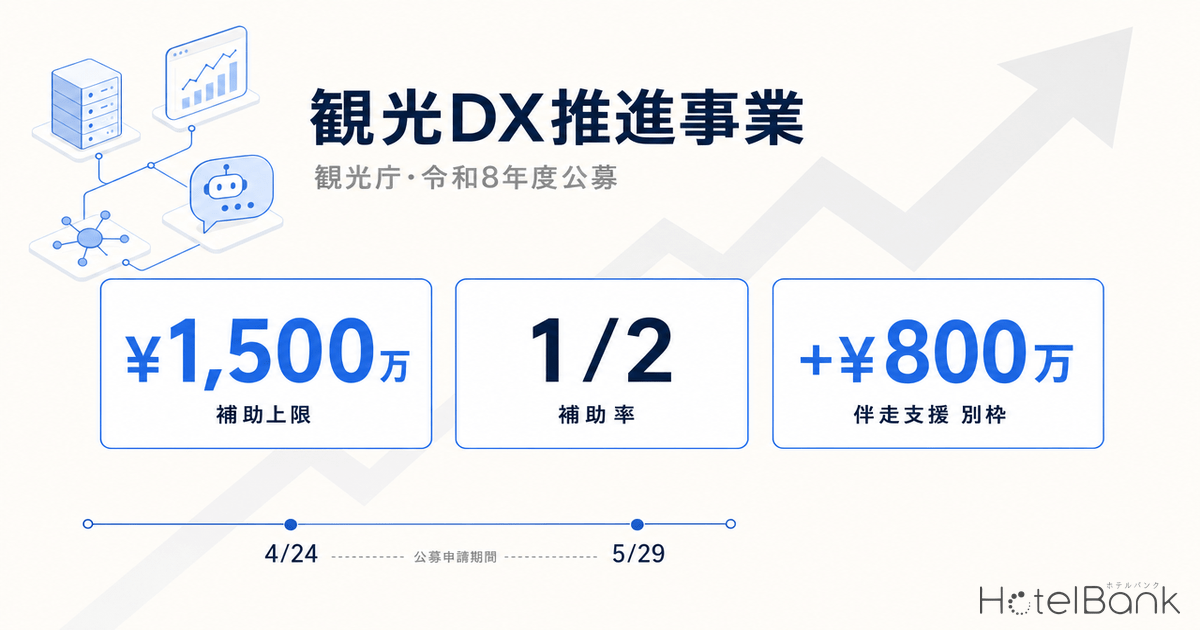

The flagship tourism DX-related subsidy program for FY2026 (Reiwa 8) is the “Tourism DX Promotion Project for Tourist Destinations and the Tourism Industry Nationwide” (全国の観光地・観光産業における観光DX推進事業), administered directly by the Japan Tourism Agency (観光庁). For lodging operators, a “Revenue and Productivity Improvement for the Tourism Industry” category is provided, offering a 1/2 subsidy rate with a ¥15 million cap, plus an additional separate frame of up to ¥8 million for hands-on support by specialized human resources. This article explains the concrete steps from application through post-adoption operation, centered on the introduction of a Revenue Management System (RMS). At the end of the article, download links for an Application Checklist (PDF) and a KPI Setting Template (Excel) are also provided.
Program Overview — 1/2 Subsidy Rate, ¥15M Cap + ¥8M Hands-On Support
The Tourism DX Promotion Project is a direct project of the Japan Tourism Agency, budgeted under the FY Reiwa 7 supplementary budget and to be publicly solicited in FY Reiwa 8. The program is divided into two categories: “Sales Channel Expansion and Marketing Strengthening for Tourist Destinations” and “Revenue and Productivity Improvement for the Tourism Industry,” and lodging operators may apply directly to the latter. The subsidy rate is 1/2 of eligible expenses, with a subsidy cap of ¥15 million. In addition, up to ¥8 million is subsidized as a separate frame for expenses related to hands-on support by specialized human resources for planning, introduction, and utilization of tourism DX.
The fact that this “¥8 million hands-on support” is provided in a separate frame is the greatest feature of this program. The reason is that with digital tools such as PMS and Revenue Management Systems (RMS), the operational design after introduction determines success or failure, so a structure that allows tool costs and consulting costs to be applied for separately is extremely practical to use.
| Item | Details |
|---|---|
| Program Name | Tourism DX Promotion Project for Tourist Destinations and the Tourism Industry Nationwide (Revenue and Productivity Improvement for the Tourism Industry) |
| Administering Body | Japan Tourism Agency (Direct Project) → Japan Tourism Agency Public Solicitation Page |
| Eligible Applicants | Lodging operators |
| Subsidy Rate | 1/2 of eligible expenses |
| Subsidy Cap | ¥15 million (tool introduction expenses) |
| Hands-On Support (Separate Frame) | Up to ¥8 million (planning, introduction, and utilization support by specialized human resources) |
| Subscription Treatment | Monthly/annual fees eligible for up to 2 years |
| Participation Application | April 17 – May 22, 2026 (until 17:00) → Secretariat Official Site |
| Plan Application | April 24 – May 29, 2026 (until 17:00) → Electronic Application System |
Source: Compiled by HotelBank Editorial Team based on the Japan Tourism Agency “FY Reiwa 8 Tourism DX Promotion Project for Tourist Destinations and the Tourism Industry Nationwide” Public Solicitation Guidelines
Eligible Tools — PMS, RMS, Reservation Channel Manager, AI Chatbot, Multilingual Support
The digital tools eligible for subsidy include a wide range of solutions directly tied to revenue and productivity improvement for lodging operators. Specifically, PMS (Property Management Systems), Revenue Management Systems, reservation channel managers, AI chatbots, and multilingual website development are all eligible. For monthly/annual subscription products, the fact that up to 2 years of usage fees are eligible for subsidy is also significant in practice. With cloud-based SaaS becoming the standard in the lodging industry, the design that subsidizes not only initial costs but also operational costs significantly lowers the introduction hurdle for small and medium-sized lodging facilities.
| Tool Category | Main Functions | Expected Revenue Effect |
|---|---|---|
| PMS Property Management System | Reservation management, room management, accounting, unified guest ledger | Reduction of work hours, building of data analysis foundation |
| RMS (MetroEngines, etc.) Revenue Management | Demand forecasting, price optimization, competitor price monitoring | ADR improvement, reduction of missed revenue opportunities |
| Reservation Channel Manager Site Controller | Unified inventory and rate management across multiple sales channels | Overbooking prevention, improved sales efficiency |
| AI Chatbot | Automated inquiry response, multilingual support, 24-hour availability | Labor cost reduction, improved customer satisfaction |
| Multilingual Website | Multilingualization of official website, strengthening direct bookings | Improvement of inbound direct booking ratio |
Source: Compiled by HotelBank Editorial Team based on Japan Tourism Agency Public Solicitation Guidelines
Subscriptions Eligible for 2 Years — Cost Simulation
What enhances the practical usability of this program is that for monthly/annual subscription-type products, up to 2 years of usage fees are eligible for subsidy. The following is a simulation example of a tool configuration centered on RMS.
| Tool | Monthly (Reference) | 2-Year Total | Subsidy (1/2) |
|---|---|---|---|
| PMS (Cloud-based) | ¥150,000 | ¥3,600,000 | ¥1,800,000 |
| RMS (MetroEngines, etc.) | ¥100,000 | ¥2,400,000 | ¥1,200,000 |
| Site Controller | ¥50,000 | ¥1,200,000 | ¥600,000 |
| AI Chatbot | ¥30,000 | ¥720,000 | ¥360,000 |
| Multilingual Site Build (Initial) | — | ¥4,000,000 | ¥2,000,000 |
| Total | — | ¥11,920,000 | ¥5,960,000 |
Note: This table is a reference simulation based on the subsidy cap and rate. Actual subsidy amounts will be determined based on application content and review of public solicitation guidelines. Monthly unit prices are approximate examples only.
In the simulation above, the subsidy amount for tool introduction expenses is approximately ¥5.96 million. In addition, by utilizing specialized human resource hands-on support (separate frame, up to ¥8 million), it may be possible to receive a combined subsidy of up to approximately ¥14 million. Since tool introduction expenses are subsidized at 1/2, for example, to receive the ¥15 million cap, eligible expenses on the order of ¥30 million would be required, but this is a level fully achievable through accumulation including 2 years of subscriptions. For small and medium-sized facilities, this is a structure that significantly lowers the conventional hurdle of “wanting to invest in DX but financially difficult.”
Checkpoints for RMS Selection
Revenue Management Systems (RMS) are offered by various providers, and the optimal product differs depending on the facility’s scale and challenges. When selecting, it is good to compare and consider the following points.
- Competitor Price Collection Range: Coverage of domestic OTAs, number of facilities tracked
- Demand Forecasting Accuracy: To what extent past performance, event information, and competitor trends are taken into account
- PMS Integration: Whether automatic integration with existing PMS or site controllers is possible
- Pricing Recommendation Automation: Whether only suggested prices are presented, or whether automatic reflection via PMS is supported
- Support System: Onboarding at introduction, inquiry response after operation begins
- Pricing Structure: Monthly or annual, usage-based by room count or fixed
When applying for the subsidy, the reasons for selection must be clearly stated in the business plan. It is desirable to obtain demos and quotations from multiple companies and to leave a record of the comparison and consideration process.
6 Application Steps Centered on RMS Introduction
From here, we explain a step-by-step guide for concretely advancing the application for the Tourism DX Promotion Project, centered on the introduction of a Revenue Management System (RMS).
Step 1: Take Stock of Your Facility’s DX Challenges (Time Required: 1–2 days)
First, organize current business workflows and clarify which areas DX investment will be most effective in. Write out your facility’s current state from the following perspectives.
- Pricing: How frequently are rates currently changed? To what extent are competitor prices monitored? Are price adjustments based on demand forecasting being conducted?
- Reservation Management: How many channels are sales conducted on? Is inventory management manual or automatic? What is the frequency of overbooking?
- Front Desk Operations: How long do check-in/check-out take? How much manual data entry work is involved?
- Inbound Response: What is the response system for foreign-language inquiries? What is the multilingualization status of the official website?
💡 Tip: RMS vendors (such as MetroEngines) often offer free demos. Since you can review reports visualizing your facility’s price position relative to competitors, requesting a demo at this stage allows you to use it as KPI evidence material when creating the business plan in Step 3.
Step 2: Select Tools to Introduce and Obtain Quotations (Time Required: 3–5 days)
Select tools that address the challenges identified in Step 1, and obtain official quotations from each vendor. The subsidy application requires attaching quotations as evidence for cost breakdowns.
- RMS: Domestic RMS such as MetroEngines provide competitor price monitoring, demand forecasting, and price optimization recommendations in a single package. Since they are monthly subscription-based, up to 2 years (24 months) are eligible for subsidy.
- PMS: Migration from existing PMS to cloud-based, or selection of a PMS capable of integrating with RMS.
- Site Controller: Unified inventory and rate management across OTAs and the official website.
- Others: AI chatbots, multilingual website development, etc., added according to facility needs.
💡 Tips for Obtaining Quotations: If you mention that you are “considering applying for the Tourism DX Promotion Project,” vendors will often issue quotations in a format suitable for subsidy applications. Have them list the total of monthly fee × 24 months separately from initial costs.
Step 3: Create the Business Plan — KPI Setting Is Key (Time Required: 5–7 days)
The business plan is the core of the adoption review. You must show numerically “why DX investment is necessary” and “which metrics will improve by how much after introduction.” Set the following KPIs and clearly state current values and target values.
| KPI Metric | Setting Points | Evidence Data from MetroEngines |
|---|---|---|
| ADR (Average Daily Rate) | In many cases, a 5–15% improvement is targeted through price optimization via RMS introduction | Competitor comparison reports, price recommendation history |
| OCC (Occupancy Rate) | Set primarily around occupancy improvement during off-season | Area-by-area occupancy trends |
| Direct Booking Ratio | Set when introducing multilingual sites or chatbots | Channel-by-channel sales analysis |
| Front Desk Work Hours | Quantify reduction time through PMS automation | — (measured by facility) |
| Inquiry Response Time | Set when introducing AI chatbots | — (measured by facility) |
💡 Tip: On the RMS dashboard, you can confirm your facility’s price position (positioning within the area’s price range) and price differences with competitors. For example, MetroEngines provides analytical reports based on public price data of approximately 168,000 facilities in Japan, and including such data as “evidence for current KPI values” in the business plan greatly improves persuasiveness in the review.
👉 Download the Application Preparation Template (Excel) and fill in the 5 sheets (Facility Info, KPI, Costs, Schedule, Organization) to complete the framework of the business plan.
Additionally, RMS vendors (such as MetroEngines) may provide support for creating KPI evidence materials and business plans necessary for subsidy applications. We recommend consulting with vendors regarding the preparation of materials that enhance persuasiveness in the review, such as competitor price analysis reports and trial calculations of introduction effects.
Step 4: Submit the Participation Application (Deadline: May 22, 17:00)
Obtain an account on the electronic application system and complete the participation application. The participation application is a preliminary stage to the plan application, where the basic facility information is registered.
- The URL and procedures for the electronic application system are stated in the public solicitation guidelines
- Enter facility basic information (name, location, room count, operator information)
- If acquisition of GBizID is required, apply with sufficient lead time in advance (acquisition can take 1–2 weeks)
⚠️ Caution: There is only a one-week gap between the participation application (5/22) and the plan application (5/29). It is desirable that the business plan be nearly complete by the participation application stage.
Step 5: Submit the Plan Application (Deadline: May 29, 17:00)
Prepare the business plan, quotations, and other necessary documents and submit the plan application. Make a final check of the following before submission.
- Business Plan: purpose and background, overview of introduced tools, KPI targets and current values, operational structure, schedule
- Cost Breakdown: list monthly fee × period by tool, initial costs, and hands-on support fees separately
- Quotations: attach official quotations from each vendor
- Operational Structure Diagram: clearly state personnel and responsible parties after introduction
👉 Download the Application Checklist (PDF) and confirm all items before submission.
Step 6: After Adoption — Tool Introduction and Operation Start
After receiving the adoption notice, promptly begin tool introduction and operation. RMS introduction generally proceeds in the following flow.
- Initial Setup (1–2 weeks): Register facility information, set competitor facilities, configure PMS integration
- Data Accumulation Period (2–4 weeks): RMS accumulates price data for your facility and competitors and builds a demand forecasting model
- Operation Start: Begin price adjustments based on RMS rate recommendations while monitoring competitor prices and demand forecasts on the dashboard
- Monthly Review: Monitor KPI achievement status and continuously improve pricing strategy
- Interim/Final Reports: Report KPI improvement results based on subsidy requirements
💡 Utilizing Hands-On Support: By utilizing hands-on support by specialized human resources (separate frame, up to ¥8 million), revenue management experts can provide continuous support on how to read data and how to design pricing strategies. The major appeal of this program is that it allows building a system that not only introduces tools but also “fully utilizes” them.
Conclusion — Use the Subsidy to Begin Data-Driven Pricing Strategy
The FY2026 Tourism DX Promotion Project, with its structure of 1/2 subsidy rate, ¥15 million cap, and ¥8 million hands-on support in a separate frame, can be called the flagship tourism DX-related subsidy program for lodging operators. By combining a Revenue Management System (RMS) at the core with PMS, site controller, AI chatbot, and other tools, it offers a subsidy amount fully usable even by small and medium-sized facilities.
About 4 weeks remain until the plan application deadline (May 29). We recommend utilizing the 6 steps and downloadable materials introduced in this article to start preparing as quickly as possible.
📥 Download Materials (Free)
- Application Checklist (PDF, 55 items in total)
- Application Preparation Template (Excel, 5 sheets, with auto-calculation formulas)
*These materials are for reference. They do not guarantee adoption of the application.
Reference Links / Related Articles
For details on this program, please check the official websites of the Japan Tourism Agency and the secretariat.
- Tourism DX Promotion Project for Tourist Destinations and the Tourism Industry Nationwide (Secretariat Official Site)
- Japan Tourism Agency 2026 Public Solicitation Information Page
Disclaimer
This article and the downloadable materials are reference information prepared by the HotelBank Editorial Team and do not guarantee the adoption of subsidy applications. While every effort has been made to ensure the accuracy of the content, please always confirm the details and latest information of the program on the Japan Tourism Agency public solicitation guidelines and the secretariat official site. The HotelBank Editorial Team and related parties assume no responsibility for any damages arising from the use of this article or materials.