

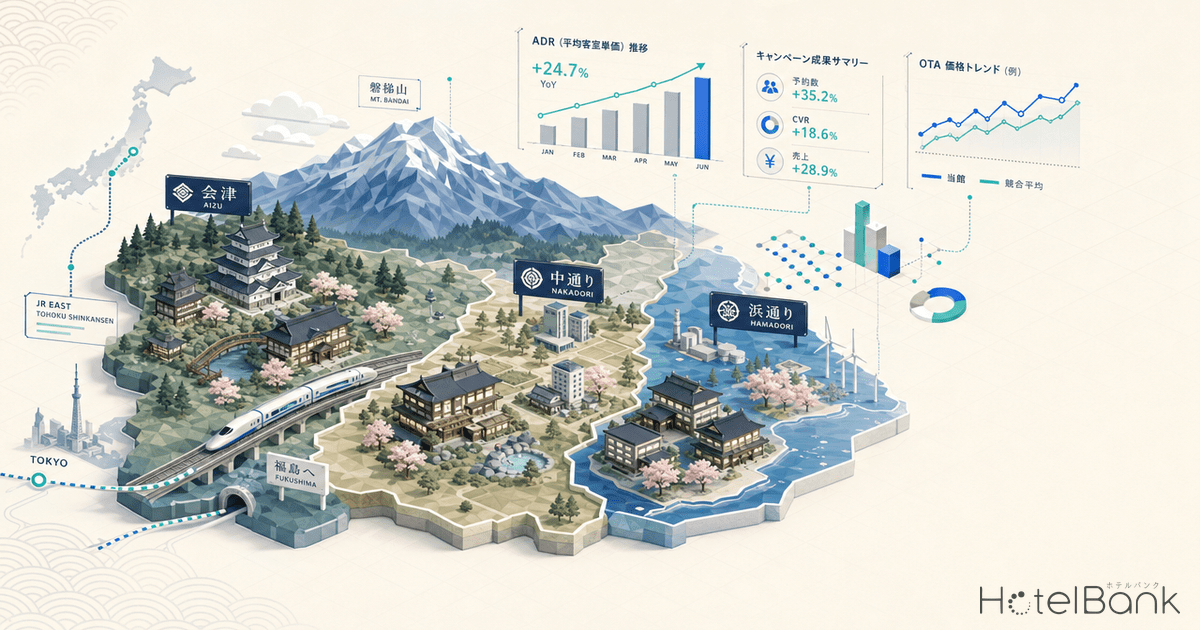

Exactly one month has passed since the Fukushima Destination Campaign (Fukushima DC) opened on April 1, 2026. At the same time, Fukushima Prefecture is also running its own lodging discount campaign, “Mata Kite. Wari” (Come Again Discount), creating a large-scale visitor promotion in which JR East, the prefecture, municipalities, and tourism operators are working in concert. In this article, we examine how Fukushima’s lodging market actually moved, using OTA published-price data compiled by MetroEngines Research, by checking actual ADR and sold-out rates from April through June.
Metric Definitions Used in This Article
- ADR (Average Daily Rate): The average of selling prices published on OTAs and similar channels. This differs from the actual transaction price. Per-room rate for double occupancy (tax included), averaged across all plan types (room-only through meal-inclusive).
- Sold-out rate: The proportion of plans that had ended OTA reservation acceptance at the time of the survey. This differs from a property’s overall room occupancy rate.
- Data source: MetroEngines Research
Fukushima DC and “Mata Kite. Wari” — Program Design in One Minute
To begin with, a Destination Campaign (DC) is a large-scale tourism promotion jointly run by the six JR Group passenger companies and the host region’s local governments and tourism-related operators. The period typically runs three months, during which all JR companies simultaneously roll out marketing to drive visitors into the targeted area. This Fukushima DC runs three months, from April 1 to June 30, 2026, with the catchphrase “Shiawase no Kaze Fukushima” (Winds of Happiness, Fukushima). A distinguishing feature compared with past DCs in other prefectures is that JR East has partnered with Square Enix to roll out a major “FUKUSHIMA FANTASY” advertising campaign.
The prefecture, separately, is running a parallel lodging discount called “Mata Kite. Wari” as an independent support measure. The mechanism is a ¥3,000 discount per person per night on lodging priced at ¥8,000 or more (tax included) per person per night. The first phase covers stays from May 11 to June 30, 2026, with reservations opening on April 1. The discount applies to bookings via OTAs as well as direct on-site reservations, and there are no limits on the number of uses, party size, or consecutive nights. In short, this is a two-stage rocket structure: the DC pulls in tourists, and the prefecture directly subsidizes their wallets.
| Item | Fukushima DC | Mata Kite. Wari (Phase 1) |
|---|---|---|
| Operator | JR East + Fukushima Pref. + Municipalities | Fukushima Pref. (prefecture-only program) |
| Period | April 1 – June 30, 2026 | Eligible stays: May 11 – June 30; reservations open April 1 |
| Benefits | Promotion, regional travel discounts, special trains | ¥3,000 off per person per night (lodging at ¥8,000+ qualifies) |
| Usage caps | — | No limits on uses, party size, or consecutive nights; combinable with other coupons |
| Funding | JR Group advertising budget | Prefecture budget (split into 4 phases per year) |
Source: Compiled by HotelBank Editorial Team from Fukushima Prefecture and JR East press releases
The key point is that “Mata Kite. Wari” eligible stays are set from May 11 onward. In other words, stays during all of April (the DC opening month) feel only the DC’s advertising effect, while from mid-May onward the subsidy is layered on top — a two-stage structure. By exploiting this timing gap, we can separately observe the DC’s pure advertising effect on its own and the additional uplift when the subsidy is added. This article tests exactly that structure using actual ADR data.
Fukushima’s June ADR Reaches ¥32,700, Highest YoY Growth Among Tohoku’s 6 Prefectures
First, we look at prefecture-level movement. According to MetroEngines Research data, Fukushima Prefecture’s June 2026 ADR was ¥32,700 (567 properties, N=1,067,403), up +11.8% from ¥29,300 in the same month last year. This is the largest growth rate among Tohoku’s six prefectures. Within Tohoku, Yamagata Prefecture has the highest absolute level at ¥40,100, but Fukushima clearly leads on growth rate.
Source: MetroEngines Research; compiled by HotelBank Editorial Team
That said, compared with the national June ADR average of ¥37,300, Fukushima’s level is still only about 87% of the national figure. In other words, Fukushima’s current position is “still below the national average in absolute level, yet leading Tohoku in growth rate.” This indicates that the DC effect is genuinely showing up, but there is still room for the prefecture to capture a tourist-destination price premium.
Looking at monthly trends, YoY growth was +5.5% in April, +10.3% in May, and +11.8% in June — accelerating in stages. Worth noting is the sold-out rate trajectory. April’s was high at 23.0%, but this reflects a month-boundary effect (early bookings for May aren’t counted in the April figure) along with a buildup of bookings already on the books as of April. More importantly, once the “Mata Kite. Wari” eligible window opens in May, ADR pushes up to ¥33,400 while the sold-out rate drops to the 15% range. This suggests that lodging operators, anticipating the subsidy, raised published rates — and as a result the sold-out rate temporarily dipped.
Source: MetroEngines Research; compiled by HotelBank Editorial Team
City-Level ADR — Sharp Gains in Northern Nakadori; Aizu Stays Steady
The prefecture-wide YoY of +11.8% reveals an even more interesting structure when broken down by municipality. The northern Nakadori cities of Fukushima City and Koriyama City have surged ahead of the rest, posting late-double-digit growth of YoY +22.0% and +23.0% respectively. By contrast, Aizu-area destinations such as Aizuwakamatsu City, Inawashiro Town, and Kitashiobara Village stayed in the +5% to +12% range, and Iwaki City was relatively muted at +6.4%.
| Municipality | June 2026 ADR | Same Month Prior Year | YoY | Sold-out Rate | Properties |
|---|---|---|---|---|---|
| Aizuwakamatsu City | ¥42,400 | ¥37,800 | +12.2% | 14.2% | 40 |
| Kitashiobara Village (Urabandai) | ¥36,100 | ¥34,400 | +4.9% | 13.9% | 57 |
| Inawashiro Town | ¥35,800 | ¥32,700 | +9.5% | 5.6% | 40 |
| Koriyama City | ¥30,800 | ¥25,000 | +23.0% | 13.3% | 58 |
| Fukushima City | ¥28,600 | ¥23,500 | +22.0% | 16.1% | 72 |
| Iwaki City | ¥22,100 | ¥20,800 | +6.4% | 5.5% | 92 |
Source: MetroEngines Research; compiled by HotelBank Editorial Team (June 2026, double occupancy, tax included)
Source: MetroEngines Research; compiled by HotelBank Editorial Team
How should this gap be read? One hypothesis: Fukushima City and Koriyama City are dominated by business hotels with abundant inventory in the ¥10,000–¥20,000 per-night band, where price elasticity is inherently high. The DC’s broad awareness boost and event-linked demand likely fed straight into bookings, making it easier for lodging operators to push rates up. The Aizu and Urabandai areas, by contrast, are dominated by hot-spring ryokan and resort properties that already command higher year-round rates, so the relative uplift the DC could deliver was smaller.
Iwaki City’s modest growth is also worth noting. Iwaki sits on the Pacific coast, where summer demand from beachgoers and Spa Resort Hawaiians does not really kick in until July or later. The April–June DC window thus falls in the pre-peak shoulder season. Even with the DC tailwind, the low base means the absolute level remains at ¥22,100.
“Mata Kite. Wari” Hits Hardest in the ¥16,000–¥30,000 Band
“Mata Kite. Wari” applies to lodging at ¥8,000 or more per person per night — i.e., ¥16,000 or more for double occupancy. A ¥3,000 discount equates to a 19% price cut on a ¥16,000 plan and 10% on a ¥30,000 plan. The share of plans falling in this band therefore indicates the size of the market where the subsidy directly bites. Tabulating Fukushima Prefecture’s plans by price band, the largest bucket is ¥10,000–¥16,000 (22% of plans), followed by ¥20,000–¥30,000 (19%) and ¥30,000–¥40,000 (15%).
Source: MetroEngines Research; compiled by HotelBank Editorial Team
So plans at ¥16,000 or above — the eligible band — make up roughly 74% of total inventory, but there’s a thick volume zone of 22% sitting just below the subsidy threshold at ¥10,000–¥16,000. For operators in this layer, there’s a clear strategic choice: stay below ¥16,000, or shift just above it to make plans subsidy-eligible.
Looking by municipality, the share of plans in the subsidy-friendly ¥16,000–¥30,000 band is 42.5% in Kitashiobara Village, 36.6% in Iwaki City, 35.9% in Inawashiro Town, 35.3% in Koriyama City, 23.8% in Aizuwakamatsu City, and 22.6% in Fukushima City. In the Urabandai resort area (Kitashiobara, Inawashiro), inventory in the eligible band is the thickest, so “Mata Kite. Wari” most directly translates into incremental bookings. Conversely, in Aizuwakamatsu City, plans at ¥30,000 or more make up 65.8% of inventory, so the subsidy’s relative discount effect is muted and the DC’s awareness effect matters more.
| Municipality | Under ¥16,000 | ¥16,000 – ¥30,000 (strong subsidy effect) | ¥30,000+ |
|---|---|---|---|
| Kitashiobara Village | 5.0% | 42.5% | 52.5% |
| Iwaki City | 41.1% | 36.6% | 22.3% |
| Inawashiro Town | 5.1% | 35.9% | 58.9% |
| Koriyama City | 36.0% | 35.3% | 28.7% |
| Aizuwakamatsu City | 10.5% | 23.8% | 65.8% |
| Fukushima City | 47.7% | 22.6% | 29.7% |
Source: MetroEngines Research; compiled by HotelBank Editorial Team (price-band plan composition for stays from May 11 to June 30, 2026)
Comparison with Ishikawa: Two “Recovery × Tourism” Campaigns Side by Side
Another useful comparison for interpreting Fukushima’s price movements is Ishikawa Prefecture. As of one year and four months after the January 2024 Noto Peninsula earthquake, Ishikawa has continued an extension of the Hokuriku Recovery Discount along with its own lodging discounts, attempting to balance disaster recovery with inbound recovery. Fukushima Prefecture is also still inside the long-term recovery process from the 2011 Great East Japan Earthquake, so both prefectures share a common “recovery × tourism promotion” structure.
Comparing June 2026 ADR, Ishikawa is at ¥37,800 (YoY +6.8%) and Fukushima at ¥32,700 (YoY +11.8%). In absolute level, Ishikawa runs about 16% above Fukushima thanks to the Kanazawa brand and Noto’s high-end ryokan, but on growth rate Fukushima is far ahead. Sold-out rates are roughly comparable — Ishikawa 14.9%, Fukushima 12.2%.
Source: MetroEngines Research; compiled by HotelBank Editorial Team
What this contrast tells us is that Fukushima’s YoY +11.8% has a strength that cannot be explained by the broader nationwide inflation trend alone. Given that the national June ADR growth rate is roughly in the +5% to +7% range, Fukushima’s +11.8% clearly shows that the demand-side boost from the DC opening is making a measurable contribution. Ishikawa’s +6.8%, by contrast, is part of a gradual base recovery from the earthquake — a fundamentally different pattern from Fukushima’s short-term demand-surge profile.
Practical Reader Tips — When to Book for the Lowest Rates
Finally, some practical analysis for readers planning a trip during the Fukushima DC. Aggregating ADR and sold-out rates by day of week across May–June 2026 in Fukushima Prefecture reveals a clear day-of-week pattern. The cheapest day is Wednesday (¥31,000), the most expensive is Saturday (¥37,900) — a gap of about ¥6,900, or 22%.
Source: MetroEngines Research; compiled by HotelBank Editorial Team
What stands out is the sold-out rate behavior: Saturday climbs to 17.6%, with popular plans selling out earlier. Wednesday and Thursday, by contrast, are stable at around 12.7%, leaving more options and more pricing flexibility for travelers. To maximize the combined value with the “Mata Kite. Wari” ¥3,000 discount, a weekday Wednesday stay paired with the subsidy delivers the largest effective price cut.
Concretely, on a roughly ¥18,000 weekday plan, applying the “Mata Kite. Wari” subsidy of ¥6,000 (for two people) brings the effective cost to ¥12,000 — a difference of ¥26,000 per night versus a Saturday booking at the full ¥38,000 rate. Across the three-month campaign, targeting weekdays in late May through June represents the most rational choice from a cost-performance standpoint.
Conclusion — DC Effect Is Real, but Watch the Polarization
Pulling together one month of OTA actual-price data since the Fukushima DC’s opening, Fukushima’s lodging market is showing a clear DC effect. The prefecture-wide June ADR rose +11.8% YoY — top among Tohoku’s six prefectures — and northern Nakadori cities Fukushima City and Koriyama City posted especially sharp jumps above +22%. The Aizu area, on the other hand, was relatively muted at +5% to +12%, with the differences in price-band structure showing up directly as differences in demand uplift.
The “Mata Kite. Wari” subsidy delivers maximum impact on plans in the ¥16,000–¥30,000 (double occupancy) range. The share of plans in this band is high in Kitashiobara Village, Iwaki City, Inawashiro Town, and Koriyama City — between 35% and 42% — which means the subsidy can act as the final nudge toward booking. By contrast, Aizuwakamatsu City is dominated by the ¥30,000+ band, so the subsidy’s relative discount effect is limited and the DC’s advertising effect matters more.
The next question is what happens to ADR levels and sold-out rates from July onward, once the subsidy phase pauses — this will be the next test of the DC’s true durable effect. A sharp rebound would be read as “subsidy-dependent”; stability would suggest genuine awareness gains and demand creation. We will continue to validate this with actual data, including how Phase 2 (summer) of the campaign plays out.
Note on ADR for future dates: The ADR figures in this article reflect average selling prices published on OTAs at the time of the survey, and they fluctuate as the check-in date approaches. Rates that look high now may be cut closer to the date.