

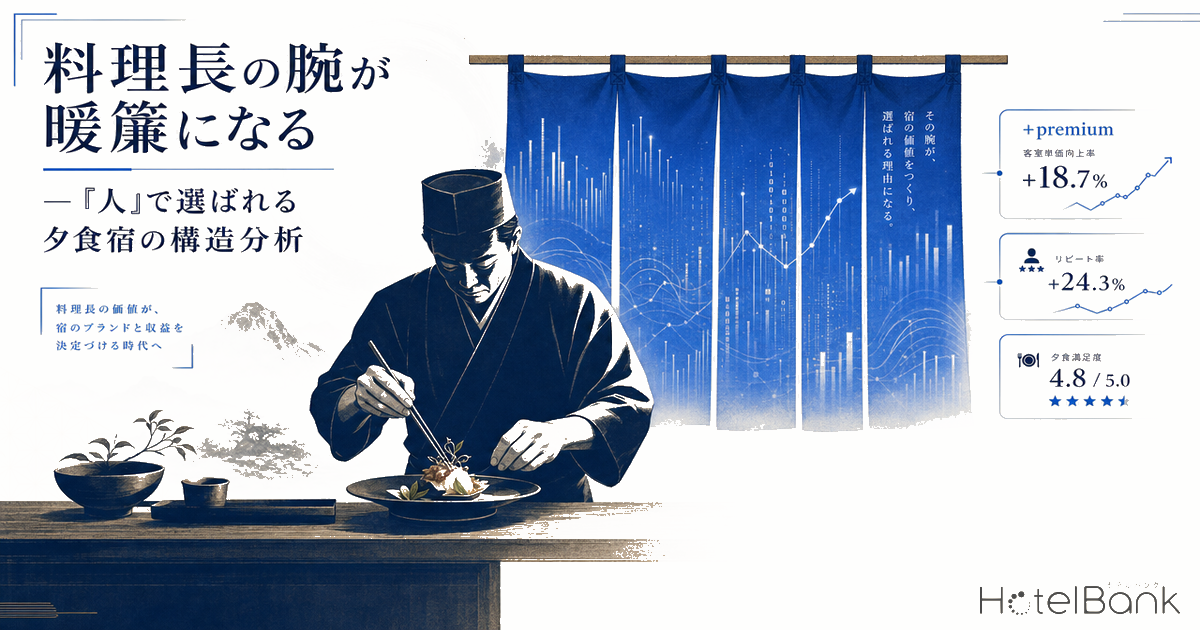
Not the “brand of beef.” Not the “live-station breakfast.” Rather, the person — the skill of the head chef or executive chef — how much do guests value that? In this report, we extract guest reviews that mention “the skill of the chef, head chef, or kitchen master,” and analyze across ADR (publicly listed rates), review scores, and room counts of the inns where such mentions cluster. We read from the data the structure of “noren power” — the dynamic by which the chef as an individual becomes the very source of an inn’s drawing power.
Metric Definitions Used in This Article
- Chef mention: Guest reviews tagged via NLP analysis as referring to “the skill of the chef, head chef, or kitchen master.” Source: HotelBank Editorial Team.
- ADR (Average Daily Rate): The average of publicly listed prices on OTAs and similar channels. This differs from the actual transacted price (unsold high-tier plans tend to remain visible, biasing the published average upward). Per-room rate for double occupancy (tax included), averaged across all plans (room-only through dinner-and-breakfast). ADR figures in this article are aggregated for July 2026 check-ins.
- Premium: The percentage by which a property’s ADR exceeds the prefectural average ADR for the same accommodation category (ryokan, resort, etc.).
- Review Score: A 5-point scale rating. Source: HotelBank Editorial Team.
- — Among the 50 nationwide properties with the highest mention rates for “chef skill,” 37 are ryokan, with the remainder skewing to auberges and resorts — concentrated in formats where food is the centerpiece of the stay.
- — All 50 properties’ published ADRs exceed their prefecture’s same-category average without exception, by an average of +128% (median +113%). Properties selling at more than double the prefectural average make up the majority.
- — Despite high prices, review scores hold at an average of 4.55, 0.36 points above the national average of 4.19 (N=3.51M reviews). Price and satisfaction coexist.
- — Of 1,125 chef-mentioning reviews, 51.0% explicitly cite a title or honorific. Some inns are even spoken of by chefs’ proper names — the chef’s craft now functions as the modern “noren” (the curtain that signals a shop’s reputation).
A Third Axis: Inns Chosen for “Who”
When writing about the appeal of dinner, most articles to date have focused on “what to eat” — inns built around branded ingredients such as wagyu, or those serving freshly grilled or made-to-order dishes via live kitchens. Both angles center on the quality or presentation of the food itself. Read reviews carefully, however, and another evaluative axis emerges: “who makes it” — references to the maker themselves, be it the head chef, the executive chef, or the itamae (master sushi/kappo chef).
Comments like “the chef personally explains each dish at the table” or “you can feel the head chef’s dedication” reflect more than the taste of the food — they value the closeness to the maker and his or her personality. In other words, the chef is no longer a behind-the-scenes figure supporting the menu; the chef has become the very reason for choosing the inn. In this report we extract 50 nationwide properties with the highest chef-mention rates and quantitatively verify their shared structure.
Top 20 by Chef Mention — Mostly High-Priced Small Inns
The table below ranks properties by the number of mentions of “chef/head-chef skill.” Looking at the N=50 lineup, a clear pattern emerges. 37 of the 50 properties are ryokan, followed by auberges and resort hotels. Business hotels and large city hotels barely appear at all. The chef’s presence emerges as an evaluative axis chiefly in formats where food sits at the heart of the stay.
| Rank | Property | Format | Rooms | Chef Mention Rate | ADR (2026/7) | Premium vs Prefectural Avg | Score |
|---|---|---|---|---|---|---|---|
| 1 | Awara Onsen Seifuso (あわら温泉 清風荘) | Ryokan | 170 | 5.14% | ¥77,130 | +136% | 4.34 |
| 2 | Yamaichi Bekkan (山一別館) | Ryokan | 4 | 11.53% | ¥38,507 | +16% | 4.8 |
| 3 | Umi no Gochiso WATANABE (海のごちそう WATANABE) | Auberge | 7 | 37.25% | ¥65,844 | +62% | 4.94 |
| 4 | Disney Ambassador Hotel (ディズニーアンバサダーホテル) | Deluxe Hotel | 504 | 7.89% | ¥84,350 | +98% | 4.64 |
| 5 | Asanoya (朝野家) | Ryokan | 66 | 9.02% | ¥63,388 | +74% | 4.77 |
| 6 | Ryokan Sensui (旅館 泉翠) | Ryokan | 13 | 9.5% | ¥54,430 | +50% | 4.51 |
| 7 | Hakone Yuyado Zen (箱根湯宿 然) | Ryokan | 9 | 10.46% | ¥94,348 | +182% | 4.82 |
| 8 | Fuefukigawa Onsen Bettei Zabo (笛吹川温泉 別邸 坐忘) | Ryokan | 18 | 8.91% | ¥101,426 | +184% | 4.79 |
| 9 | Hotel Mille Cours Shogetsu (ホテルマイユクール祥月) | Ryokan | 38 | 4.52% | ¥58,326 | +74% | 4.52 |
| 10 | Auberge Le Temps (オーベルジュ ル・タン) | Auberge | 8 | 35.9% | ¥50,664 | +24% | 5 |
| 11 | Dogokan (道後舘) | Ryokan | 90 | 5.11% | ¥78,364 | +167% | 4.71 |
| 12 | Hotel Futari Komoreyo (ホテル ふたり木もれ陽) | Resort Hotel | 10 | 7.87% | ¥158,908 | +290% | 4.92 |
| 13 | Grandia Hosen (グランディア芳泉) | Ryokan | 111 | 2.37% | ¥89,696 | +174% | 4.55 |
| 14 | Kitakobushi Shiretoko Hotel & Resort (北こぶし知床ホテル&リゾート) | Resort Hotel | 181 | 2.34% | ¥93,272 | +143% | 4.54 |
| 15 | Kissho CAREN (吉祥CAREN) | Ryokan | 30 | 8.68% | ¥75,056 | +100% | 4.71 |
| 16 | Yugawara Onsen Kawasekien Isuzu Hotel (湯河原温泉 川堰苑いすゞホテル) | Ryokan | 29 | 8.88% | ¥48,146 | +28% | 3.8 |
| 17 | Yusen no Yado Yuamu (湧泉の宿 ゆあむ) | Ryokan | 36 | 5.79% | ¥56,671 | +56% | 4.72 |
| 18 | Umiakari (うみあかり) | Ryokan | 46 | 5.58% | ¥64,278 | +80% | 4.4 |
| 19 | Ito Hotel Juraku (伊東ホテルジュラク) | Resort Hotel | 99 | 2.27% | ¥67,669 | +66% | 3.76 |
| 20 | Clayton Bay Hotel (クレイトン ベイ ホテル) | City Hotel | 60 | 3.87% | ¥40,822 | +12% | 4.29 |
Source: HotelBank Editorial Team (NLP review analysis) / MetroEngines Research (ADR). N=50 properties. Mention rate = share of chef-mentioning reviews within the property’s total review volume. Room counts and ADR via MetroEngines Research.
Looking at the mention rate, properties with fewer rooms tend to score higher. The 7-room auberge “Umi no Gochiso WATANABE” reaches a 37.3% mention rate; the 8-room “Auberge Le Temps” hits 35.9%. At small inns where chef and guest are physically close and dishes are served face-to-face, the maker’s presence is etched into reviews. At the same time, 500-room mega-hotels and 100-plus-room ryokan also appear in the upper ranks — “inns spoken of as people” exist regardless of scale.
Inns Where Chefs Are Discussed Exceed Prefectural Averages by +128%
This is the report’s core finding. Comparing the ADR of each of the 50 properties against the prefectural average ADR for the same accommodation category, all 50 properties exceed their prefectural average without exception. The average premium is +128% (median +113%). Inns where chefs are discussed sell confidently at more than double the price range of standard local lodging. The overall structure of how dinner itself lifts ADR has been examined separately in our analysis of the prevailing premium attached to one-night-with-dinner-and-breakfast (一泊二食) plans in 2026.
Source: Compiled from MetroEngines Research and HotelBank Editorial Team data.
Looking at the premium distribution, properties at +100% or higher — that is, selling at twice or more the prefectural average — make up 27 of the 50, a clear majority. Eight properties even exceed +200%. This shows that the intangible value of “the chef’s craft” has been converted clearly into price. A markup that cannot be explained by ingredient costs or capital investment alone is pushing up these inns’ revenue power as trust in the maker.
High Price and High Score Coexist — The Price × Satisfaction Correlation
Are high prices sacrificing satisfaction? The answer is the opposite. The average review score across the 50 chef-mentioning properties is 4.55 — 0.36 points above the nationwide review average of 4.19 (N=3.51M reviews). Within the same aggregation, isolating only chef-mentioning reviews lifts the average score to 4.55 (N=11,700 reviews), a sharp gap versus the non-mentioning population. Experiences in which the maker leaves an impression raise overall satisfaction.
Source: MetroEngines Research (ADR premium); HotelBank Editorial Team (review score). Each dot = 1 property; bubble size = room count. N=50.
The scatter plot shows scores clustering at 4.5–5.0 even in the high-premium region. Holding strong ratings while raising prices — this coexistence is the strength of inns built around chefs. Even at high prices, voices saying “worth every yen” or “I want to come back” abound; price and satisfaction reinforce each other. This represents a form of competitive advantage that resists imitation — one distinct from price-cutting or facility arms races.
Long-Term Trend in “Chef” Mentions Across Reviews
How has the share of chef mentions evolved within the broader review universe? Tracking the share of chef-mentioning reviews per 10,000 reviews over the past 24 months, we see — alongside seasonal swings — a sustained level of attention. Mentions rise during peak travel seasons, and we can see a structure in which the chef’s presence is more readily reflected in reviews.
Source: HotelBank Editorial Team (NLP review analysis). Share of chef-mentioning reviews per 10,000 reviews, past 24 months.
Mentions do not vanish in any given season — they have settled in as an evaluative axis for choosing inns. Unlike photogenic elements such as plating or dish counts, evaluation of “people” emerges from the lived experience of guests who actually stayed. That is precisely why it accumulates in the form of word-of-mouth, becoming reference material for the next guest’s decision.
The Essence of “Noren Power” — Inns Spoken of by Title and Name
Breaking down the contents of chef mentions further reveals an interesting structure. Among 1,125 chef-mentioning reviews across the top 50 properties, 51.0% contain a specific title or honorific for the maker — “head chef” (料理長), “chef” (シェフ), “itamae/master” (板長), “taisho” (大将), or “okami” (女将). In 49 of the 50 properties, at least one such “named-person” review exists.
Source: HotelBank Editorial Team (NLP review analysis). Honorifics for the maker contained in 1,125 chef-mentioning reviews (multiple matches possible).
Some reviews even refer to the chef by proper name — “Head Chef Negami’s dedication to the food,” for example. Reviews that name the maker as an individual appear. Chefs remembered by title or name pull in repeat visitors — proof that the inn is branded not just by its building, but by its people. Just as a long-established noren (the shop curtain that historically signaled a house’s reputation) was a symbol of trust, the chef’s craft now functions as a new “noren” for modern inns. Facilities can be renovated and locations cannot be moved, but trust built by people cannot be easily copied. This is the essence of “noren power.”
This structure of putting the chef at center stage also represents a major growth opportunity for inns. Properties that already command strong demand can deepen the storytelling around the maker through reviews and plan design, further thickening the layer of name-recognition demand that does not rely on price appeals. Sharpening experiences such as chef’s-table seating, counter service, or in-person dialogue with the chef can simultaneously raise both satisfaction and rate — a clear upside. Anchoring differentiation on “the person” rather than on ingredients or production values is a direction that still holds substantial growth headroom for the future of the inn business.
Conclusion
Inns where head chefs and chefs are frequently mentioned (1) are mostly small ryokan and auberges built around food, (2) sell at high rates that average +128% above the prefectural mean, and (3) still maintain a 4.55 review score above the national average. Furthermore, the majority of chef-mentioning reviews include a specific honorific for the maker, and some inns are remembered by proper name. The reason for choosing an inn extends beyond “what to eat” toward “who makes it” — the structure in which the chef’s craft becomes the noren is poised to grow in weight ahead, as a powerful differentiator that holds both price and satisfaction together.
References and Sources
- HotelBank Editorial Team — NLP analysis of guest reviews (chef-mention tag, N=50 top-ranked properties, 1,125 chef-mentioning reviews, 24-month trend)
- MetroEngines Research — OTA published price data (ADR, July 2026 check-ins, prefectural and format-level averages)
- Review score differential: average 4.55 for chef-mentioning reviews (N=11,700) vs. 4.19 across all reviews (N=3.51M); both via HotelBank Editorial Team