

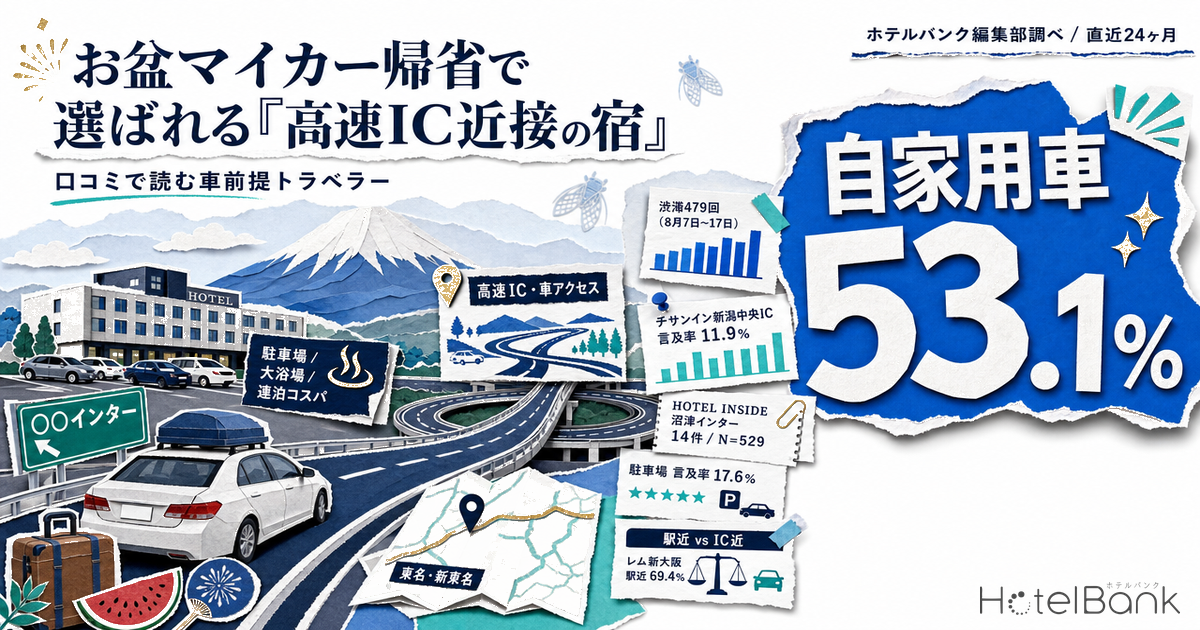
During Japan’s Obon homecoming season, the private car ranks alongside rail and air as a pillar of domestic movement. According to JTB estimates, the private car was the single most-used mode of transport for domestic travel over the New Year holidays at 53.1%, and summer 2026 domestic travel is likewise expected to be dominated by short-distance, car-based trips taken with the goal of “spending time with family.” At the same time, the NEXCO expressway operators’ congestion forecast for the previous year’s Obon period (August 7–17, 2025) projected 479 instances of traffic jams of 10 km or longer across inbound and outbound lanes combined — and demand for a “stopover night” to dodge that congestion swells every year. This article reads how these car-first travelers rate their accommodation, drawing on mentions of “expressway interchange and car access” in guest reviews.
Metric Definitions Used in This Article
- Mention rate: The share of the guest reviews under analysis that refer to the theme in question (e.g. expressway IC / car access, parking).
- Mention count: The number of reviews referring to that theme. This is distinct from a rating score — it indicates how frequently the topic is raised.
- Scope of analysis: Values aggregated by theme after NLP semantic analysis of each property’s guest reviews from the most recent 24 months.
- Data source: HotelBank Editorial Team research
- — Car-access mention rates sit in the low single digits at roadside hotels, versus 60–70% for “close to the station” in urban properties — yet for car-first travelers it is a primary condition. Chisun Inn Niigata Chuo IC records 11.9%.
- — Among the top-rated properties for car access, Shizuoka (the Tomei / Shin-Tomei corridor) accounts for 36% of the top 25, clustered around the interchanges of Numazu, Yaizu and Hamamatsu.
- — The bundle of values car-first travelers prize is “IC proximity, ample parking, a large communal bath, spacious rooms, and multi-night value” — a strong fit for Obon stopover nights and multi-night family stays.
Hotels praised for “being near an expressway IC” occupy a different geography from station-front hotels
We began by extracting, from guest reviews nationwide, the properties most often praised for proximity to expressways, interchanges, arterial roads and service areas — in short, car access. What tops the list are roadside properties that carry the interchange name in the property name itself. At the very top, HOTEL INSIDE Numazu Interchange (HOTEL INSIDE 沼津インター; Numazu, Shizuoka; 150 rooms), 14 of the 529 reviews from the most recent 24 months mention car access. Short phrases such as “right by the Numazu interchange” — succinct endorsements of the location — stand out.
What matters here is that car access is a value raised by a minority of guests, but as a decisive reason. At hotels near major urban rail terminals, “close to the station” becomes the dominant value, cited by 40–70% of guests; at roadside properties, the car-access mention rate stays in the low single digits. Yet those few percent come exclusively from travelers who move by car in the first place, and for them it is a primary condition of choosing a hotel. At Chisun Inn Niigata Chuo Interchange (チサンイン 新潟中央インター; Niigata City, Niigata; 98 rooms), where the mention rate is conspicuously high, car access appears in 11.9% of all reviews — meaning a large share of guests name “next to the IC” as an explicit reason for booking.
Source: HotelBank Editorial Team research (guest reviews from the most recent 24 months for each property)
By mention count, hotels in Shizuoka Prefecture dominate the upper ranks. That is because properties praised for car access cluster around the interchanges of Numazu, Yaizu, Hamamatsu, Shimizu and Gotemba along the Tomei and Shin-Tomei expressways. The reviews mirror, almost literally, the role of the roadside hotel: a place to spend one night, partway along the great artery linking the Tokyo metropolitan area with Chukyo and Kansai, for travelers worn out from driving.
Source: HotelBank Editorial Team research (prefectural distribution of the top 25 properties by car-access mentions)
The hotels car-first travelers choose — location × parking at the core
The table below lists the properties nationwide that drew the most mentions of car access. Most are in the 100–200 room range, and they share the habit of writing the location — the interchange name — into the property name. Regional interchange branches of chains such as Route Inn, Candeo and Az Inn line up together, hinting at the depth of a segment that advertises “easy to reach by car” along regional arterial roads.
| Property | Location | Rooms | Car-access mentions | Mention rate |
|---|---|---|---|---|
| HOTEL INSIDE Numazu IC (沼津インター) | Shizuoka / Numazu | 150 | 14 | 2.7% |
| Hotel Selurm Pal Sendai (ホテルシーラックパル仙台) | Miyagi / Sendai | 176 | 12 | 2.6% |
| Hotel Select Inn Numazu (ホテルセレクトイン沼津) | Shizuoka / Numazu | 92 | 11 | 3.6% |
| Tokinosumika Numazu Interchange Grand Hotel (時之栖 沼津インターグランドホテル) | Shizuoka / Numazu | 105 | 10 | 3.6% |
| Hotel Route Inn Yaizu Inter (ホテルルートイン焼津インター) | Shizuoka / Yaizu | 135 | 8 | 2.6% |
| Hotel Gen Hamamatsu Inter (ホテル玄 浜松インター) | Shizuoka / Hamamatsu | 141 | 8 | 3.0% |
| Hana Hotel Hanazono Inter (ハナホテル花園インター) | Saitama / Fukaya | 117 | 8 | 1.6% |
| Candeo Hotels Kameyama (カンデオホテルズ 亀山) | Mie / Kameyama | 162 | 8 | 1.4% |
| Hotel Route Inn Ishinomaki Kanan Inter (ホテルルートイン石巻河南インター) | Miyagi / Ishinomaki | 169 | 7 | 3.3% |
| Az Inn Handa Inter (アズイン半田インター) | Aichi / Handa | 127 | 7 | 5.3% |
| CANDEO HOTELS Sano (CANDEO HOTELS 佐野) | Tochigi / Sano | 124 | 7 | 1.5% |
| Chisun Inn Niigata Chuo Inter (チサンイン 新潟中央インター) | Niigata / Niigata | 98 | 5 | 11.9% |
Source: HotelBank Editorial Team research (guest reviews from the most recent 24 months for each property) / room counts from MetroEngines Research
What people traveling by car want from a hotel is not only proximity to the interchange. Breaking down the reviews of HOTEL INSIDE Numazu Interchange (N=529), the property with the most car-access mentions, by function reveals the full bundle of values. After cleanliness (23.6% mention rate) and room spaciousness (20.4%) come parking (17.6%), the large communal bath (15.7%) and value for money (15.9%), all discussed at high frequency. “You can park in a big lot,” “you can wash the fatigue of driving away in the large bath,” “even a multi-night stay is easy on the wallet” — these are precisely the priorities of a family that has just driven a long distance.
Source: HotelBank Editorial Team research (HOTEL INSIDE Numazu Interchange / N=529, most recent 24 months)
“Near the station” and “near the IC” — two traveler geographies
The outline of the car-first traveler grows sharper when set beside its opposite, the rail-first traveler. Extracting the properties nationwide most highly rated for “closeness to the station” turns up large hotels connected directly to urban rail terminals. At Miyako City Kintetsu Kyoto Station (都シティ 近鉄京都駅), station proximity appears in 64.8% of reviews; at Remm Shin-Osaka (レム新大阪), 69.4%; at Hotel Gracery Sapporo (ホテルグレイスリー札幌), 68.3%. Where two in three guests at a station-front hotel cite closeness to the station, the car-access mention rate at roadside hotels stays in the low single digits.
| Type | Location characteristics | Representative properties and mention rates |
|---|---|---|
| Station-front hotels (rail-first) | Directly connected to urban terminals; entertainment districts | Remm Shin-Osaka 69.4% / Gracery Sapporo 68.3% / Miyako City Kintetsu Kyoto Station 64.8% |
| IC-adjacent roadside hotels (car-first) | Around regional interchanges; along arterial roads; ample parking | Chisun Inn Niigata Chuo IC 11.9% / Az Inn Handa IC 5.3% / Select Inn Numazu 3.6% |
Source: HotelBank Editorial Team research
The gap is not a ranking of merit; it shows that two kinds of demand stand on different geographies. The absolute mention rates differ because rail guests treat “near the station” as a shared, taken-for-granted vocabulary, whereas car guests make up a relatively small base within the overall review pool of a roadside hotel. Read the other way, car access is a field where differentiation from competitors has yet to be fully put into words — leaving considerable room to articulate explicitly car-first values such as parking, a large communal bath, spacious rooms and multi-night value. As long as the private car remains the most-used mode of transport for summer domestic travel and short-distance family trips remain the norm, roadside hotels at regional interchange locations have real room to grow.
Fit with Obon stopover nights and multi-night family stays
NEXCO’s congestion forecast puts the 2026 Obon outbound peak on the morning of August 13 and the inbound peak on the afternoon of August 16. Leaving unhurriedly in the afternoon to avoid the peak hours, then spending a night at a hotel along the expressway before running into the jams — this “stopover night” pattern is taking hold as a congestion-avoidance tactic in its own right. What answers that demand is exactly the roadside hotel: minutes from an interchange, with a large car park and a communal bath to soak away the fatigue of driving.
Equally worth noting is that the center of gravity for car-based travel is the goal of “spending time with family.” For a family traveling with a lot of luggage, being able to drive right up to the entrance and step straight into a reasonably spacious room is a substantial benefit. A price range that spans room-only through breakfast-included, and rates that stay manageable across several nights, also suit multi-night family stays. For operators, spelling out these car-first, family-first values explicitly — in plan names and in-house guidance — looks like an effective move for capturing Obon demand.
For operators: plan-name cues that work for this theme
To target Obon car homecoming and stopover nights, it pays to weave into the plan name the words car-first travelers actually search with —
Free parking Minutes from the IC Large communal bath Stopover night Multi-night family stay
*Reference information based on trends in guest reviews; it does not demonstrate a causal link between naming and sales.
Conclusion
Tracing Obon car-homecoming and stopover demand through guest reviews brings a distinct segment into view: the hotel close to an expressway interchange. The core of its value is a bundle — proximity to the IC, ample parking, a large communal bath, spacious rooms and multi-night value — and it stands on a traveler geography entirely different from the “near the station” of urban terminals. In sheer volume of mentions, station proximity dominates; but car-first value remains a field with ample room for differentiation to be put into words. With the private car accounting for the largest share of domestic movement today, there is a steady growth opportunity for roadside hotels at regional interchange locations that sharpen — and clearly state — their value to families arriving by car.
Related reading
- Hotel analysis by travel style
- Seasonal and event demand analysis
- HotelBank original research reports
References and sources
- NEXCO West Japan, “Expressway Congestion Forecast for the Obon Period (Nationwide Edition)”
- JTB, “Travel Trends for Summer 2026 (July 15 – August 31)”
- JTB, “Travel Trends for the New Year Holidays (December 20, 2025 – January 5, 2026)” (source of the 53.1% private-car share)
- HotelBank Editorial Team research — NLP tag analysis of guest reviews (most recent 24 months per property)
- MetroEngines Research — property data including room counts