

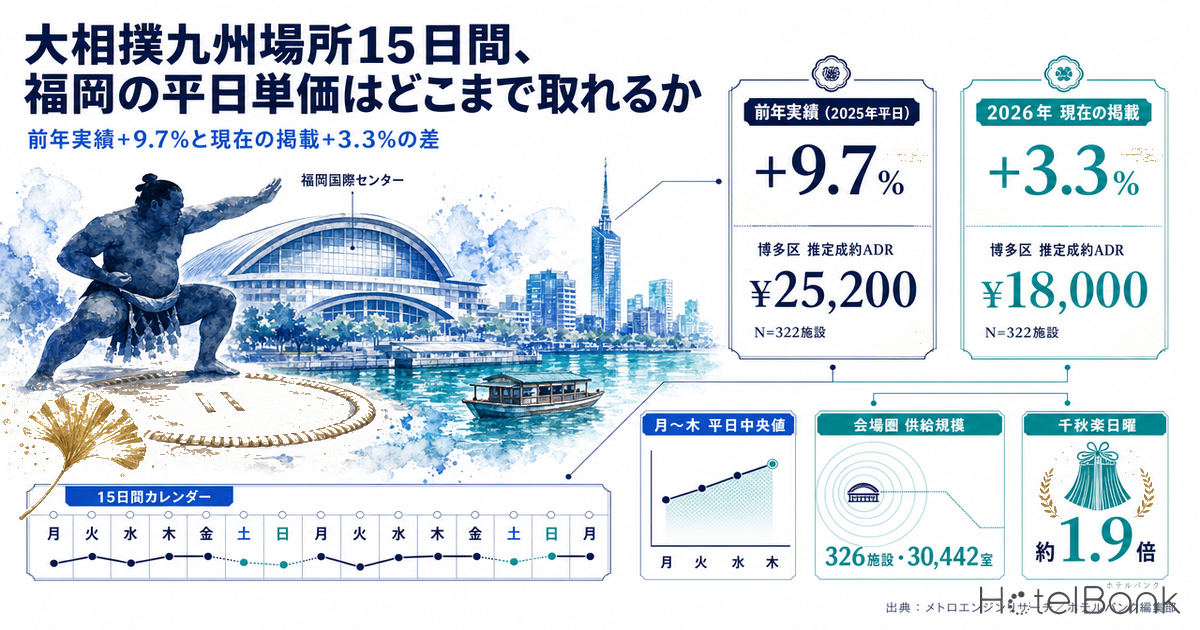
For Fukuoka’s accommodation market, the Grand Sumo Kyushu Basho is the one event each year that runs for 15 consecutive days. That makes it fundamentally different from a fireworks festival or a concert with a single-day peak: it is a long haul that includes ten weekdays. The 2026 November tournament opens on Sunday, November 8 and closes on Sunday, November 22. The venue, as in past years, is the Fukuoka Kokusai Center (Chikko Honmachi, Hakata Ward, Fukuoka City). We examined how a 15-day tournament of the same format moves rates around its venue in our analysis of Ryogoku accommodation demand during the May 2026 tournament.
This article quantifies, using a same-property panel, how much weekday rates actually rose during the tournament in the prior year (2025) and the year before that (2024), then checks how far the prices currently in the market for November 2026 have moved toward that level. The intended reader is a hotel operator or revenue manager in Fukuoka City, and the conclusions land on a practical question: on which days, and how aggressively, can you push rate?
Metric Definitions Used in This Article
- Listed price: the average across all plans of the selling prices each property publishes on OTAs and similar channels (room-only through meal-inclusive). Price per room for two-person single-room occupancy (tax included). All day-level analysis uses this listed price, compared at the median of a panel composed solely of identical properties (limited to properties observable on every day of the period).
- ADR (average daily rate): an estimated settled rate (tax-exclusive equivalent) calculated by applying category-specific adjustment coefficients to the lowest-plan level each property publishes on OTAs (per room, two-person single-room occupancy, tax included). Cross-checked against property-level actuals disclosed by listed hotel REITs (91 properties, most recent three months), the median error is approximately 7%. It is an estimate and differs from each property’s actual transacted prices and accounting figures. Area-level ADR is the median across the properties covered (the level of a typical property in the area).
- OCC (occupancy): sold rooms as a share of total rooms in the area (an estimate based on OTA sales inventory). This article uses it only at the prefectural level.
- Data source: MetroEngines Research
- — +9.7% In 2025, the median listed price on tournament weekdays (Mon-Thu) exceeded non-tournament weekdays, and 81% of the 322 properties in the same-property panel showed an increase.
- — +1.9% The control group, Kitakyushu (N=58 properties), was essentially flat. This is localized demand around the venue, not a November seasonal effect.
- — +3.3% Prices currently listed for November 2026 have priced in the weekdays only shallowly. A gap of roughly 6 points to the prior-year result remains.
- — ¥18,000 Hakata Ward’s estimated settled ADR for November 2026 is the annual peak for the third consecutive year, running +13.9% year on year.
- — 10 weekdays The market has already priced in the five weekend days of the 15. The opportunity lies on the weekday side, which offers depth no single-day event can provide.
Prior-year result: tournament weekdays ran 9.7% above non-tournament weekdays
The first thing to establish is that nothing can be concluded from the November 2026 inventory signal. At the time of writing, check-in dates are still more than 90 days out, and at that distance neither how much inventory each property has released to OTAs nor the demand-side booking peak has begun to take shape. We therefore make no judgments about “fastest sellout” or “sellout rate.” Every assertion rests on confirmed results from the prior year and the year before.
The analysis is designed as follows. Covering Fukuoka City’s five central wards (Hakata, Chuo, Higashi, Sawara and Nishi), we kept only properties for which a price could be observed on all 42 days from October 26 to December 6, 2025, and took the daily median listed price. The panel comprises N=322 properties. This step removes apparent movements caused by properties entering and leaving the sample.
Source: MetroEngines Research; compiled by the HotelBank Editorial Team
What the chart shows at a glance is that November in Fukuoka is a market that swings sharply by day of week. Saturdays jump to more than double weekday levels, and Sundays fall. Comparing “tournament period vs non-tournament period” without removing this day-of-week effect would let the conclusion turn on nothing more than how many weekend days each period happens to contain. We therefore align the comparison by day of week.
In 2025, the median listed price on tournament weekdays (Mon-Thu, November 9-23) was ¥25,200. Non-tournament weekdays around the same part of November came to ¥23,000, a difference of +9.7%. Nor was that increase driven by a small group of properties: 81% of the 322 panel properties priced tournament weekdays above non-tournament weekdays. The market as a whole was moving.
One striking figure is the ¥52,100 recorded on Saturday, November 8, the eve of opening day. It stands out even against the other Saturdays that month (¥36,900 on November 1 and ¥49,100 on November 29), suggesting the market had priced in visiting spectators arriving the night before to watch the opening day.
Is this really the tournament effect? Kitakyushu as a control group
The objection that “November in Fukuoka is expensive simply because autumn-foliage season lifts prices nationwide” is a fair one. So we applied the same treatment to Kitakyushu (Kokurakita, Yahatanishi, Moji and other wards) as a control group: within the same prefecture, more than 60 km from the venue, and thus not directly exposed to the tournament.
Source: MetroEngines Research; compiled by the HotelBank Editorial Team
The result was unambiguous. In the Kitakyushu panel (N=58 properties), the median listed price on weekdays over the same November 9-23 window was ¥13,400 against ¥13,200 on non-tournament weekdays — a difference of just +1.9%. The share of properties that raised rates was 55%, close to an even split. The +9.7% observed in central Fukuoka City therefore reads as a localized phenomenon in the city center near the venue, not a November seasonal effect.
We ran the same test on the year before (2024, tournament period November 10-24). With a panel of N=361 properties, the weekday lift was +12.8% and the share of properties raising rates was 85%. The pattern reproduces across two consecutive years, and at a similar magnitude — high single digits to low double digits. This is not single-year noise.
| Comparison | Mon | Tue | Wed | Thu | Fri | Sat | Sun | Weekday (Mon-Thu) |
|---|---|---|---|---|---|---|---|---|
| Fukuoka City 5 central wards, 2025 (actual) | +12.1% | +13.1% | +7.2% | +10.6% | +7.9% | +11.4% | +20.5% | +9.7% |
| Fukuoka City 5 central wards, 2024 (actual) | +8.3% | +12.0% | +17.4% | +13.2% | +14.2% | +7.6% | -23.1% | +12.8% |
| Kitakyushu, 2025 (control group) | +3.6% | +3.4% | +1.1% | +0.1% | -0.8% | +15.0% | +12.9% | +1.9% |
| Fukuoka City 5 central wards, 2026 (currently listed) | -0.0% | +3.2% | +4.7% | +6.0% | +5.5% | +6.9% | +38.0% | +3.3% |
Source: MetroEngines Research; compiled by the HotelBank Editorial Team (same-property panels: Fukuoka 2025 N=322, Fukuoka 2024 N=361, Kitakyushu 2025 N=58, Fukuoka 2026 N=359)
The Sunday figures require care in interpretation. Because national holidays fall in November, the level shifts entirely depending on whether the closing-day Sunday is followed by a holiday. The +20.5% for Sunday in 2025 is heavily pulled by the fact that the final day (November 23, Labor Thanksgiving Day) fell on the eve of a substitute holiday, while the negative Sunday figure in 2024 reflects a high non-tournament comparison day on November 3 (Sunday, Culture Day). What can be read consistently is Monday through Thursday, and that is the axis this article uses.
Where 2026 stands: the final day is priced in, weekdays are still at +3.3%
So what do the prices currently in the market for November 2026 look like? We aggregated listed prices for October 25 to December 5, 2026 using the same method (panel N=359 properties).
Source: MetroEngines Research; compiled by the HotelBank Editorial Team
The Saturdays (¥60,900 on November 14 and ¥60,400 on November 21) and the closing Sunday (¥51,900 on November 22) have already been lifted distinctly. The closing Sunday in particular sits at roughly 1.9 times the ¥27,800 of its comparison day, Sunday November 29. Because November 23, 2026 falls on a Monday and is Labor Thanksgiving Day, staying on the night of the final day and traveling home the next day works as an itinerary. The market has read this structure accurately.
Weekdays are another matter. The median for tournament weekdays (Mon-Thu) is ¥27,900 against ¥27,000 for non-tournament weekdays, a difference of +3.3%. Set against the +9.7% the prior year ultimately reached and the +12.8% of the year before, the current level is less than half. By day of week, Monday is flat at ±0% and Tuesday +3.2% — the start of the week is essentially unmoved.
A fair caveat is in order. The 2024 and 2025 figures are final levels that incorporate rate revisions right up to check-in, whereas the 2026 figure is a snapshot about three months out. Prices rising as lead time shortens is normal behavior, and reading that gap directly as “money left on the table” would not be accurate. What should be read is how much room remains to be filled over the next three months. On that basis, roughly six points of headroom relative to the prior year remain, across ten weekdays.
Hakata Ward’s ADR peaks in November — a structure now in its third year
Lifting the view from daily listed prices to a monthly frame, what does estimated settled ADR show? We overlaid three years of monthly ADR for Hakata Ward, where the venue is located.
Source: MetroEngines Research; compiled by the HotelBank Editorial Team (Hakata Ward, estimated settled ADR; properties covered N=138-149 per month)
In both 2024 and 2025, the annual high is set in November. November 2024 came to ¥14,600 and November 2025 to ¥15,800, while November 2026 is estimated at ¥18,000 from currently listed levels — +13.9% year on year. That exceeds October (¥17,200) and December (¥17,600), and the structure in which November is the month Hakata Ward can command its highest rates of the year looks set to hold in 2026 as well.
Note, however, that the figures for September to December 2026 are estimates based on selling prices published as of the survey date and will shift with subsequent rate revisions. For November in particular, since weekdays have been priced in only shallowly as shown above, it is reasonable to treat the number as carrying room to move upward.
The supply-demand backdrop is worth noting too. Occupancy in Fukuoka Prefecture (estimated on an OTA listed-inventory basis) ran at around 90% throughout the year — 89.8% in April 2026, 91.3% in May, 90.5% in June and 91.1% in July. In the business-hotel category in particular, weekdays (Mon-Thu) averaged 91.7%, above the 91.4% of weekends (Fri-Sun). Central Fukuoka is a market that is inherently strong on weekdays, and onto that a 15-day major event is layered. For more on this underlying rate strength, our analysis of Fukuoka’s estimated settled ADR beating the prior year in all six months of the first half digs into the background.
Supply around the venue: 326 properties and 30,000 rooms within 2 km
It is worth confirming the scale of supply on the receiving end of that demand. Centering on the Fukuoka Kokusai Center, we aggregated by distance band the properties confirmed to be selling for November 2026.
Source: MetroEngines Research; compiled by the HotelBank Editorial Team
| Distance from venue | Properties | Rooms |
|---|---|---|
| Within 1 km | 103 properties | 6,179 rooms |
| Within 2 km | 326 properties | 30,442 rooms |
| Within 3 km | 445 properties | 36,249 rooms |
| Within 5 km | 474 properties | 38,688 rooms |
Source: MetroEngines Research; compiled by the HotelBank Editorial Team (limited to properties confirmed selling for November 2026, N=474 properties)
The 1 km radius is limited at 103 properties and 6,179 rooms, but widening to 2 km lifts that sharply to 326 properties and 30,442 rooms. The venue sits roughly midway between Hakata Station and Tenjin on the waterfront side, so the accommodation cluster around Hakata Station falls neatly inside the 2 km band. The 3 km band holds 36,249 rooms and the 5 km band 38,688. In other words, only a subset of properties within 1 km can win on venue-proximity scarcity alone; most compete on convenience of access from Hakata Station and Tenjin.
Supply growth also deserves a look. Within the scope MetroEngines Research tracks, 40 properties and 1,159 rooms were confirmed opening in Fukuoka Prefecture in 2026 (on an OTA-listing-confirmed basis). Among them, new supply in the Hakata area comes on stream shortly before the tournament, including a 117-room property scheduled to open in September. Note, though, that because OTA listings appear several months ahead of opening, counts for the most recent months onward may rise as further listings appear. For how the medium-term capacity broadens out through 2028, see our review of room supply in Fukuoka’s Hakata and Tenjin districts for 2026-2028.
A timeline of demand triggers — September 19 and October 26 are the two peaks
Ticket sales scheduling cannot be ignored when designing the timing of rate moves. According to the Japan Sumo Association, general advance-ticket sales for the November 2026 tournament in Fukuoka begin on Saturday, September 19, and the banzuke (rankings) are announced on Monday, October 26.
| Date | Event | Implication for accommodation demand |
|---|---|---|
| Saturday, September 19, 2026 | General advance-ticket sales open | The first peak, when visiting spectators begin considering accommodation in earnest. Inventory and pricing at this point set the initial trajectory |
| Monday, October 26, 2026 | Banzuke (rankings) announced | The second wave, as bout scheduling and headline wrestlers are fixed and day-to-day differences in appeal become visible |
| Sunday, November 8, 2026 | Opening day | Demand begins building from the night before (Saturday, November 7) |
| Sunday, November 22, 2026 | Final day (senshuraku) | The following day, Monday, November 23, is Labor Thanksgiving Day. Sunday-night demand jumps structurally |
Source: compiled by the HotelBank Editorial Team from the Japan Sumo Association’s spectator guide for the November 2026 tournament (Fukuoka)
September 19, when advance sales open, is the first trigger at which guests who have decided to travel start looking for a room. If prices are still sitting at non-tournament weekday levels at that point, you capture the least price-sensitive segment at a discount. The banzuke announcement on October 26 is the second wave, when day-to-day differences in appeal surface: the gap between days with a marquee matchup and days without becomes visible here.
Practical recommendations: how to capture the ten weekdays
Translating the data so far into operator actions. To set the premise, the 15 days of the November 2026 tournament break down into 10 weekdays (Mon-Fri), 2 Saturdays and 3 Sundays. The market has already priced in the five weekend days; the opportunity is in the ten weekdays.
First, there is considerable room to revisit how Mondays and Tuesdays are set. In currently listed prices, tournament Mondays sit level with non-tournament Mondays (±0%) and Tuesdays at +3.2%. Yet in the prior year’s results, Monday was +12.1% and Tuesday +13.1% — the start of the week rose the most. Because the tournament runs for 15 consecutive days, spectator stays do not concentrate on the weekend but spread into the early part of the week as well. There is room to reflect that structure in pricing.
Second, the pre-stay demand for Saturday, November 7. In 2025, Saturday November 8 — the eve of opening day — reached ¥52,100, well above the month’s other Saturdays. The corresponding day in 2026 is Saturday, November 7, currently listed at ¥57,000. That is level with other November Saturdays (¥57,700 on November 28), so the opening-eve premium has not yet been applied.
Third, the area around the final day is already strong. The ¥51,900 for Sunday, November 22 reflects the market correctly valuing the following-day holiday. Rather than raising rates further here, designing inventory release (consecutive-night requirements or minimum length of stay) to extend stays is likely to be more effective. Capturing the two-night stay across Saturday November 21 and Sunday November 22 builds both rate and occupancy.
Fourth, design the increases in stages. The realistic approach is to build the two triggers — the start of advance sales (September 19) and the banzuke announcement (October 26) — into the calendar as rate-revision checkpoints: one step up on the weekday base before September 19, and a second step reflecting day-to-day demand differences after October 26.
A rough take on the revenue impact. Hakata Ward’s estimated settled ADR for November 2026 is ¥18,000. If the ten weekdays were brought up to the prior year’s lift (+9.7%), adding the roughly six points that separate it from the current +3.3%, that works out to about ¥1,100 more per room per night, or about ¥11,000 across ten nights. For a 200-room property running at 90% occupancy, that equates to roughly ¥2.0 million of additional revenue from the tournament weekdays alone. This is a calculation built on stated assumptions; in practice the outcome will vary with day-to-day demand differences, competitor moves and the composition of existing bookings.
Because that estimate is only a single point, we present a range by level attained. The lift levels are the measured values confirmed in the body of this article, and the revenue figures are simple calculations on the same assumptions as above.
| Scenario | Level attained | Tournament weekday lift | Additional vs now | Uplift per room-night | Revenue gain over 10 weekdays |
|---|---|---|---|---|---|
| Pessimistic | Holds at the currently listed level | +3.3% | +0.0pt | ¥0 | approx. ¥0 |
| Mid | Reaches the 2025 result (+9.7%) | +9.7% | +6.4pt | ¥1,152 | approx. ¥2.07M |
| Optimistic | Reaches the 2024 result (+12.8%) | +12.8% | +9.5pt | ¥1,710 | approx. ¥3.08M |
Source: MetroEngines Research; compiled by the HotelBank Editorial Team (lift levels are the measured values in the body text; revenue gain is a simple calculation on the assumptions stated in the body. The “approx. ¥1,100 / approx. ¥2.0 million” in the body is the mid case, rounded)
Varying room count and the size of the increase, the scale of the opportunity distributes as follows. The table is meant to be read against your own property’s size and how many points you think you can add at the two triggers of September 19 and October 26.
| Additional lift vs now | 100 rooms | 150 rooms | 200 rooms | 300 rooms | 400 rooms |
|---|---|---|---|---|---|
| +2.0pt | 0.32 | 0.49 | 0.65 | 0.97 | 1.30 |
| +4.0pt | 0.65 | 0.97 | 1.30 | 1.94 | 2.59 |
| +6.4pt | 1.04 | 1.56 | 2.07 | 3.11 | 4.15 |
| +8.0pt | 1.30 | 1.94 | 2.59 | 3.89 | 5.18 |
| +9.5pt | 1.54 | 2.31 | 3.08 | 4.62 | 6.16 |
Source: compiled by the HotelBank Editorial Team (each cell = ADR ¥18,000 x lift x 10 nights x room count x 90% occupancy. The shaded cell is the mid case in the body text)
Put the other way round, an opportunity of this size exists with a depth — ten days out of fifteen — that no single-day event can ever offer. For Fukuoka’s accommodation market, the Kyushu Basho is a rare window, once a year, in which weekdays can be pursued strategically.
⚠ Note on prices for future dates: The listed prices and ADR figures for September 2026 onward in this article are estimates based on selling prices published on OTAs and similar channels as of the survey date (August 9, 2026), and will change as check-in dates approach. This article also makes no supply-demand assertions from inventory conditions more than 90 days ahead of check-in, and contains no judgments regarding sellouts or booking pace. Statements about future dates indicate only “the shape of prices currently in the market.”
Summary
The effect of the Grand Sumo Kyushu Basho on Fukuoka’s accommodation market can be confirmed clearly in the actual data. In 2025, listed prices on tournament weekdays (Mon-Thu) ran +9.7% above non-tournament weekdays, with increases observed at 81% of the 322 panel properties. 2024 reproduced the pattern at +12.8%, while the control group of Kitakyushu came in at just +1.9%. This is localized demand around the venue, not a November seasonal effect.
For November 2026, the market has already priced in the Saturdays and the closing Sunday. Weekdays, by contrast, are priced in only shallowly at +3.3%, leaving a gap of roughly six points to the prior-year result. How to build up the ten weekdays around the two triggers of the advance-sales opening (September 19) and the banzuke announcement (October 26) is the central question for this year’s Kyushu Basho.
Related reading
- Obon T-7: Kyushu’s 31.7pt Gap — Fukuoka 73.0%, Kagoshima 41.3%
- Fukuoka Hotel Supply 2026-2028: ~1,000 Rooms/Year in Hakata & Tenjin
- Fukuoka Settled ADR +10.9% in H1 2026 While Osaka Falls 32.8% in June
- Sumo May 2026: 15-Day Ryogoku Hotel ADR & Sellout Analysis
- Weekday ADR in Tokyo, Nagoya, Osaka & Fukuoka: Business Demand Recovery
- All articles on Seasonal Events
- All articles on Area & Property Analysis
- All articles on Market Trends
References and Sources
■ Data sources
Daily aggregation of listed prices by MetroEngines Research (same-property panels for Fukuoka City’s five central wards and Kitakyushu: 2025 N=322 properties, 2024 N=361 properties, Kitakyushu N=58 properties, 2026 N=359 properties), the monthly series of estimated settled ADR (Hakata Ward, N=138-149 properties per month), occupancy estimates (Fukuoka Prefecture, OTA listed-inventory basis), and property and room counts around the venue (properties confirmed selling for November 2026, N=474). Tournament dates, the advance-ticket sales date and the banzuke announcement date are from materials published by the Japan Sumo Association.
■ Assumptions used in the estimates
To remove apparent differences arising from day-of-week composition, tournament and non-tournament periods are compared like-for-like by day of week. Panels are limited to properties for which a price was observable on every day of the target period, and daily medians are used. The revenue estimate is a simple calculation applying the roughly six-point difference between the prior-year result (+9.7%) and the current level (+3.3%) to the assumptions stated in the body (Hakata Ward estimated settled ADR of ¥18,000 for November 2026, 10 weekdays, 200 rooms, 90% occupancy). The lift levels in the scenario and sensitivity tables use only the measured values confirmed in the body (+3.3% currently, +9.7% in 2025, +12.8% in 2024); no new assumptions are introduced.
■ Limitations and caveats
Listed prices are selling prices, not transacted prices. Estimated settled ADR is an estimate with a median error of approximately 7% against property-level actuals disclosed by listed hotel REITs, and differs from each property’s accounting figures. The 2024 and 2025 figures are final levels incorporating rate revisions right up to check-in, while the 2026 figures are a snapshot about three months out; the difference between them cannot be read directly as revenue left on the table. Note also that the lift rates are on a Monday-Thursday basis while the “10 weekdays” in the revenue estimate is on a Monday-Friday basis, so the two are not on matching granularity. Occupancy is an estimate based on OTA listed inventory, not actual occupancy. No judgments about sellouts or booking pace are made from inventory more than 90 days ahead of check-in.
■ Market data
- MetroEngines Research — daily aggregation of listed prices (same-property panels for Fukuoka City’s five central wards and Kitakyushu), estimated settled ADR (Hakata and Chuo wards), occupancy estimates (Fukuoka Prefecture), property and room counts around the venue
- MetroEngines Research & Consulting (OTA-listing-confirmed basis, 2026 Fukuoka Prefecture N=40 properties) — new-opening data
■ Tournament and venue information
- Japan Sumo Association, spectator guide for the November 2026 tournament (Fukuoka)
- Japan Sumo Association, access guide for the November 2026 tournament (Fukuoka)
■ Market background
- HotelBank, “Fukuoka City’s new hotel openings: an urban accommodation market spanning Hakata, Tenjin and the airport area” (May 2026, Japanese-language article)
- Zaikai Kyushu, “Real estate report: a run of large-scale hotel developments in Fukuoka City” (April 2026)