

Serving dinner in the guest room rather than in a banquet hall or restaurant — heyashoku (in-room dining) — is one of the most labour-intensive service formats in Japanese lodging. Every course has to be carried to and cleared from each room individually, and temperature control has to be managed room by room. At a time when hiring in both kitchen and service roles has become difficult simultaneously, where and how much of this format still survives? And does the extra labour actually show up in room rates?
For this study we ran semantic analysis on 6,952,636 guest reviews posted over the past 24 months (August 2024 to August 2026) and extracted 51,290 reviews (0.74% of the total) in which dinner served in the guest room was described. We analysed the 469 properties with 20 or more such mentions, and examined the top 30 by mention rate, prefecture-level retention, and the gap in estimated settled ADR between ryokan that operate in-room dining and those that do not.
Metric Definitions Used in This Article
- In-room dining mention: the number of guest reviews that semantic analysis judged to describe, in positive terms, an experience of dinner being served inside the guest room. Based on what guests who actually stayed wrote, not on the facilities a property lists.
- Mention rate: in-room dining mentions ÷ that property’s total reviews over the same period × 100.
- ADR (average daily rate): an estimated settled rate (tax-excluded equivalent) calculated by applying a property-type correction factor to the lowest published plan level each property lists on OTAs and similar channels (two guests per room, per-room rate, tax included). Cross-checked against per-property results disclosed by listed hotel REITs (184 property-months, April–May 2026), the median error is 7.5%. These are estimates and differ from each property’s actual transacted prices or accounting figures. Area-level ADR is the median of the properties in scope (the level of a typical property in that area).
- Periods covered: reviews span the 24 months from August 2024 to August 2026. ADR is the three-month average for September–November 2026.
- Data sources: HotelBank Editorial Team research (reviews) / MetroEngines Research (pricing)
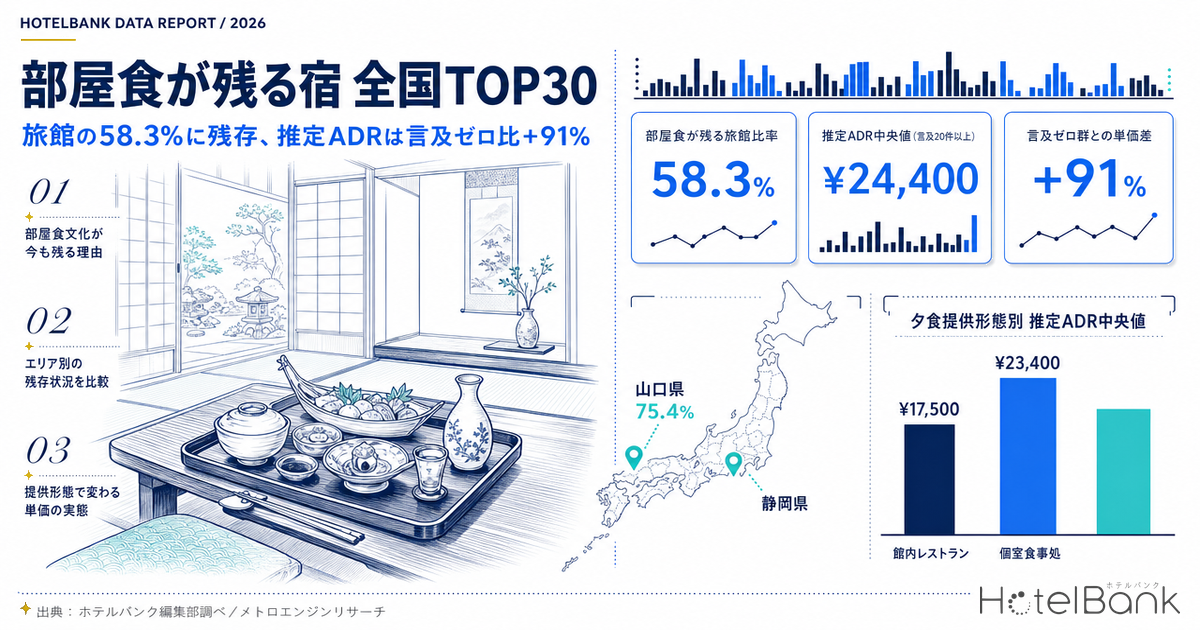
- — Of the 5,924 ryokan with 20 or more reviews, 58.3% (3,451 properties) have in-room dining described at least once. But only 238 properties — 4.0% have it embedded deeply enough to reach 20 or more mentions.
- — Ryokan with 20 or more in-room dining mentions have a median estimated settled ADR of ¥24,400 (N=237), versus ¥12,800 (N=2,103) for the zero-mention group — a gap of +91% (September–November 2026).
- — Holding room count to 10–40 rooms widens the gap to +115%; holding review volume to 50–200 reviews narrows it to +67%. Even after controlling for scale and exposure, a gap of roughly 70% remains.
- — Retention varies sharply by prefecture: Yamaguchi 75.4% and Shizuoka 71.0% against Tokyo 33.9% and Miyazaki 33.3%. On embedded-operation rates, Saitama 9.8%, Kanagawa 8.8% and Shizuoka 8.3% lead.
- — Most of the premium corresponds not to having in-room dining but to the density with which it is talked about. Against the middle group, the gap narrows to +16% once conditions are controlled.
Dinner service splits into five formats — in-room dining survives at 58.3% of ryokan
Start with the overall picture. Using the 5,924 ryokan with 20 or more reviews as the population, we sorted how dinner service formats are described. The most common are in-house restaurants (5,086 properties, 85.9%) and kaiseki course dinners (5,013 properties, 84.6%) — effectively standard equipment for a ryokan. In-room dining sits at 3,451 properties, 58.3%, at the “described at least once” level.
But being described once and being embedded as a standing operation are different things. Only 238 ryokan — 4.0% of the population — have 20 or more in-room dining mentions. In other words, more than half of ryokan are places where in-room dining “can be chosen,” while only one in 25 is a place where in-room dining is talked about as the face of the property. Private dining rooms (809 properties, 13.7%) are rarer still: only a single property nationwide has 20 or more mentions of them.
Source: HotelBank Editorial Team research (NLP analysis of guest reviews) / MetroEngines Research
What stands out is the ordering: the lower the share of properties describing a format, the higher the median estimated settled ADR. Ryokan where the in-house restaurant is described have a median of ¥17,500; kaiseki, ¥18,000. In-room dining stands at ¥19,500 and private dining rooms at ¥23,400 — the rarer the format, the higher the rate position. Narrowing to the 238 properties with 20 or more in-room dining mentions lifts the median to ¥25,700. The 292 ryokan where no dinner format is described at all had a median of ¥8,800.
| Dinner service format | Ryokan with mentions | Share of population | 20+ mentions | Median estimated settled ADR |
|---|---|---|---|---|
| In-house restaurant | 5,086 | 85.9% | 532 | ¥17,500 |
| Kaiseki course | 5,013 | 84.6% | 832 | ¥18,000 |
| In-room dining | 3,451 | 58.3% | 238 | ¥19,500 |
| Dinner buffet | 585 | 9.9% | 69 | ¥18,200 |
| Private dining room | 809 | 13.7% | 1 | ¥23,400 |
Population = 5,924 ryokan with 20 or more reviews over the past 24 months. ADR is the median estimated settled ADR for September–November 2026 (N = the properties within each group for which pricing data could be obtained). Because one property can fall into several formats, the shares sum to more than 100%.
Source: HotelBank Editorial Team research (NLP analysis of guest reviews) / MetroEngines Research
The national TOP 30 for in-room dining — the leader reaches a 37.0% mention rate
The table below ranks the 469 properties with 20 or more mentions by mention rate. First is Makubetsu Park Hotel Yutokan (幕別パークホテル悠湯館) in Makubetsu, Hokkaido (20 rooms): 50 of its 135 reviews, or 37.04%, touch on in-room dining. Second is La Dog Resort (ラ・ドッグリゾート) in Ito, Shizuoka (12 rooms, 35.11%), and third is Happoen (八芳園) in Tamana, Kumamoto (12 rooms, 32.00%).
Twenty-four of the top 30 are ryokan, and the median room count is 20 — small properties, well below the average scale of ryokan nationwide. Being small enough to run service routes that fan out to individual rooms, and being able to sell an experience that is self-contained within the room, appear to be the conditions under which this format survived.
| Rank | Property | Location | Type | Rooms | In-room dining mentions | Total reviews | Mention rate | Ryokan ADR in the municipality |
|---|---|---|---|---|---|---|---|---|
| 1 | Makubetsu Park Hotel Yutokan (幕別パークホテル悠湯館) | Makubetsu, Hokkaido | Ryokan | 20 | 50 | 135 | 37.04% | ¥11,768(N=3) |
| 2 | La Dog Resort (ラ・ドッグリゾート) | Ito, Shizuoka | Pension | 12 | 33 | 94 | 35.11% | ¥20,949(N=69) |
| 3 | Happoen (八芳園) | Tamana, Kumamoto | Ryokan | 12 | 24 | 75 | 32.0% | ¥25,777(N=10) |
| 4 | Hotel Chikura (ホテル千倉) | Minamiboso, Chiba | Ryokan | 20 | 21 | 68 | 30.88% | ¥15,519(N=14) |
| 5 | Saka no Ue no Yado (坂のうえの宿) | Kochi City, Kochi | Vacation rental | 1 | 23 | 75 | 30.67% | ¥9,518(N=8) |
| 6 | Regina Resort Hakone Sengokuhara (レジーナリゾート箱根仙石原) | Hakone, Kanagawa | Resort hotel | 22 | 73 | 240 | 30.42% | ¥28,011(N=147) |
| 7 | Suzukiya Ryokan (すゞきや旅館) | Shiroishi, Miyagi | Ryokan | 33 | 64 | 211 | 30.33% | ¥25,161(N=6) |
| 8 | Hotel Yumoto Noboribetsu (ホテルゆもと登別) | Noboribetsu, Hokkaido | Ryokan | 69 | 170 | 565 | 30.09% | ¥18,896(N=14) |
| 9 | Ryochiku Bettei (両築別邸) | Beppu, Oita | Ryokan | 42 | 101 | 336 | 30.06% | ¥18,311(N=79) |
| 10 | Regina Resort Hakone Ungaiso (レジーナリゾート箱根雲外荘) | Hakone, Kanagawa | Resort hotel | 10 | 27 | 91 | 29.67% | ¥28,011(N=147) |
| 11 | Matsudairakaku (松平閣) | Matsue, Shimane | Ryokan | 13 | 56 | 189 | 29.63% | ¥20,190(N=30) |
| 12 | Gero Royal Hotel Miyabitei (下呂ロイヤルホテル雅亭) | Gero, Gifu | Ryokan | 32 | 102 | 371 | 27.49% | ¥19,796(N=41) |
| 13 | Ryokan Fukuzen (旅館 ふくぜん) | Shibukawa, Gunma | Ryokan | 35 | 77 | 284 | 27.11% | ¥17,421(N=40) |
| 14 | Daikokuya (大黒屋) | Nasushiobara, Tochigi | Ryokan | 31 | 50 | 186 | 26.88% | ¥18,412(N=48) |
| 15 | Toba Kochoran (伊勢神宮のお膝元 鳥羽 胡蝶蘭) | Toba, Mie | Ryokan | 39 | 93 | 346 | 26.88% | ¥17,566(N=71) |
| 16 | Nakaya Ryokan (なかや旅館) | Fukushima City, Fukushima | Ryokan | 8 | 21 | 79 | 26.58% | ¥15,115(N=44) |
| 17 | Izu-Nagaoka Onsen Fukuritei Ogawaya (伊豆長岡温泉 福狸亭 小川家) | Izunokuni, Shizuoka | Ryokan | 15 | 28 | 106 | 26.42% | ¥15,209(N=33) |
| 18 | Arimakan (有馬館) | Kaminoyama, Yamagata | Ryokan | 35 | 60 | 228 | 26.32% | ¥20,382(N=15) |
| 19 | Hotel Bell Kaneyama (ホテルベル鐘山) | Fujiyoshida, Yamanashi | Business hotel | 39 | 20 | 77 | 25.97% | ¥30,542(N=4) |
| 20 | Kakure no Sato Yukari (かくれの里 ゆかり) | Hamada, Shimane | Ryokan | 15 | 34 | 132 | 25.76% | ¥16,408(N=7) |
| 21 | Ryoshuku Yobuko (旅宿よぶこ) | Karatsu, Saga | Ryokan | 24 | 39 | 152 | 25.66% | ¥21,854(N=20) |
| 22 | Taishikan (太子館) | Tochigi City, Tochigi | Ryokan | 7 | 23 | 90 | 25.56% | ¥20,917(N=4) |
| 23 | Gero Onsen Kisoya (下呂温泉 木曽屋) | Gero, Gifu | Ryokan | 26 | 36 | 141 | 25.53% | ¥19,796(N=41) |
| 24 | Hotel Uguisu (ホテル鶯) | Shizukuishi, Iwate | Ryokan | 16 | 20 | 79 | 25.32% | ¥10,174(N=9) |
| 25 | Izutsuya (井筒屋) | Ishikawa, Fukushima | Ryokan | 57 | 22 | 89 | 24.72% | ¥14,433(N=3) |
| 26 | Shoyokan (昇陽館) | Minamata, Kumamoto | Ryokan | 22 | 22 | 91 | 24.18% | ¥11,178(N=5) |
| 27 | Chiisana Asian Yado rakuyado Hanahana (小さなアジアン宿 rakuyadoはなはな) | Ito, Shizuoka | Pension | 6 | 21 | 89 | 23.6% | ¥20,949(N=69) |
| 28 | Iwana Chaya (岩魚茶舎) | Yamanakako, Yamanashi | Ryokan | 10 | 20 | 85 | 23.53% | ¥11,606(N=17) |
| 29 | Gen Hakone Gora (玄 箱根強羅) | Hakone, Kanagawa | Ryokan | 6 | 91 | 393 | 23.16% | ¥28,011(N=147) |
| 30 | Yurariyura Mizudori no Yado Sakihana (ゆらりゆら 水鳥の宿 さきはな) | Agano, Niigata | Ryokan | 13 | 22 | 98 | 22.45% | ¥18,263(N=9) |
Scope = the 469 properties with 20 or more in-room dining mentions over the past 24 months. One property that could not be confirmed as currently on sale via OTAs or similar channels was excluded. The ryokan ADR for the municipality is the average estimated settled ADR for September–November 2026; N in parentheses is the number of properties aggregated. Municipalities with N below 10 have thin samples and should be treated as reference values.
Source: HotelBank Editorial Team research (NLP analysis of guest reviews) / MetroEngines Research
Stepping into the guests’ own words shows what in-room dining is carrying. Comments run along the lines of “dinner was served in the room with a boat-style sashimi platter…”, “we could eat in our room and take our time without worrying about anyone around us…”, and “dinner was in the room so we could eat at our own pace, and there was somewhere for the children to play…”. In every case, not sharing a space with other guests is at the centre of the appraisal. One guest wrote, “free-flowing hot-spring water in the room’s own bath, dinner in the room… everything is complete inside the room” — the design of a stay that closes entirely within the guest room has itself become the product.
Where it survived and where it thinned out — Yamaguchi 75.4% and Shizuoka 71.0% against Tokyo 33.9%
Next, how the format survives by prefecture. Using ryokan with 20 or more reviews as the denominator, we calculated the share with at least one in-room dining mention. The national average is 58.3%, but the spread between prefectures is wide.
Highest is Yamaguchi at 75.4% (46 of 61 properties), followed by Saga at 72.7%, Shizuoka at 71.0%, Chiba at 70.5% and Tochigi at 67.8%. The top of the table combines hot-spring destinations within reach of the Tokyo metropolitan area — Izu, Boso, Nasu, Yugawara and Hakone — with the small-ryokan belts of the San’in region and northern Kyushu. At the other end are Miyazaki at 33.3%, Tokyo at 33.9%, Aomori at 36.5%, Tokushima at 44.4% and Nagano at 46.7%.
Source: HotelBank Editorial Team research (NLP analysis of guest reviews) / MetroEngines Research
Nagano’s 46.7% needs a note. Nagano has the largest ryokan population in the country at 505 properties, yet only six of them (1.2%) have 20 or more in-room dining mentions. The likely reason is that its population is heavily weighted towards large hot-spring ryokan and ski lodgings designed around communal dining halls. For the same reason, Aomori, Akita and Hokkaido — regions with a high share of large hot-spring ryokan — also sit relatively low.
Mention rate and “embeddedness,” however, do not always line up. Yamaguchi ranks first nationally on at-least-once mentions but has zero properties with 20 or more. On embeddedness, the leaders are Saitama at 9.8%, Kanagawa at 8.8%, Shizuoka at 8.3%, Tottori at 8.3%, Mie at 7.2% and Hyogo at 7.0%. The hot-spring areas within day-trip range of the Tokyo and Nagoya metropolitan areas are the ones best able to sustain in-room dining as a permanent operation.
| Prefecture | Ryokan (20+ reviews) | With in-room dining mentions | Mention rate | 20+ mentions | Embeddedness |
|---|---|---|---|---|---|
| Yamaguchi | 61 | 46 | 75.4% | 0 | 0.0% |
| Saga | 77 | 56 | 72.7% | 4 | 5.2% |
| Shizuoka | 373 | 265 | 71.0% | 31 | 8.3% |
| Chiba | 105 | 74 | 70.5% | 5 | 4.8% |
| Tochigi | 205 | 139 | 67.8% | 12 | 5.9% |
| Kanagawa | 262 | 173 | 66.0% | 23 | 8.8% |
| Nagasaki | 61 | 40 | 65.6% | 1 | 1.6% |
| Ishikawa | 104 | 68 | 65.4% | 4 | 3.8% |
| Gunma | 262 | 168 | 64.1% | 9 | 3.4% |
| Saitama | 41 | 26 | 63.4% | 4 | 9.8% |
| Oita | 272 | 172 | 63.2% | 4 | 1.5% |
| Yamagata | 176 | 111 | 63.1% | 5 | 2.8% |
| Shimane | 91 | 43 | 47.3% | 4 | 4.4% |
| Nagano | 505 | 236 | 46.7% | 6 | 1.2% |
| Tokushima | 36 | 16 | 44.4% | 1 | 2.8% |
| Aomori | 74 | 27 | 36.5% | 0 | 0.0% |
| Tokyo | 56 | 19 | 33.9% | 0 | 0.0% |
| Miyazaki | 33 | 11 | 33.3% | 0 | 0.0% |
Top 12 and bottom 6 prefectures shown. Prefectures with fewer than 20 ryokan are excluded from the aggregation. The national population is 5,915 properties across 46 prefectures.
Source: HotelBank Editorial Team research (NLP analysis of guest reviews) / MetroEngines Research
The size of the premium — ryokan running in-room dining have a median estimated ADR of ¥24,400
Here is the core question. Does a labour-intensive service format show up in the rate? We split the 5,924 ryokan into three groups by the intensity of in-room dining mentions and compared median estimated settled ADR for September–November 2026.
The group with 20 or more mentions (N=237) sits at ¥24,400; the group with 1–19 mentions (N=3,033) at ¥19,200; and the zero-mention group (N=2,103) at ¥12,800. Top to bottom, the gap reaches +91%.
Source: HotelBank Editorial Team research (NLP analysis of guest reviews) / MetroEngines Research
It would be premature, though, to read that gap directly as “the added value of in-room dining.” Properties that run in-room dining are smaller (a median of 35 rooms against 14 for the zero-mention group) and have accumulated more reviews (414 against 55). Differences in scale and exposure may be mixed into the rate gap. We therefore ran two comparisons with conditions held constant.
Limiting the sample to 10–40 rooms gives ¥26,100 (N=133) / ¥19,000 (N=1,790) / ¥12,100 (N=1,290) — a gap that actually widens to +115%. Limiting it to 50–200 reviews gives ¥22,100 (N=40) / ¥19,100 (N=1,399) / ¥13,200 (N=923), or +67%. Even with conditions equalised, properties where in-room dining is talked about hold a rate gap of roughly 70% over those with no mentions at all. Against the middle group with 1–19 mentions, however, the gap narrows to +16% — most of the premium corresponds less to “having in-room dining” than to “the density with which in-room dining is described as the centre of the stay.”
| Control condition | 20+ mentions | 1–19 mentions | Zero mentions | Top group − zero group | Top group − middle group |
|---|---|---|---|---|---|
| No control (5,924 ryokan) | ¥24,400(N=237) | ¥19,200(N=3,033) | ¥12,800(N=2,103) | +91% | +27% |
| Held to 10–40 rooms | ¥26,100(N=133) | ¥19,000(N=1,790) | ¥12,100(N=1,290) | +115% | +37% |
| Held to 50–200 reviews | ¥22,100(N=40) | ¥19,100(N=1,399) | ¥13,200(N=923) | +67% | +16% |
| Observed range (low / mid / high) | Depending on the control condition, the top group ranges between ¥22,100 and ¥26,100 | +67% / +91% / +115% | +16% / +27% / +37% | ||
All three rows are measured values presented in the text, not forward projections. “Low / mid / high” shows the observed range over which the gap moves as the control condition changes. That the gap against the middle group (+16% to +37%) is smaller than the gap against the zero group indicates the premium corresponds to “the density with which it is described” rather than to the mere presence or absence of in-room dining.
Source: HotelBank Editorial Team research (NLP analysis of guest reviews) / MetroEngines Research
Running the same comparison by prefecture reveals regional character in how the gap appears. In Yamanashi, the in-room dining group stands at ¥31,400 against ¥11,600 for the zero-mention group (+171%); Tottori is ¥26,300 against ¥10,800 (+144%); and Tochigi is ¥30,900 against ¥14,100 (+119%). Each is a prefecture containing hot-spring destinations with a wide internal price range.
Source: HotelBank Editorial Team research (NLP analysis of guest reviews) / MetroEngines Research
It is worth checking at the individual-property level too. For the 27 of the top 30 for which pricing data could be obtained, comparing each property’s estimated settled ADR with the ryokan ADR of its municipality (the same municipal average used in the table) shows 15 properties above the municipal average, with a median deviation of +19%. Regina Resort Hakone Sengokuhara (レジーナリゾート箱根仙石原) in Hakone (22 rooms) sits at roughly 2.0 times the municipal average, and Gen Hakone Gora (玄 箱根強羅) (6 rooms) at roughly 3.4 times. The more thoroughly a property commits to a small-scale, in-room, self-contained design, the further its rate band stands from the area average.
Who chooses in-room dining — families 14.2%, travelling with dogs 4.3%
Looking at what else is described in the same reviews that mention in-room dining sketches the outline of the demand. The most frequent co-occurrence is attentive staff (29.5%), followed by hot springs (27.4%), room cleanliness (24.4%) and room spaciousness (23.5%). Characteristically, it is service and space — rather than the food itself — that are described alongside it.
On occasions, family stays stand out at 14.2%, followed by solo travel at 5.9%, multi-night and long stays at 5.4%, travelling with dogs at 4.3% and anniversaries at 3.7%. For stays with infants or elderly family members, or stays where guests want to remain with their pet, not having to move to a dining hall is itself the value. Three of the top 30 properties are built primarily around accommodating dogs — evidence that in-room dining is not only a remnant of Japanese ryokan culture but is being redefined in the new context of travelling with companions. For the distribution of pet-accepting properties themselves, Pet-Friendly Hotels in Japan: 81-Property Review Ranking, Autumn 2026 maps it on a review-mention basis.
| Element described alongside in-room dining | Co-occurrence rate | Occasion | Co-occurrence rate |
|---|---|---|---|
| Attentive staff | 29.5% | Family stay | 14.2% |
| Hot spring | 27.4% | Solo travel | 5.9% |
| Room cleanliness | 24.4% | Multi-night / long stay | 5.4% |
| Room spaciousness | 23.5% | Travelling with a dog | 4.3% |
| Value for money | 20.4% | Anniversary | 3.7% |
| Open-air bath | 15.6% | Couples | 3.1% |
Denominator = 57,288 passages describing in-room dining in positive terms (counted per mention instance; because a single review can contain several mention instances, this exceeds the 51,290 extracted reviews). Because one review can contain several elements, the shares do not sum to 100%.
Source: HotelBank Editorial Team research (NLP analysis of guest reviews) / MetroEngines Research
How to price a labour-intensive format — three areas of upside
The data points to three areas of upside for in-room dining as a service format.
First, room to raise density. The rate gap between the middle group with 1–19 mentions (3,033 properties) and the group with 20 or more (237 properties) was +27% — narrowing to +16% once conditions are equalised. Many properties hold in-room dining as a “selectable option,” but few reach the density at which it is described as the centre of the stay. Tilting plan composition, room types and photographic appeal towards in-room dining — and thereby lifting the share of reviews that describe it — is growth available without changing existing facilities.
Second, companion demand as a new entry point. A 4.3% co-occurrence rate for travelling with dogs is small today, but the fact that three of the top 30 fall into this category shows that in-room dining in this context holds up at a high price band. Stays where it is hard to go out to a dining hall — with pets, with small children, or across three generations — are a structural tailwind for the format.
Third, pricing the scarcity itself. Ryokan where private dining rooms are described number 809 (13.7%) with a median of ¥23,400, and the 238 properties with 20 or more in-room dining mentions sit at ¥25,700. Against ¥17,500 for restaurant-centred properties, that gap means the scarcity of the service format is being reflected directly in the rate band. The harder it becomes to secure kitchen and service staff across ryokan nationwide, the greater the relative scarcity of the properties that keep going. How private dining rooms are used on the demand side is covered in Shichi-Go-San Weekend: 22 Private-Dining Ryokan, ¥57,500 vs ¥71,000.
On the hiring side, a survey conducted in November 2025 put “service (restaurant and banquet)” first among roles of concern for shortages (26.7%) and “kitchen” second (25.6%) — precisely the two roles that support in-room dining. In March 2025 the rules were amended so that foreign nationals holding the Specified Skilled Worker status for the food service industry can work in food and beverage outlets inside ryokan and hotels, widening the options for securing staff. Setting the cost of maintaining a labour-intensive format against the premium it commands is what will shape the design of the half-board model from here — and the tightness in kitchen and service staffing is best treated not only as a cost problem but as a trigger to redesign how the two-meal offer is delivered.
⚠ Note on ADR for future dates: the ADR figures in this article (September–November 2026) are estimates based on selling prices published on OTAs and similar channels at the time of the survey, and they move as the check-in date approaches. Please note that current levels will not necessarily be realised as they stand.
Methodology and sources
The review data comes from semantic analysis of 6,952,636 guest reviews posted over the past 24 months (August 2024 to August 2026), from which passages judged to describe, in positive terms, dinner being served inside the guest room were extracted. The ranking covers the 469 properties that had 20 or more total reviews in the period and 20 or more in-room dining mentions. Properties with a high mention rate but fewer than 20 mentions are excluded from the table. One property that could not be confirmed as currently on sale via OTAs or similar channels was also excluded.
The prefecture-level analysis was restricted to the ryokan category to avoid apparent differences driven by differing property-type mixes. The population is the 5,924 ryokan with 20 or more reviews (for the prefecture aggregation, 5,915 properties across 46 prefectures, since prefectures with fewer than 20 ryokan are excluded). ADR uses the estimated settled ADR by municipality × ryokan category for September–November 2026; property-level comparisons use per-property estimated settled ADR for the same period.
Note that the ADR gaps in this article show correlation and do not demonstrate that introducing in-room dining causes rates to rise. Because properties that run in-room dining have distinctive characteristics in scale, location and price band, comparisons holding room count and review volume constant are presented alongside.
Related reading
- Shichi-Go-San Weekend: 22 Private-Dining Ryokan, ¥57,500 vs ¥71,000
- Oita Meal Premiums: Business Breakfast +10.6%, Half-Board +39.3%
- Hotels Chosen for Value for Money: National TOP 30 (21.6% of Reviews)
- All-Inclusive Japan 2026: Free Drinks, Lounges & the +40.7% Meal Lift
- Sake in Hotel Reviews: 1,053 Japan Properties, 0.053% of 3.29M Posts
- Pet-Friendly Hotels in Japan: 81-Property Review Ranking, Autumn 2026
- Solo Travel Hits 18.0%: Japan’s Solo-Mention Map from 25,076 Reviews
References and sources
■ Data sources
Semantic analysis of guest reviews (August 2024–August 2026, 6,952,636 reviews, of which 51,290 describe in-room dining in positive terms across 57,288 mention instances), together with estimated settled ADR by municipality × property type and by individual property (September–November 2026). Property attributes (type, room count, location) and confirmation of continued selling come from lodging inventory data.
■ Calculation assumptions
The ranking covers the 469 properties with 20 or more total reviews and 20 or more in-room dining mentions. The prefecture aggregation is restricted to the ryokan category to avoid differences in property-type mix, and excludes prefectures with fewer than 20 ryokan (5,915 properties, 46 prefectures). ADR is the average of monthly estimated settled ADR for September–November 2026, and group comparisons use the median. Controlled comparisons were run on two conditions: 10–40 rooms, and 50–200 reviews.
■ Limitations and caveats
Review mentions are based on what guests wrote rather than on the facilities a property lists, so a property that offers in-room dining but is not described as doing so is not counted (a downward bias). ADR gaps are correlation, not causation, and mix in differences of scale, location and price band. September–November 2026 are future dates, so prices may still move. Municipalities with N below 10 are reference values.
■ Review and pricing data
- HotelBank Editorial Team research — semantic analysis of guest reviews (6,952,636 reviews, August 2024–August 2026)
- MetroEngines Research — estimated settled ADR (September–November 2026, by municipality × property type and by individual property)
■ Workforce and regulation
- Dive / Yadoya-juku, “Survey on the state of hotel and ryokan staffing in 2026” (3–16 November 2025, 152 respondents at lodging properties)
- Commentary on the March 2025 amendment allowing Specified Skilled Worker (food service industry) status holders to work in food and beverage outlets inside ryokan and hotels