

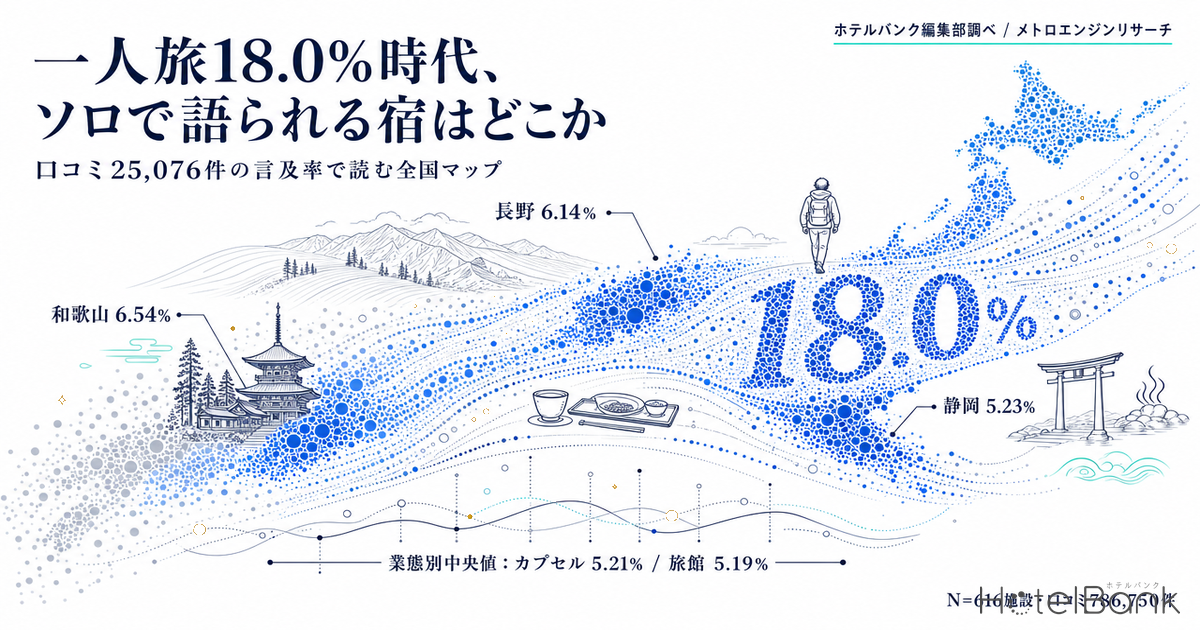
Solo travel accounted for 18.0% of domestic leisure lodging trips in Japan in FY2024. That is up 2.1 points from 15.9% the previous year, making it the second most common travel party type after “couples travelling as a pair” (25.6%). At the same time, Japanese guest nights in 2025 contracted by 2.7% year on year. With total domestic demand stagnating, how to capture the solo segment — the one group steadily gaining share — is becoming a practical question for many properties. In this article we use 25,076 mentions identified as “discussed in a solo-travel context,” extracted from 786,750 guest reviews, to quantify which property categories, price bands and regions the hotels that solo guests talk about are concentrated in.
Metric Definitions Used in This Article
- Mention rate: the share of guest reviews posted in the past 24 months that were written in the context of solo travel or single occupancy. This is a measure of how often something is talked about, not a satisfaction score. A low mention rate does not mean low satisfaction. Conversely, a high mention rate only indicates that a property is likely to come up in solo guests’ conversations.
- ADR (average daily rate): an estimated transacted rate (tax-exclusive equivalent) calculated by applying category-specific adjustment coefficients to the lowest published plan level each property lists on OTAs and similar channels (double occupancy, per-room rate, tax-inclusive). Cross-checked against property-level actuals disclosed by listed hotel REITs, the median error is 6.6%. These are estimates and differ from each property’s actual transacted rates and accounting figures. This article uses the average of monthly estimates from August 2025 to July 2026.
- The language a review is written in is not nationality. This article does not break results down by language or nationality.
- Data sources: HotelBank Editorial Team research (NLP analysis of guest reviews) / MetroEngines Research
Solo Travel at 18.0% — The Only Segment Gaining Share While the Total Shrinks
It is worth first outlining the market with external data. According to a large-scale survey of domestic leisure lodging trips in FY2024 (April 2024 to March 2025; roughly 16,000 valid responses, published July 2025), the largest travel party type was “couples travelling as a pair” at 25.6%, followed by “solo travel” at 18.0%. Solo travel rose 2.1 points from 15.9% the previous year, a larger gain than any other party type. By age group, the share of men was particularly high among those aged 18–29 and in their 50s, and the survey also reports continued growth among women.
On the other hand, the Japan Tourism Agency’s Overnight Travel Statistics Survey (2025 annual figures, final) put total guest nights in 2025 at 661.11 million (up 0.3% year on year), the highest on record since the statistics began in 2010. Looking at the breakdown, however, Japanese guests accounted for 481.18 million guest nights, down 2.7% year on year, while foreign guests grew to 179.92 million (up 9.4%) and lifted the overall total. In other words, even though the headline number is a record high, domestic volume is shrinking. Within that picture, the solo segment is clearly gaining share — one of the few areas of genuine upside still available.
So where are the properties actually being discussed in a solo-travel context? From here we verify this with property-level data.
How the Sample Was Built — All 47 Prefectures Aggregated Individually
The methodology first. Using the guest reviews held by the HotelBank Editorial Team, we extracted mentions tagged as indicating a solo-travel or single-occupancy context over the past 24 months. Because a single nationwide query returns only top-ranked properties, we aggregated each of the 47 prefectures individually and then consolidated the results. The extraction conditions were at least 50 total reviews and at least 25 solo-context mentions (30 or more for Kyoto only, due to a processing constraint).
A total of 634 properties met these conditions. Together they hold 786,750 reviews, of which 25,076 were solo-context mentions. The median mention rate is 3.58%. For the analysis that follows, to avoid volatility caused by a thin denominator, we used the 616 properties with 300 or more total reviews as the primary analysis set. Under this condition, the 25-mention floor corresponds to a mention rate of 8.3%, which is below the level of the 30th-ranked property (8.68%), so the top ranking is not truncated by the floor.
Note that the retrieval limit is 100 properties per prefecture, and only Tokyo reached this cap. The actual number of qualifying properties in Tokyo exceeds this, but re-running the query without the cap adds no properties at a level that would enter the top ranking (discussed below). We also individually checked recent listing status for the top-ranked properties and confirmed that no property whose listings have lapsed is included.
National TOP 30: Properties With the Highest Solo-Context Mention Rates
Below are the top 30 properties by mention rate among the 616 with 300 or more reviews. To repeat, this is not a ranking by rating — it is a ranking by how frequently a property is discussed in a solo-travel context.
| # | Property | Location | Category | Rooms | Reviews | Solo Mentions | Mention Rate |
|---|---|---|---|---|---|---|---|
| 1 | Gora Hanaogi (強羅花扇) | Kanagawa | Ryokan | 20 | 335 | 61 | 18.2% |
| 2 | Saizen-in (西禅院) | Wakayama | Other Simple Lodging | 15 | 334 | 54 | 16.2% |
| 3 | Yatsugatake Grace Hotel (八ヶ岳グレイスホテル) | Nagano | Resort Hotel | 48 | 356 | 54 | 15.2% |
| 4 | Ekoin Temple Lodging (宿坊 恵光院) | Wakayama | Other Simple Lodging | 25 | 407 | 61 | 15.0% |
| 5 | The Millennials Shibuya (ザ・ミレニアルズ渋谷) | Tokyo | Capsule Hotel | 120 | 422 | 61 | 14.4% |
| 6 | Kakurinbo (覚林坊) | Yamanashi | Other Simple Lodging | 20 | 356 | 47 | 13.2% |
| 7 | Ryokan Suiranro (旅館 翠嵐楼) | Kumamoto | Ryokan | 30 | 307 | 37 | 12.1% |
| 8 | Matsuzakaya Honten (松坂屋本店) | Kanagawa | Ryokan | 21 | 460 | 52 | 11.3% |
| 9 | Izu Kogen Hinodeya (伊豆高原・日の出屋) | Shizuoka | Ryokan | 9 | 323 | 33 | 10.2% |
| 10 | Kinnotake Tonosawa (金乃竹 塔ノ澤) | Kanagawa | Ryokan | 23 | 317 | 32 | 10.1% |
| 11 | Naraya (奈良屋) | Gunma | Ryokan | 36 | 309 | 31 | 10.0% |
| 12 | The Millennials Kyoto (ザ・ミレニアルズ京都) | Kyoto | Capsule Hotel | 87 | 580 | 58 | 10.0% |
| 13 | Hakone Ryori-yado Yuan (箱根料理宿 弓庵) | Kanagawa | Ryokan | 10 | 397 | 39 | 9.8% |
| 14 | Spaland Hotel Naito (スパランドホテル内藤) | Yamanashi | Business Hotel | 206 | 572 | 56 | 9.8% |
| 15 | Kashoen (佳松園) | Iwate | Ryokan | 50 | 370 | 36 | 9.7% |
| 16 | Sojiin (総持院) | Wakayama | Other Simple Lodging | 14 | 332 | 32 | 9.6% |
| 17 | Anshin Oyado Premier Shimbashi Shiodome (豪華カプセルホテル 安心お宿プレミア 新橋汐留店) | Tokyo | Capsule Hotel | 180 | 1,222 | 115 | 9.4% |
| 18 | Kagaribi no Yado Onishiya Suishoen (かがり火の宿 大西屋 水翔苑) | Hyogo | Ryokan | 34 | 596 | 56 | 9.4% |
| 19 | Hidaya (飛騨屋) | Gifu | Minshuku | 6 | 334 | 31 | 9.3% |
| 20 | Hotel Futari Komorebi (ホテル ふたり木もれ陽) | Shizuoka | Resort Hotel | 10 | 334 | 31 | 9.3% |
| 21 | Wa no Yado Hotel Iya Onsen (和の宿 ホテル祖谷温泉) | Tokushima | Ryokan | 17 | 411 | 38 | 9.2% |
| 22 | First Cabin Midosuji Namba (ファーストキャビン御堂筋難波) | Osaka | Capsule Hotel | 59 | 317 | 29 | 9.2% |
| 23 | Akakura Kanko Hotel (赤倉観光ホテル) | Niigata | Resort Hotel | 76 | 308 | 28 | 9.1% |
| 24 | Washin no Yado Omori (和心の宿オーモリ) | Gunma | Ryokan | 37 | 650 | 59 | 9.1% |
| 25 | 1166 Backpackers (1166 バックパッカーズ) | Nagano | Guesthouse | 3 | 349 | 31 | 8.9% |
| 26 | Tateshina Shinyu Onsen (蓼科 親湯温泉) | Nagano | Ryokan | 52 | 397 | 35 | 8.8% |
| 27 | Haimurubushi (はいむるぶし) | Okinawa | Resort Hotel | 148 | 342 | 30 | 8.8% |
| 28 | Hakone Takumi no Yado Kasho (箱根 匠の宿 佳松) | Kanagawa | Ryokan | 18 | 412 | 36 | 8.7% |
| 29 | Izu Ito Onsen Daitokan (伊豆・伊東温泉 大東館) | Shizuoka | Ryokan | 29 | 378 | 33 | 8.7% |
| 30 | Gora Onsen Setsugekka Bettei Suiun (強羅温泉 雪月花別邸 翠雲) | Kanagawa | Resort Hotel | 43 | 576 | 50 | 8.7% |
Source: HotelBank Editorial Team research (guest reviews from the past 24 months; top 30 of the 616 properties with 300+ total reviews and 25+ solo mentions)
The first thing that stands out is how rarely large chain hotels appear. More than half of the top 30 have 30 rooms or fewer, and only four exceed 100 rooms. The temple lodgings of Koyasan (Saizen-in, Ekoin, Sojiin), small ryokan in Hakone and Izu, and — in urban markets — a new generation of capsule-format properties cluster at the top.
Gora Hanaogi (Kanagawa, 20 rooms) ranks first, with 61 of its 335 reviews, or 18.2%, framed in a solo-travel context. The Millennials Shibuya (Tokyo, 120 rooms) ranks fifth at 14.4% and The Millennials Kyoto twelfth at 10.0% — new-generation formats standing out even among urban capsule properties. Anshin Oyado Premier Shimbashi Shiodome, at 17th, sustains 9.4% on a large base of 1,222 reviews, with comments to the effect of “reassuring even for a first-timer” and “an easy, relaxed stay.”
By Category — Capsule Hotels and Ryokan Nearly Tied, Double the City Hotel Level
Taking the median mention rate by property category, the ordering is unambiguous.
Source: HotelBank Editorial Team research (616 properties with 300+ total reviews; figures in parentheses are property counts)
Capsule hotels at 5.21% and ryokan at 5.19% sit almost level with each other, roughly double the 2.44% of city hotels. Simple lodgings including temple lodgings (13.20%, 5 properties) and hostels (6.16%, 7 properties) are higher still, but the property counts are small enough that these should be treated as reference values.
It is telling that capsule hotels and ryokan — two categories with completely different price points and completely different experiences — land at the same level. Capsules are designed on the premise of single occupancy; for ryokan, the willingness to accommodate a solo guest at all is itself what gets talked about. Two different routes arrive at the same number. In practice, ryokan reviews frequently discuss whether solo stays are accepted and whether a meal is served for one.
One factor mattered even more than category: property size.
Source: HotelBank Editorial Team research (616 properties with 300+ total reviews and identifiable room counts)
Properties with 30 rooms or fewer are at 7.18%, against 2.28% for those with 301 rooms or more — a gap of more than three times. This does not mean large properties have few solo guests in absolute terms (by raw mention count, large properties rank at the top); it is purely a matter of share within total reviews. Reviews at large properties are filled with a wide range of contexts — groups, families, business travel — so the solo weighting is diluted. Put the other way round, at small properties solo guests’ voices shape the property’s reputation to a much greater degree.
A U-Shaped Relationship With Price — The Mid Band Is Thinnest
Next we matched each property’s estimated transacted ADR against its mention rate. The chart below plots the 553 properties for which ADR was available.
Source: MetroEngines Research (estimated transacted ADR, monthly average August 2025–July 2026) / HotelBank Editorial Team research (solo mention rate), N=553 properties
The correlation coefficient is a weak 0.19, so there is no simple “the higher the price, the more solo mentions” relationship. Break the data into ADR bands, however, and a clear U-shape emerges.
Source: MetroEngines Research (estimated transacted ADR) / HotelBank Editorial Team research, N=553 properties
The band below ¥12,000 is at 3.69%, ¥12,000–18,000 at 3.01%, ¥18,000–25,000 at 3.11%, ¥25,000–40,000 at 3.54%, and ¥40,000 and above at 4.51%. The thinnest band is ¥12,000–18,000 — the volume zone — while the thickest is the ¥40,000-plus premium band.
The natural reading is that solo demand clusters at both ends. The low band is structurally solo-heavy: the “hotel as transit” or “casual one-nighter.” The high band involves highly intentional travel — spending one’s own time and money on oneself — where being alone is part of the experience being described. In between, the range covering typical business hotels through mid-tier ryokan, solo use mixes with business trips, couples and small groups, and the solo profile becomes relatively indistinct.
Looking at median estimated transacted ADR by category: capsule hotels approximately ¥6,200, business hotels approximately ¥16,600, resort hotels approximately ¥21,800, city hotels approximately ¥22,600, and ryokan approximately ¥26,100. The two ends of the U-shape are made up of precisely the two top-ranked categories — capsule hotels and ryokan.
The National Map — Dense in Koyasan, Shinshu and Izu; Thin in the Metros
The map below shows the median mention rate by prefecture. Circle size represents the mention rate; colour depth represents the number of qualifying properties.
Source: HotelBank Editorial Team research (28 prefectures with 5 or more qualifying properties) / Map tiles: CartoDB
Source: HotelBank Editorial Team research (28 prefectures with 5 or more qualifying properties; figures in parentheses are property counts)
Wakayama leads at 6.54% (7 properties). Its sample is made up of the temple lodgings of Koyasan, where the experience of shojin ryori vegetarian cuisine and morning prayer services lends itself readily to solo guests’ accounts. Next come Nagano at 6.14% (20 properties), Shizuoka at 5.23% (25 properties), Yamagata at 5.22% (10 properties) and Ishikawa at 5.10% (9 properties) — the highlands of Shinshu, the hot spring areas of Izu and Hakone, and the therapeutic-bathing culture of Tohoku and Hokuriku occupy the upper ranks.
At the other end are Chiba at 1.88% (28 properties), Kumamoto at 2.18%, Aichi at 2.46% and Nagasaki at 2.48%. In Chiba, large hotels around the theme parks form the core of the sample, so family and group contexts account for most reviews. The major metropolitan areas — Tokyo at 3.03% (100 properties), Kyoto at 2.96% (36 properties) and Osaka at 2.96% (53 properties) — all came in below the national median. These areas have many properties and highly varied demand, so the solo weighting comes out relatively thin. Note that Tokyo’s 100 properties is a truncated figure that hit the per-query retrieval cap; re-running the query split by category yields 132 qualifying properties and a median of 2.91%. All of the additional properties have mention rates below 8%, so neither the composition of the top 30 nor the conclusion that the major metros fall below the national median changes.
Where the Headroom Is — Sorting the Remaining Opportunities
Let us organise the data so far into the room properties actually have to move.
First, the ¥12,000–18,000 band. This band has the thinnest solo mention rate of any ADR band (3.01%), yet it is also the largest volume zone in the market. It is reasonable to read this not as an absence of structural solo demand, but as a relative shortage of cues that let a solo guest recognise “this place is for me.” Simply making explicit how rates are presented for single occupancy, whether a meal is served for one, and how check-in works can change how a property is talked about.
Second, the major metropolitan areas. Tokyo, Kyoto and Osaka all sit around 3.0% and below the national median, but this does not mean demand is thin. On the contrary, the absolute number of solo guests is overwhelmingly larger there. What the urban capsule hotels in the top ranks demonstrate is that even in the major metros, products designed on the premise of single occupancy are clearly discussed in a solo context. For existing business and city hotels, there is still room to carve out solo-first products at the floor level or the plan level.
Third, mid-to-large ryokan and resorts. Ryokan rank highly by category with a median mention rate of 5.19%, but that figure is strongly driven by small properties of 30 rooms or fewer. Within ryokan alone, properties of 101 rooms or more fall to 3.92%, and across all categories the 101–300 room band sits at 3.1%. Operational design — securing a set allocation for solo stays, making private dining rooms available to single guests — is precisely the area larger properties have left untouched. It is also where differentiation from competitors comes most easily.
Fourth, “time alone” as a regional asset. What the temple lodgings of Koyasan, the highlands of Shinshu and the hot spring inns of Izu all share is an experience designed around the premise that being alone is itself meaningful. This works not at the level of an individual property but in combination with the surrounding regional context. Areas with comparable assets — mountain worship, therapeutic bathing, literary and pilgrimage routes — are scattered across the country, and there is considerable room to build solo-oriented positioning at the regional level.
Conclusion
Solo travel has grown to account for 18.0% of domestic leisure lodging trips — one of the few segments gaining share while Japanese guest nights contract. Aggregating the 25,076 solo mentions extracted from 786,750 guest reviews shows that the properties this segment talks about are distributed in a distinctly skewed way: by category, capsule hotels (5.21%) and ryokan (5.19%); by size, 30 rooms or fewer (7.18%); by price, the two ends below ¥12,000 and above ¥40,000; and by region, the hot spring, highland and temple-lodging areas of Wakayama, Nagano and Shizuoka.
Conversely, the ¥12,000–18,000 volume zone, the major metropolitan areas, and ryokan and resorts of more than 100 rooms are still thinly represented in solo-context conversation. Given that the absolute number of solo guests is in fact highest in exactly those areas, there appears to be real headroom to be gained through product design and how information is presented. Mention rate is no substitute for a rating, but it is a mirror reflecting whose trip your property is understood to be for. If the 18.0% share moves further from here, how to change what that mirror shows is a question well worth considering.
Related Reading
- Hotels Chosen for Value for Money: National TOP 30 (21.6% of Reviews)
- Japan’s Vegetarian Inbound Map: Koyasan 4.9x Average, 654 Reviews
References and Sources
■ Government Statistics
- Japan Tourism Agency, “Overnight Travel Statistics Survey (2025 annual figures, final)”
- Japan Tourism Agency, “Overnight Travel Statistics Survey, January–December 2025 Annual Figures (Final) — Press Release (PDF)”
- Japan Tourism Agency, “Travel and Tourism Consumption Trend Survey”
■ Private-Sector Survey (source of the 18.0% solo travel figure)
- Recruit Co., Ltd. press release, “Domestic Overnight Travel Survey 2025: Travel Market Trends” (published 15 July 2025; FY2024 results; approximately 16,000 valid responses)
- Travel Voice, “Domestic Overnight Travel Survey 2025 released: solo travel expands to 18%” (30 July 2025)
■ Proprietary Data
- HotelBank Editorial Team research — solo-travel context tag aggregation via NLP analysis of guest reviews (past 24 months, all 47 prefectures aggregated individually; 634 qualifying properties, 786,750 total reviews, 25,076 solo mentions)
- MetroEngines Research — estimated transacted ADR (average of monthly estimates, August 2025–July 2026, N=553 properties)