

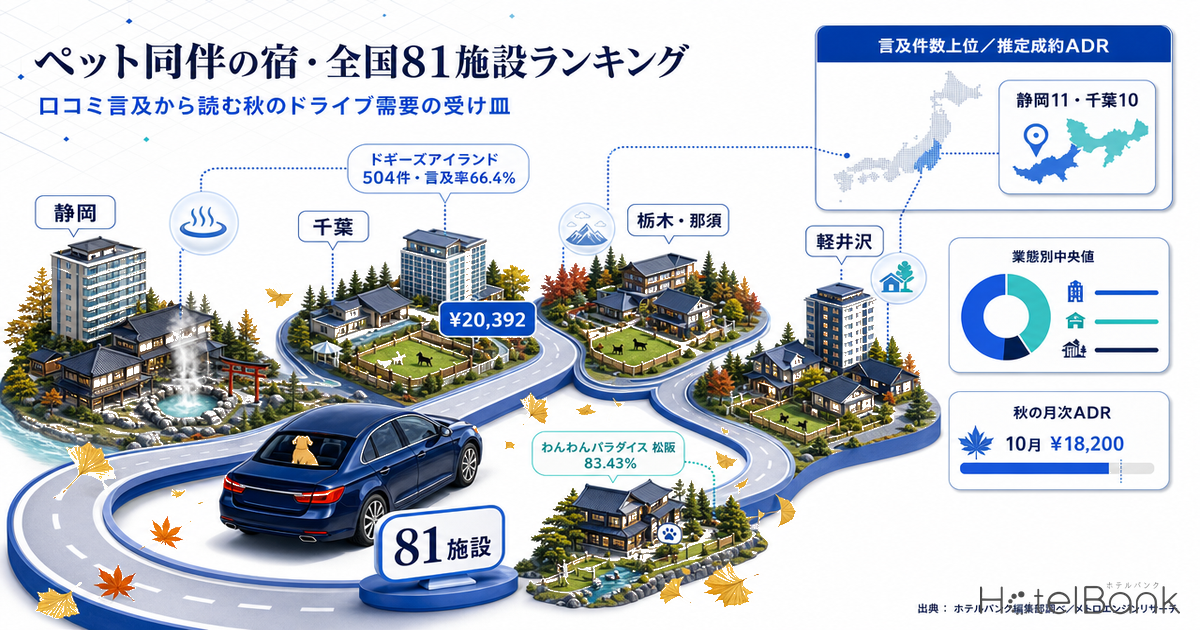
Properties where guests can stay with their dogs and cats are shifting from an amenity that is “nice to have” to a factor that determines whether a segment of travelers takes a trip at all. According to the Japan Pet Food Association’s 2025 National Dog and Cat Ownership Survey, the dog population rose to 6.82 million from 6.796 million a year earlier, and new acquisitions over the past twelve months reached 451,000, also above the prior year. This article aggregates guest-review mentions of pet accompaniment, dog runs, and pet facilities across Japan to identify which properties are winning support, and how that support correlates with property type, region, and price band. We also add a practical view on how operators can capture autumn road-trip demand.
Metric Definitions Used in This Article
- Mention count: The number of guest-review passages over the trailing 24 months (August 2024 – July 2026) extracted as positive mentions of pet accompaniment, dog runs, or pet facilities.
- Mention rate: Mention count divided by total reviews over the same period. Because a single review can contain multiple mentions, this figure can exceed 100%. Mention rate indicates how much a topic is discussed in reviews; it is not a measure of a property’s quality or service standard.
- ADR (average daily rate): An estimated settled rate (tax-exclusive equivalent) derived by applying property-type correction coefficients to the lowest publicly listed plan level on OTAs and other channels (double occupancy, per room, tax-inclusive). Cross-checked against property-level disclosures from listed hotel REITs (91 properties, trailing 3 months), the median error is approximately 7%. These are estimates and differ from each property’s actual transacted rates or accounting figures. Estimated settled ADR is calculated only for properties with a verified property-type classification (ryokan, resort hotel, city hotel, business hotel, etc.); cottages, pensions, lodges, and guesthouses are out of scope.
- Data sources: Review aggregation = HotelBank Editorial Team analysis / Pricing = MetroEngines Research
- — 81 properties across 32 prefectures — 81 properties nationwide recorded 40 or more pet-related mentions over the trailing 24 months. Shizuoka (11) and Chiba (10) alone account for 25.9%, clustering in the two-to-three-hour driving band from the Tokyo metropolitan area.
- — 71.9% have 30 rooms or fewer — Of the 57 properties with a mention rate of 20% or higher, 41 have no more than 30 rooms. Capacity for pet-accompanied demand is heavily skewed toward small properties.
- — Only 7 urban properties — 87.7% of the 57 properties sit on the leisure-lodging side. Median ADR for the urban group is ¥11,984, and supply for pre-trip, post-trip, and travel-leg stays is thin.
- — 9 “resident-cat” properties — Separate from the 45 pet-accompaniment properties, nine small properties of 10–36 rooms draw support through character rather than capital investment.
- — October is the autumn pricing window — Across the 36 pet-accompaniment properties with calculable ADR, the monthly median peaks at ¥21,500 in August 2026, falls to ¥18,200 in October (about 15% below summer), then rises 5.4% in November.
Scope of the Analysis — 81 Properties Drawn from All 47 Prefectures, Distributed Across 32
The aggregation covered all 47 prefectures. Of those, 81 properties met the threshold of 40 or more pet-related mentions over the trailing 24 months, and these are located in 32 prefectures. No qualifying property was identified in the remaining 15 prefectures. This does not mean those prefectures have no pet-friendly accommodation; it means only that, within the review coverage available to MetroEngines Research, no property there had accumulated enough repeated pet mentions to clear the threshold.
The 81 properties account for 8,163 mentions in total. However, at large hotels with high room counts, the ratio of pet mentions to total reviews is structurally diluted. For the typology analysis in this article we therefore added a secondary condition of a mention rate of 20% or higher, yielding 57 properties (28 prefectures; 6,710 mentions across 12,623 reviews) as the main analytical set. Of these 57, 71.9% (41 properties) have 30 rooms or fewer — capacity for pet-accompanied demand is overwhelmingly concentrated in small properties.
Reading the content of the extracted mentions also revealed two distinct strands mixed together. One is the “accompaniment type,” where guests bring their own dog or cat, covering 45 properties. The other is the “resident-animal type,” where guests can meet a house cat living on site, covering 9 properties. The remaining 3 properties showed a mix of both. The rankings below cover the 45 accompaniment-type properties.
National Ranking — The Top 15 Cluster in Boso, Izu, Nasu, and Karuizawa
The top property by mention count is Koyaru no Sato Doggy’s Island (小谷流の里 ドギーズアイランド) in Yachimata, Chiba, with 504 mentions and a 66.4% mention rate. According to its official site, the 101-room property features three large all-natural-turf dog run areas and a dog pool, and reviews include comments on booking the dog run privately for day use. Second is Angel Forest Nasu Shirakawa (エンゼルフォレスト那須白河) in Tenei, Fukushima (391 mentions, 58.6%), followed by Ducale Garden Hotel Kujukuri (ドゥカーレ ガーデンホテル 九十九里) in Sanmu, Chiba (383 mentions, 32.2%).
Source: HotelBank Editorial Team analysis (natural-language processing of guest reviews; trailing 24 months; top 15 of N=45 properties)
Four of the top 15 carry the “Wanwan Paradise (わんわんパラダイス)” brand name (six across the full set of 57 properties with a 20%+ mention rate). Iconia Hospitality consolidated 13 dog-friendly hotels under that brand on February 11, 2026, and has continued to expand since, announcing a network of 28 properties and more than 500 rooms nationwide. The dog-friendly segment, once dependent on the efforts of individual properties, has reached the stage where brand-level networks have emerged. Wanwan Paradise Izu Kogen (わんわんパラダイス 伊豆高原) in Shizuoka — formerly Izu Kogen Wanwan Paradise Hotel & Cottage — reopened on April 1, 2026 with an all-weather indoor play space, and already shows a high 57.9% mention rate at an early stage of review accumulation.
| # | Property | Prefecture | Type | Rooms | Mentions | Mention rate | Est. settled ADR |
|---|---|---|---|---|---|---|---|
| 1 | Doggy’s Island (ドギーズアイランド) | Chiba | Resort hotel | 99 | 504 | 66.4% | ¥20,392 |
| 2 | Angel Forest Nasu Shirakawa (エンゼルフォレスト那須白河) | Fukushima | Cottage | 76 | 391 | 58.62% | — |
| 3 | Ducale Garden Hotel Kujukuri (ドゥカーレ ガーデンホテル 九十九里) | Chiba | Resort hotel | 23 | 383 | 32.21% | ¥11,618 |
| 4 | Wanwan Paradise Hamanako (わんわんパラダイス 浜名湖) | Shizuoka | Ryokan | 42 | 327 | 68.99% | ¥17,712 |
| 5 | Wanwan Paradise Toba (わんわんパラダイス 鳥羽) | Mie | City hotel | 57 | 305 | 59.92% | ¥21,441 |
| 6 | Wanwan Paradise Matsusaka (わんわんパラダイス 松阪) | Mie | Ryokan | 22 | 292 | 83.43% | ¥22,557 |
| 7 | Wanwan Paradise Takayama (わんわんパラダイス 高山) | Gifu | Business hotel | 39 | 238 | 61.03% | ¥24,262 |
| 8 | Aiken Oyado Izu Kogen (愛犬お宿 伊豆高原) | Shizuoka | Resort hotel | 20 | 228 | 76.0% | ¥37,630 |
| 9 | Kinugawa Kokusai Hotel (きぬ川国際ホテル) | Tochigi | Ryokan | 24 | 182 | 71.65% | ¥23,283 |
| 10 | Kaike Onsen Shotoen (皆生温泉 松涛園) | Tottori | Ryokan | 38 | 163 | 81.5% | ¥18,064 |
| 11 | Le Chien Kyu-Karuizawa (ル・シアン旧軽井沢) | Nagano | Resort hotel | 50 | 153 | 51.17% | ¥20,579 |
| 12 | Corredor Yugawara Dog & Resort (コレドール湯河原 ドッグアンドリゾート) | Kanagawa | Resort hotel | 13 | 151 | 88.82% | ¥33,673 |
| 13 | Sora Hotel Karuizawa Outlet (ソラホテル軽井沢 アウトレット) | Nagano | Lodge | 17 | 151 | 51.71% | — |
| 14 | Ubud no Mori Izu Kogen (ウブドの森 伊豆高原) | Shizuoka | Resort hotel | 18 | 137 | 56.38% | ¥50,674 |
| 15 | Yufuin Lamp no Yado (湯布院ランプの宿) | Oita | Ryokan | 11 | 131 | 39.46% | ¥18,239 |
| 16 | Yutorelo Toyako (ゆとりろ洞爺湖) | Hokkaido | Ryokan | 58 | 112 | 23.19% | ¥12,232 |
| 17 | Wanpakutei (わん泊亭) | Gifu | Ryokan | 19 | 106 | 48.85% | ¥18,358 |
| 18 | Wanwan Paradise Yatsugatake (わんわんパラダイス 八ヶ岳) | Yamanashi | Cottage | 38 | 106 | 64.63% | — |
| 19 | Kojokan (古城館) | Niigata | Ryokan | 17 | 99 | 42.49% | ¥16,589 |
| 20 | Hotel Forest Hills Nasu (ホテルフォレストヒルズ那須) | Tochigi | Cottage | 23 | 98 | 63.23% | — |
Source: Review aggregation = HotelBank Editorial Team analysis (trailing 24 months) / Estimated settled ADR = MetroEngines Research (trailing 12-month monthly median). Room counts and property-type classifications are our recorded values and may differ slightly from official property announcements. Cottages, pensions, and similar categories are out of ADR scope.
Geographic Skew — Shizuoka (11) and Chiba (10) Hold a Quarter of the Field
Breaking the 81 properties down by prefecture, Shizuoka (11) and Chiba (10) stand out, together accounting for 25.9% of the total. Tochigi (6), Nagano (6), Oita (5), and Hokkaido (5) follow. Within each prefecture the properties cluster tightly: Izu Kogen, Atami, Ajiro, and West Izu in Shizuoka; Kujukuri, Minami-Boso, and Yachimata in Chiba; Nasu and Kinugawa in Tochigi; Karuizawa and Tateshina in Nagano.
Source: HotelBank Editorial Team analysis (N=81 properties with 40+ mentions, distributed across 32 prefectures)
This distribution can be read as a reflection of how heavily pet travel depends on the private car. A Honda Access survey published in October 2025 (458 respondents with dog-ownership experience) found that 44.8% had taken their dog on a leisure outing and 33.2% on an overnight trip. The larger the dog, the tighter the constraints on public transport, making car travel the default. It is rational, then, that properties concentrate in the two-to-three-hour expressway band from the Tokyo and Nagoya metropolitan areas. Conversely, within an hour’s drive of major cities and in nearby suburban markets, there is still thin supply and open space. For how properties built around car-borne visitors are being rated, see our parking-review ranking across car-dependent Japan, which breaks the picture down by prefecture.
Source: HotelBank Editorial Team analysis (N=57 properties with a mention rate of 20% or higher)
Two Distinct Types — “Dog-Run Resort” versus “Urban Pet-Friendly”
Sorting the 57 properties by type gives 26 ryokan, 15 resort hotels, and 9 cottages/pensions/lodges, against just 7 urban properties (business hotels, city hotels, hostels, and guesthouses). In other words, 87.7% of the properties where pets are a major review topic sit on the leisure-lodging side.
| Property-type group | Properties | Median mention rate | Median rooms | Median est. settled ADR | Accompaniment / resident-animal |
|---|---|---|---|---|---|
| Ryokan | 26 | 57.6% | 21 rooms | ¥17,150 | 19 / 5 |
| Resort hotel | 15 | 58.4% | 23 rooms | ¥20,945 | 14 / 0 |
| Cottage / pension / lodge | 9 | 64.6% | 17 rooms | Out of scope | 9 / 0 |
| Urban (business, city, hostel, etc.) | 7 | 59.9% | 32 rooms | ¥11,984 | 3 / 4 |
Source: Review aggregation = HotelBank Editorial Team analysis (N=57 properties with a mention rate of 20% or higher) / ADR = MetroEngines Research (46 properties in scope)
Plotting mention rate against ADR, the leisure group spreads widely with mention rates concentrated in the 50–90% range, while ADR stretches vertically from under ¥10,000 to the ¥50,000 band. Properties that have built their concept around a dog run or dedicated facilities are winning support regardless of price band. The urban group, by contrast, has a median ADR of ¥11,984, and excluding the two properties from a brand that leads with dog accompaniment (¥21,441 and ¥24,262), the rest sit around ¥10,000. Even under the same “pets allowed” label, resort properties are chosen for experiential value and urban properties as travel-and-stay infrastructure.
Source: Review aggregation = HotelBank Editorial Team analysis / ADR = MetroEngines Research (N=46 properties with a mention rate of 20% or higher and ADR in scope; bubble size represents room count)
Comparing the 43 properties with a mention rate of 40% or higher against the 14 in the 20–40% band, the former have a median of 20 rooms and a median ADR of ¥20,000, the latter 24 rooms and ¥15,500. The more central pets are to the property concept, the more rate a property appears able to hold even at small scale. That represents clear upside for existing small properties.
Where Urban Pet-Friendly Stands — Seven Properties Is Itself the Headroom
The seven urban properties break down into three centered on dog accompaniment and four where a resident cat is the talking point. A representative case of “dog accompaniment” becoming a major review topic at a small or mid-sized business hotel in a city center is Kobe Kitanozaka Hotel (神戸北の坂ホテル) in Hyogo (32 rooms, 54 mentions, 36.5% mention rate), where reviews describe staying with a dog and choosing the property because options for pet-accompanied business hotels are limited.
| Property | Prefecture | Type | Rooms | Mentions | Mention rate | Est. settled ADR | Focus of mentions |
|---|---|---|---|---|---|---|---|
| Wanwan Paradise Toba (わんわんパラダイス 鳥羽) | Mie | City hotel | 57 | 305 | 59.92% | ¥21,441 | Dog accompaniment |
| Wanwan Paradise Takayama (わんわんパラダイス 高山) | Gifu | Business hotel | 39 | 238 | 61.03% | ¥24,262 | Dog accompaniment |
| Tama Hotel (タマホテル) | Miyagi | Business hotel | 11 | 171 | 86.36% | ¥5,878 | Resident cat |
| Iruka Hostel (いるかホステル) | Toyama | Hostel | 36 | 69 | 32.86% | — | Resident cat |
| Hotel Daiki (ホテル ダイキ) | Osaka | Business hotel | 14 | 62 | 64.58% | ¥11,984 | Resident cat |
| Kobe Kitanozaka Hotel (神戸北の坂ホテル) | Hyogo | Business hotel | 32 | 54 | 36.49% | ¥9,334 | Dog accompaniment |
| guest house Holoholo | Okinawa | Guesthouse | 12 | 47 | 24.48% | — | Resident cat |
Source: Review aggregation = HotelBank Editorial Team analysis (N=7 urban-type properties with a mention rate of 20% or higher) / ADR = MetroEngines Research
Because the ratio to total reviews is diluted at large hotels, a ratio-only view misses part of the field. A representative large-scale property in the Tokyo metropolitan area that officially accepts pets is the 1,016-room Sheraton Grande Tokyo Bay Hotel (シェラトン・グランデ・トーキョーベイ・ホテル) in Urayasu, Chiba. It offers the premium “Dog Lovers’ Suite at Tokyo Bay,” dog-friendly rooms, a first-floor dog lounge, and a dedicated check-in counter for guests with pets. Pet-related mentions total 77, or 2.4% of all reviews — not a leading in-house topic — but in absolute terms that ranks among the highest nationally. The case shows that a “partial-conversion” model, in which a large hotel dedicates a portion of its inventory to pets, can work as a distinct model from purpose-built resorts.
Only seven urban properties is not proof of small demand. It points instead to a supply gap: owners who travel by car struggle to find accommodation for a night before or after a trip, a stopover on the way home, or travel for veterinary appointments and competitions. Setting aside just a few pet-capable rooms and establishing a dedicated cleaning workflow and bedding protocol would give existing business hotels ample room to enter. That the urban properties accumulating mentions sit around ¥10,000 means they are being chosen without moving price much — which conversely suggests headroom to build rate by improving facilities and service.
The Other Strand — “Properties Where You Can Meet the House Cat”
A second clear finding from this aggregation is that, alongside the accompaniment type, there exists a separate strand of properties where the draw is meeting a cat that lives on site. The nine qualifying properties include Shoraku Ryokan (松楽旅館) in Ehime (241 mentions), Tama Hotel (タマホテル) in Miyagi (171), and Hotel Shiroi Todai (ホテル白い燈台) in Tokushima (98), with reviews describing return visits made specifically for the time spent with the cat.
| Property | Prefecture | Type | Rooms | Mentions | Mention rate |
|---|---|---|---|---|---|
| Shoraku Ryokan (松楽旅館) | Ehime | Ryokan | 16 | 241 | 120.5% |
| Tama Hotel (タマホテル) | Miyagi | Business hotel | 11 | 171 | 86.36% |
| Hotel Shiroi Todai (ホテル白い燈台) | Tokushima | Ryokan | 29 | 98 | 100.0% |
| Iruka Hostel (いるかホステル) | Toyama | Hostel | 36 | 69 | 32.86% |
| Hotel Daiki (ホテル ダイキ) | Osaka | Business hotel | 14 | 62 | 64.58% |
| Akazawa Onsen Ryokan (赤沢温泉旅館) | Tochigi | Ryokan | 10 | 50 | 57.47% |
| guest house Holoholo | Okinawa | Guesthouse | 12 | 47 | 24.48% |
| Nakamuraya Ryokan (中村屋旅館) | Gunma | Ryokan | 10 | 41 | 56.16% |
| Kannawa Yunoka (かんなわ ゆの香) | Oita | Ryokan | 10 | 40 | 85.11% |
Source: HotelBank Editorial Team analysis (N=9 properties with a mention rate of 20% or higher whose mentions center on resident animals). Mention rate can exceed 100% when a single review contains multiple mentions.
Properties in this strand are mostly small, at 10–36 rooms, and are chosen for the story inside the building rather than for capital investment. Accepting accompanying pets requires a corresponding operational setup; this strand, by contrast, lets an existing small property convert the character it already has into a strength, and offers a low barrier as an entry point to differentiation in the pet context. Framing the discussion of pet-heavy properties solely around “how complete the accompaniment facilities are” would miss the value of this layer.
Autumn Driving and Foliage Trips — Through Mid-October Is the Value Window
In Honda Access’s autumn 2025 survey, 64.1% said they wanted to take their dog on a leisure trip that autumn, with the most popular destinations being dog runs (54.4%), dog cafés (52.0%), camping (32.0%), barbecues (31.2%), and hot springs (28.0%). Areas where a dog run and an onsen coexist — Izu, Nasu, Karuizawa, Boso — are precisely where autumn demand concentrates.
How does pricing move? Tracking the monthly median across the 36 of the 45 accompaniment-type properties with calculable ADR, 2026 peaks at ¥21,500 in August, then runs ¥18,400 in September, ¥18,200 in October, and ¥19,100 in November. October sits about 15% below the summer-holiday peak, and November lifts again with the foliage season. Year on year, September is firm at +7.7%, while October is −1.6% and November −4.8% — the early-to-middle part of autumn has not yet exceeded prior-year levels.
Source: MetroEngines Research (monthly median for N=36 ADR-eligible properties among the 45 dog-accompaniment properties). Figures from July 2026 onward are estimates based on listed rate levels as of the survey date.
This shape makes the “when to book” question easy to answer for travelers. To combine foliage with price, target early to mid-October. Higher-elevation Nasu, Karuizawa, and Tateshina begin to turn from mid-October, so the onset of the foliage season overlaps with a period when ADR sits mid-range for the year. From November, prices rise 5.4% month over month, so anyone targeting the November foliage peak benefits from booking early. Between the summer-holiday highs and the New Year period (¥22,700 in January 2026), autumn is a relatively favorable window.
From the operator’s side, the fact that September is running above prior year while October and November have yet to reach it points directly to where the upside sits. Autumn is a season in which “dog run + onsen + foliage” can be presented as a single story, leaving substantial room to propose stays that include weekdays. Pet travel also tends not to be locked to fixed dates by a travel companion’s schedule, making weekday travel easier to choose. Multi-night stays, weekday shifting, and early booking are all workable angles in autumn.
Conclusion
The 81 properties leading the country in pet-related mentions cluster in the two-to-three-hour driving band from the Tokyo metropolitan area, centered on Shizuoka and Chiba, and most have 30 rooms or fewer. Of the 57 properties with a mention rate of 20% or higher, 50 are leisure-lodging and 7 are urban. Dog-run resorts win support as experiential value regardless of price band, while urban properties are chosen as travel infrastructure at around the ¥10,000 mark — the two sit in the market on different logics.
The thinness of the urban segment, and the blank space remaining on the fringes of major cities, is itself the headroom for growth. The partial-conversion model, which can start with just a few pet-capable rooms, already has an implementation example at a large hotel in the Tokyo metropolitan area. And the “meet the house cat” strand shows a path to turning character into a strength without capital investment. This period, as autumn car-travel demand builds, is a fitting season to test that first step.
⚠ Note on forward-dated ADR: ADR figures for July 2026 onward in this article are estimates based on rates publicly listed on OTAs and other channels as of the survey date, and will move as the check-in date approaches. Please note that current levels may shift with last-minute rate adjustments.
Related Reading
- Pet-Friendly Hotel Market: ¥1.9 Trillion Industry Drives Weekday Resort Demand with ADR +14.8%
- Pet-Friendly Hotels in Japan: ADR Premium Hits +33% in Ryokans (2026)
- Rainy June Hotels: 48-Property Review Ranking by Indoor-Facility Strength
- Parking-Review Ranking Across Car-Dependent Japan + EV Charging Edge
References and Sources
■ Data sources
Review mentions = natural-language processing of guest reviews (trailing 24 months = August 2024 – July 2026, covering all 47 prefectures). We extracted the 81 properties with 40 or more positive mentions of pet accompaniment, dog runs, or pet facilities, and used the 57 with a mention rate of 20% or higher as the primary set for typology analysis. Estimated settled ADR = MetroEngines Research (monthly series by property; per-property ADR in this article is the trailing 12-month monthly median, and the autumn month-by-month comparison uses the monthly median for the 36 in-scope properties among the 45 accompaniment-type properties). Ownership counts and leisure behavior are from the Japan Pet Food Association’s National Dog and Cat Ownership Survey (2025) and a Honda Access survey (published October 2025; 458 respondents with dog-ownership experience).
■ Calculation assumptions
Mention rate = mention count ÷ total reviews over the same period. Because a single review can contain multiple mentions, it can exceed 100%. Estimated settled ADR is an estimate (tax-exclusive equivalent) derived by applying property-type correction coefficients to each property’s lowest publicly listed plan level (double occupancy, per room, tax-inclusive); cross-checked against property-level disclosures from listed hotel REITs, the median error is approximately 7%. Only properties with a verified property-type classification are in scope, and cottages, pensions, lodges, and guesthouses are excluded (hence the ADR base of 46 of the 57 properties with a 20%+ mention rate, and 36 of the 45 accompaniment-type properties). The split into two types was determined by whether mentions center on accompanied stays or on resident animals.
■ Limitations and caveats
Mention rate indicates how much a topic is discussed in reviews; it is not a measure of a property’s quality or service standard. At large properties with high room counts, the ratio of pet mentions to total reviews is structurally diluted, so ratios must be read alongside absolute counts (we supplement this with the Sheraton Grande Tokyo Bay case). The 15 prefectures in which no qualifying property was identified are not prefectures without pet-friendly accommodation; the finding indicates only that review accumulation has not reached the threshold. ADR from July 2026 onward is estimated from listed rates as of the survey date and will move as check-in approaches. Room counts and property-type classifications are our recorded values and may differ slightly from official property announcements.
■ Proprietary data
- HotelBank Editorial Team analysis — natural-language processing of guest reviews (trailing 24 months, all 47 prefectures; N=81 properties with 40+ mentions / N=57 with a mention rate of 20% or higher)
- MetroEngines Research — estimated settled ADR (monthly, N=36–46 properties)
■ Public statistics and industry surveys
- Japan Pet Food Association, “National Dog and Cat Ownership Survey” (2025)
- “Autumn 2025 leisure: car camping and dog-accompanied drives gain popularity — Honda Access survey” (Response, October 23, 2025)
■ Property and corporate disclosures
- Koyaru no Sato Doggy’s Island official site (Yachimata, Chiba; 101 rooms)
- Iconia Hospitality, “13 dog-friendly hotels rebranded as ‘Wanwan Paradise’ on February 11” (February 2026)
- “Renewal plans now on sale to mark the reopening of Wanwan Paradise Izu Kogen” (May 2026)
- Sheraton Grande Tokyo Bay Hotel launches “Dog Lovers’ Suite at Tokyo Bay” (Monthly Hoteres)