

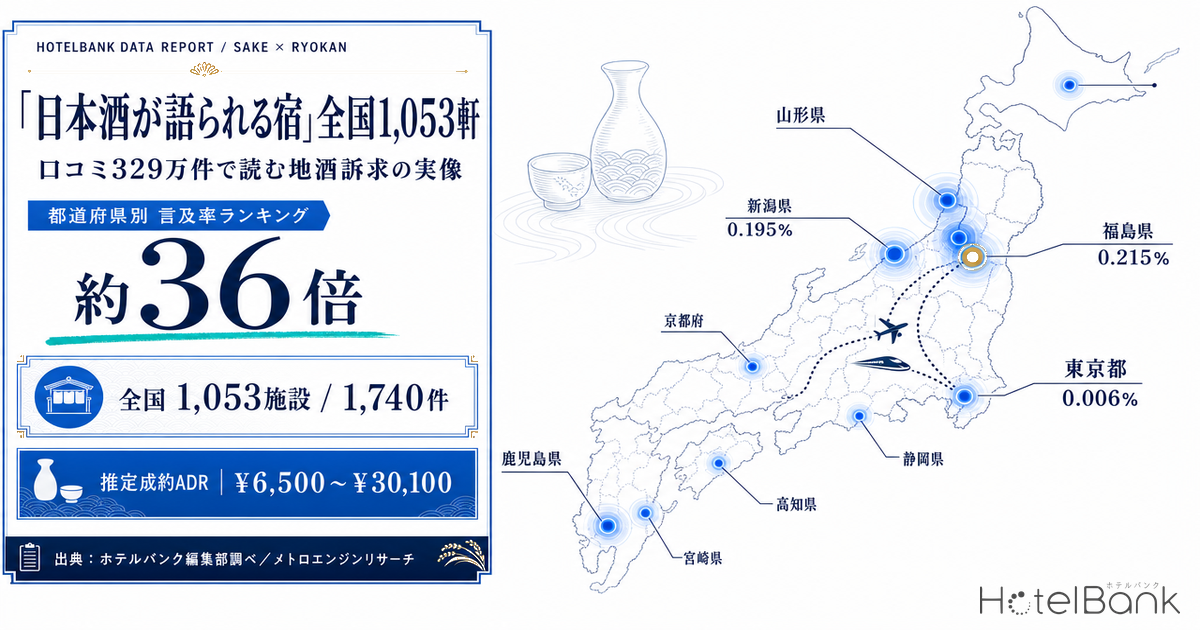
Read enough guest reviews and a distinct group emerges — travellers who write not about the food or the hot spring, but about the sake itself. Yet their voices are far from numerous. Of roughly 3.29 million guest reviews compiled by the HotelBank Editorial Team (24 months, August 2024 to July 2026), only 1,740 posts touched on the selection of sake, local sake or shochu — just 0.053% of the total. At a time when breakfast, crab and regional cuisine have been analysed to exhaustion, sake remains a subject that is barely spoken about. This article traces where those rare 1,740 mentions cluster — by region and by named property — and quantifies the room that still exists in beverage-led positioning.
Metric Definitions Used in This Article
- Mention rate: the share of guest reviews in the period that touched on the selection of sake, local sake or shochu (junmai-shu, sake tastings, local brewery bottles and the like). Posts are classified by meaning using natural language processing; this is a separate metric from star ratings. A high mention rate indicates that a topic gets talked about — it does not indicate superiority in taste or quality.
- Period and population: guest reviews posted over the 24 months from August 2024 to July 2026. The prefecture-level tally covers the 42 prefectures where at least 10 mentions could be confirmed (3,288,924 reviews in total). The property-level ranking starts from the 40 properties nationwide with at least 20 total reviews and at least 5 sake-related mentions, then narrows to the 25 properties where the substance of the sake, local sake or shochu reference could be confirmed in the review text itself.
- ADR (average daily rate): an estimated settled rate (tax-exclusive equivalent), derived by applying category-specific correction coefficients to the lowest publicly listed plan level on OTAs and other channels (two guests per room, per-room price, tax included). Cross-checked against property-level results disclosed by listed hotel REITs, the median error is approximately 7%. These are estimates and differ from each property’s actual transacted prices or accounting figures. This article uses the 11-month average from August 2025 to June 2026.
- Data sources: review analysis = HotelBank Editorial Team research / price data = MetroEngines Research
- — Reviews mentioning sake, local sake or shochu totalled 1,740 over 24 months, or 0.053% of all posts. Against the 8.0% recorded for breakfast buffets, that is two orders of magnitude smaller — a territory still largely unspoken.
- — The highest mention rate is Fukushima at 0.215%, followed by Yamagata at 0.199% and Niigata at 0.195%. The gap to Tokyo (0.006%) is roughly 36-fold, tracking the geography of sake brewing almost exactly.
- — Among the 25 properties that passed text verification, the leader is Nagaoka Grand Hotel (Niigata, 92 rooms, 4.29% mention rate). Scale is entirely inconsistent, ranging from a 12-room ryokan to a 348-room hotel.
- — At 15 of the 25 properties, what guests described was the format of service itself — “free tasting”, “sake-tasting corner”, “welcome local sake”. It is the mechanism, not the label on the bottle, that generates mentions.
- — Estimated settled ADR is spread across ¥6,500 to ¥30,100 (median ¥16,400), with no visible correlation between room rate and whether sake gets talked about.
1,053 Properties Where Sake Gets Talked About — 0.05% of All Reviews
Start with the overall picture. Across the 42 prefectures where mentions of sake, local sake or shochu could be confirmed, 1,053 properties were involved and the mention count was 1,740. Set against a denominator of roughly 3.29 million reviews, that works out to 0.053% — about one review in every 1,900. On the same analytical base, the mention rate for breakfast buffets is 8.0% (as of the most recent three months, HotelBank Editorial Team research): two orders of magnitude apart. Note that the breakfast figure covers the latest three months while the sake figure covers 24 months, so the difference in window length should be discounted when reading the comparison.
Beyond that, five prefectures — Okinawa, Aichi, Kagawa, Shiga and Tokushima — did not reach 10 confirmed mentions. In Okinawa’s case, awamori is plausibly discussed as a category separate from sake and shochu. Either way, it is clear that properties which prompt guests to talk about drink are not evenly distributed across the country. This pattern — mentions of a given food theme concentrating in a handful of prefectures while many others remain blank — is not unique to sake. When the same method was applied to crab, 25 prefectures returned no confirmed mentions at all.
So where do these rare mentions accumulate? Lined up by prefecture, the picture is remarkably straightforward.
Source: HotelBank Editorial Team research (August 2024–July 2026; 42 prefectures, 3,288,924 reviews analysed)
| Rank | Prefecture | Mentions | Properties with mentions | Mention rate |
|---|---|---|---|---|
| 1 | Fukushima | 102 | 55 | 0.215% |
| 2 | Yamagata | 68 | 38 | 0.199% |
| 3 | Niigata | 110 | 56 | 0.195% |
| 4 | Akita | 30 | 19 | 0.152% |
| 5 | Kagoshima | 62 | 31 | 0.149% |
| 6 | Fukui | 29 | 18 | 0.148% |
| 7 | Shimane | 30 | 20 | 0.131% |
| 8 | Yamaguchi | 29 | 19 | 0.117% |
| 9 | Aomori | 34 | 23 | 0.111% |
| 10 | Nara | 28 | 14 | 0.111% |
| 11 | Tochigi | 64 | 43 | 0.108% |
| 12 | Iwate | 32 | 17 | 0.106% |
Source: HotelBank Editorial Team research (top 12 prefectures, August 2024–July 2026)
Fukushima, Yamagata and Niigata Take the Top — a 36-Fold Gap to Tokyo
The highest mention rate is Fukushima at 0.215% (102 mentions across 55 properties), followed by Yamagata at 0.199% (68 mentions, 38 properties) and Niigata at 0.195% (110 mentions, 56 properties) — the sake-producing heartlands of Tohoku and Hokuriku-Shinetsu occupying the top places. Below them sit Akita at 0.152%, Kagoshima at 0.149%, Fukui at 0.148%, Shimane at 0.131% and Yamaguchi at 0.117%: again, a roll-call of brewing regions. Kagoshima and Miyazaki ranking high can reasonably be read as a reflection of shochu culture. This correlation with production regions does not break down when the season is changed either — a separate analysis narrowed to the hiyaoroshi season found substantially the same prefectures at the top.
By contrast, mention rates in the major metropolitan areas are extremely low. Tokyo stands at 0.006% (34 mentions across 27 properties), Osaka at 0.008%, Chiba at 0.011% and Fukuoka at 0.011%. The gap between Fukushima and Tokyo is roughly 36-fold. Tokyo has the largest review base in the country at 533,486 posts, and yet only 34 of them touch on sake. In urban hotels, location, rooms and cleanliness are the axes that get discussed; the conversation appears never to reach the drinks.
Source: HotelBank Editorial Team research (bottom 10 prefectures by mention rate, August 2024–July 2026)
One caveat is worth stating here: none of this means urban hotels lack good sake. The mention rate is a measure of how readily a topic gets talked about, and it reflects what guests chose as the subject of their trip. Turned around, if an urban property can design an experience that makes guests talk about sake, that becomes a clear point of separation from its competitors.
Named Ranking TOP 20 — the “Local Sake Inns” Reviews Point To
From here the view shifts to individual properties. Of the 40 properties nationwide meeting the threshold of at least 20 total reviews and at least 5 sake-related mentions, the 25 where specific content about sake, local sake or shochu could be confirmed in the review text are listed below, ordered by mention rate.
| Rank | Prefecture | Property | Rooms | Reviews | Mentions | Mention rate | Est. settled ADR |
|---|---|---|---|---|---|---|---|
| 1 | Niigata | Nagaoka Grand Hotel (長岡グランドホテル) | 92 | 233 | 10 | 4.29% | ¥7,600 |
| 2 | Yamagata | Mikiya Sansorai (三木屋 参蒼来) | 12 | 169 | 6 | 3.55% | ¥26,300 |
| 3 | Kochi | Mercure Kochi Tosa Resort & Spa (メルキュール高知土佐リゾート&スパ) | 195 | 177 | 5 | 2.82% | ¥17,200 |
| 4 | Shizuoka | Dogashima Onsen Hotel (堂ヶ島温泉ホテル) | 80 | 393 | 11 | 2.80% | ¥16,400 |
| 5 | Fukushima | Kutsurogi-Jyuku Chiyotaki (くつろぎ宿 千代滝) | 66 | 325 | 8 | 2.46% | ¥19,100 |
| 6 | Hokkaido | Yutorelo Toyako (ゆとりろ洞爺湖) | 58 | 481 | 11 | 2.29% | ¥12,700 |
| 7 | Toyama | Himi Onsengo Uomeguri-no-Yado Eihokaku (氷見温泉郷 魚巡りの宿 永芳閣) | 50 | 268 | 6 | 2.24% | ¥18,000 |
| 8 | Kyoto | Village Kyoto (ヴィラージュ京都) | 81 | 721 | 16 | 2.22% | ¥29,100 |
| 9 | Kagoshima | HOTEL&RESIDENCE Nanshukan (HOTEL&RESIDENCE 南洲館) | 62 | 305 | 6 | 1.97% | ¥6,500 |
| 10 | Saitama | Chichibu Onsen Hananoya (ちちぶ温泉 はなのや) | 25 | 315 | 6 | 1.90% | ¥30,100 |
| 11 | Hiroshima | Hotel Kamogawaso (ホテル賀茂川荘) | 41 | 271 | 5 | 1.85% | ¥14,200 |
| 12 | Miyazaki | Tamayura Onsen Miyazaki Kanko Hotel (たまゆら温泉 宮崎観光ホテル) | 348 | 275 | 5 | 1.82% | — |
| 13 | Nagano | Chisun Grand Nagano (チサン グランド 長野) | 136 | 1,200 | 20 | 1.67% | ¥12,500 |
| 14 | Ehime | Yamatoya Honten (大和屋本店) | 91 | 607 | 10 | 1.65% | ¥25,900 |
| 15 | Mie | Satobito Kumano Club (里創人 熊野倶楽部) | 40 | 566 | 9 | 1.59% | — |
| 16 | Ishikawa | Yamanaka Onsen Ohanami Kyubei (山中温泉 お花見久兵衛) | 49 | 447 | 7 | 1.57% | ¥20,400 |
| 17 | Niigata | Art Hotel Niigata Station (アートホテル新潟駅前) | 304 | 1,076 | 14 | 1.30% | ¥10,900 |
| 18 | Iwate | Aishinkan (愛真館) | 113 | 558 | 7 | 1.25% | ¥16,800 |
| 19 | Fukushima | Shosuke-no-Yado Takinoyu (庄助の宿 瀧の湯) | 50 | 714 | 8 | 1.12% | ¥15,700 |
| 20 | Hokkaido | Hotel WBF Grande Asahikawa (ホテルWBFグランデ旭川) | 120 | 927 | 9 | 0.97% | ¥13,800 |
Sources: review analysis = HotelBank Editorial Team research (N=25 properties, August 2024–July 2026) / estimated settled ADR = MetroEngines Research (11-month average, August 2025–June 2026)
First place goes to Nagaoka Grand Hotel in Niigata (92 rooms). Ten of its 233 reviews touch on sake, and its 4.29% mention rate puts clear distance between it and second place. According to the property’s official site, the executive lounge available to guests in its upper room categories is equipped with a sake-tasting dispenser stocked by a Nagaoka brewery, letting guests choose three from six Niigata labels at no charge. Reviews echo this directly, with comments such as “it was great that we could taste the sake”.
Second is Mikiya Sansorai (12 rooms) in Kaminoyama Onsen, Yamagata — a small ryokan rebranded and reopened in 2020 by the Meito Ichimon Takamiya group, where guests on the drink-inclusive plan can enjoy the bar lounge’s alcohol at no extra charge. One review describes the experience precisely: “the sake was served chilled, a little at a time, so we tasted all four varieties, and could have a second pour of the one we liked — very satisfying.” The manner of service itself has become the object of the review.
From third place down, the geography scatters — Kochi, Shizuoka, Fukushima, Hokkaido, Toyama, Kyoto. While the top 20 includes four properties from Tohoku and five from Hokuriku-Shinetsu, entries from outside the traditional brewing regions are equally conspicuous: Kyoto, Saitama, Hiroshima, Ehime, Miyazaki and Kochi. Even in prefectures where mentions are thin at the aggregate level, individual properties that get talked about disproportionately do exist.
How the population was built, and what was excluded
Where the threshold is set changes the shape of the ranking. At 5+ mentions and 20+ reviews, 40 properties remain; raise the bar to 10+ mentions and the population shrinks to 8. This article uses the 5-mention threshold so that small ryokan are not mechanically eliminated.
In addition, properties that rank highly on machine-classified mention counts alone but whose review text, on re-reading, contained no specific description of sake, local sake or shochu have been excluded. That applied to 15 of the 40 properties, among them an urban hotel with one of the highest mention counts in the set (966 reviews, 22 mentions). The posts in question there consisted mainly of general stay assessments written in English and Chinese, with no confirmable reference to sake, so the property was left out. If properties are to be named, the policy is to publish only those that pass text verification.
Below 21st place, the following five properties also had specific descriptions of sake, local sake or shochu confirmed in their review text. All are large properties with more than 700 reviews; the larger denominator pushes the mention rate down, but in absolute terms they are not behind the leaders.
| Prefecture | Property | Rooms | Reviews | Mentions | Mention rate | Est. settled ADR |
|---|---|---|---|---|---|---|
| Akita | ANA Crowne Plaza Akita (ANAクラウンプラザホテル秋田) | 192 | 736 | 6 | 0.82% | ¥14,300 |
| Fukui | Awara Onsen Mimatsu (あわら温泉美松) | 84 | 756 | 6 | 0.79% | ¥18,400 |
| Kagoshima | Kirishima Kokusai Hotel (霧島国際ホテル) | 165 | 1,203 | 6 | 0.50% | ¥15,800 |
| Kyoto | Kyoto Century Hotel (京都センチュリーホテル) | 214 | 1,533 | 7 | 0.46% | ¥28,700 |
| Nara | Hotel Nikko Nara (ホテル日航奈良) | 330 | 1,340 | 6 | 0.45% | ¥13,900 |
Sources: review analysis = HotelBank Editorial Team research / estimated settled ADR = MetroEngines Research
Mapping the 25 — Anchored in Tohoku and Hokuriku, Kyushu Answers with Shochu
Placed on a map, the 25 text-verified properties resolve into two clusters: a belt running from Tohoku through Hokuriku-Shinetsu, and the shochu country of Kagoshima and Miyazaki. Circle size represents room count — and the range is entirely uneven, from a 12-room ryokan to a 348-room hotel.
Source: review analysis = HotelBank Editorial Team research (N=25 properties)
The Common Thread Is Not the Label — It Is “Something You Can Try for Free”
Read through the review text of all 25 properties and a clear tendency emerges in what is actually being described. What guests write down is not so much the label or the taste of the sake as the way they came to encounter it — the design of the experience.
“Free”, “tasting”, “sake-tasting corner”, “self-service”, “welcome drink” — posts touching on this kind of service format were confirmed at 15 of the 25 properties. It is not the paid add-on order but the design that lets guests try something easily within the room rate that generates the mentions.
What can be verified on official websites supports the same pattern. Yutorelo Toyako runs an all-inclusive model, offering unlimited sake from across Japan alongside soft drinks in the lobby from 15:00 to 21:00, with in-house activities and dinner drinks available at no extra charge. Yamanaka Onsen Ohanami Kyubei offers an experience menu including a local-sake tasting flight to day visitors as well. Nagaoka Grand Hotel’s tasting dispenser works the same way — a format that lets guests choose at their own pace.
The implication for food and beverage operations follows from this. Rather than assembling expensive labels, offer small pours of several varieties, in a form guests choose for themselves, with no additional burden — that design alone changes how reviews are written. Set three local sakes out in a corner of the lounge and guests will remember it as an act of choosing, and write it down. How this kind of design — folding in-house food and beverage into the room rate — feeds back into rate is examined in All-Inclusive Japan 2026: Free Drinks, Lounges & the +40.7% Meal Lift, which tests it against price differences by meal type within the same property.
One further point: at the properties in Kagoshima and Miyazaki, shochu plays exactly the same role. Comments such as “the welcome shochu bar in the lounge…” at Kirishima Kokusai Hotel, or “the hospitality touches like the shirokuma ice and the shochu are appealing” at HOTEL&RESIDENCE Nanshukan, show that the idea translates directly into the local drinking culture. It does not have to be sake.
Because this involves serving alcohol, operational design — pour sizes, time windows, consideration for guests arriving by car — is a precondition. It is worth noting that every property above offers the service in a form limited by time window or by eligible guest.
“Sake at Dinner” and “Sake Itself” Are Different Axes
To read this analysis correctly, the metric boundaries need setting out. In the HotelBank Editorial Team’s review classification, beverage-related topics are tallied across several separate axes.
| Axis | What it captures | Typical post |
|---|---|---|
| Sake, local sake and shochu | The drink itself — selection, labels, tastings. Regardless of the setting in which it is served | “There were three junmai-shu from local breweries.” |
| Drinks at dinner | Wine, pairings and drinks menus in general, in the dinner setting | “The pairings matched to the dishes were excellent.” |
| All-you-can-drink / free drinks | Timed unlimited service, free alcohol in the lounge | “Drinks at dinner were all-you-can-drink.” |
| Welcome drink | The single glass on arrival or at check-in | “They served us a drink when we arrived.” |
Source: HotelBank Editorial Team research (review classification definitions)
This article deals with the first row. A post such as “the range of sake at dinner was superb” falls under both the drink selection and the dinner setting, so it is captured on both axes. Conversely, “the wine pairing was outstanding” is counted only under drinks at dinner and does not enter this article’s tally.
In practice, among the leading properties, Mikiya Sansorai also stands out on the drinks-at-dinner axis at a 30.77% mention rate — its sake selection and its dinner experience are described as one. Nagaoka Grand Hotel, by contrast (3.86% on drinks at dinner), has its sake discussed in the lounge, a setting outside dinner. Even among properties that are “strong on sake”, the touchpoint at which the conversation happens differs by property. When re-reading your own reviews, separating these two makes the available moves far more concrete.
Price Band Is Irrelevant — Estimated Settled ADR of ¥6,500 to ¥30,100
The other finding is that properties where sake gets talked about show almost no skew by price band. Lining up the 23 properties for which an estimated settled ADR could be calculated, the lowest is HOTEL&RESIDENCE Nanshukan (Kagoshima) at about ¥6,500 and the highest is Chichibu Onsen Hananoya (Saitama) at about ¥30,100. The median is roughly ¥16,400, with the distribution running broadly from under ¥10,000 to over ¥30,000.
Source: MetroEngines Research (N=23 properties, 11-month average August 2025–June 2026; excludes 2 properties whose category does not permit an estimated settled ADR)
The same holds for room count. Small ryokan such as the 12-room Mikiya Sansorai and the 25-room Chichibu Onsen Hananoya sit in the same ranking as large properties like the 304-room Art Hotel Niigata Station and the 348-room Tamayura Onsen Miyazaki Kanko Hotel. This is not a story about economies of scale; it is a question of operational design.
Source: review analysis = HotelBank Editorial Team research (N=25 properties, August 2024–July 2026)
Worth noting is that business-hotel-type properties with an estimated settled ADR around ¥10,000 — Nagaoka Grand Hotel (about ¥7,600), Art Hotel Niigata Station (about ¥10,900), Chisun Grand Nagano (about ¥12,500) — break into the upper ranks. No correlation is visible between a high room rate and whether sake gets talked about. Use an existing space such as the lounge or the breakfast room, and set out local sake in small pours. That alone can change how reviews are written, at any rate band.
Conclusion — the Room Lies in What Is Not Yet Being Said
Reviews touching on sake, local sake or shochu amount to just 1,740 posts over 24 months — 0.053% of the total. Among the 42 prefectures, the top places go to the brewing regions of Fukushima (0.215%), Yamagata (0.199%) and Niigata (0.195%), with a roughly 36-fold gap to Tokyo (0.006%). At property level, the 25 whose content could be confirmed in the review text are scattered across the country, and at 15 of them it was the service format itself — free tasting, sake-tasting corner, welcome local sake — that guests described.
Set against breakfast or regional cuisine, sake is still a territory that goes unspoken. That is precisely why it stays in the memory. From a property at an estimated settled ADR of ¥6,500 to one at ¥30,100, from 12 rooms to 348, the leaders have nothing consistent about them. The one thing they shared was a design that let guests choose for themselves and try a little at a time. Partner with a local brewery; set a few bottles out in a corner of the lounge. This small-investment move is creating separation in the most visible place there is — the reviews.
Frequently Asked Questions
Q. How is the mention rate for sake and local sake calculated?
A. The denominator is the number of guest reviews in the target period (the 24 months from August 2024 to July 2026); the numerator is the number of posts touching on the selection of sake, local sake or shochu (junmai-shu, sake tastings, local brewery bottles and the like). Posts are classified by meaning using natural language processing; this is a separate metric from star ratings.
Q. Why is the national average as low as 0.053%?
A. Because posts that take the drink itself as their subject are inherently few. On the same analytical base, the mention rate for breakfast buffets is 8.0% (as of the most recent three months) — two orders of magnitude apart. That a territory goes unspoken means, conversely, that room for differentiation remains.
Q. What do the top-ranked properties have in common?
A. Not lavish labels, but “a mechanism for trying small pours, free or at no additional charge”. At 15 of the 25 properties that passed text verification, reviews described the service format itself — free tasting, sake-tasting corner, welcome local sake. Most run this using existing spaces such as the lounge or the breakfast room.
Q. Does a higher room rate make sake more likely to be talked about?
A. No correlation is visible. Estimated settled ADR ranges from about ¥6,500 to about ¥30,100, with a median of roughly ¥16,400. Business-hotel-type properties around ¥10,000 also rank highly, and room counts run anywhere from 12 to 348. This is a question of operational design, not economies of scale.
Q. How does this differ from “drinks at dinner”?
A. This article covers the axis of “the drink selection itself”, regardless of the setting in which it is served. Wine and pairings in the dinner setting are tallied on a separate axis, so a post saying “the wine pairing was outstanding” does not enter this article’s count. Posts that fall under both are captured on both axes.
Q. Were any properties excluded from the ranking?
A. Yes. Properties where the machine classification recorded mentions but no specific description of sake, local sake or shochu could be confirmed in the review text were left out. That applied to 15 of the 40 properties, among them an urban hotel with one of the highest mention counts in the set (966 reviews, 22 mentions).
Related Reading
- All-Inclusive Japan 2026: Free Drinks, Lounges & the +40.7% Meal Lift
- Local Cuisine at Breakfast: Regional Ranking of Hotels Highly Rated for Local Ingredients
- Hotels Chosen for Value for Money: National TOP 30 (21.6% of Reviews)
- Chosen for the Water: Japan’s Top 30 Onsen Inns by Review Mentions
References and Sources
■ Review and price data
- HotelBank Editorial Team research — classification of guest reviews by natural language processing (August 2024–July 2026; 42 prefectures, 3,288,924 reviews)
- MetroEngines Research — estimated settled ADR (August 2025–June 2026, N=23 properties)
■ Data sources
This article cross-references the classification of guest reviews by natural language processing (HotelBank Editorial Team research, August 2024–July 2026; 42 prefectures, 3,288,924 reviews) with estimated settled ADR derived by applying category-specific corrections to OTA listed prices (MetroEngines Research, 11-month average August 2025–June 2026).
■ Calculation assumptions (aggregation conditions, thresholds, exclusion criteria)
- Population conditions: at least 20 total reviews and at least 5 sake-related mentions (raising the bar to 10+ mentions leaves a population of 8 properties)
- Exclusion criteria: properties where the machine classification recorded mentions but no specific description of sake, local sake or shochu could be confirmed in the review text are excluded (15 of 40 properties excluded)
- Aggregation windows: review mention rate = the 24 months from August 2024 to July 2026 / comparison figure for breakfast buffet mention rate = most recent three months
- Room counts and property specifications: cross-checked against figures published on each property’s official website
■ Limitations and caveats
The mention rate measures whether a topic tends to get talked about; it is a separate axis from the quality of what is offered or from satisfaction scores. Machine classification produces both misses and false positives, and this article names only properties that passed text verification. Estimated settled ADR is an estimate and does not guarantee any property’s actual transacted price. A prefecture with few mentions is not thereby “weak on sake” — differences in review volume and in how guests write also play a part.
■ Property official websites