

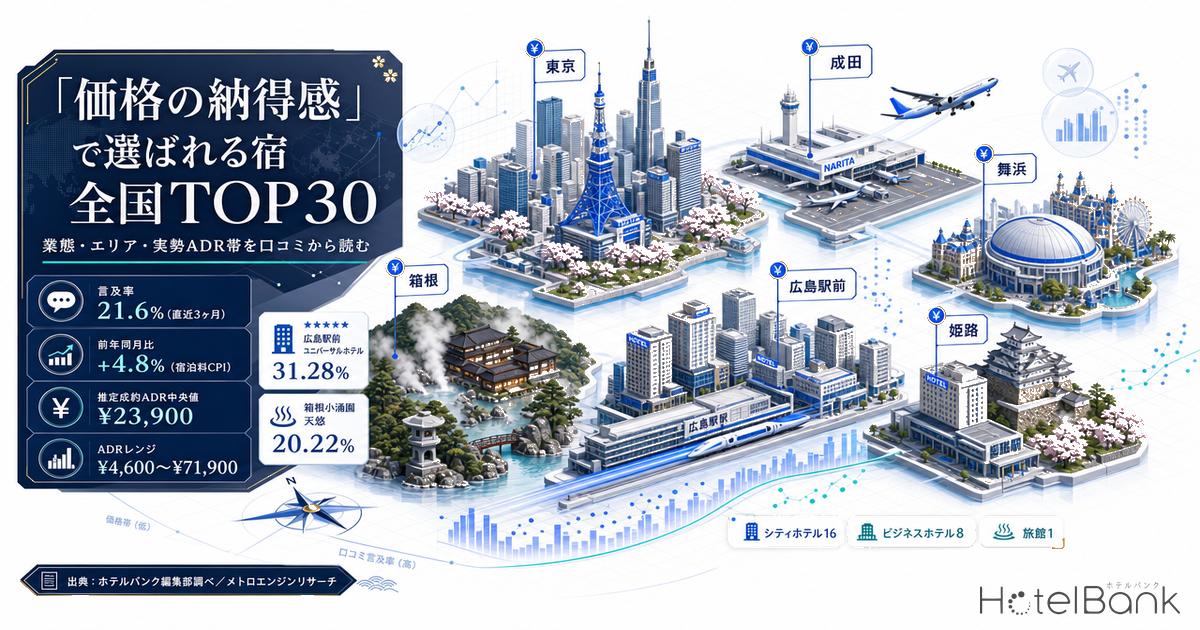
Against a backdrop of rising costs and wage growth, room rates in Japan continue to climb. The Ministry of Internal Affairs and Communications’ Consumer Price Index for accommodation charges (national) reached 172.3 in May 2026 (2020 = 100), up 4.8% from 164.4 a year earlier. Amid this, the industry’s attention is shifting from “what price to charge” to “how to make that price feel justified.” This article aggregates, at the national level, an NLP-derived “value-for-money” tag extracted from guest reviews — mentions expressing satisfaction with, or acceptance of, the price paid — and reads the property types, regions and prevailing ADR bands of the top 30 properties.
Metric Definitions Used in This Article
- Value-for-money tag: Guest review text is semantically analyzed with NLP to extract mentions expressing acceptance of or satisfaction with the price — phrases such as “worth more than what I paid” or “at this price, for this content.” The aggregation covers the most recent 24 months and positive mentions only. The mention rate is the share of a property’s total reviews that carry this tag — it is not the property’s star rating.
- ADR (average daily rate): An estimated settled rate (tax-exclusive equivalent) calculated by applying property-type correction coefficients to the lowest published plan level each property lists on OTAs and other booking sites (two guests per room, per-room rate, tax included). Cross-checked against property-level actuals disclosed by listed hotel REITs (91 properties, most recent 3 months), the median error is approximately 7%. These are estimates and differ from each property’s actual transacted prices or accounting figures. This article reports the median of the monthly estimated settled ADR over the most recent 12 months.
- Data sources: Reviews = HotelBank Editorial Team research (NLP analysis) / ADR = MetroEngines Research / Price index = Ministry of Internal Affairs and Communications, “Consumer Price Index”
- — 21.6% of the 425,012 reviews posted in the most recent three months mention value for money. That is up 5.8 points from 15.9% in the preceding 12 months — the second-largest gain among all 79 tags.
- — The backdrop is a period of rate increases. The Consumer Price Index for accommodation charges stood at 172.3 in May 2026 (2020 = 100), up 4.8% year on year.
- — By mention count, the TOP 30 is 80% urban: 16 city hotels and 8 business hotels, concentrated in just seven prefectures centered on Tokyo and Chiba (note the aggregation bias that favors large properties with big review bases).
- — Re-sorted by mention rate rather than count, the leader is Hiroshima Ekimae Universal Hotel Shinkansen-guchi Migi in Hiroshima at 31.3%. Station-front business hotels in regional and sub-central locations move to the top.
- — Estimated settled ADR spans roughly ¥4,600 to ¥71,900 — a more than fifteenfold spread — yet the mention-rate ranges largely overlap. Value for money is not determined by price band.
Price has become the main battleground in guest reviews
Let us first look at which evaluation axes are growing across all reviews nationwide. Comparing the most recent three months (April 17 to July 16, 2026, N=425,012) with the preceding 12 months (April 22, 2025 to April 17, 2026, N=1,659,530), mentions of value for money rose from 15.9% to 21.6% — a gain of 5.8 points, the second largest among all 79 tags. Roughly one in five reviews posted in the last three months now touches on how guests judge the price.
Source: HotelBank Editorial Team research (NLP analysis; most recent 3 months N=425,012 / preceding 12 months N=1,659,530)
The figure needs care in interpretation, however. Comprehensive axes such as location, service and facilities also rose together at the top of the list, which suggests part of the movement reflects reviews themselves being written more specifically and from more angles than before. Rather than reading the absolute level of the mention rate, it is more defensible to read the structure: price has become a topic of the same magnitude as food. Note also that properties earning high marks on individual experience axes such as the room view show a distinct geographic skew — for a case study applying the same review-analysis method to a different axis, see Hotels Where Room-View Ratings Are Rising: National TOP 30.
Behind this lies the rise in rate levels. Overlaying the accommodation-charge Consumer Price Index year by year shows a consistent step up across 2024, 2025 and 2026. May 2026’s reading of 172.3 sits 72% above the 2020 average. Yadoken, a media outlet covering the lodging industry, likewise noted in its 2026 industry outlook that its own survey found the top reason guests gave for not choosing a property was that “the price did not feel justified,” concluding that the key to filling rooms is not cheapness but a sense that the price makes sense.
Source: Compiled by the HotelBank Editorial Team from the Ministry of Internal Affairs and Communications’ “Consumer Price Index” (accommodation charges, national, 2020 = 100)
The national TOP 30 for “worth more than the price”
So which properties are actually described this way most often? Using reviews from the most recent 24 months, we extracted the national top 30 properties by the number of positive mentions of value for money. Because this is a count-based aggregation, large properties with big review bases tend to rise to the top — a caveat worth stating up front. The median room count across the TOP 30 is 577, and every property has accumulated thousands of reviews per year. This table is therefore not a ranking of “the best-value hotels in Japan” but rather a list of properties whose value for money is repeatedly described by large numbers of guests.
| # | Property | Region | Type | Rooms | Mentions | Mention rate | Est. settled ADR |
|---|---|---|---|---|---|---|---|
| 1 | Narita Tobu Hotel Airport (成田東武ホテルエアポート) | Chiba | City hotel | 484 | 1,204 | 12.81% | ¥11,600 |
| 2 | Grand Nikko Tokyo Bay Maihama (グランドニッコー東京ベイ 舞浜) | Chiba | Resort hotel | 707 | 826 | 13.34% | ¥23,900 |
| 3 | Keio Plaza Hotel (京王プラザホテル) | Tokyo | Deluxe hotel | 1,438 | 779 | 20.81% | — |
| 4 | Hotel Gracery Shinjuku (ホテルグレイスリー新宿) | Tokyo | Business hotel | 970 | 706 | 12.47% | ¥35,100 |
| 5 | Kyoto Universal Hotel Karasuma (京都ユニバーサルホテル烏丸) | Kyoto | Business hotel | 424 | 682 | 27.27% | ¥6,000 |
| 6 | Hotel Nikko Narita (ホテル日航成田) | Chiba | City hotel | 685 | 661 | 13.98% | ¥11,200 |
| 7 | Hotel Sunroute Plaza Shinjuku (ホテルサンルートプラザ新宿) | Tokyo | Business hotel | 624 | 629 | 12.65% | ¥32,500 |
| 8 | HOTEL THE FLAG Shinsaibashi (HOTEL THE FLAG 心斎橋) | Osaka | Business hotel | 162 | 597 | 20.49% | — |
| 9 | HOTEL MYSTAYS PREMIER Narita (ホテルマイステイズプレミア成田) | Chiba | City hotel | 711 | 588 | 17.22% | ¥9,700 |
| 10 | The Royal Park Hotel Tokyo Haneda (ザ ロイヤルパークホテル 東京羽田) | Tokyo | City hotel | 313 | 587 | 10.11% | ¥27,600 |
| 11 | Imperial Hotel Tokyo (帝国ホテル東京) | Tokyo | Deluxe hotel | 570 | 571 | 18.74% | — |
| 12 | Hotel Metropolitan Edmont (ホテルメトロポリタン エドモント) | Tokyo | City hotel | 666 | 549 | 21.0% | ¥22,500 |
| 13 | Hiroshima Ekimae Universal Hotel Shinkansen-guchi Migi (広島駅前ユニバーサルホテル新幹線口右) | Hiroshima | Business hotel | 301 | 548 | 31.28% | ¥5,500 |
| 14 | Kobe Meriken Park Oriental Hotel (神戸メリケンパークオリエンタルホテル) | Hyogo | City hotel | 323 | 529 | 12.21% | ¥30,600 |
| 15 | Himeji Ekimae Universal Hotel Minamiguchi (姫路駅前ユニバーサルホテル南口) | Hyogo | Business hotel | 338 | 512 | 24.95% | ¥4,600 |
| 16 | THE KNOT TOKYO Shinjuku | Tokyo | City hotel | 408 | 507 | 11.25% | ¥28,900 |
| 17 | The Prince Park Tower Tokyo (ザ・プリンス パークタワー東京) | Tokyo | City hotel | 603 | 501 | 20.37% | ¥71,900 |
| 18 | Kobe Portopia Hotel (神戸ポートピアホテル) | Hyogo | City hotel | 737 | 498 | 12.8% | ¥19,500 |
| 19 | Hotel Emion Tokyo Bay (ホテルエミオン東京ベイ) | Chiba | City hotel | 583 | 481 | 16.78% | ¥30,900 |
| 20 | International Garden Hotel Narita (インターナショナルガーデンホテル成田) | Chiba | City hotel | 463 | 480 | 17.45% | ¥8,300 |
| 21 | Grand Nikko Tokyo Daiba (グランドニッコー東京 台場) | Tokyo | City hotel | 882 | 478 | 16.99% | ¥44,500 |
| 22 | Kawasaki King Skyfront Tokyu REI Hotel (川崎キングスカイフロント東急REIホテル) | Kanagawa | Business hotel | 186 | 477 | 15.95% | ¥17,500 |
| 23 | Miyako Hotel Kyoto Hachijo (都ホテル 京都八条) | Kyoto | City hotel | 988 | 473 | 18.88% | ¥20,400 |
| 24 | APA Hotel & Resort Tokyo Bay Makuhari (アパホテル&リゾート〈東京ベイ幕張〉) | Chiba | City hotel | 2,007 | 439 | 9.01% | ¥13,500 |
| 25 | Hotel Keihan Universal Tower (ホテル京阪 ユニバーサル・タワー) | Osaka | City hotel | 641 | 437 | 11.61% | ¥29,100 |
| 26 | Daiwa Roynet Hotel Nishi-Shinjuku PREMIER (ダイワロイネットホテル西新宿 PREMIER) | Tokyo | Business hotel | 280 | 423 | 17.57% | ¥40,100 |
| 27 | Hakone Kowakien Ten-yu (箱根小涌園 天悠) | Kanagawa | Ryokan | 150 | 423 | 20.22% | ¥56,400 |
| 28 | Oriental Hotel Tokyo Bay (オリエンタルホテル東京ベイ) | Chiba | Deluxe hotel | 511 | 421 | 10.6% | — |
| 29 | Tobu Hotel Levant Tokyo (東武ホテルレバント東京) | Tokyo | City hotel | 383 | 416 | 15.14% | ¥25,600 |
| 30 | Hotel Nikko Osaka (ホテル日航大阪) | Osaka | Deluxe hotel | 603 | 416 | 15.23% | — |
Source: Reviews = HotelBank Editorial Team research (NLP analysis, most recent 24 months, positive mentions only, N=30 properties) / ADR = MetroEngines Research (median of estimated settled ADR over the most recent 12 months). A dash in the ADR column indicates a property that falls outside the validated property-type categories for estimated settled ADR, or for which insufficient observation months have accumulated.
The leader is Narita Tobu Hotel Airport (Chiba, 484 rooms), where 1,204 of 9,402 reviews (12.8%) mention value for money. It is followed by Grand Nikko Tokyo Bay Maihama (826 mentions) and Keio Plaza Hotel (779). What stands out is that the top of the table is filled with locations where the purpose of the stay is unambiguous: adjacent to an airport, adjacent to a theme park, or at a central-city terminal.
Property-type mix — 16 city hotels, with resorts and ryokan at one each
Broken down by property type, the TOP 30 comprises 16 city hotels — a majority — plus 8 business hotels, 4 deluxe hotels, and one resort hotel and one ryokan.
Source: HotelBank Editorial Team research (NLP analysis, N=30 properties); property-type classification from MetroEngines Research
City hotels and business hotels together account for 24 properties — 80% of the list is urban, accommodation-led inventory. This is the flip side of the review-base bias noted above. Ryokan and resorts have smaller room counts and accumulate reviews at an order of magnitude below large urban boxes, so a count-based national aggregation structurally works against them.
The one ryokan that did make the list is Hakone Kowakien Ten-yu (Kanagawa, 150 rooms). At that scale it has gathered 2,092 reviews, of which 423 (20.2%) touch on value for money. Its estimated settled ADR of roughly ¥56,400 is the second highest in the TOP 30. That one in five guests at a high-rate ryokan explicitly writes that the stay was worth the price is a good illustration of how value for money can hold on an axis entirely separate from cheapness. Similarly, the sole resort hotel — Grand Nikko Tokyo Bay Maihama (707 rooms) — ranks second nationally, showing a structure in which the clear purpose-value of a theme-park stay underpins how the price is judged.
Regional distribution — concentrated in seven prefectures, anchored by airports and theme parks
By region, the list is confined to just seven prefectures: Tokyo with 11 properties, Chiba with 8, Osaka and Hyogo with 3 each, Kyoto and Kanagawa with 2 each, and Hiroshima with 1.
Source: HotelBank Editorial Team research (NLP analysis, N=30 properties)
Of Chiba’s 8 properties, 5 sit in the Narita Airport catchment (Narita Tobu Hotel Airport, Hotel Nikko Narita, HOTEL MYSTAYS PREMIER Narita and International Garden Hotel Narita), with the remainder in the Maihama and Makuhari areas. In Tokyo, The Royal Park Hotel Tokyo Haneda near Haneda Airport and several properties around the Shinjuku terminal appear. In Kanagawa, Kawasaki King Skyfront Tokyu REI Hotel makes the list on the strength of its proximity to Haneda.
What this suggests is that locations where value for money gets discussed share a common character. Airports, theme parks and terminals are places guests book with a clear answer to “what am I staying here for.” The clearer the purpose, the more the room charge is judged as a cost of achieving that purpose, and the more readily functions such as “the shuttle works” or “you can walk there” translate directly into justification of the price. Where the purpose is vaguer and the property is compared on open-ended criteria, price is instead exposed to relative comparison with competitors. The difference in how easily a location itself generates that sense of justification likely sits behind this distribution.
Prevailing ADR band — median ¥23,900, spanning ¥4,600 to ¥71,900
For the 25 TOP 30 properties for which an estimated settled ADR could be calculated, we look at the level over the most recent 12 months. The median is approximately ¥23,900, and the range runs from about ¥4,600 to about ¥71,900 — a spread of more than fifteen times.
Source: MetroEngines Research (estimated settled ADR, median over the most recent 12 months, N=25 properties) / Reviews = HotelBank Editorial Team research
The distribution does not cluster in any one price band. Five properties sit below ¥10,000, five between ¥10,000 and ¥19,999, seven between ¥20,000 and ¥29,999, six between ¥30,000 and ¥49,999, and two at ¥50,000 or above — scattered across essentially the entire range. Value for money is not the exclusive preserve of the low-price band — this is the single most important implication of the aggregation. The two properties above ¥50,000 (The Prince Park Tower Tokyo at roughly ¥71,900 and Hakone Kowakien Ten-yu at roughly ¥56,400) both hold mention rates in the 20% range.
Plotting ADR against mention rate on a scatter chart makes that independence clearer still.
Source: MetroEngines Research (estimated settled ADR) / HotelBank Editorial Team research (mention rate, N=25 properties)
The low-ADR band contains properties with mention rates of 25% to 31%, while the high-ADR band above ¥50,000 also has properties in the 20% range, and the ¥20,000–¥40,000 middle band spreads broadly across 10% to 21%. There is no relationship in which mentions of value for money increase monotonically as price falls.
Re-sort by mention rate and a different picture emerges
Sorting by mention rate rather than count changes the complexion of the TOP 30. The leader is Hiroshima Ekimae Universal Hotel Shinkansen-guchi Migi (Hiroshima, 301 rooms) at 31.3%: 548 of its 1,752 reviews touch on value for money, approaching one in three. Its estimated settled ADR is about ¥5,500. Next come Kyoto Universal Hotel Karasuma (Kyoto, 424 rooms) at 27.3% and roughly ¥6,000, and Himeji Ekimae Universal Hotel Minamiguchi (Hyogo, 338 rooms) at 25.0% and roughly ¥4,600. These are station-front properties in regional and sub-central locations, holding a clearly defined low price band while earning high mention rates. For the ADR levels of business hotels serving corporate travel demand and the regional differences in value-for-money assessment, Business Hotel Price Surge: National ADR Analysis & 10 Cost-Effective Prefectures provides a prefecture-by-prefecture analysis.
From fourth place down come Hotel Metropolitan Edmont (21.0%), Keio Plaza Hotel (20.8%), HOTEL THE FLAG Shinsaibashi (20.5%), The Prince Park Tower Tokyo (20.4%), Hakone Kowakien Ten-yu (20.2%), Miyako Hotel Kyoto Hachijo (18.9%) and Imperial Hotel Tokyo (18.7%). A station-front business hotel at an ADR of roughly ¥5,000 and a luxury city hotel at roughly ¥72,000 sit within nearly the same mention-rate range. When guests write that a stay was worth more than what they paid, the yardstick is evidently not the absolute amount but the gap against the expectations they held going in.
Here lies the practical implication for raising the sense that a price is justified. In a period of rising ADR, what matters is not holding the price itself down but identifying what guests in that price band expect in advance, and reliably delivering an experience that slightly exceeds it. In the low band that means cleanliness and proximity to the station; in the high band, the view, the food and the quality of service — the content of expectation differs by price band. That the TOP 30 houses both low- and high-ADR properties means every price band retains room to build up that sense of justification.
For operators: plan-naming cues that work on this theme
Elements most common in published plan names that pitch value for money (N=1,269) —
Breakfast included 30%Early-booking discount 28%Room only 20%Multi-night discount 17%Discount 13%Last-minute deal 11%
Examples of actual names (anonymized):
- Fixed weekday rate [breakfast included] 22+ consecutive nights — eco monthly plan
- ★Chef’s pick★ Indulgent [all-crab] kaiseki ★in-room dining ★free private bath
- Fixed weekday rate [room only] 22+ consecutive nights — eco monthly plan
*A tendency observed in aggregated published plan names; it does not demonstrate that naming causes sales.
Conclusion
Of the 425,012 reviews posted in the most recent three months, 21.6% mention value for money — up 5.8 points from 15.9% in the preceding 12 months. With the accommodation-charge Consumer Price Index running 4.8% above a year earlier, price has become one of the topics guests discuss most.
The national TOP 30 for value-for-money mentions is 80% urban by property type — 16 city hotels and 8 business hotels — and regionally confined to seven prefectures centered on Tokyo and Chiba. That said, this reflects the aggregation characteristic whereby large properties with big review bases rise on a count basis; it does not mean ryokan and resorts lack value for money. Indeed, Hakone Kowakien Ten-yu holds a 20.2% mention rate with 150 rooms and an estimated settled ADR of roughly ¥56,400.
Most important of all, estimated settled ADR spans more than fifteenfold — from about ¥4,600 to about ¥71,900 — while the mention-rate ranges largely overlap. Value for money is not determined by price band. Even in a period of rising ADR, a property that accurately grasps the expectations attached to its own price band and designs an experience that reliably exceeds them can keep building that sense of justification. In the battle for guests in 2026, this design capability sits at the center of the remaining upside.
Related reading
- Business Hotel Price Surge: National ADR Analysis & 10 Cost-Effective Prefectures
- Hotels Where Room-View Ratings Are Rising: National TOP 30 — Summer 2026, the Scarcity of a Firework View From Your Room
References and Sources
■ Review and market data
- HotelBank Editorial Team research (NLP analysis of guest reviews) — national aggregation of the value-for-money tag (most recent 24 months, positive mentions, N=30 properties); national trend aggregation (most recent 3 months N=425,012 / preceding 12 months N=1,659,530)
- MetroEngines Research — estimated settled ADR (median over the most recent 12 months, N=25 properties); property-type and room-count classification
- MetroEngines Research — aggregation of appeal elements in published plan names (N=1,269)
■ Government statistics
- Ministry of Internal Affairs and Communications, “Consumer Price Index” (statistics ID: 0003427113, accommodation charges, national, 2020 = 100)
- Japan Tourism Agency, “Overnight Travel Statistics Survey”
■ Industry reports and columns