

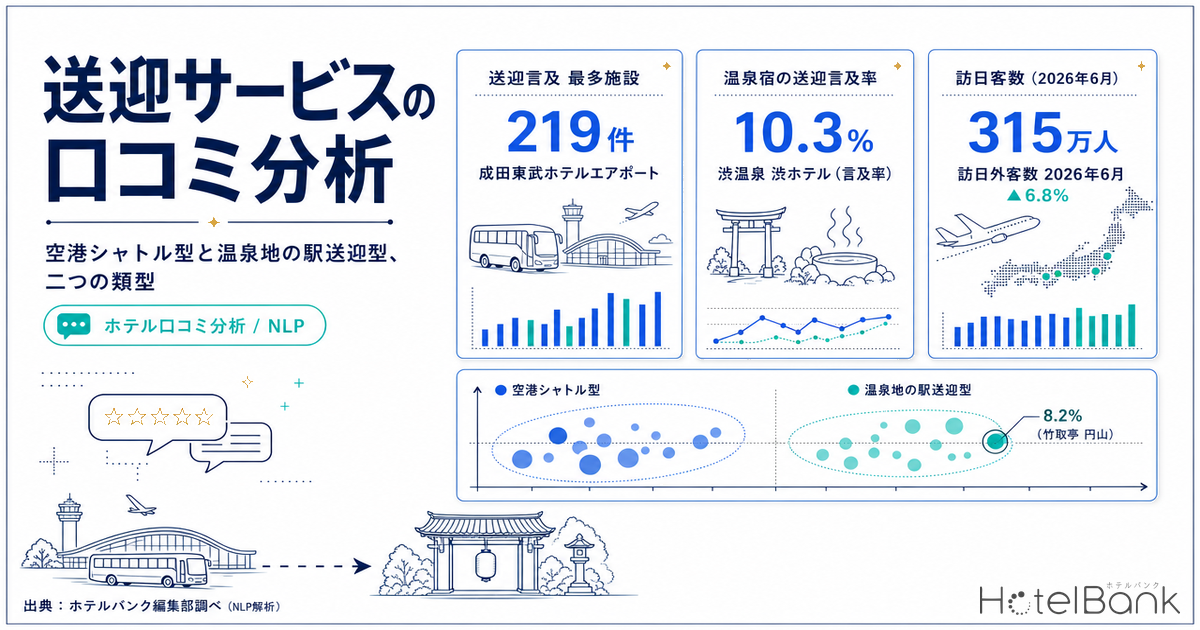
As inbound travel to Japan shifts further toward independently arranged trips (FIT), one practical consideration in choosing accommodation has been quietly gaining weight: shuttle and pickup services. “Secondary transport” — the links connecting airports and major stations to sightseeing areas and lodging — has long been a theme in attracting visitors to regional Japan. According to the Japan National Tourism Organization (JNTO), inbound visitor arrivals in June 2026 totaled 3.15 million (-6.8% year on year), with the first-half cumulative figure at 21.08 million (-2.0%). While weakness in the Chinese market weighed on the overall total, markets driven mainly by independent travel held firm: South Korea at 787,000 (+7.8%), Taiwan at 670,000 (+14.6%), and the United States at 355,000 (+2.7%). Now that self-arranged itineraries have become the norm, how are hotel shuttles filling in the “last few kilometers” that public transport leaves open? The HotelBank Editorial Team reads its aggregated guest reviews through the lens of shuttle-service mentions.
Metric Definitions Used in This Article
- Mention rate: The share of a property’s guest reviews that refer to shuttle or pickup service. This indicates how often the topic came up — it is not an evaluation score in itself.
- Scope of analysis: Guest reviews held by the HotelBank Editorial Team were classified using natural language processing, and properties with a certain minimum number of shuttle-related mentions were aggregated. The dataset covers reviews posted over the most recent 24 months (August 2024 – July 2026).
- Mention profile: The tendency for certain topics to be discussed more often, broken down by the language a review was written in. Because the language of writing is not the same as the reviewer’s nationality, we make no assertions about “which country rates a property highly.”
- Data source: HotelBank Editorial Team research (NLP analysis)
- — Shuttle mentions cluster around airports. Narita Tobu Hotel Airport (成田東武ホテルエアポート) leads with 219 mentions, and gateway properties around Narita, Haneda, and Kansai dominate the upper ranks.
- — Two distinct types emerge. The “airport shuttle” type holds a steady mention rate in the 2-3% range, while the “onsen-town station pickup” type — such as Shibu Onsen Shibu Hotel (渋温泉 渋ホテル) at 10.3% — puts the shuttle at the center of the conversation.
- — A lever that turns a locational disadvantage into value. At onsen-town properties, the pickup shapes the first impression of the stay and can become a booking decision factor for increasingly FIT-oriented inbound travelers.
Properties with the most shuttle mentions skew heavily toward airport areas
Aggregating the properties with the most shuttle-related mentions nationwide reveals a clear tilt toward hotels near airports. The top spot goes to Narita Tobu Hotel Airport (成田東武ホテルエアポート, Chiba) in the Narita Airport area with 219 shuttle mentions. Hotel Nikko Narita (ホテル日航成田, also Chiba) follows in second place with 174, and Kawasaki King Skyfront Tokyu REI Hotel (川崎キングスカイフロント東急REIホテル, Kanagawa — in the King Skyfront district across the water from Haneda Airport) ranks third with 92. Below them come Hotel MyStays Premier Narita (ホテルマイステイズプレミア成田), Kansai Airport Washington Hotel (関西エアポートワシントンホテル, Osaka), and Toyoko Inn Narita Airport Main Building (東横INN成田空港本館, Chiba) — properties clustered around the three major gateway airports of Narita, Haneda, and Kansai.
These airport hotels commonly offer 24-hour free shuttles and pickup service timed to early-morning departures and late-night arrivals. As the starting and ending point of an itinerary, the shuttle itself forms the core of the property’s value proposition. The Narita and Haneda areas in particular are gateways for inbound visitors, and the share of foreign-language reviews there is high. The shuttle registers as “infrastructure you would expect to be there,” steadily accumulating mentions within an enormous volume of reviews.
Source: HotelBank Editorial Team research (NLP analysis)
As the color coding shows, most of the top 15 properties fall into the airport shuttle type. What stands out, however, is the presence of onsen-town properties: Dogo Prince Hotel (道後プリンスホテル, Ehime — Dogo Onsen) in 14th place, along with Shibu Onsen Shibu Hotel (渋温泉 渋ホテル, Nagano) and Taketoritei Maruyama (竹取亭 円山, Hyogo — Arima Onsen) somewhat further down. In absolute counts they do not match the airport properties, but at these onsen inns the shuttle carries a different meaning. The next section visualizes that difference.
The “airport shuttle” type and the “onsen-town station pickup” type
Plotting shuttle mentions along two dimensions — absolute count (horizontal axis) and mention rate (vertical axis) — brings two clusters of distinctly different character into view. The horizontal axis represents how many reviews discussed the shuttle at all; the vertical axis represents what share of that property’s total reviews the shuttle accounts for.
Source: HotelBank Editorial Team research (NLP analysis) / bubble size = total review count
The airport shuttle type operates on an entirely different scale of review volume (Narita Tobu Hotel Airport recorded N=9,340 reviews over the most recent 24 months). Shuttle mentions are numerous in absolute terms, but because the conversation about value spans many topics — guest rooms, breakfast, location and more — the shuttle mention rate settles in the 2-3% range. The shuttle is discussed consistently, as one evaluation axis among many.
The onsen-town station pickup type, by contrast, has far smaller total review counts yet a strikingly high share of the conversation devoted to the shuttle. Shibu Onsen Shibu Hotel reaches a 10.3% shuttle mention rate (N=290), Taketoritei Maruyama 8.2% (N=451), and Dogo Prince Hotel 5.6% (N=663). Where the nearest station is reachable only by bus, or lies beyond walking distance, the property’s pickup service determines whether a guest can get there at all. That is precisely why guests speak about it so much — the high mention rate is the signature of properties compensating for a locational disadvantage with a shuttle.
How location gets talked about determines which type a property belongs to
The contrast between the two types becomes sharper still when shuttle mentions are placed alongside location-related tags (airport proximity, station access). The chart below compares mention rates across six representative properties.
Source: HotelBank Editorial Team research (NLP analysis)
At the airport properties — Narita Tobu Hotel Airport and Kawasaki King Skyfront Tokyu REI Hotel — location talk concentrates on airport proximity (mention rates of 75.0% and 70.5% respectively). For guests, the greatest value is closeness to the airport, and the shuttle is discussed at a modest rate (2.6% and 3.3%) as the means of realizing that proximity. The appeal of the location plays the lead role; the shuttle is the supporting act.
At onsen-town properties the composition inverts. Taketoritei Maruyama (Arima Onsen) records a shuttle mention rate of 8.2%, exceeding airport proximity (5.5%), and at Shibu Onsen Shibu Hotel airport proximity is mentioned virtually not at all against a 10.3% shuttle rate. Here, the shuttle itself becomes the way the property’s appeal is described. As guest comments illustrate — “From the moment we boarded the shuttle bus at the station until checkout, the service we received was wonderful” (Taketoritei Maruyama), and “The car pickup and the way we were looked after were all superb” (Shibu Onsen Shibu Hotel; both translated from Japanese-language reviews) — the shuttle is at once a means of access and the entrance to the hospitality that shapes a guest’s first impression of the stay. This pattern, in which the way a location is talked about determines how a property’s appeal is framed, is not unique to shuttle services; the same lens applies to other locational attributes, such as proximity to dining and nightlife districts.
Differences in mention profile — interest in airport access by language of writing
Interest in shuttles and airport access also varies by the language a review is written in. The essential caveat here is that the language of writing is not the same as the reviewer’s nationality. Someone writing in English is not necessarily from an English-speaking country, so these figures must be read strictly as a mention profile — which topics tend to appear in reviews written in which language. Below, nationwide reviews are aggregated by language of writing and compared on mention rates for airport proximity and station access.
Source: HotelBank Editorial Team research (NLP analysis) / most recent 24 months, nationwide
The airport-proximity mention rate is highest for English (4.08%), followed by Traditional Chinese (3.69%) and Simplified Chinese (3.15%). In Korean-language reviews, airport proximity does not rank among the leading topics; interest concentrates instead on station access (24.0%). This may suggest that the weighting of interest around airports differs between the Korean market, which is close enough to choose freely between air and rail, and English-language markets that involve long-haul flights. Traditional Chinese also shows the highest station-access mention rate of any language at 32.2%, which can be read as itineraries built around rail-based touring being reflected in how guests write. None of this is conclusive; it is best treated as a reference line when considering which language markets to optimize a property’s communications for. These language-level differences in interest surface in how onsen bathing culture itself is evaluated as well, where the same by-language breakdown illuminates how demand disperses toward regional hot-spring destinations.
Shuttle mention ranking — national TOP 20
The 20 properties nationwide with the most shuttle mentions are listed below along with their type classification. Airport properties (Narita, Haneda, Kansai, Itami, Hiroshima) dominate, but urban tourism bases (Kobe, Nagoya), onsen towns (Arima, Dogo, Shibu), and the bay area around theme parks also appear — the locations where a shuttle carries value spread across multiple layers. Properties such as the Toyoko Inn locations at Narita and Itami, which demonstrate strong drawing power through clear, well-run shuttle operations, also rank near the top.
| Rank | Type | Prefecture | Property | Shuttle mentions | Mention rate |
|---|
Source: HotelBank Editorial Team research (NLP analysis, most recent 24 months) / type classification by the editorial team based on the nearest transport hub
Turning a locational disadvantage into value — the opportunity for regional properties
What this analysis makes visible is that a shuttle is not merely “a ride to the station” but can be a device that prompts guests to talk about a property’s strengths. For airport hotels, the shuttle is the base infrastructure supporting proximity and the foundation of steady demand. For onsen-town properties, by contrast, the shuttle holds the potential to convert what looks like an unfavorable condition — distance from the station — into a narrative of “hospitality that begins the moment you are met.”
Indeed, at onsen properties with high shuttle mention rates, shuttle-related reviews occupied the center of location talk and shaped the first impression of the property. In regional areas where secondary transport is thinning, a hotel shuttle that fills the gaps left by public transport can become a decisive booking factor for both increasingly FIT-oriented inbound visitors and domestic independent travelers. By sharpening communication — publishing clear departure times, providing easy-to-follow guidance at the time of booking, and explaining the service in multiple languages — properties have room to turn a locational handicap into upside for attracting guests. How much station proximity shapes lodging choices among independent overseas travelers is a closely related question, and one the same review-by-country demand lens can address. Whether a shuttle can be designed not as a “cost” but as “value worth talking about” marks one of the dividing lines in the competition for guests ahead.
Summary
Reading guest voices through the lens of shuttle service brings two types of distinctly different character into view: the “airport shuttle” type and the “onsen-town station pickup” type. In the former, the shuttle is discussed steadily within an enormous volume of reviews; in the latter, the shuttle occupies the center of the conversation. As independently arranged travel grows and inbound demand disperses into the regions, hotel shuttles that fill the gaps in secondary transport are becoming a practical lever for turning a locational disadvantage into value. Designing that service carefully — and communicating its existence accurately — will be key to lifting a property’s potential to attract guests.
Related Reading
References and Sources
- Japan National Tourism Organization (JNTO), “Foreign Visitors to Japan (June 2026 estimate)”
- Travel Voice, “Inbound visitors to Japan down 6.8% year on year to 3.15 million in June 2026” (July 15, 2026)
- Yamatogokoro.jp, “A Complete Guide to ‘Secondary Transport’ for Regional Revitalization”
- Honichi Lab, “What is secondary transport? Why transport network development is key to regional tourism promotion”
- HotelBank Editorial Team research (NLP analysis of guest reviews; most recent 24 months, nationwide; 131 properties with shuttle mentions)