

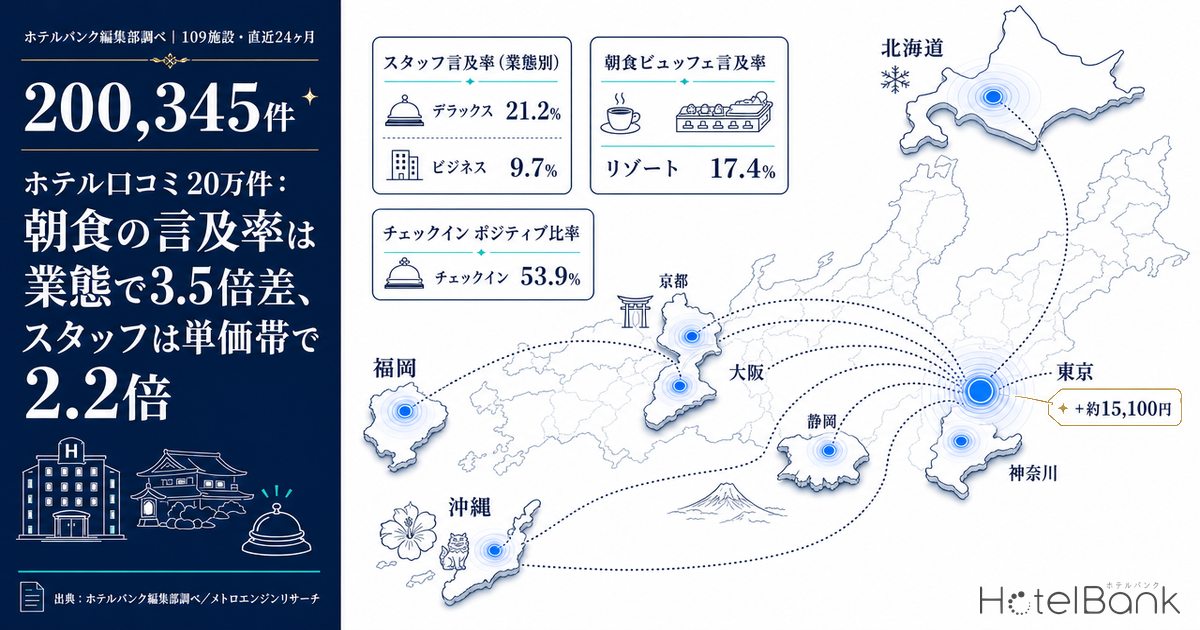
What guests write about most in their reviews is neither the room nor the price — it is people and food. HotelBank Editorial Team ran a tag analysis on 200,345 guest reviews (trailing 24 months) from 109 properties across eight major prefectures. Staff-related mentions ran at 21.2% for the Deluxe band versus 9.7% for Business — a 2.2x gap — while breakfast buffet mentions hit 17.4% at Resort properties against 5.0% at Business, a 3.5x spread.
Dig one layer deeper and the split in guest sentiment is not about kindness or attentiveness at all. It concentrates on two touchpoints a property can move through operations alone: the check-in flow and the breakfast venue. This article cross-references tag mention rates, positive shares and breakfast pricing to locate — quantitatively — where the revenue upside is sitting.
Metric Definitions Used in This Article
- Mention rate: number of reviews carrying the tag ÷ total reviews for the property (trailing 24 months). A single review can carry multiple tags, so tag shares sum to more than 100%.
- Positive share: the proportion of reviews carrying that tag judged to be positive. The remainder are neutral or negative mentions.
- Breakfast premium (listed-price basis): the listed-price gap between the room-only plan and the breakfast-included plan sold by the same property. Stated as the per-room rate for two guests sharing one room (tax included), as a paired comparison limited to properties selling both plan types.
- Sample: 109 properties and 200,345 reviews, drawn by segment from properties with 400 or more reviews across eight prefectures (Tokyo, Kanagawa, Shizuoka, Osaka, Kyoto, Hokkaido, Fukuoka and Okinawa). Only the top 50 tags per property are retrieved, so tags with a mention rate below roughly 1.6% do not appear in the aggregates.
- Data sources: review tags — HotelBank Editorial Team analysis (NLP); listed prices — MetroEngines Research.
- — Staff mention rates scale with the rate band, widening 2.2x from 9.7% at Business to 21.2% at Deluxe. The higher the band, the more the evaluation shifts from things to people.
- — Breakfast buffet mention rates show a 3.5x gap — Resort 17.4% versus Business 5.0%. The longer the stay and the more central the food, the more breakfast gets written about.
- — What actually divides guests is not personality but the front-desk touchpoint — check-in 53.9%, request handling 56.6% and front desk 62.1%, against 99.7% for friendliness and smiles.
- — Breakfast mentions and breakfast pricing are inverted. The most-discussed segment, Resort, carries the thinnest premium at +5.1%, while Deluxe runs +22.1% (about +¥15,100).
- — 37.7% of reviews are in a language other than Japanese (English 21.7%, Korean 5.0%) — above the 27.2% foreign share of person-nights the Japan Tourism Agency reports for 2025.
Higher Rate Bands Talk About People — Staff Mentions Differ 2.2x
Start from the national baseline. Of the 699,356 reviews posted in the trailing three months (25 May to 23 August 2026), 14.1% touched on staff in general and 6.1% on the breakfast buffet. Staff is one of the single largest topics in guest reviews — from the property side, an item that is graded every single time.
The weight of that topic, however, shifts sharply by segment. Taking property-level medians across the 109 properties by category, general staff mention rates stack up cleanly with the rate band: Business 9.7%, City 14.2% and Deluxe 21.2%. Breakfast buffet mentions run the other way, with Resort at 17.4% and Ryokan at 14.9% standing out — more than triple the 5.0% at Business. The longer the stay and the more central food is to the experience, the more clearly breakfast surfaces in reviews.
Source: HotelBank Editorial Team analysis (109 properties, 200,345 guest reviews, trailing 24 months)
| Segment | Properties | Reviews | Staff (general) mention rate | Breakfast buffet mention rate | Total staff-tag mentions (per 100 reviews) |
|---|---|---|---|---|---|
| Business | 23 | 55,224 | 9.7% | 5.0% | 38.3 |
| City | 24 | 57,997 | 14.2% | 6.3% | 48.3 |
| Deluxe | 22 | 31,608 | 21.2% | 6.4% | 62.1 |
| Resort | 18 | 29,347 | 13.8% | 17.4% | 41.6 |
| Ryokan | 22 | 26,169 | 13.8% | 14.9% | 48.2 |
Mention rates are property-level medians. Total mentions are the sum of eight staff-related tags. Source: HotelBank Editorial Team analysis (N=109 properties)
The rightmost column, total mentions, sums the eight staff-related tags and converts them to a per-100-review basis. Business runs 38.3 against 62.1 at Deluxe. Across the same 100 reviews, the upper bands draw 1.6x as many references to service. As the rate rises, the axis on which the stay is judged migrates from things to people.
How It Is Discussed Changes Too — Business Means Process, Upper Bands Mean Attentiveness
It is not only the volume of mentions that differs by segment but the substance. Break the staff tags into their components — friendliness, politeness, attentiveness, omotenashi, front desk, check-in and request handling — and the centre of gravity clearly shifts from one segment to the next.
Source: HotelBank Editorial Team analysis (64,632 staff-tag mentions, 109 properties, trailing 24 months)
In the Business band, check-in at 23.1% and front desk at 18.2% combine to 41.3% — four in ten staff mentions point at front-desk work itself. In the Deluxe band those two fall to 22.8%, while attentiveness rises to 15.3% and omotenashi to 8.7%. Ryokan and Resort properties sit in between, holding attentiveness at 13.0-13.5% while front desk and check-in still account for more than 30%.
The difference shows up in what guests actually write. At upper-band properties, comments point to conduct beyond the transaction — “fresh, never overfamiliar service…”, “it was ready before we even asked…”. At the same time, plenty of reviews grade the handling of requests itself: “after-hours pickup, arranging a taxi… handled courteously” (from guest reviews compiled by HotelBank Editorial Team, September 2024 to August 2026).
Note: the omotenashi tag reads 0.0% for the Business band because it fell outside the top 50 tags at those properties (a mention rate below roughly 1.6%). It does not mean there were zero mentions.
What Divides Guests Is the Check-in Flow — a 53.9% Positive Share
Line up positive shares tag by tag and it becomes obvious where review sentiment splits. Hospitality tags are almost uniformly positive: friendliness and smiles 99.7%, attentiveness 97.2%, omotenashi 96.1%. That said, these tags pick up emotive language itself, so they are structurally skewed toward the positive and should be read with that discount.
The tags worth watching are the neutral ones that capture a situation. Check-in 53.9%, request handling 56.6% and front desk 62.1% mix positive, neutral and negative. In other words, what genuinely divides guests is not personality but the operation at the front-desk touchpoint.
Source: HotelBank Editorial Team analysis (109 properties, trailing 24 months; figures in parentheses are the mention counts for each tag)
There is a clear revenue opportunity here. The check-in flow — wait times, wayfinding, the design of pre-check-in — is an operational domain that does not depend on individual staff aptitude. A property already scoring 99.7% on friendliness still has room to lift the overall impression of its reviews simply by tidying that flow, with the same headcount. Breakfast buffet at 80.8% and room cleanliness at 76.7% sit in the same range, where operational improvement feeds straight back into the score. In-house beverage service is another touchpoint that moves satisfaction without capital spend, and we quantified its effect in In-House Coffee in Guest Reviews — 122 Japan Hotels, 17,385 Mentions.
Breakfast: How Much It Is Discussed and How It Is Priced Do Not Match — a 7x Spread
On breakfast, setting review volume against actual pricing reveals an interesting inversion. Aggregating the listed-price gap between the room-only and breakfast-included plans sold by the same property (August 2026, two guests per room, tax included) gives Business +10.8% (about +¥2,000, N=1,244 properties), City +17.0% (about +¥5,500, N=290 properties) and Deluxe +22.1% (about +¥15,100, N=37 properties) — while Resort stops at +5.1% (about +¥2,600, N=187 properties). The same cross-segment spread is visible at prefecture level; Nagano Breakfast Premium: City +11.1% vs Resort +3.2% — 3x Segment Gap tests how far regional markets can push it.
Mention rates — HotelBank Editorial Team analysis (N=109 properties) / breakfast premium — MetroEngines Research (August 2026, eight prefectures, paired comparison)
Resort properties have the highest breakfast mention rate of any segment at 17.4%: breakfast is the lead act of the stay in their reviews. And yet their percentage gap over the room-only rate is the smallest of all. The main reason is that the room-only rate itself is high, inflating the denominator — in absolute terms the uplift is about ¥2,600 at Resort against about ¥2,000 at Business, not a wide gap.
Put differently, in the Resort band breakfast is the most-discussed element of the stay while its value is not fully expressed in the price gap. If breakfast is being talked about as the centre of stay value, there is upside in spelling out what the breakfast-included plan contains and widening the price gap in stages. The Deluxe band shows the opposite: a thick premium of about +¥15,100 already holds, evidence that at the top end breakfast functions as a standalone product. Note that the Deluxe figure covers only 37 properties in Tokyo and Osaka, so the sample is limited.
TOP 10 Properties Where Breakfast Gets Talked About — Above 18% Mentions, 80%+ Positive
Of the 109 properties, the list below ranks those with high breakfast buffet mention rates that also hold a positive share of 80% or more. At each of them, roughly one review in five touches on breakfast — breakfast is working as a headline draw.
| # | Property | Segment / location | Mention rate | Positive share | Mentions / reviews |
|---|---|---|---|---|---|
| 1 | Well Season Hamanako (ウェルシーズン浜名湖) | Ryokan / Shizuoka | 30.7% | 92.5% | 252 / 822 |
| 2 | The Lake View TOYA Nonokaze Resort (ザ レイクビューTOYA 乃の風リゾート) | Resort / Hokkaido | 28.4% | 89.9% | 680 / 2,392 |
| 3 | Tenseien (天成園) | Ryokan / Kanagawa | 27.7% | 84.2% | 689 / 2,491 |
| 4 | Mahoroba Mines Miura (マホロバマインズ三浦) | Resort / Kanagawa | 26.7% | 91.1% | 236 / 884 |
| 5 | EN RESORT Re’Cove Hakone | Resort / Kanagawa | 26.0% | 91.6% | 594 / 2,284 |
| 6 | Rizzan Sea-Park Hotel Tancha Bay (リザンシーパークホテル谷茶ベイ) | Resort / Okinawa | 21.2% | 86.7% | 532 / 2,512 |
| 7 | Atami New Fujiya Hotel (熱海ニューフジヤホテル) | Ryokan / Shizuoka | 20.9% | 81.9% | 354 / 1,693 |
| 8 | Hakone Ashinoko Hanaori (箱根・芦ノ湖 はなをり) | Resort / Kanagawa | 19.5% | 84.2% | 583 / 2,986 |
| 9 | La Vista Hakodate Bay (ラビスタ函館ベイ) | Resort / Hokkaido | 19.0% | 87.1% | 403 / 2,121 |
| 10 | Hakone Kowakien Ten-yu (箱根小涌園 天悠) | Ryokan / Kanagawa | 18.2% | 86.9% | 512 / 2,812 |
Limited to properties with 60 or more mentions and a positive share of 80% or higher. Source: HotelBank Editorial Team analysis (trailing 24 months)
Reviews of the top-ranked properties line up around range and local character: “the buffet had such a wide variety…”, “Hokkaido dishes in abundance…”, “the buffet was very good at both dinner and breakfast…”. At ryokan and resort properties, the two buffet services tend to be discussed as one, so breakfast alone is hard to separate from satisfaction with dinner. Read the other way, it means the whole food programme has become a powerful marketing asset that appears in more than one review in five.
TOP 10 Properties Where People Get Talked About — Imperial Hotel Tokyo Leads at 31.2%
Ranking general staff mention rates on the same basis puts the Deluxe band on top. Imperial Hotel Tokyo (帝国ホテル東京) leads: 978 of its 3,131 reviews — fully 31.2% — touch on staff, with a positive share of 94.5%.
| # | Property | Segment / location | Mention rate | Positive share | Mentions / reviews |
|---|---|---|---|---|---|
| 1 | Imperial Hotel Tokyo (帝国ホテル東京) | Deluxe / Tokyo | 31.2% | 94.5% | 978 / 3,131 |
| 2 | Kaze no Kaoru (風の薫) | Deluxe / Shizuoka | 30.3% | 92.8% | 195 / 644 |
| 3 | Hyatt Regency Kyoto (ハイアット リージェンシー 京都) | Deluxe / Kyoto | 26.2% | 91.2% | 136 / 518 |
| 4 | ATAMI Sekaie (ATAMIせかいえ) | Deluxe / Shizuoka | 23.7% | 94.5% | 128 / 541 |
| 5 | Dogashima New Ginsui (堂ヶ島 ニュー銀水) | Resort / Shizuoka | 23.1% | 87.0% | 324 / 1,403 |
| 6 | ANA InterContinental Tokyo (ANAインターコンチネンタルホテル東京) | Deluxe / Tokyo | 22.7% | 90.1% | 425 / 1,869 |
| 7 | Hotel Nikko Fukuoka (ホテル日航福岡) | City / Fukuoka | 22.3% | 93.5% | 291 / 1,307 |
| 8 | Keio Plaza Hotel (京王プラザホテル) | Deluxe / Tokyo | 22.3% | 91.7% | 1,177 / 5,288 |
| 9 | Hakone Kowakien Ten-yu (箱根小涌園 天悠) | Ryokan / Kanagawa | 22.1% | 90.0% | 621 / 2,812 |
| 10 | Sapporo Grand Hotel (札幌グランドホテル) | City / Hokkaido | 22.0% | 91.0% | 636 / 2,892 |
Limited to properties with 60 or more mentions and a positive share of 80% or higher. Source: HotelBank Editorial Team analysis (trailing 24 months)
Third-placed Hyatt Regency Kyoto is a mid-sized property of 187 rooms that opened in March 2006, and its 518 reviews are the fewest in the top ten. Even so, one review in four mentions staff — service is being discussed by density, not by scale. Eighth-placed Keio Plaza Hotel holds 22.3% with a 91.7% positive share across a base of 5,288 reviews, an example of standardising service quality while operating at size.
Narrowing to the omotenashi tag alone, Kaze no Kaoru (風の薫) in Shizuoka ranks highest at 18.9% (122 mentions, positive share 100%), followed by The Ritz-Carlton Okinawa (ザ・リッツ・カールトン沖縄) at 14.2% and ATAMI Sekaie at 10.2%. Guest comments repeat phrases such as “the warm hospitality of every member of staff…” and “attentive to every detail…”.
37.7% of Reviews Are Not in Japanese — Method and Assumptions
Broken out by the language they were posted in, the 200,345 reviews are 62.3% Japanese (124,876), 21.7% English (43,491), 5.0% Korean (9,960), 3.7% traditional Chinese (7,327) and 1.1% simplified Chinese (2,105). Posting language does not itself indicate nationality, but the fact that non-Japanese accounts for 37.7% shows that review operations are not addressing domestic guests alone. On how the evaluation axes themselves differ by language, What Guests Write About in 8 Languages — 3.46M Review Tag Analysis goes into detail.
For reference, the Japan Tourism Agency’s Overnight Travel Statistics Survey puts full-year 2025 (final figures) at 661.11 million person-nights, of which 179.92 million — 27.2% — were foreign guests. This sample’s foreign-language share runs above that, most likely because the scope is limited to major properties with 400 or more reviews and therefore skews urban and upper-band.
To restate the method: the scope is 114 properties selected mechanically as the top three by review count in each of five segments (Business, City, Deluxe, Resort and Ryokan) among properties with 400 or more reviews across eight prefectures (Tokyo, Kanagawa, Shizuoka, Osaka, Kyoto, Hokkaido, Fukuoka and Okinawa); of those, the 109 for which tag analysis was possible form the analysis set. Reviews were collected over the trailing 24 months (September 2024 to August 2026). Only the top 50 tags are retrievable per property, so tags with a mention rate below roughly 1.6% do not appear in the tables. A “0.0%” on a component tag is therefore not proof of zero mentions — it means the tag fell outside the top 50.
Tagging is also automated, so individual judgments carry error. This article works only with property-level and segment-level aggregates and does not treat the content of any individual review as evidence. Guest comments quoted here are partial excerpts from genuine posts and are not linked to any attribute of the person who wrote them.
Conclusion — the Upside in Reviews Is Flow and Pricing, Not Personality
Three structural findings emerge from the tag analysis of 109 properties and 200,345 reviews. First, staff mentions rise in proportion to the rate band, from 9.7% at Business to 21.2% at Deluxe, and the way they are discussed shifts from process to attentiveness. Second, what actually divides guests is not hospitality but the operation at the front-desk touchpoint — check-in 53.9%, request handling 56.6% and front desk 62.1%. Third, breakfast mentions and breakfast pricing are inverted across segments, with the thinnest percentage premium sitting in the Resort band where breakfast is discussed most.
All three are areas a property can move without adding headcount: designing the check-in flow, and rethinking how breakfast is productised and priced. On both counts, the properties already scoring well tend to earn the larger return per yen invested. Reviews are the outcome of an evaluation — and, at the same time, diagnostic data pointing to the next move.
Related Reading
- New Hotel Reviews Rise +0.38pt in 2 Months: 1,728 Japan 2025 Openings
- In-Room Dining Ryokan TOP 30: 58.3% Still Offer It, ADR +91%
- Japan’s Top 30 Hotels for Friend Group Trips: 65,744 Reviews Analyzed
- Japan’s Customer Harassment Mandate Oct 1: The 14.0% Retention Upside
- In-House Coffee in Guest Reviews — 122 Japan Hotels, 17,385 Mentions
- Nagano Breakfast Premium: City +11.1% vs Resort +3.2% — 3x Segment Gap
- What Guests Write About in 8 Languages — 3.46M Review Tag Analysis
- What Price Gets Called ‘Good Value’? 2.9M Reviews Map a U-Curve
References and Sources
- HotelBank Editorial Team analysis — tag analysis of guest reviews (109 properties, 200,345 reviews, trailing 24 months)
- MetroEngines Research — paired comparison of listed prices for room-only versus breakfast-included plans (August 2026, eight prefectures)
- Japan Tourism Agency, “Overnight Travel Statistics Survey” (April 2026 second preliminary figures, May 2026 first preliminary figures and full-year 2025 final figures)
- Japan Tourism Agency, “Overnight Travel Statistics Survey” statistics index
- Japan National Tourism Organization (JNTO), “Statistics of Visitors to Japan”
- Hyatt Hotels and Resorts, “Hyatt Japan press materials, April 2026” — source for the opening date (March 2006) and room count (187 rooms) of Hyatt Regency Kyoto
■ Data Sources
Tag analysis of guest reviews is HotelBank Editorial Team analysis (automatic tagging via natural language processing). The scope is 114 properties selected mechanically as the top three by review count in each of five segments among properties with 400 or more reviews across eight prefectures (Tokyo, Kanagawa, Shizuoka, Osaka, Kyoto, Hokkaido, Fukuoka and Okinawa); of those, the 109 for which tag analysis was possible, covering 200,345 reviews (collected September 2024 to August 2026). The national baseline is 699,356 reviews over the trailing three months (25 May to 23 August 2026). The breakfast premium uses MetroEngines Research listed prices (August 2026, two guests per room, tax included). External statistics are the Japan Tourism Agency “Overnight Travel Statistics Survey” full-year 2025 final figures.
■ Calculation Assumptions
Mention rate = number of reviews carrying the tag ÷ total reviews for the property. A single review can carry multiple tags, so tag shares sum to more than 100%. Segment figures are property-level medians; total mentions sum eight staff-related tags and are converted to a per-100-review basis. The breakfast premium is a paired comparison of the listed-price gap between the room-only and breakfast-included plans sold by the same property, limited to properties selling both. The TOP 10 tables use 60 or more mentions and a positive share of 80% or higher as selection criteria.
■ Limitations and Caveats
Only the top 50 tags are retrievable per property, so tags with a mention rate below roughly 1.6% do not appear in the aggregates. A “0.0%” on a component tag is therefore not proof of zero mentions. Tagging is automated, so individual judgments carry error, and this article works only with property-level and segment-level aggregates. Positive shares run structurally higher for tags that pick up emotive language itself. The Deluxe breakfast premium rests on a limited sample of 37 properties. Posting language does not indicate the nationality of the person posting. Listed prices are not transacted prices.