

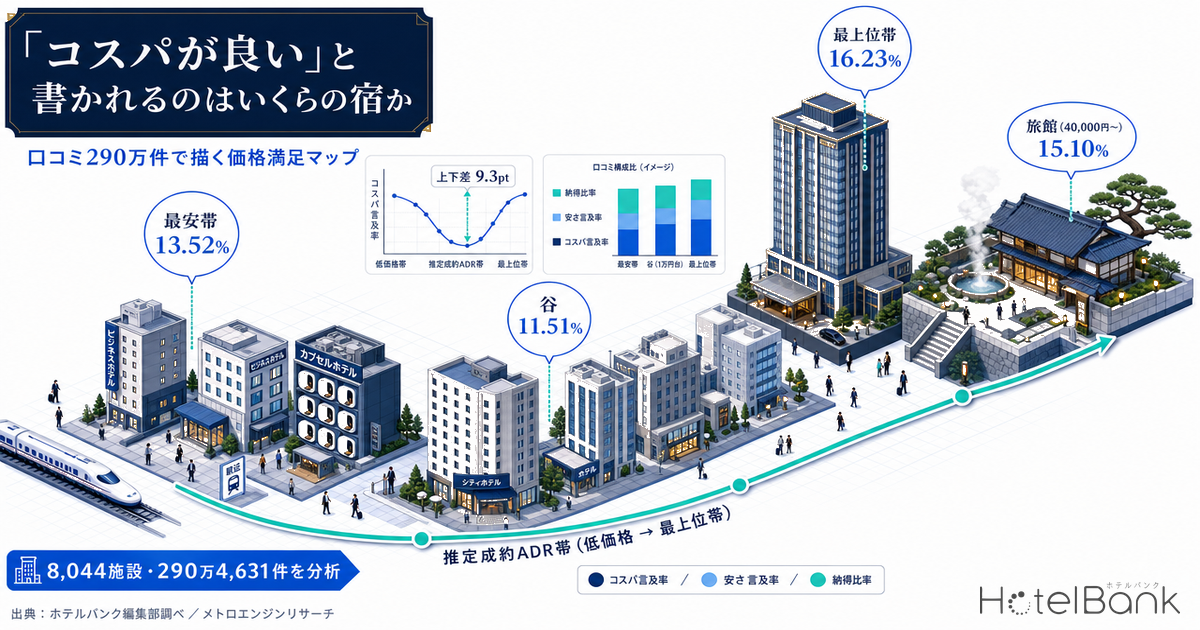
Which hotels get described as “good value for money” in guest reviews — and what do they charge? Intuition says the cheapest properties should attract that phrase most often. But when 2.9 million guest reviews from the past 24 months are analyzed through the lens of price satisfaction, the result says otherwise. The mention rate for “good value” traces a U-curve against price, and it peaks not at the cheapest band but at the top band above ¥40,000 per night.
This article maps three types of price-satisfaction mentions — “good value,” “cheap,” and “worth more than the price” — against each property’s estimated settled ADR, showing where and how price satisfaction is generated across the price spectrum. For operators, it offers a way to check what guests are actually saying at their own price point, and to build the language used to communicate the value on offer.
Metric Definitions Used in This Article
- ADR (average daily rate): An estimated settled rate (tax-exclusive equivalent) calculated by applying category-specific adjustment coefficients to the lowest publicly listed plan rate each property posts on OTAs and similar channels (double occupancy, per room, tax inclusive). Cross-checked against property-level results disclosed by listed hotel REITs, the median error is approximately 7%. These are estimates and differ from each property’s actual transaction prices and accounting figures. This article uses, as each property’s price level, the average of its monthly estimated settled ADR from August 2025 to July 2026, limited to properties with at least six months of observations. Where listed prices are referenced, they are per-room rates at double occupancy (tax inclusive).
- Price-satisfaction mention rate: Guest reviews are analyzed with natural language processing, and the number of reviews tagged with a positive price-related mention is divided by that property’s total review count. Multiple mentions of the same type within a single review are counted once. The three types break down as follows.
・Value mentions = expressions of price satisfaction such as “good value for money,” “worth the price,” “a bargain,” or “reasonably priced relative to quality”
・Low-price mentions = expressions of absolute cheapness such as “cheap,” “inexpensive,” “low-priced,” or “affordable”
・Worth-it mentions = affirmations of value against price such as “worth more than what I paid” or “expensive but justified” - Period and population: Guest reviews posted between August 5, 2024 and August 5, 2026. The analysis covers 8,044 properties and 2,904,631 reviews — those with at least 50 reviews over the 24-month window and at least six months of observed estimated settled ADR.
- Data sources: Review analysis = HotelBank Editorial Team research / Pricing = MetroEngines Research
- — The value mention rate traces a U-curve against estimated settled ADR. The trough sits at 11.6–11.7% in the ¥8,000–20,000 bands, below both ends: 13.52% at the cheapest band and 14.45% above ¥40,000.
- — The low-price mention rate falls monotonically from 12.47% in the ¥3,000s to 0.32% in the ¥60,000s — a 39-fold decline. The basis of price satisfaction shifts from “cheap” to “justified.”
- — The crossover happens in the low ¥10,000s. The worth-it share passes 80% in the ¥10,000–15,000 bands and 90% in the ¥18,000–26,000 bands.
- — Within a single price band, the gap between the top 10% and bottom 10% of properties is 9.3–10.6 points — far wider than the differences between bands (roughly 3 points at most). The upside lies in the property, not the band.
- — Ryokan post the highest figure of any segment above ¥40,000, at 15.10% (238 properties). A high rate does not mean guests stay silent about value.
“Good value” traces a U-curve — the top band, not the cheapest, is written about most
Start with the overall picture. Averaged across the 8,044 properties analyzed, the value mention rate was 12.26%, the low-price mention rate 2.91%, and the worth-it mention rate 0.14%. In other words, roughly one guest in eight touches on price satisfaction, and most of them reach for the phrase “good value.”
The chart below splits those properties into 13 bands by estimated settled ADR. The low-price mention rate declines cleanly and monotonically as ADR rises. In the ¥3,000s band, 12.47% of reviews say “cheap”; in the ¥60,000s band, only 0.32% do — a contraction to one thirty-ninth. So far, so intuitive.
The value mention rate, however, behaves differently. It falls from 19.92% in the ¥3,000s, bottoms out at 11.51% in the ¥8,000–10,000 band, and then reverses and climbs. It reaches 12.32% in the high ¥20,000s, 13.83% in the ¥40,000s, and 16.23% in the ¥60,000s — nearly back to the level of the cheapest band. The trough spans roughly the ¥8,000–20,000 range, where the value mention rate stays almost flat at 11.5–11.9%.
Source: Compiled from HotelBank Editorial Team research (review analysis) and MetroEngines Research (pricing) / N=8,044 properties, 2,904,631 reviews
The meaning of this shape is clear. Price satisfaction does not arise from cheapness alone. At inexpensive properties it comes from comparison — “this much for this price” — while at expensive ones it comes from justification — “for this experience, that price is fair.” Two different routes to the same feeling. And exactly between them, the ¥10,000s band is where price satisfaction is least likely to be voiced at all.
One note on how to read the underlying tag ranking: sort by raw mention count and large properties dominate, simply because a bigger review base produces more absolute mentions. Narita Tobu Hotel Airport (成田東武ホテルエアポート, Chiba, 9,343 reviews) and Grand Nikko Tokyo Bay Maihama (グランドニッコー東京ベイ 舞浜, Chiba, 6,243 reviews) rank nationally by mention count, yet their mention rates of 12.08% and 11.95% are right at the overall average of 12.26%. Comparisons between properties must use the rate, not the count.
How price satisfaction is expressed flips in the ¥10,000s
To understand what happens in the trough, look at the composition of positive price mentions. Here we call the combined share of value mentions plus worth-it mentions, as a proportion of all three types, the worth-it share, and the share taken by low-price mentions the low-price share.
The low-price share shrinks twenty-fold, from 38.3% in the ¥3,000s to 1.9% in the ¥60,000s. Inverted, the worth-it share rises from 61.7% to 98.1%. What deserves attention is the speed of that change: the worth-it share crosses 80% between the ¥10,000–12,000 band (79.6%) and the ¥12,000–15,000 band (82.7%), and crosses 90% between the ¥18,000–22,000 band (89.5%) and the ¥22,000–26,000 band (91.5%).
Source: Compiled from HotelBank Editorial Team research (review analysis) and MetroEngines Research (pricing) / N=8,044 properties, 2,904,631 reviews
The low ¥10,000s, then, is the boundary where the language of price satisfaction changes hands. Below it, what stays in the words is “I chose this because it was cheap.” Above it, what stays is “I paid this and I’m satisfied.” The same satisfaction with price, but guests are measuring it against something different in their heads.
| Estimated settled ADR band | Properties | Reviews | Median ADR of band | Value mention rate | Low-price mention rate | Worth-it share |
|---|---|---|---|---|---|---|
| Up to ¥8,000 | 2,326 | 512,479 | ¥6,600 | 13.52% | 6.64% | 67.3% |
| ¥8,000–12,000 | 1,939 | 671,623 | ¥9,500 | 11.64% | 3.59% | 76.6% |
| ¥12,000–20,000 | 1,896 | 886,512 | ¥15,300 | 11.69% | 2.11% | 84.9% |
| ¥20,000–40,000 | 1,554 | 719,347 | ¥26,600 | 12.30% | 1.01% | 92.5% |
| ¥40,000 and above | 329 | 114,670 | ¥49,200 | 14.45% | 0.35% | 97.6% |
Source: Compiled from HotelBank Editorial Team research (review analysis) and MetroEngines Research (pricing)
A caveat on worth-it mentions: the base is extremely small. Reviews tagged with a “worth more than the price” sentiment account for just 0.14% of the total, and 2,540 of the 8,044 properties had at least one such mention over the 24 months. An initial attempt to filter for properties with 20 or more worth-it mentions returned no qualifying set, so this article aggregates all properties without a threshold. The figures below should be read as indicative of direction only.
With that caveat, comparing low-price and worth-it mention rates by band reveals a crossover point. In the ¥55,000–70,000 band, the low-price mention rate of 0.330% and the worth-it rate of 0.309% are near parity; above ¥70,000, the worth-it rate of 0.366% exceeds the low-price rate of 0.297%. This is the final boundary between bands “chosen for being cheap” and bands “chosen for being justified.” The samples are thin, however — 67 and 40 properties, with 19,388 and 10,106 reviews respectively — so year-to-year variation is not small.
By category — ryokan run high at both ends, business hotels are strong at the low end
Even within the same price band, price satisfaction is generated differently by property category. The chart below lines up the value mention rate by band for the four main categories.
Source: Compiled from HotelBank Editorial Team research (review analysis) and MetroEngines Research (pricing) / property counts per cell are given in the text
The ryokan U-curve is especially deep. Both ends run high — 15.06% below ¥8,000 (261 properties) and 15.10% above ¥40,000 (238 properties) — while the middle ¥12,000–20,000 band drops to 12.51% (749 properties). That one guest in seven touches on price satisfaction at a ryokan charging more than ¥40,000 a night indicates that high-end cuisine, hot springs, and service are functioning as an explanation of the price. Indeed, in the above-¥40,000 band, the worth-it mention rate for ryokan is 0.326%, ahead of resort hotels (0.151%) and city hotels (0.179%).
Business hotels show the opposite profile: 13.46% below ¥8,000 (1,791 properties), then falling to 11.43% in the ¥8,000–12,000 band and 11.40% in the ¥12,000–20,000 band. Their low-price mention rate declines in parallel, 7.05% → 3.72% → 2.10%, so as price rises both “cheap” and “good value” become less likely to be voiced. That leaves room to put the experience delivered for the price into words. For how business hotel price levels themselves are moving nationally, see Business Hotel Price Surge: National ADR Analysis & 10 Cost-Effective Prefectures.
Sorting by grade shows the same pattern. The budget tier (2,459 properties, median ADR ¥7,100) records a 12.95% value mention rate and a 5.75% low-price mention rate; the luxury tier (1,560 properties, median ADR ¥27,900) records 12.65% and 1.14%. The value mention rate barely moves, while the low-price rate falls to one fifth. The judgment “good value” arises at any price point — what changes is the reasoning behind it.
Source: Compiled from HotelBank Editorial Team research (review analysis) and MetroEngines Research (pricing) / N=8,044 properties
A 10-point spread within the same band — the upside is the property, not the band
So far we have looked at band averages. What matters operationally, though, is how far properties differ from one another inside the same band. Taking the distribution of property-level value mention rates within each band, the gap between the top 10% and bottom 10% comes out as follows.
Source: Compiled from HotelBank Editorial Team research (review analysis) and MetroEngines Research (pricing) / property counts per band are given in the table
In the ¥12,000–20,000 band, the top 10% sit at 16.8% against 7.5% for the bottom 10% — a 9.3-point spread. The ¥20,000–40,000 band shows 9.1 points, and the above-¥40,000 band 10.6 points. The spread within a band is far larger than the differences between band averages, which top out at roughly 3 points.
So the explanation “guests don’t write about value at our price point” does not hold up in the data. At identical prices, some properties reach guests as good value and others do not, and that difference is more likely to originate in how the offer is presented than in the price itself. That is where the growth headroom sits. For a concrete procedure to check your own position by matching review scores against estimated settled ADR within a single area, see A 4.1 Review Score Is Average, Not a Strength: Sapporo Price Position.
For reference, here are the highest-rate properties within the ¥12,000–20,000 trough band, limited to those with at least 250 reviews. What lines up here is not necessarily a list of properties competing on price.
| # | Property | Location | Category | Reviews | Value mention rate | Low-price mention rate | Estimated settled ADR |
|---|---|---|---|---|---|---|---|
| 1 | Higashiyama Park Hotel Shinpugetsu (東山パークホテル新風月) | Fukushima | Ryokan | 317 | 23.66% | 8.20% | ¥12,700 |
| 2 | Heike no Sho (桓武平氏ゆかりの宿 平家の庄) | Tochigi | Ryokan | 860 | 23.14% | 7.09% | ¥12,600 |
| 3 | Iwaki Toma Onsen Hotel Kairi (いわき藤間温泉ホテル浬) | Fukushima | Ryokan | 418 | 22.73% | 0.96% | ¥13,100 |
| 4 | Gensen Yu no Yado Sen no Tani (源泉湯の宿 千の谷) | Gunma | Ryokan | 799 | 22.65% | 4.38% | ¥14,200 |
| 5 | The Millennials Shibuya (ザ・ミレニアルズ渋谷) | Tokyo | Capsule Hotel | 425 | 22.12% | 0.24% | ¥15,800 |
| 6 | Imagine Hotel & Resort Hakodate (イマジン ホテル&リゾート函館) | Hokkaido | Resort Hotel | 1,340 | 21.87% | 5.07% | ¥15,000 |
| 7 | Coco Garden Resort Okinawa (ココガーデンリゾートオキナワ) | Okinawa | Resort Hotel | 286 | 21.68% | 2.45% | ¥12,200 |
| 8 | Zenkoku Chosonkaikan (全国町村会館) | Tokyo | City Hotel | 251 | 21.51% | 3.59% | ¥15,600 |
| 9 | Nishi-Izu Crystal View Hotel (西伊豆クリスタルビューホテル) | Shizuoka | Resort Hotel | 403 | 21.09% | 3.97% | ¥12,800 |
| 10 | Hananoyu (華乃湯) | Miyagi | Ryokan | 503 | 20.87% | 3.18% | ¥17,600 |
Source: Compiled from HotelBank Editorial Team research (review analysis) and MetroEngines Research (pricing) / scope: properties in the estimated settled ADR ¥12,000–20,000 band with 250+ reviews
What stands out is that properties such as Iwaki Toma Onsen Hotel Kairi (low-price mention rate 0.96%) and The Millennials Shibuya (0.24%) clear a 20% value mention rate while cheapness is barely mentioned at all. At these properties, guests are not responding to a low price; they are judging the experience on offer to be more than sufficient for what it costs. This is what being chosen on justification looks like.
High-price properties with strong price satisfaction — a high rate does not silence guests
Lining up properties above ¥20,000 in estimated settled ADR with at least 200 reviews and a high value mention rate shows clearly how guests receive a premium price.
| # | Property | Location | Category | Reviews | Value mention rate | Estimated settled ADR |
|---|---|---|---|---|---|---|
| 1 | sankara hotel & spa Yakushima (sankara hotel & spa 屋久島) | Kagoshima | Resort Hotel | 250 | 26.00% | ¥90,200 |
| 2 | Gora Hanaogi (強羅花扇) | Kanagawa | Ryokan | 338 | 24.26% | ¥60,300 |
| 3 | Hakone Takumi no Yado Kasho (箱根 匠の宿 佳松) | Kanagawa | Ryokan | 419 | 24.11% | ¥55,400 |
| 4 | Matsuzakaya Honten (松坂屋本店) | Kanagawa | Ryokan | 468 | 23.50% | ¥59,500 |
| 5 | The Okura Tokyo | Tokyo | City Hotel | 981 | 23.34% | ¥94,600 |
| 6 | Shiroyamakan (城山館) | Gifu | Ryokan | 304 | 23.03% | ¥43,100 |
| 7 | Kaminarimon Ryokan (雷門旅館) | Tokyo | Ryokan | 325 | 22.15% | ¥41,900 |
| 8 | Ohtou no Hana Yubo Ichiraku (桜桃の花 湯坊いちらく) | Yamagata | Ryokan | 283 | 21.91% | ¥29,000 |
| 9 | Izu Imaihama Onsen Imaiso (伊豆今井浜温泉 今井荘) | Shizuoka | Ryokan | 647 | 21.79% | ¥40,900 |
| 10 | Strings Hotel Tokyo InterContinental (ストリングスホテル東京インターコンチネンタル) | Tokyo | City Hotel | 329 | 21.58% | ¥69,100 |
| 11 | Hotel Kanra Kyoto (ホテルカンラ京都) | Kyoto | City Hotel | 673 | 21.40% | ¥51,300 |
| 12 | Fujisan Onsen Hotel Kaneyamaen (富士山温泉 ホテル鐘山苑) | Yamanashi | Ryokan | 672 | 20.68% | ¥46,100 |
Source: Compiled from HotelBank Editorial Team research (review analysis) and MetroEngines Research (pricing) / scope: properties at estimated settled ADR of ¥20,000 and above with 200+ reviews
At sankara hotel & spa Yakushima, where a night runs into the ¥90,000s, one guest in four touches on price satisfaction; The Okura Tokyo reaches 23.34%. Both are close to double the all-property average of 12.26%. Whether a premium rate is received as “expensive” or as “fair” is not decided by the price level itself — these figures say so plainly.
The concentration of ryokan near the top is also notable. A package that combines dinner, breakfast, hot springs, and service gives guests an abundance of cues for evaluating the price, and that appears to feed the sense of justification. In the above-¥40,000 band, the 15.10% value mention rate across 238 ryokan exceeds that of resort hotels (42 properties, 13.20%) and city hotels (36 properties, 14.17%) in the same band.
Regional differences — the same price level, a different vocabulary
By prefecture (limited to areas with 60 or more properties in the analysis), the highest value mention rate is Tottori at 13.73% (74 properties, median ADR ¥10,000), followed by Kyoto at 13.68% (221 properties, ¥17,200) and Okayama at 13.35% (89 properties, ¥8,600). Kyoto stands out: its median ADR sits in the ¥17,000s, yet it still ranks near the top nationally on value mentions.
Low-price mention rates, by contrast, are highest where median ADR falls below ¥10,000 — Okayama at 4.34%, Kochi at 4.25%, and Tottori at 3.71%. Comparing Tottori and Kyoto, both high on value mentions, the low-price rates of 3.71% and 2.22% differ by nearly 1.5 points, which tells us the substance of price satisfaction differs between them.
Brought back to day-to-day operations, the task is to identify which of the two patterns your own area resembles, and then choose the words used to convey value accordingly. In areas where low-price mentions run high, there is room to add reasons beyond price; in areas with a high worth-it share, that reasoning is already working, so the next move is a more ambitious presentation of value.
Opportunity by price band — where the headroom remains
Finally, the results organized from a revenue-opportunity perspective. What follows is a set of suggestions, not an assessment of any individual property’s operations.
ADR ¥8,000–20,000 (3,835 properties, 1,558,135 reviews) — The value mention rate of 11.6–11.7% is the lowest of any band, and the low-price mention rate has also fallen to 2.1–3.6%. Guests here struggle to find cues for evaluating the price, which conversely means that putting the value on offer into words translates fairly directly into a higher mention rate. The spread between the top and bottom 10% runs 9.3–10.6 points in this range, confirming how widely the message lands even at identical prices. There is ample room to make explicit — through plan names, photography, and in-house guidance — what guests are paying for.
ADR ¥20,000–40,000 (1,554 properties, 719,347 reviews) — The worth-it share has already reached 92.5%, past the stage of being chosen for cheapness. The value mention rate of 12.30% also exceeds the middle bands. Here the explanation of price is broadly functioning, and there is upside in raising the density of the experience to move into a higher band. Indeed, the value mention rate is 12.84% in the ¥32,000–40,000 band and 13.83% in the ¥40,000–55,000 band — rising, rather than falling, with price.
ADR ¥40,000 and above (329 properties, 114,670 reviews) — The 14.45% value mention rate is the highest of any band. In this range a high price is not an obstacle to satisfaction; rather, the experience justifies the price. The worth-it mention rate of 0.230% is also the highest. Rather than a ceiling, this looks like a band with room to raise price and experience together.
ADR below ¥8,000 (2,326 properties, 512,479 reviews) — The 13.52% value mention rate is high, but a third of it rests on low-price mentions (a low-price share of 32.7%). Cheapness is a powerful pitch, though one that invites dependence on price competition. If properties in this band can add a single evaluation axis beyond price, they gain the ability to explain a rate increase. That the top 10% reach 21.8% shows it is possible to be chosen for reasons other than price even at the low end.
A note on reading this data: Mention rates measure how often guests wrote about a topic in reviews; they are not evaluation scores. The estimated settled ADR used here is a monthly average for August 2025 – July 2026, which does not fully align with the review posting window (August 2024 – August 2026). Properties that changed their pricing during that time will show a gap between the two. Because worth-it mentions account for only 0.14% of the total, comparisons by price band should be read as indicative of direction only.
Conclusion
So, what does a property called “good value” charge? The answer, on this evidence, is both the cheap ones and the expensive ones. Matching 2,904,631 reviews across 8,044 properties against estimated settled ADR, the value mention rate traces a U-curve with its trough in the ¥8,000–20,000 range and high points at both ends — 13.52% at the cheapest band and 14.45% at the top.
What changes is less the rate itself than its substance. The low-price mention rate declines monotonically from 12.47% in the ¥3,000s to 0.32% in the ¥60,000s, and the worth-it share of price satisfaction moves from 61.7% to 98.1%. That handover occurs in the low ¥10,000s, and the low-price and worth-it mention rates finally invert above ¥70,000 (0.297% and 0.366% respectively, across 40 properties and 10,106 reviews).
The most operationally useful finding is that differences between properties within the same band (9–15 points) far exceed the differences between band averages (roughly 3 points at most). A price band does not set a ceiling on price satisfaction. Even in the ¥12,000–20,000 trough, properties clearing a 20% value mention rate exist. The headroom lies not in setting the price, but in explaining it.
The consumer price index for accommodation stood at 160.6 as of June 2026 (2020 = 100, nationwide), a high level, and the upward phase in rates continues. What determines whether an increase is accepted is not the absolute price but whether guests can understand what that price includes. The data here indicates that such understanding can be established at any price point.
Related Reading
- Japan Autumn 2026 Hotel Price Range: 3.3x CV Gap Across 47 Prefectures
- Hotel Shuttle Reviews: Airport Shuttle vs Onsen Station Pickup Types
- Hotels Chosen for Value for Money: National TOP 30 (21.6% of Reviews)
- A 4.1 Review Score Is Average, Not a Strength: Sapporo Price Position
- Business Hotel Price Surge: National ADR Analysis & 10 Cost-Effective Prefectures
References and Sources
■ Data sources
Price-satisfaction tags in guest reviews (“good value” = value mention, “cheap” = low-price mention, “worth more than the price” = worth-it mention) were assigned via natural language processing, and mention rates were calculated at the property level as tagged reviews divided by that property’s total reviews. On the pricing side, each property’s estimated settled ADR (monthly average, August 2025 – July 2026) was matched to it. The aggregation reference date is August 5, 2026.
■ Calculation assumptions
The assumptions behind the aggregation and calculations are as follows. Scope: 8,044 properties and 2,904,631 reviews with at least 50 reviews in the trailing 24 months and at least six months of observed estimated settled ADR. Price bands are defined by each property’s estimated settled ADR into 13 bands (charts) and five bands (table), with properties averaged unweighted within each band (no weighting by review count). Because a threshold of 20 or more worth-it mentions per property yielded no qualifying set, worth-it mentions are aggregated across all properties without a threshold.
■ Limitations and caveats
(1) Mention rates measure how often a topic appears in reviews and are not evaluation scores. (2) The review posting window (August 2024 – August 2026) and the estimated settled ADR observation window (August 2025 – July 2026) do not fully align, so properties that repriced within the period will show a gap. (3) Because the population is a trailing 24-month rolling window, property-level mention rates shift slightly as the reference date changes. (4) Worth-it mentions represent only 0.14% of the total, so comparisons by price band and by category are indicative of direction only. (5) Property rankings are top extracts subject to a minimum review count (250 / 200) and are not rankings of all properties.
■ Review and pricing data
- HotelBank Editorial Team research — natural language processing analysis of price-satisfaction tags in guest reviews (posted August 5, 2024 – August 5, 2026; 8,044 properties, 2,904,631 reviews)
- MetroEngines Research — estimated settled ADR (monthly average, August 2025 – July 2026, properties with six or more months of observations)
■ Government statistics
- e-Stat “Consumer Price Index,” accommodation charges (statistics ID: 0003427113; nationwide, 2020 = 100; June 2026 = 160.6)
- Japan Tourism Agency, “Overnight Travel Statistics Survey”
- Japan Tourism Agency, “Overnight Travel Statistics Survey (May 2026 second preliminary report; June 2026 first preliminary report)”