

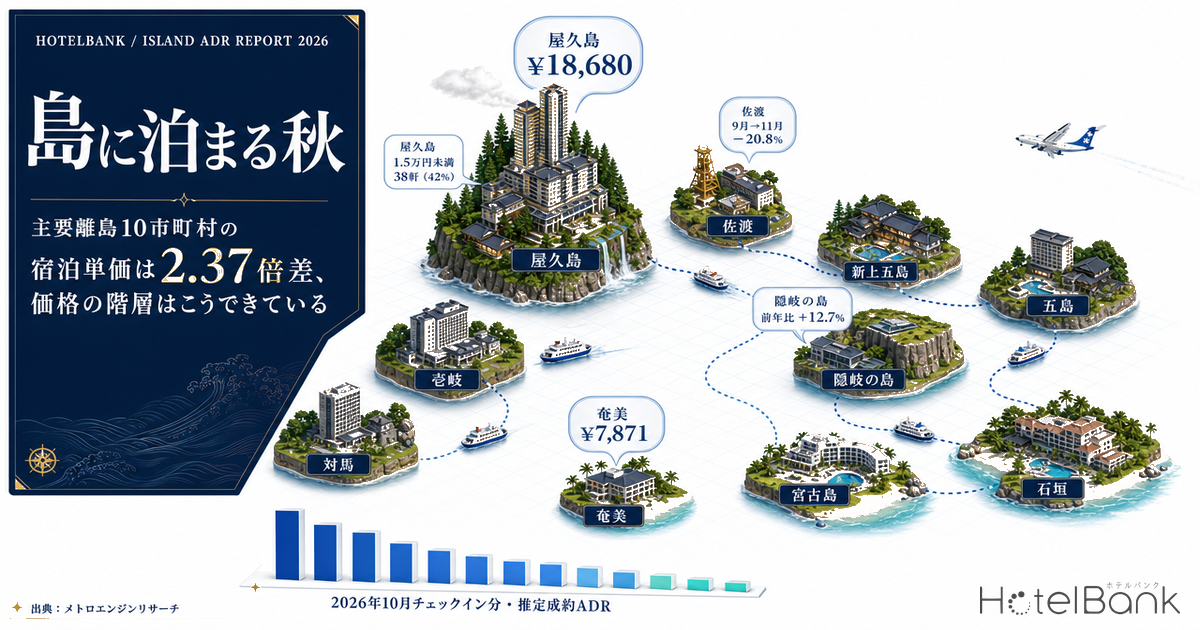
Autumn is when the islands are at their best. The sea is still calm, summer peak pricing has come off, and ferry cancellation rates are not as high as in winter. Yet the question of how much an island stay actually costs has rarely been answered on a like-for-like basis. This article lines up autumn 2026 lodging rates and room stock for ten major remote-island municipalities — Sado, Iki, Tsushima, Goto, Shin-Kamigoto, Okinoshima, Amami and Yakushima, plus Miyakojima and Ishigaki as reference points — using a single yardstick, and maps out the price tiers behind the island stays available this autumn.
Metric Definitions Used in This Article
- ADR (average daily rate): Estimated settled rate (tax-excluded equivalent) calculated by applying property-type correction coefficients to the lowest published plan level on OTAs and similar channels (2 guests per room, per-room rate, tax included). Cross-checked against property-level results disclosed by listed hotel REITs (184 property-months, April–May 2026), the median error is about 7%. These are estimates and differ from each property’s actual transacted prices or accounting figures. Area-level ADR is the median of the covered properties (the level of a typical property in the area).
- Listed price: The average of all plans listed on OTAs and similar channels (2 guests per room, per-room rate, tax included, from room-only to meal-inclusive). Because the population and the tax treatment both differ from estimated settled ADR, do not subtract one from the other directly.
- Property types covered by estimated settled ADR: Five types — business hotels, city hotels, resort hotels, ryokan and capsule hotels. Minshuku, pensions, vacation rentals, guesthouses and the like are excluded, so on islands where these account for a large share, estimated settled ADR represents the level of hotel- and ryokan-type accommodation only.
- Data source: MetroEngines Research
- — 2.37x — Estimated settled ADR for October 2026 check-ins peaks at ¥18,680 in Yakushima and bottoms at ¥7,871 in Amami. Even within the same remote-island bracket, what guests pay belongs to different markets.
- — 1.34x — Even among Nagasaki’s own islands the spread runs from ¥9,758 in Tsushima to ¥13,075 in Shin-Kamigoto. What creates the gap is not resort development but the property-type mix of the room stock.
- — Sep → Nov — Sado (−20.8%) and Ishigaki (−19.1%) ease sharply, while Tsushima (−0.5%) and Shin-Kamigoto (−1.1%) are essentially flat. Iki rises into autumn at +6.6%.
- — YoY on a settled basis — Okinoshima (+12.7%) and Iki (+10.3%) gained, while Yakushima (−14.6%) and Amami (−10.6%) declined. On estimated levels for autumn 2026, Yakushima is back at the top of the ten islands.
- — A budget of ¥15,000 or less covers 41.8% of properties in Yakushima but only 10.6% in Sado, a 3.9x gap. Widen the budget to ¥30,000 and it narrows to 76.9% versus 59.1%, or 1.3x.
October 2026: Island Lodging Is Built on a 2.37x Price Ladder
Start with the conclusion. For October 2026 check-ins, estimated settled ADR at hotel- and ryokan-type properties across the ten municipalities runs from about ¥18,700 at the top in Yakushima (Kagoshima) to about ¥7,900 at the bottom in Amami (Kagoshima) — a 2.37x spread. They sit under the same remote-island label, yet the level guests actually pay belongs to entirely different markets.
What is striking is that Miyakojima (about ¥15,200) and Ishigaki (about ¥12,300), the most heavily resort-developed of the group, do not monopolise the top. Yakushima outranks Miyakojima, and Sado (about ¥13,300), Shin-Kamigoto (about ¥13,100) and Goto (about ¥12,900) sit almost level with Ishigaki. The islands of the Sea of Japan and Kyushu are not cheap islands: limited to hotel- and ryokan-type accommodation, they occupy a price band that can compete with the resort islands of the Nansei archipelago.
Estimated settled ADR for October 2026 check-ins (estimates based on listed levels at the time of the survey). Grey bars are the two Okinawa cities included for reference. Source: MetroEngines Research; compiled by the HotelBank Editorial Team
That headline number, however, is looking at different things on different islands. Because estimated settled ADR covers only the five hotel- and ryokan-type categories, on islands with a high share of minshuku and vacation rentals it captures only part of the total supply. The “covered properties” column in the table below shows that range. In Yakushima, only 14 of the 85 properties with observable prices (16%) fall within the scope of estimated settled ADR, while in Okinoshima 9 of 16 (56%) do.
| Island (prefecture) | Est. settled ADR Oct 2026 | Covered properties | Listed on OTAs Observed properties | Coverage | Listed price (ref., all types) |
|---|---|---|---|---|---|
| Yakushima (Kagoshima) | ¥18,680 | 14 properties | 85 properties | 16% | ¥17,006 |
| Miyakojima (Okinawa) | ¥15,202 | 73 properties | 280 properties | 26% | ¥30,174 |
| Sado (Niigata) | ¥13,282 | 25 properties | 64 properties | 39% | ¥27,416 |
| Shin-Kamigoto (Nagasaki) | ¥13,075 | 7 properties | 13 properties | 54% | ¥19,970 |
| Goto (Nagasaki) | ¥12,938 | 14 properties | 54 properties | 26% | ¥25,049 |
| Ishigaki (Okinawa) | ¥12,260 | 55 properties | 272 properties | 20% | ¥26,846 |
| Okinoshima (Shimane) | ¥12,154 | 9 properties | 16 properties | 56% | ¥22,223 |
| Iki (Nagasaki) | ¥11,175 | 17 properties | 47 properties | 36% | ¥22,172 |
| Tsushima (Nagasaki) | ¥9,758 | 9 properties | 28 properties | 32% | ¥16,604 |
| Amami (Kagoshima) | ¥7,871 | 11 properties | 68 properties | 16% | ¥24,954 |
October 2026 check-ins. Listed price is the average across all plans (tax included) and differs from estimated settled ADR in both population and tax treatment. Source: MetroEngines Research; compiled by the HotelBank Editorial Team
Yakushima is the one island where estimated settled ADR (about ¥18,700) exceeds the average listed price (about ¥17,000). That is not a contradiction. The average listed price across the 85 observed properties in Yakushima includes 45 minshuku and pensions, which pull the average down sharply, whereas estimated settled ADR looks at 14 properties centred on six resort hotels and five ryokan. Yakushima therefore has a two-layer structure: an island of minshuku that nonetheless carries an expensive hotel and ryokan layer.
A 1.34x Gap Within Nagasaki Alone — Room Stock Composition Sets the Rate
Take just Nagasaki’s four islands and the range still runs 1.34x, from about ¥9,800 in Tsushima to about ¥13,100 in Shin-Kamigoto. The reason islands so similar in distance and climate diverge this much lies in their mix of accommodation types.
Property-type composition of properties with observable prices on OTAs and similar channels in October 2026 (by property count). Source: MetroEngines Research; compiled by the HotelBank Editorial Team
| Island | Observed properties | Total rooms | Hotel/ryokan-type | Share (room basis) | Minshuku / pension | Vacation rental / simple lodging |
|---|---|---|---|---|---|---|
| Sado (Niigata) | 66 properties | 1,093 rooms | 25 properties / 784 rooms | 72% | 16 properties | 20 properties |
| Okinoshima (Shimane) | 16 properties | 276 rooms | 9 properties / 213 rooms | 77% | 2 properties | 4 properties |
| Iki (Nagasaki) | 49 properties | 544 rooms | 18 properties / 345 rooms | 63% | 11 properties | 18 properties |
| Tsushima (Nagasaki) | 29 properties | 919 rooms | 11 properties / 782 rooms | 85% | 8 properties | 9 properties |
| Goto (Nagasaki) | 55 properties | 588 rooms | 16 properties / 477 rooms | 81% | 2 properties | 35 properties |
| Shin-Kamigoto (Nagasaki) | 14 properties | 230 rooms | 7 properties / 149 rooms | 65% | 2 properties | 5 properties |
| Yakushima (Kagoshima) | 91 properties | 992 rooms | 14 properties / 577 rooms | 58% | 45 properties | 30 properties |
| Amami (Kagoshima) | 70 properties | 1,233 rooms | 11 properties / 1,062 rooms | 86% | 3 properties | 54 properties |
| Miyakojima (Okinawa) | 295 properties | 6,294 rooms | 82 properties / 4,970 rooms | 79% | 22 properties | 185 properties |
| Ishigaki (Okinawa) | 280 properties | 5,745 rooms | 65 properties / 4,454 rooms | 78% | 26 properties | 184 properties |
Aggregated from properties with observable prices on OTAs and similar channels in October 2026. Room counts are the registered values in the property master. Source: MetroEngines Research; compiled by the HotelBank Editorial Team
Of Tsushima’s 919 total rooms, 782 (85%) belong to hotel- and ryokan-type properties, but within that, seven business hotels account for 684 rooms. Its lodging rates are the lowest of the group because most of the room stock consists of room-only, business-oriented supply. Shin-Kamigoto, by contrast, has just 7 hotel/ryokan-type properties with 149 rooms, and two resort hotels (58 rooms) lift the overall level. Even among Nagasaki’s islands, one absorbs business demand and the other stay-oriented demand, and that difference in character feeds straight into price.
Sado has the heaviest ryokan layer of the ten municipalities. Of its 66 observed properties, 19 are ryokan (589 rooms), and hotel/ryokan-type accommodation accounts for 784 of 1,093 rooms (72%). Islands built around ryokan that assume two meals tend to post higher estimated settled ADR than islands dominated by room-only stays. Okinoshima is similar, with 6 of its 16 properties being ryokan (115 rooms).
Goto, Amami, Miyakojima and Ishigaki, by contrast, have a high share of vacation rentals and simple lodging. In Goto 35 of 55 properties and in Amami 54 of 70 fall into that layer, mostly at a scale of one or two rooms each. Counting properties alone makes supply look plentiful, but as room stock it is concentrated in hotel/ryokan-type accommodation (86% on a room basis in Amami). The distinction between the number of places to stay and the number of rooms you can actually book matters when reading an island lodging market.
From September to December — Islands Where Prices Fall, and Islands Where They Don’t
How do rates move through autumn? Lining up estimated settled ADR for August through December 2026 check-ins, the character of each island comes into sharp relief.
Estimated settled ADR for August–December 2026 check-ins. All are estimates based on listed levels at the time of the survey and will shift as check-in dates approach. Source: MetroEngines Research; compiled by the HotelBank Editorial Team
| Island | Aug | Sep | Oct | Nov | Dec | Sep → Nov |
|---|---|---|---|---|---|---|
| Yakushima (Kagoshima) | ¥20,072 | ¥17,949 | ¥18,680 | ¥16,169 | ¥14,834 | -9.9% |
| Sado (Niigata) | ¥14,942 | ¥15,365 | ¥13,282 | ¥12,169 | ¥12,288 | -20.8% |
| Shin-Kamigoto (Nagasaki) | ¥13,978 | ¥14,032 | ¥13,075 | ¥13,880 | ¥13,726 | -1.1% |
| Goto (Nagasaki) | ¥12,892 | ¥12,417 | ¥12,938 | ¥11,886 | ¥13,448 | -4.3% |
| Okinoshima (Shimane) | ¥12,342 | ¥12,169 | ¥12,154 | ¥11,645 | ¥11,112 | -4.3% |
| Iki (Nagasaki) | ¥11,597 | ¥11,117 | ¥11,175 | ¥11,848 | ¥10,197 | +6.6% |
| Tsushima (Nagasaki) | ¥10,050 | ¥9,823 | ¥9,758 | ¥9,774 | ¥9,729 | -0.5% |
| Amami (Kagoshima) | ¥7,440 | ¥7,918 | ¥7,871 | ¥9,310 | ¥7,792 | +17.6% |
| Miyakojima (Okinawa) | ¥17,506 | ¥14,456 | ¥15,202 | ¥13,220 | ¥13,883 | -8.6% |
| Ishigaki (Okinawa) | ¥17,346 | ¥13,428 | ¥12,260 | ¥10,868 | ¥11,844 | -19.1% |
2026, estimated settled ADR. December figures for Sado (14 covered properties) and Okinoshima (4) are reference values because the covered property count falls below 60% of other months. Source: MetroEngines Research; compiled by the HotelBank Editorial Team
The sharpest easing from September to November is in Sado (−20.8%), where the level falls from about ¥15,400 in September to about ¥12,200 in November. On Sea of Japan islands, seasonal winds disrupt ferry routes from November onwards, and prices soften as demand thins. Ishigaki (−19.1%) shows the same pattern, with a steep decline once summer resort demand drops away.
Tsushima (−0.5%) and Shin-Kamigoto (−1.1%), by contrast, stay essentially flat. Islands underpinned by business demand and local ties are less exposed to tourism seasonality. Iki shows the rare pattern of rising into autumn, from about ¥11,100 in September to about ¥11,800 in November, up 6.6%.
The practical implication for travellers is clear. If you want an island that gets cheap in autumn, go for Sado or Ishigaki in November; if you want an island whose level is predictable whenever you go, choose Tsushima or Shin-Kamigoto. Conversely, on Iki and Amami (Sep→Nov +17.6%), factor in the chance that rates climb through late autumn and book early.
Year-on-Year on Settled Data — Okinoshima +12.7%, Yakushima −14.6%
All the autumn 2026 figures so far are forward-looking levels estimated from prices published at the time of the survey. Comparing years for which results are settled against the same period a year earlier sharpens the direction of travel for each island. The chart below compares autumn 2024 (September–November average) with autumn 2025 (same basis), both on a settled basis.
Year-on-year change in estimated settled ADR from the Sep–Nov 2024 average to the Sep–Nov 2025 average (both on a settled basis). Source: MetroEngines Research; compiled by the HotelBank Editorial Team
| Island | Autumn 2024 | Autumn 2025 | YoY | Covered properties |
|---|---|---|---|---|
| Okinoshima (Shimane) | ¥7,948 | ¥8,956 | +12.7% | 9.0→8.0 |
| Miyakojima (Okinawa) | ¥11,250 | ¥12,404 | +10.3% | 75.7→71.7 |
| Iki (Nagasaki) | ¥7,230 | ¥7,977 | +10.3% | 17.0→17.0 |
| Shin-Kamigoto (Nagasaki) | ¥7,787 | ¥8,355 | +7.3% | 7.0→7.0 |
| Goto (Nagasaki) | ¥6,660 | ¥6,861 | +3.0% | 17.3→19.0 |
| Ishigaki (Okinawa) | ¥10,021 | ¥10,226 | +2.0% | 59.0→59.3 |
| Sado (Niigata) | ¥9,743 | ¥9,780 | +0.4% | 26.0→25.0 |
| Tsushima (Nagasaki) | ¥5,839 | ¥5,840 | +0.0% | 12.0→9.3 |
| Amami (Kagoshima) | ¥7,248 | ¥6,480 | -10.6% | 11.0→12.0 |
| Yakushima (Kagoshima) | ¥11,485 | ¥9,812 | -14.6% | 13.0→13.0 |
Three-month average for September–November. Covered property counts are three-month averages. Source: MetroEngines Research; compiled by the HotelBank Editorial Team
The biggest gains are in Okinoshima (+12.7%), Iki (+10.3%) and Miyakojima (+10.3%). The Oki Islands have been building up visitor infrastructure around the Oki UNESCO Global Geopark and have steadily lifted their level despite a small population of 9 to 8 covered properties. Where Oki sits within Shimane’s price hierarchy is set out in Shimane Hotel Market: Kamiarizuki’s 4-Tier ADR Split, which organises the prefecture into four tiers alongside Izumo, Matsue and Iwami. Iki is covered by Nagasaki’s remote-island development programmes, and the creation of experience-inclusive lodging plans may be contributing to its rate improvement.
Yakushima, on the other hand, fell 14.6% and Amami 10.6%. Yakushima retreated from about ¥11,500 in autumn 2024 to about ¥9,800 in autumn 2025 — a decline with the covered population unchanged at 13 properties. There is room to grow from here. As noted above, Yakushima is back at the highest level of the ten islands on estimated figures for autumn 2026, suggesting its hotel- and ryokan-type properties are moving to win back pricing power.
Sado (+0.4%) and Tsushima (±0.0%) landed roughly flat year on year. Sado is the island where the Sado Island Gold Mines were inscribed as a UNESCO World Heritage site in July 2024, raising expectations of more visitors. A survey report by the Development Bank of Japan estimated the economic ripple effects of World Heritage inscription while flagging accommodation capacity and securing operational staff as issues to address. That estimated settled ADR in autumn 2025 stayed level with the previous year indicates there is still room to convert demand growth into rate. For how Sado’s investment headroom compares with Niigata City and Echigo-Yuzawa, see Niigata Hotel Investment Map.
Stays Under ¥15,000: 38 Properties in Yakushima, Just 3 in Okinoshima
From the perspective of someone actually looking for a room, how many properties sit in each price band is more useful than an average. For properties with observable prices on OTAs and similar channels in October 2026, we assigned a price band using each property’s average listed price (2 guests per room, per room, tax included) and derived the distribution by island.
October 2026 check-ins. Classified by each property’s within-month average listed price (2 guests per room, per room, tax included); shares in %. Source: MetroEngines Research; compiled by the HotelBank Editorial Team
| Island | Under ¥10k | ¥10k–15k | ¥15k–20k | ¥20k–30k | ¥30k–50k | ¥50k+ | Under ¥15k total |
|---|---|---|---|---|---|---|---|
| Yakushima (Kagoshima) | 11 | 27 | 15 | 17 | 9 | 12 | 38 (42%) |
| Tsushima (Nagasaki) | 2 | 9 | 8 | 4 | 4 | 2 | 11 (38%) |
| Goto (Nagasaki) | 2 | 13 | 8 | 10 | 14 | 8 | 15 (27%) |
| Amami (Kagoshima) | 6 | 13 | 7 | 15 | 19 | 10 | 19 (27%) |
| Ishigaki (Okinawa) | 30 | 39 | 32 | 54 | 58 | 67 | 69 (25%) |
| Iki (Nagasaki) | 1 | 11 | 6 | 17 | 3 | 11 | 12 (24%) |
| Miyakojima (Okinawa) | 25 | 40 | 41 | 38 | 53 | 97 | 65 (22%) |
| Shin-Kamigoto (Nagasaki) | 0 | 3 | 3 | 5 | 1 | 2 | 3 (21%) |
| Okinoshima (Shimane) | 0 | 3 | 4 | 5 | 2 | 2 | 3 (19%) |
| Sado (Niigata) | 0 | 7 | 11 | 21 | 15 | 12 | 7 (11%) |
Figures are property counts, on a listed-price basis (a different metric from estimated settled ADR). Source: MetroEngines Research; compiled by the HotelBank Editorial Team
Yakushima has the most stays available under ¥15,000, at 38 properties (42% of the island’s total), of which 11 come in below ¥10,000. The depth of an island with 45 minshuku translates directly into breadth of choice. Next come Amami with 19, Goto with 15, Iki with 12 and Tsushima with 11. Tsushima has 11 of 29 properties (38%) under ¥15,000, second only to Yakushima by share — an island that is easy to book.
At the other end, Okinoshima and Shin-Kamigoto have just three each. With populations of only 16 and 14 properties, low-priced options are limited. Sado, too, has only 7 of 66 properties (11%) under ¥15,000, with the ¥20,000–30,000 band (21 properties) and the ¥30,000–50,000 band (15) at the centre. Ryokan-heavy islands are better understood as a market for staying with two meals than for staying cheaply.
Miyakojima and Ishigaki have property counts of a different order, holding 97 and 67 properties respectively in the ¥50,000-plus band alone. At the same time they have 65 and 69 properties under ¥15,000, giving them a wide price base. The impression that the Nansei islands are expensive is created by the depth of the upper bands, not by a high floor on the options available.
Location, Scale and Rate for All Ten Islands at a Glance
Finally, we map the ten municipalities. Circle size represents the number of observed properties and colour the level of estimated settled ADR. From the Sea of Japan (Sado, Okinoshima) to the Tsushima Strait (Tsushima, Iki), the East China Sea (Goto, Shin-Kamigoto) and the Nansei archipelago (Yakushima, Amami, Miyakojima, Ishigaki), markets spread nearly 1,500 km apart in latitude are placed on a single yardstick.
Circle size = number of observed properties in October 2026; colour = estimated settled ADR level. Coordinates are the average position of accommodation in each municipality. Source: MetroEngines Research; compiled by the HotelBank Editorial Team
Supply Headroom — New Openings Cluster in the Nansei Islands, Rooms Concentrate in a Few Properties
Turning to supply, movement in island room stock is heavily skewed towards the Nansei archipelago. Across the ten municipalities, 23 properties of 20 rooms or more have been confirmed as opening since 2024, of which 15 are in Miyakojima and 5 in Ishigaki (including Canopy by Hilton Okinawa Miyakojima Resort with 310 rooms and seven x seven Ishigaki with 121 rooms). On the Sea of Japan and Kyushu islands (Sado, Okinoshima, Iki, Tsushima, Goto, Shin-Kamigoto) there are only two: one in Sado (49 rooms, April 2026) and one in Shin-Kamigoto (21 rooms, November 2025). No openings of 20 rooms or more have been confirmed in Okinoshima, Iki, Tsushima or Goto.
New-opening counts are based on confirmed OTA listings. Only about 19% of properties are listed on OTAs before opening and more than half are listed after opening, so counts for the most recent years and months may rise as listings are reflected. We recommend reading them alongside the building-plan pipeline based on construction confirmation applications (MLIT Construction Statistics Survey).
Looking at the planning pipeline based on construction confirmation applications, no accommodation projects are currently confirmed in the four prefectures of Niigata, Shimane, Nagasaki and Kagoshima; only one is recorded in Okinawa (Urasoe City, 200 rooms, completion scheduled for July 2026). This does not mean future supply is zero. Confirmation applications are usually filed one to two years before opening, so counts for future years are structurally low. They should be read as a floor for the currently confirmed pipeline.
What deserves more attention is the concentration of existing stock. In Amami, 1,062 of 1,233 total rooms (86%) are hotel/ryokan-type, and in Tsushima 782 of 919 (85%). A handful of large properties effectively determines an island’s capacity, so if one sells out in a peak period the island’s options thin out rapidly. Put the other way, islands with a thin middle layer at ryokan and pension scale (10–30 rooms) have room for supply to grow when demand rises.
In Nagasaki, the prefecture runs the Nagasaki Island Trip Discount Campaign covering Tsushima, Iki, Shimo-Goto, Kami-Goto, Uku and Ojika, discounting experience-inclusive lodging plans by up to ¥3,000 per night. For fiscal 2026 the second round of coupon distribution began on 3 August, with stays covered through checkouts on 5 October (periods vary by distribution channel). Attaching subsidies to plans that build in experiences can be a tailwind as room-only-dominated islands try to raise rates.
Where You Set Your Budget Reshuffles the Islands — Three Cuts and a 10-Island × 5-Budget Grid
So far we have lined up average levels by island. What someone booking a room actually faces, though, is how many properties they can choose from within their budget. So we cumulate the price-band distribution above (Table 5) up to each budget ceiling and show how the choice set changes at three and five budget levels. No new price forecasts or model extrapolation are involved; this is a re-aggregation that simply sums the price bands already presented in this article.
| Island (prefecture) | Properties with an assigned band | Tight budget ≤¥15,000 | Standard ≤¥20,000 | Comfortable ≤¥30,000 |
|---|---|---|---|---|
| Yakushima (Kagoshima) | 91 | 38 (41.8%) | 53 (58.2%) | 70 (76.9%) |
| Tsushima (Nagasaki) | 29 | 11 (37.9%) | 19 (65.5%) | 23 (79.3%) |
| Goto (Nagasaki) | 55 | 15 (27.3%) | 23 (41.8%) | 33 (60.0%) |
| Amami (Kagoshima) | 70 | 19 (27.1%) | 26 (37.1%) | 41 (58.6%) |
| Ishigaki (Okinawa) (ref.) | 280 | 69 (24.6%) | 101 (36.1%) | 155 (55.4%) |
| Iki (Nagasaki) | 49 | 12 (24.5%) | 18 (36.7%) | 35 (71.4%) |
| Miyakojima (Okinawa) (ref.) | 294 | 65 (22.1%) | 106 (36.1%) | 144 (49.0%) |
| Shin-Kamigoto (Nagasaki) | 14 | 3 (21.4%) | 6 (42.9%) | 11 (78.6%) |
| Okinoshima (Shimane) | 16 | 3 (18.8%) | 7 (43.8%) | 12 (75.0%) |
| Sado (Niigata) | 66 | 7 (10.6%) | 18 (27.3%) | 39 (59.1%) |
Cumulated from the price bands in Table 5 up to each budget ceiling. Listed-price basis (a different metric from estimated settled ADR). Source: MetroEngines Research; compiled by the HotelBank Editorial Team
Across the three cuts, the ranking of how easy an island is to book changes with where the budget sits. At ¥15,000 or less, Yakushima’s 41.8% versus Sado’s 10.6% is a 3.9x gap; widen the budget to ¥30,000 and it narrows to 76.9% versus 59.1%, or 1.3x. The difficulty of choosing on ryokan-heavy islands is not an absolute property — it disappears the moment the budget is set on a meals-included total. Practical note 3 below, comparing on the meal-inclusive total, is what this number supports.
Tsushima also stands out: at a budget of ¥20,000 or less it reaches 65.5%, the highest of the ten municipalities. At ¥15,000 or less it is second only to Yakushima at 37.9%, showing an island whose price distribution is concentrated in the ¥10,000–20,000 range.
| Island (prefecture) | ¥10,000 or less | ¥15,000 or less | ¥20,000 or less | ¥30,000 or less | ¥50,000 or less | Base |
|---|---|---|---|---|---|---|
| Yakushima (Kagoshima) | 12.1% | 41.8% | 58.2% | 76.9% | 86.8% | 91 |
| Tsushima (Nagasaki) | 6.9% | 37.9% | 65.5% | 79.3% | 93.1% | 29 |
| Goto (Nagasaki) | 3.6% | 27.3% | 41.8% | 60.0% | 85.5% | 55 |
| Amami (Kagoshima) | 8.6% | 27.1% | 37.1% | 58.6% | 85.7% | 70 |
| Ishigaki (Okinawa) (ref.) | 10.7% | 24.6% | 36.1% | 55.4% | 76.1% | 280 |
| Iki (Nagasaki) | 2.0% | 24.5% | 36.7% | 71.4% | 77.6% | 49 |
| Miyakojima (Okinawa) (ref.) | 8.5% | 22.1% | 36.1% | 49.0% | 67.0% | 294 |
| Shin-Kamigoto (Nagasaki) | 0.0% | 21.4% | 42.9% | 78.6% | 85.7% | 14 |
| Okinoshima (Shimane) | 0.0% | 18.8% | 43.8% | 75.0% | 87.5% | 16 |
| Sado (Niigata) | 0.0% | 10.6% | 27.3% | 59.1% | 81.8% | 66 |
Vertical axis = the 10 municipalities, horizontal axis = 5 budget ceilings. Values are the share of properties with an assigned price band on each island. Total base 964 properties. Darker shading indicates wider choice. Source: MetroEngines Research; compiled by the HotelBank Editorial Team
Reading the grid vertically makes clear the need to separate share from absolute numbers. Okinoshima shows 75.0% at ¥30,000 or less and Shin-Kamigoto 78.6%, but the absolute numbers are only 12 and 11 properties. Because their populations are just 16 and 14 properties, raising the budget barely increases the actual number of stays you can choose. Practical note 4 — that these are islands to book early — comes from the absolute numbers rather than the shares.
Miyakojima and Ishigaki, conversely, sit mid-table on share at ¥15,000 or less (22.1% and 24.6%), but in absolute terms they have 65 and 69 properties, far above the combined 108 in that band across the eight Sea of Japan and Kyushu island municipalities. The impression that the Nansei islands are expensive comes from the depth of the upper bands; in the sheer number of low-priced options they dominate.
How to Book an Island Stay This Autumn — Four Practical Notes
1. Looking for a cheap island? Sado or Ishigaki in November.These two islands ease the most from September to November (−20.8% and −19.1% respectively). Note that from November onwards Sado also enters the season when ferry cancellation risk rises, so leave slack in your schedule.
2. The deepest choice under ¥15,000 is in Yakushima and Tsushima.Yakushima has 38 properties (42%) and Tsushima 11 (38%). Both are supported by a layer of minshuku and business hotels, making room-only itineraries easy to build.
3. On ryokan-heavy islands, compare the meal-inclusive total rather than the room rate.In Sado (19 ryokan), Okinoshima (6) and Iki (14), two meals are close to standard. Listed price levels may look high, but on islands where sourcing dinner and breakfast outside is difficult the effective gap narrows.
4. Book early on islands with only a dozen or so options.Shin-Kamigoto (14 properties) and Okinoshima (16) simply have few observed properties. On dates that coincide with long weekends or local events, availability can shrink rapidly across every price band.
Summary
Estimated settled ADR for October 2026 across the ten major remote-island municipalities spans 2.37x, from about ¥18,700 in Yakushima to about ¥7,900 in Amami. What creates that gap is not the presence or absence of resort development but each island’s room stock composition. Ryokan-heavy Sado and Okinoshima sit high, while Tsushima and Amami, where rooms are concentrated in business hotels, sit low. Even within Nagasaki, Tsushima and Shin-Kamigoto differ by 1.34x.
On settled year-on-year data, Okinoshima (+12.7%) and Iki (+10.3%) gained while Yakushima (−14.6%) and Amami (−10.6%) declined. Yakushima, however, is back at the top of the ten islands on estimated levels for autumn 2026, so the direction has reversed. Sado remained flat (+0.4%) even after World Heritage inscription, leaving room to convert demand into rate.
On the supply side, 20 of the 23 new openings of 20 rooms or more since 2024 are concentrated in Miyakojima and Ishigaki, with only two — in Sado and Shin-Kamigoto — across the Sea of Japan and Kyushu islands. On many islands rooms are concentrated in a few large properties and the mid-scale layer is thin. As autumn brings the most comfortable season for island travel, that structure also represents headroom for accommodation operators.
⚠ Note on ADR for future dates: Figures for August 2026 onwards in this article are estimates calculated from selling prices published on OTAs and similar channels at the time of the survey, and will shift as check-in dates approach. Prices set high at present may fall through last-minute discounting, and levels may also move as new plans are added. Because data through July 2026 is on a settled basis while August onwards is estimated from listed levels at the time of the survey, we do not calculate year-on-year comparisons that straddle the two.
⚠ Data coverage: This is an aggregation within the scope captured by MetroEngines Research and is not a complete census. Minshuku, simple lodging and room-only inns not listed on OTAs and similar channels are excluded, so on islands with a high minshuku share (Yakushima, Sado, Iki and others) the captured property count may be lower than the actual number. Estimated settled ADR is also limited to the five hotel- and ryokan-type categories.
Related Reading
- Shimane Hotel Market: Kamiarizuki’s 4-Tier ADR Split, +59.3% Peak
- Japan Intra-Prefecture ADR Gaps Reach 5.2x: 368 Municipalities Ranked
- Okinawa’s 2% Lodging Tax: ¥60–¥340 per Guest Night by Municipality
- Japan’s 15 Trailhead Towns: Autumn ADR Peaks vs Winter Ski Premiums
- Kagawa’s 16 Municipalities: 9.4x ADR Gap and Four Autumn Price Tiers
- Niigata Hotel Investment Map: Niigata City, Yuzawa & Sado in 3 Layers
References and Sources
■ Data sources
MetroEngines Research monthly municipal aggregates (estimated settled ADR, listed price, observed property counts, room counts). Coverage: Sado City (Niigata), Okinoshima Town (Shimane), Iki City, Tsushima City, Goto City and Shin-Kamigoto Town (Nagasaki), Amami City and Yakushima Town (Kagoshima), and Miyakojima City and Ishigaki City (Okinawa) — ten municipalities in total. Data through July 2026 is on a settled basis and August 2026 onwards is estimated from listed levels at the time of the survey; year-on-year comparisons straddling the two are not calculated. Year-on-year figures compare settled bases with each other (the Sep–Nov 2024 average against the Sep–Nov 2025 average).
■ Calculation assumptions
The budget-based choice-set aggregation (Tables 6 and 7) is a re-aggregation cumulating the price bands in Table 5 (each property’s within-month average listed price, 2 guests per room, per room, tax included) up to each budget ceiling; no future price forecasting or model extrapolation is involved. The base is the 964 properties with an assigned price band (of 965 observed, one property in Miyakojima could not be assigned a band and was excluded). Area-level ADR is the median of covered properties, and shares are rounded to one decimal place.
■ Limitations and caveats
Estimated settled ADR is limited to five categories — business hotels, city hotels, resort hotels, ryokan and capsule hotels — and excludes minshuku, pensions, vacation rentals and simple lodging. Listed price and estimated settled ADR differ in both population and tax treatment, so they cannot be subtracted from each other. December 2026 for Sado and Okinoshima are reference values where the covered property count falls below 60% of other months. Properties not listed on OTAs and similar channels are outside the aggregation, which is not a complete census, and capture rates are lower on islands with a high minshuku share. New-opening counts are based on confirmed OTA listings, so recent periods may see counts rise as listings are reflected.
■ Market data
- MetroEngines Research — estimated settled ADR, listed price, property counts and room counts (October 2026 check-ins; 965 observed properties across the ten municipalities)
- MetroEngines Research & Consulting (based on confirmed OTA listings) — aggregation of newly opened properties
- MLIT Construction Statistics Survey — compiled by MetroEngines Research & Consulting; planning pipeline based on construction confirmation applications
■ Public and regional sources
- Nagasaki Island Trip Discount Campaign 2026 (Nagasaki Tabinet / Nagasaki Prefecture Convention and Tourism Association)
- Sado Island Gold Mines (official website of Sado City, Niigata)
- Survey report on enhancing regional value following the World Heritage inscription of the Sado Island Gold Mines (Development Bank of Japan)
- Consumption Trend Survey for Foreigners Visiting Japan, April–June 2026 (first preliminary report) (Japan Tourism Agency)
- Nagasaki Island Travel (Nagasaki Prefecture Convention and Tourism Association)