

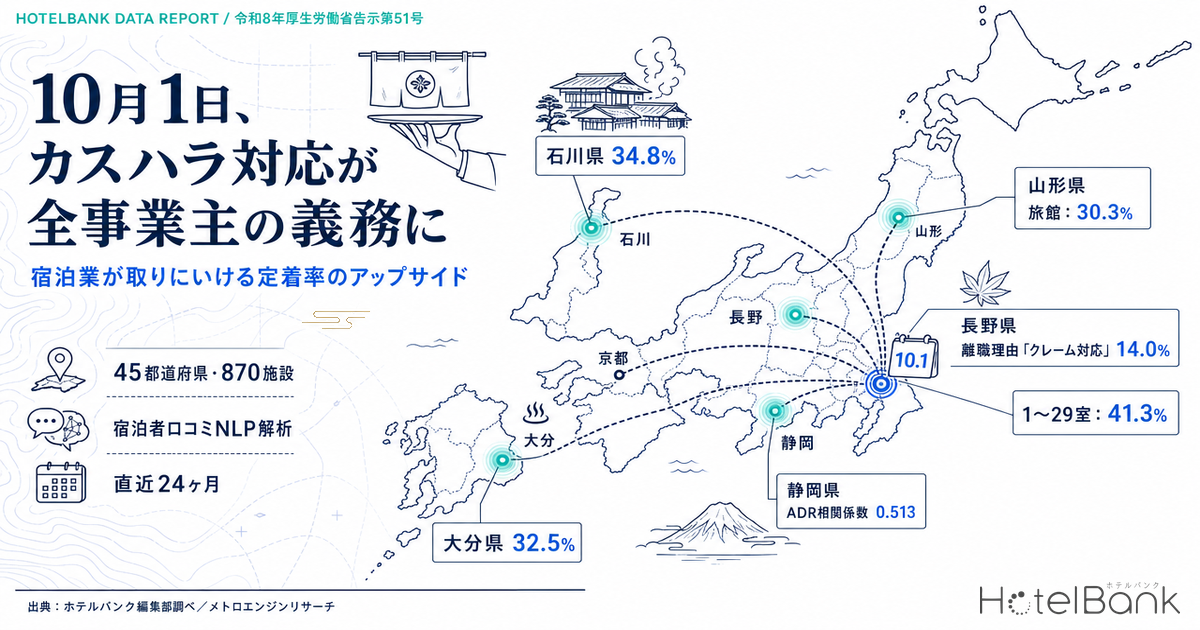
On October 1, 2026, addressing customer harassment (kasu-hara) becomes a legal obligation for every employer in Japan. The legal basis is the amended Labor Measures Comprehensive Promotion Act together with the “Guidelines on Measures Employers Must Take in Employment Management Regarding Problems Arising from the Conduct of Customers and Others in the Workplace” (MHLW Notification No. 51 of 2026), promulgated on February 26, 2026. Any business that employs even a single worker is covered, and unlike the power-harassment legislation, no grace period has been granted to small and medium-sized enterprises. For the accommodation industry, this is not merely a compliance exercise: it is an opportunity to lift three assets at once — retention, recruitment, and review reputation. This article first sets out the facts of the notification, then translates it into the three front lines of a hotel or ryokan — front desk, housekeeping, and restaurant — and finally uses a review analysis of 870 properties to draw, in numbers, the profile of the properties where service is talked about.
Metric Definitions Used in This Article
- Mention rate: the share of guest reviews posted for a given property over the trailing 24 months that touch on the theme in question. The mention rate is not a rating score — it is a frequency metric expressing how much a topic is talked about, and it does not indicate whether star ratings are high or low. All mentions used in this article were classified as positive in context.
- ADR (average daily rate): an estimated settled rate (tax-exclusive equivalent) calculated by applying category-specific correction coefficients to the lowest published plan level each property posts on OTAs and similar channels (two guests per room, per-room rate, tax-inclusive). Cross-checked against property-level results disclosed by listed hotel REITs, the median error is approximately 7%. These are estimates and differ from each property’s actual transacted prices and accounting figures. Area-level ADR is the median across the covered properties.
- Coverage: properties ranking near the top for mention volume on this theme within each prefecture (limited to those with at least 10 mentions per property). This is not a census of all properties nationwide; it is a cross-section of the group of properties where service is talked about at high frequency.
- Data sources: MetroEngines Research / guest review aggregation by the HotelBank Editorial Team
- — On October 1, 2026, customer-harassment response becomes a mandatory employment-management measure for all employers. Any business employing even one worker is covered, and no grace period has been granted to SMEs (MHLW Notification No. 51 of 2026).
- — 14.0% of people who left the accommodation industry cited “the mental stress of handling complaints” as a reason for leaving, ahead of “dissatisfied with pay” at 11.3% (Japan Tourism Agency FY2024 survey, leavers N=300).
- — The accommodation industry has been operating a line-drawing framework — “specified demand conduct” under the amended Hotel Business Act — since December 2023. This is not a build from zero, but a rewrite of existing criteria into an employee-protection workflow.
- — Service is talked about more at smaller, higher-priced properties: ryokan 30.3% and 1–29 rooms 41.3%, with a correlation coefficient of 0.513 against estimated settled ADR (log) across N=799 properties over the trailing 24 months.
- — Four things grow once the framework is in place: retention, recruitment, the occupancy ceiling, and review reputation. The minimum viable setup is a posted policy, a consultation desk, a time threshold for two-person response, a quantified limit on free-of-charge accommodation, and a named decision-maker.
What Changes on October 1 — The Facts of Notification No. 51
It is worth pinning down the structure of the rules precisely. Under the “Act Partially Amending the Labor Measures Comprehensive Promotion Act and Related Acts,” enacted in June 2025, customer-harassment countermeasures were positioned as a mandatory employment-management measure for employers. The specific content was set out in MHLW Notification No. 51 of 2026, promulgated on February 26, 2026 and applicable from October 1, 2026. Every date and number above can be verified against primary sources published by the Ministry of Health, Labour and Welfare and the Japan Institute for Labour Policy and Training.
| Item | Content |
|---|---|
| Effective date | October 1, 2026 |
| Legal basis | Amended Labor Measures Comprehensive Promotion Act / MHLW Notification No. 51 of 2026 (promulgated February 26, 2026) |
| Covered employers | All employers with at least one employee. No distinction by company size |
| Grace period | No transitional measure (grace period) has been provided for SMEs |
| Definition of customer harassment | Conduct by customers and others carried out in the workplace that, in light of the nature of the work the employee performs and other circumstances, exceeds the bounds of what is socially acceptable and harms the employee’s working environment |
| Enforcement | Demands for reports, advice, guidance, recommendations, and public disclosure (no criminal penalties are provided) |
Source: Ministry of Health, Labour and Welfare, “On the Partial Amendment of the Labor Measures Comprehensive Promotion Act and Related Acts (2025),” and MHLW Notification No. 51 of 2026; compiled by the HotelBank Editorial Team
The measures the guidelines require of employers are structured as four main pillars plus one item on privacy protection. First, clarifying and disseminating a policy: stating that the company will respond firmly to customer harassment and protect its workers, and making the substance of that response known to employees. Second, establishing a consultation system: designating a consultation desk in advance and building a structure capable of responding appropriately. Third, post-incident response: promptly confirming the facts, taking accommodating measures for the affected employee, and putting recurrence-prevention measures in place. Fourth, deterrent measures: setting out in advance a response policy for particularly egregious conduct, such as reporting to the police or barring entry. In addition to these, employers are required to establish and publicize rules protecting the privacy of those who come forward and prohibiting disadvantageous treatment on the grounds of having consulted.
What stands out here is that all four pillars ask about “organizational mechanisms” rather than “individual capability.” The requirement is not that a veteran handle the situation deftly alone, but that a state exist in which whoever is on duty is protected by the same procedure. Put the other way round: a design that lets even inexperienced staff stand on the floor with confidence is now recommended as a matter of law as well.
Accommodation Already Has a Line-Drawing Framework — The Link to the Amended Hotel Business Act
Compared with other industries, accommodation enjoys one favorable precondition. Through the amended Hotel Business Act, which took effect on December 13, 2023, the concept of “specified demand conduct” has already been implemented in the accommodation sector as a matter of law. Demands for unjustified discounts; demands for excessive services such as pick-up and drop-off not covered by the contract; unjustified demands sustained over long periods; demands whose means or manner is inappropriate — where such conduct is repeated and threatens to significantly obstruct the provision of services to other guests, the operator may refuse accommodation.
In other words, accommodation is an industry that has already spent roughly two and a half years training itself to think about the line between “legitimate requests” and “excessive demands” along government guidelines. The obligation taking effect in October is easiest to understand as the work of reconnecting that line — from a criterion for handling guests to a criterion of labor management that protects employees. Rather than writing rules from scratch, existing criteria are rewritten from the employee’s point of view. That difference in starting position is by no means small in terms of preparation workload.
How the two frameworks relate
Amended Hotel Business Act (in force December 13, 2023) = the criterion for whether accommodation may be refused. It allows refusal of guests who repeat specified demand conduct.
Amended Labor Measures Comprehensive Promotion Act / Notification No. 51 (applicable October 1, 2026) = the criterion for how employees are protected. It mandates policy clarification, a consultation system, post-incident response, and deterrent measures.
By folding the decision criteria of the former into the operating workflow of the latter, accommodation businesses are positioned to meet the requirements with comparatively little effort.
Where the Upside Lies — The 14.0% Cited by Those Who Left the Industry
Why is this an upside worth going after? The FY2024 report on the “Survey of the State of Human Resource Acquisition and Development in the Accommodation Industry,” published by the Japan Tourism Agency in March 2025, contains a figure that answers the question. Asked why they left, people who had departed the accommodation industry (leavers survey, N=300) selected “there were many complaints to handle and it was mentally stressful” at 14.0% — the third most common reason among all options. Tied at the same 14.0% is “the workload per person was too heavy due to staff shortages and similar factors.”
What deserves attention is that this 14.0% exceeds “I was dissatisfied with my pay” (11.3%). Improving compensation requires funding; building mechanisms that reduce the burden of guest handling does not necessarily require large additional cost. Documenting procedures, formalizing two-person response, standardizing record formats, naming escalation paths — all of these can be addressed through operational design. Putting this in order on the occasion of the October start is an investment that acts directly on one of the leading reasons people leave. Retention can also be approached from the capital-expenditure side rather than from operations alone — staff housing and similar people-infrastructure investment is one such lever, with turnover reduction as the measurable effect.
Source: Japan Tourism Agency, “FY2024 Survey of the State of Human Resource Acquisition and Development in the Accommodation Industry” report (March 21, 2025; leavers survey N=300); compiled by the HotelBank Editorial Team
The same report also suggests, in its analysis of the operator survey (N=363), that properties with higher turnover rates are more likely not to conduct training. Mechanisms that protect people and mechanisms that develop people move together. Building customer-harassment training into the program satisfies the “dissemination of policy” the guidelines require while simultaneously raising the level of the development system itself.
Conditions in the recruitment market are also favorable. According to Teikoku Databank’s “Survey of Corporate Trends Regarding Labor Shortages” (January 2026 survey, 10,620 valid responses), the share of ryokan and hotels reporting a shortage of non-regular staff was 44.0%, improving for a third consecutive year and falling below 50%. A phase in which the squeeze has eased is a good moment to shift the center of gravity from chasing the volume of hiring to raising the quality of retention.
Translating It to Three Front Lines — Front Desk, Housekeeping, Restaurant
Because the guidelines are written generically, without reference to any particular industry, putting them into practice requires translation into your own property’s operating reality. A useful hint here comes from the industry cluster analysis in the customer-harassment survey conducted by UA Zensen in 2024 (January 18 to March 18, 2024; 210 unions, 33,133 responses). The survey identifies, as characteristics of the group that includes hotels and leisure, that incidents run long — over an hour; that conduct often takes the form of hair-splitting argument and fault-finding; and that responses are frequently handled by more than one person. Long duration, argumentative style, and multi-person response translate directly into requirements for designing a property’s response workflow.
The same survey found that 46.8% of respondents reported experiencing abusive conduct within the previous two years, down from 56.7% in the 2020 survey. That figure indicates that public awareness and labor-management efforts have produced some results, and the October mandate can be positioned as locking that trend into place as a matter of law.
| Pillar of the guidelines | Front desk | Housekeeping | Restaurant and banquet |
|---|---|---|---|
| Policy clarification | State the response policy on in-house signage and in booking confirmation emails. Standardize the wording used at check-in | Write the line on what can be handled while a guest is in the room (entry times, scope of requests) into the work manual | Disclose allergy handling, service times, and the scope of accepted additional requests in advance on menus and booking terms |
| Drawing the line against legitimate requests | Create an authority table for room changes and rate adjustments, removing the decision from individual discretion | Define the scope of free-of-charge extra cleaning and extra amenities in quantitative terms | Set the criteria for re-service and refunds as a matrix of amount and cause |
| A workflow that leaves no one alone | A rule that a second person joins once an interaction exceeds 15 minutes. Secure a route for moving the conversation to the back office | On a complaint inside a guest room, leave immediately and switch to a joint response with the front desk. Never resolve it single-handed | Two-tier response by floor staff and a supervisor. For late-night banquets, specify the hours the supervisor is on site |
| Protecting the affected employee | Adjust assignments so the same staff member is taken off that guest on a return visit. Share the response record across shifts | Allow rotation changes for assigned rooms to be made without a formal request | Permit a break immediately after the incident at the supervisor’s discretion. Keep the consultation desk permanently listed on the shift roster |
| Deterrent measures | Name the person who decides on refusal of accommodation and reporting to the police where conduct falls under specified demand conduct in the Hotel Business Act | Define and post the recording coverage of common areas and the retention period for footage | Prepare a template for the wording of a request to leave, standardized so that a supervisor reads it out |
Source: MHLW Notification No. 51 of 2026, the amended Hotel Business Act (in force December 13, 2023), and the UA Zensen survey (2024); compiled by the HotelBank Editorial Team
What the entries in this table have in common is the idea of moving the decision off the individual and onto the organization. “A second person once it passes 15 minutes,” “free-of-charge handling defined by quantity,” “name the decision-maker” — each is designed to give floor staff the reassurance that they do not have to decide alone. On the deterrent measures the guidelines call for, accommodation businesses need not draft language from scratch, since the Hotel Business Act’s specified demand conduct already supplies an axis for the judgment.
The Data on Properties Where Service Is Talked About — 870 Properties Across 45 Prefectures
So how much do guests actually talk about “staff service”? The HotelBank Editorial Team used natural language processing to extract positive mentions touching on attentiveness and fine-grained care from guest reviews posted over the trailing 24 months, then aggregated the properties ranking near the top for mention volume in each prefecture. Coverage is 870 properties across 45 prefectures; of 787,048 total reviews, 151,359 qualified.
One point deserves emphasis up front: the mention rate treated here is not a rating score. A property with a high mention rate is one where service tends to become a topic of conversation; a low mention rate does not mean the quality of service is poor. At business hotels and similar formats, where the core of a stay is location and sleep environment, review topics naturally gravitate there instead. With that premise established, let us look at the kinds of properties where “people” tend to be talked about.
Source: HotelBank Editorial Team research (NLP analysis of guest reviews, trailing 24 months, N=870 properties)
Taking the median mention rate by property category, ryokan rank highest at 30.3% (N=351), followed by resort hotels at 19.9% (N=85), city hotels at 15.5% (N=167), and business hotels at 12.7% (N=205). At ryokan, roughly one review in three touches on staff attentiveness. Given the structure of a ryokan, where nakai attendants and the okami have contact points throughout the stay, that ordering makes sense — but what stands out is the size of the gap. Between ryokan and business hotels there is a 2.4-fold difference.
Source: HotelBank Editorial Team research (NLP analysis of guest reviews, trailing 24 months, N=870 properties)
The relationship with room count is sharper still. At properties with 1–29 rooms the median mention rate reaches 41.3% (N=157), declining as scale increases: 26.5% at 30–99 rooms (N=243), 16.2% at 100–199 rooms (N=222), and 12.8% at 200–399 rooms (N=183), with a slight reversal at 400 rooms and above (14.8%, N=65). At small properties each individual staff member constitutes the stay experience itself, and the content of reviews naturally turns toward people. The structural fact that the smaller the property, the more irreplaceable an asset each employee is shows up directly in the numbers.
This structure carries an important implication for thinking about the obligation starting in October. The fewer employees a property has, the greater the effect on the entire stay experience when one of them burns out. At the same time, precisely because they are small, these properties can propagate a response workflow throughout the operation in a short time. On this issue, being small is not a disadvantage; it works as agility. Where to apply staff and where to hand work to machines is itself a design question that feeds back into how service is talked about in reviews.
The Higher the Price Band, the More “People” Are Talked About — The Relationship with Estimated Settled ADR
The relationship with price band is more linear still. Looking at the 799 covered properties for which an estimated settled ADR could be calculated, the median mention rate by ADR band rises from 12.6% below ¥10,000 (N=123) to 25.5% in the ¥20,000–29,999 band (N=207), 31.5% in the ¥30,000–49,999 band (N=139), and 53.5% at ¥50,000 and above (N=18). The correlation coefficient between the log of ADR and the mention rate is 0.513 (N=799), confirming a clear positive relationship between price band and the likelihood that service is talked about.
Source: MetroEngines Research (estimated settled ADR) / HotelBank Editorial Team research (review NLP analysis), N=799 properties
These numbers show that in the high-rate segment, the first thing guests associate with an experience worth the price is “people.” Turned around, that means in the territory where service quality supports the rate, the mechanism that protects the people delivering it is a mechanism that directly protects the product. The more a property pursues a strategy of raising its price band, the more the October obligation is worth treating as part of business strategy.
Because scale and price correlate with each other, a cross-tabulation looking at both simultaneously is also included. Within the same ADR band, properties with 99 rooms or fewer consistently show higher mention rates than those with 100 rooms or more. Scale and price act independently.
| Estimated settled ADR band | 1–99 rooms | 100 rooms and above |
|---|---|---|
| Up to ¥10,000 | 20.9% (N=24) | 11.5% (N=99) |
| ¥10,000–14,999 | 23.1% (N=44) | 12.7% (N=127) |
| ¥15,000–19,999 | 24.8% (N=61) | 14.7% (N=80) |
| ¥20,000–29,999 | 30.3% (N=117) | 19.3% (N=90) |
| ¥30,000–49,999 | 36.4% (N=92) | 19.8% (N=47) |
Median mention rate. Cells with N below 10 are not shown. Source: MetroEngines Research / HotelBank Editorial Team research
Higher in Prefectures with Onsen Districts — The Distribution by Area
By prefecture, the top of the table is occupied by those with onsen districts and a ryokan culture. Ishikawa ranks highest at 34.8% (N=19), followed by Oita at 32.5% (N=20), Shizuoka at 32.4% (N=18), Yamagata at 31.3% (N=20), and Nagano at 30.0% (N=19). Prefectures containing onsen districts such as Kaga, Beppu, Atami, Zao, and Shinshu dominate the upper ranks, with differences in category mix appearing directly as differences between areas.
| Rank | Prefecture | Mention rate (median) | Covered properties |
|---|---|---|---|
| 1 | Ishikawa | 34.8% | 19 |
| 2 | Oita | 32.5% | 20 |
| 3 | Shizuoka | 32.4% | 18 |
| 4 | Yamagata | 31.3% | 20 |
| 5 | Nagano | 30.0% | 19 |
| 6 | Tottori | 27.7% | 20 |
| 7 | Gunma | 26.3% | 20 |
| 8 | Mie | 26.2% | 19 |
| 9 | Hyogo | 24.0% | 18 |
| 10 | Ehime | 23.5% | 19 |
Prefectures with 15 or more covered properties only. For reference: Kyoto 22.3% (N=15), Kanagawa 22.2% (N=17), Okinawa 18.3% (N=19), Hokkaido 16.2% (N=20), Fukuoka 16.1% (N=20). Source: HotelBank Editorial Team research
At the individual property level, some stand out with exceptionally high mention rates. Limiting the ranking to properties with 300 or more reviews, the top places are all ryokan with small room counts. The density of contact points during a stay, combined with a fixed set of people delivering it, pushes up the density with which people appear in reviews.
| Rank | Property | Location | Rooms | Mention rate | Reviews |
|---|---|---|---|---|---|
| 1 | Seikoro Ryokan (晴鴨楼) | Kyoto | 22 | 84.0% | 494 |
| 2 | Shiraishiya (白石家) | Shimane | 73 | 80.1% | 812 |
| 3 | Yamaichi Bekkan (山一別館) | Hiroshima | 4 | 77.1% | 327 |
| 4 | Moritsuya (森津屋) | Hyogo | 12 | 66.6% | 407 |
| 5 | Kasuien Minami (佳翠苑 皆美) | Shimane | 115 | 62.8% | 470 |
| 6 | Furuya Ryokan, Atami Onsen (熱海温泉 古屋旅館) | Shizuoka | 26 | 62.4% | 425 |
| 7 | Ryokan Sensui (旅館 泉翠) | Hyogo | 13 | 62.2% | 339 |
| 8 | Ajina Yuyado Yasuragi (味な湯宿 やすらぎ) | Nagano | 6 | 61.9% | 336 |
| 9 | Shiratama-no-Yu Kaho (白玉の湯 華鳳) | Niigata | 110 | 57.7% | 435 |
| 10 | Shukaen Yunohanazen, Atami Onsen (熱海温泉 秀花園 湯の花膳) | Shizuoka | 23 | 57.3% | 634 |
| 11 | Oyado Koto-no-Yume (おやど 古都の夢) | Gifu | 23 | 57.2% | 848 |
| 12 | Hakone Takumi-no-Yado Kasho (箱根 匠の宿 佳松) | Kanagawa | 18 | 57.1% | 413 |
Limited to properties with 300 or more reviews. The mention rate is the share of mentions in a positive context and is not a rating score. Source: HotelBank Editorial Team research (trailing 24 months)
“Omotenashi” and “Language Support” Are Talked About in Different Places
Even within service, the distribution of how something is talked about varies by theme. Extracting reviews that touch on the word omotenashi itself, coverage is 209 properties across 39 prefectures, with 3,439 of 174,233 total reviews qualifying. By category, ryokan rank highest at 3.8% (N=122), followed by resort hotels at 1.6% (N=34) and city hotels at 1.0% (N=28). By room count as well, the figures run inversely with scale, from 5.2% at 1–29 rooms (N=48) down to 0.8% at 400 rooms and above (N=19). Omotenashi is a term strongly tied to small properties with a Japanese style of stay.
Reviews touching on staff English-language support, by contrast, show a completely different distribution. Coverage is 283 properties across 30 prefectures, with 5,404 of 341,348 total reviews qualifying. Here the top ranks go to guesthouses at 4.4% (N=16), hostels at 3.6% (N=12), and ryokan at 2.7% (N=75); by price band, budget at 3.4% (N=39) and economy at 2.9% (N=26) exceed luxury at 1.7% (N=79). The picture is one in which the front line of language support sits not in the high-rate segment but at small, lower-priced properties.
Source: HotelBank Editorial Team research (NLP analysis of guest reviews, trailing 24 months). Omotenashi N=209 properties, English support N=283 properties
This distribution also carries implications for designing a customer-harassment response. Where the language is not fully shared, drawing the line between a “legitimate request” and an “excessive demand” becomes harder in itself. That is exactly why it is meaningful to define the criteria in numbers — amounts, quantities, and time — rather than leaving them to nuances of wording. The designs shown in the three-front-line table above, such as “15 minutes” and “free-of-charge handling defined by quantity,” work best precisely in a multilingual environment. The smaller the operating team, the greater the effect of putting this in writing.
Note that the aggregation in this article is a cross-section limited to properties ranking near the top for mention volume in each prefecture, and is not a census of every property nationwide. The mention rate is a frequency metric distinct from a rating score, and the language a review is written in does not indicate the reviewer’s nationality. The figures should be treated as material for reading tendencies across groups of properties.
What Grows If You Get Ready by October
Layering the data covered so far, an order of events emerges. The smaller the property, the higher the rate, and the more it operates as a ryokan, the more guests talk about “people.” At properties where people are talked about, each individual employee constitutes the product itself. And as the Japan Tourism Agency survey shows, the stress of guest handling sits third among the reasons those people leave the industry. In short, a structure holds in which the properties that put mechanisms for protecting people in place first are the ones where service accumulates as a review asset.
What needs to be ready by October 1 is by no means elaborate. Put the policy on a single page and post it; list the consultation desk on the shift roster; set the threshold for two-person response in units of time; write the scope of free-of-charge handling in quantities; and name the person who decides on egregious cases. Built on the foundation of existing Hotel Business Act documentation, these five items fit within a few weeks of work at most properties.
Four things grow once that is in place. First, retention — it acts directly on one of the leading reasons people leave. Second, recruitment — in a phase where the labor squeeze has eased, spelling out the working environment becomes a differentiator at the application stage. Third, the occupancy ceiling — once staffing is stable, room comes free to open guest rooms and meal slots that had been closed during peak periods. Fourth, review reputation — employees who can stand on the floor with confidence produce, as a result, the service that gets talked about. On the third point, the structure by which staffing constraints act directly as a ceiling on occupancy is treated quantitatively in Only Hotels That Capture Demand Survive: 2026’s Occupancy Ceiling.
Regulatory compliance tends to look like a defensive investment, but in accommodation it is closer to an investment in the product itself. This is an industry that has already trained itself in line-drawing under the Hotel Business Act, and where service is among the most talked-about topics in reviews. October 1 is best seen as the day that accumulated experience is re-fixed into law. On the relationship between price band and review reputation, see also Hotels Chosen for Value for Money: National TOP 30; for the perspective of connecting review distribution to price positioning, A 4.1 Review Score Is Average, Not a Strength; and on the gap between listed prices and what actually sold, Listed vs Settled ADR Gap: Japan’s Upside Map 2026.
Frequently Asked Questions
Q. Does this apply to a small ryokan with only a few employees?
A. Yes. The mandatory measures under the amended Labor Measures Comprehensive Promotion Act apply to any employer with at least one employee, with no distinction by company size. Nor is there a grace period for SMEs of the kind granted under the power-harassment legislation, so the rules apply uniformly from October 1, 2026.
Q. Are there penalties for non-compliance?
A. No criminal penalties are provided. The enforcement mechanisms in the law are orders to submit reports, advice, guidance, recommendations, and public disclosure where a recommendation is not followed. That said, public disclosure bears directly on a property’s reputation, so its practical weight is not small.
Q. Is compliance with the amended Hotel Business Act sufficient?
A. It is a favorable starting point, but not sufficient on its own. What the Hotel Business Act (in force December 13, 2023) establishes is an operator-side decision criterion — that accommodation may be refused to guests who repeat specified demand conduct. What Notification No. 51 requires is an employee-protection structure: a consultation desk, post-incident accommodating measures, privacy protection, and a prohibition on disadvantageous treatment. The subjects differ. The work required is to rewrite the existing decision criteria into an operating workflow on the employee side.
Q. How should we draw the line between a “legitimate complaint” and customer harassment?
A. The guidelines define customer harassment as conduct by customers and others that, in light of the nature of the work and other circumstances, exceeds the bounds of what is socially acceptable and harms the employee’s working environment. In practice, the clearest approach is to judge along two axes — whether the substance of the demand is itself unjustified, and whether the means or manner of the demand is inappropriate — which is the same thinking that underlies specified demand conduct in the Hotel Business Act. To prevent hesitation on the floor, it is effective to define the scope of free-of-charge handling in quantities and the maximum handling time in minutes.
Q. What kinds of properties tend to have service talked about in reviews?
A. In this article’s aggregation (870 properties across 45 prefectures), properties with 1–29 rooms show the highest median mention rate at 41.3%, declining as scale increases. By category, ryokan rank highest at 30.3% (N=351); by price band, the mention rate rises as estimated settled ADR rises, with a correlation coefficient against the log of ADR of 0.513 (N=799). Note, however, that the mention rate is a frequency metric indicating how much a topic is talked about, and does not mean a rating score is high or low.
Related Reading
- Hotels Chosen for Value for Money: National TOP 30 (21.6% of Reviews)
- A 4.1 Review Score Is Average, Not a Strength: Sapporo Price Position
- Listed vs Settled ADR Gap: Japan’s 46-Prefecture Upside Map 2026
- Only Hotels That Capture Demand Survive: 2026’s Occupancy Ceiling
References and Sources
■ Laws and notifications
- Ministry of Health, Labour and Welfare, “On the Partial Amendment of the Labor Measures Comprehensive Promotion Act and Related Acts (2025)”
- Japan Institute for Labour Policy and Training, “Guidelines on Measures Employers Must Take in Employment Management Regarding Problems Arising from the Conduct of Customers and Others in the Workplace (MHLW Notification No. 51 of 2026),” promulgated February 26, 2026
- Ministry of Health, Labour and Welfare, “On the Draft Guidelines on Measures Employers Must Take in Employment Management Regarding Problems Arising from the Conduct of Customers and Others in the Workplace [Summary]”
- BUSINESS LAWYERS, “Customer Harassment Countermeasures Become Mandatory in October 2026: The Measures Companies Must Take”
- Travelvoice, “What Has Changed Since the Hotel Business Act Amendment? Customer Harassment at Accommodation Facilities, Past and Future,” March 28, 2025
■ Government statistics and public surveys
- Japan Tourism Agency, “FY2024 Survey of the State of Human Resource Acquisition and Development in the Accommodation Industry” report, March 21, 2025 (operator survey N=363, employee survey N=473, leavers survey N=300)
- Ministry of Health, Labour and Welfare, “Summary of the Employment Trends Survey Results for the First Half of 2025”
■ Industry surveys and reports
- UA Zensen, “Customer Harassment Countermeasures Survey Results: Press Briefing Materials,” June 5, 2024 (survey period January 18 – March 18, 2024; 210 unions, 33,133 responses)
- Teikoku Databank, “Survey of Corporate Trends Regarding Labor Shortages (January 2026)” (survey period January 19–31, 2026; 10,620 valid responses)
■ Internal data
- MetroEngines Research — estimated settled ADR (N=799 properties, median of the most recent actual month)
- HotelBank Editorial Team research — NLP analysis of guest reviews (trailing 24 months. Positive mentions of attentiveness and fine-grained care: 870 properties across 45 prefectures / 787,048 total reviews; omotenashi: 209 properties across 39 prefectures; English support: 283 properties across 30 prefectures)