

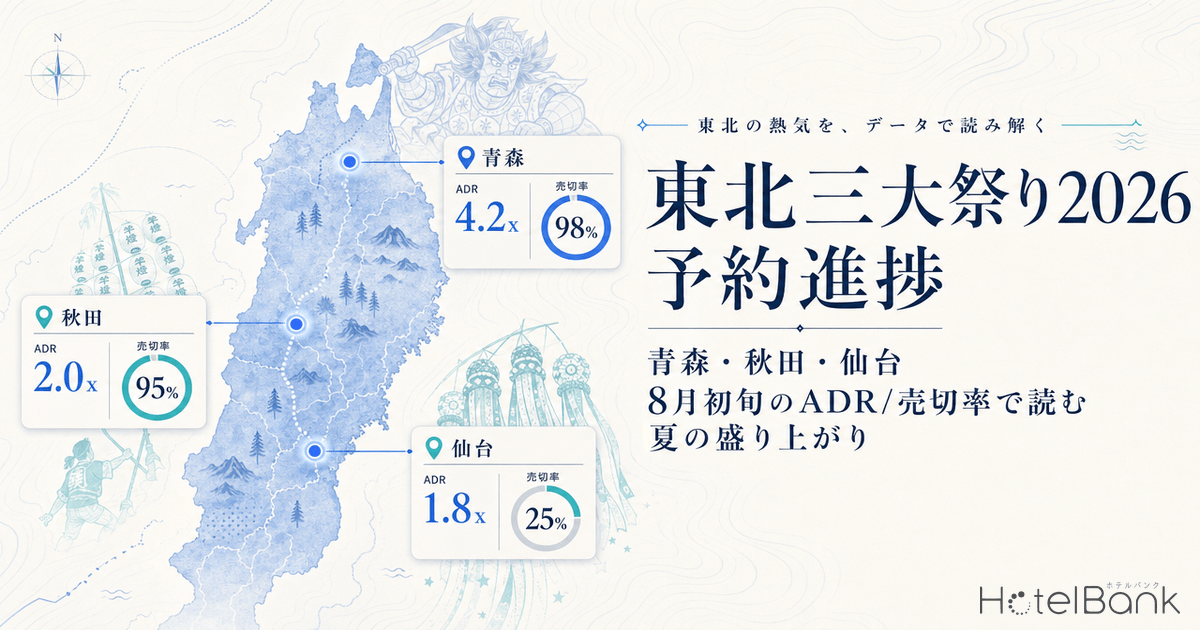
The dates for the 2026 Tohoku Three Major Festivals have been confirmed: Aomori Nebuta Festival on August 2 (Sun) – 7 (Fri), Akita Kanto Festival on August 3 (Mon) – 6 (Thu), and Sendai Tanabata Festival on August 6 (Thu) – 8 (Sat). In this article, based on publicly available OTA pricing data captured by MetroEngines Research as of late April (2026-04-27 snapshot), we examine the ADR levels and sold-out rates during the festival periods, multiples versus normal levels, spillover to neighboring prefectures, and whether the supply increase from new openings in 2026 can absorb demand. We also include a booking timing and alternative accommodation guide for individual travelers.
ADR (Average Daily Rate) = the average of publicly listed selling prices at surveyed properties; this differs from actual transaction prices. Sold-out rate = the share of sales plans that had ended bookings as of the survey date; this differs from a property’s overall occupancy rate. All prices are per-room rates (tax included) for double occupancy. Price multiples in the article are calculated as “Festival period ADR ÷ normal-period ADR for the same location.”
Aomori Hits 90%+ Sold-Out for 5 Straight Days; Peak Reaches 4x Normal
Looking at data captured on April 27, 2026 for Aomori, Miyagi, and Akita prefectures, booking progress during the festival periods diverges sharply across the three regions. Aomori City stands out: across the five core days of the Nebuta Festival from August 2 to 6, sold-out rates exceeded 90% on every single day. The most constrained day, August 6 (Thu), saw ADR reach ¥126,100 — about 4.2 times the May weekday average (¥30,300). Properties in the ¥30,000 range have effectively disappeared, and the remaining inventory is almost entirely high-end properties’ upper-tier plans.
Source: Compiled by HotelBank Editorial Team from MetroEngines Research (N = 17–35 properties in Aomori City, 17–27 in Akita City, 114–119 in Sendai City; check-in dates August 1–9, 2026; as of 2026-04-27)
Akita City presents a different kind of severity. Sold-out rates during the core Kanto Festival days from August 3 (Mon) to 6 (Thu) ranged from 89.3% to 95.4%, comparable to Aomori City. However, even at peak, ADR stayed at ¥36,100 — only about 2.0 times the May weekday average (¥18,500), making the multiple relatively mild. This is because the number of hotels in Akita City is small to begin with and weekday rates are low, leaving little physical room for dynamic pricing to push prices higher. Sendai City stayed in the 20% range for sold-out rates throughout the festival, and ADR peaked at ¥46,600 (about 1.8x the May level of ¥25,900) — a calmer picture. The depth of supply suppresses price spikes.
Comparing Multiples Across the Three Cities: Festival Peak vs Normal
Calculating the festival peak ADR divided by the May weekday average makes Aomori City’s outlier status even clearer. The conventional wisdom that “Tohoku summer festivals see 3–5x normal rates” largely holds for Aomori City but does not transfer directly to Akita City or Sendai City. Akita City matches Aomori City on sold-out rates yet shows only about half the ADR multiple. This is a clear example of how “demand strength” and “price multiples” do not always move in lockstep.
| City | Peak Date | Peak ADR | Peak Sold-Out Rate | May Weekday ADR | Multiple |
|---|---|---|---|---|---|
| Aomori City | Aug 6 | ¥126,100 | 98.0% | ¥30,300 | 4.2x |
| Akita City | Aug 5 | ¥36,100 | 95.4% | ¥18,500 | 2.0x |
| Sendai City | Aug 8 | ¥46,600 | 25.8% | ¥25,900 | 1.8x |
Source: Compiled by HotelBank Editorial Team from MetroEngines Research (snapshot as of 2026-04-27)
Source: Compiled by HotelBank Editorial Team from MetroEngines Research (sold-out rate = share of sales plans that had ended bookings as of the survey date)
In short, Aomori Nebuta is a textbook demand-overflow event in which tourist demand is overwhelmingly larger than hotel supply, with both prices and inventory tightening simultaneously. Akita Kanto, by contrast, is a “rooms run out but prices cannot go all the way up” market, while Sendai Tanabata leaves room in both inventory and pricing — the data show three completely different supply-demand structures. For a similar comparative analysis of event-driven markets where demand concentrates on specific dates, see also our Daily Analysis of OTA Prices and Sold-Out Rates Across Japan’s 3 Major 2026 Summer Festival Areas.
Akita’s Structural Bottleneck Seen Through Prefectural Capacity
Looking at the total room count across Tohoku’s six prefectures, the structure of the supply-demand crunch becomes even clearer. Within MetroEngines Research’s coverage, Miyagi Prefecture has the largest capacity in Tohoku at roughly 27,800 rooms, followed by Fukushima (about 24,500 rooms) and Iwate (about 16,300 rooms). Akita Prefecture, on the other hand, has roughly 10,800 rooms — the smallest capacity among the six Tohoku prefectures.
Source: Compiled by HotelBank Editorial Team from MetroEngines Research (operating properties only; closed and discontinued properties excluded)
The Akita Kanto Festival officially drew approximately 1.03 million attendees in 2025 (Source: Akita Kanto Festival official). Even if just 10% required overnight stays, that translates to roughly 100,000 overnight room-nights of demand — yet the entire prefecture has only about 10,000 rooms, and the surveyed properties in Akita City with practical access to the festival venue numbered only 18–27 (peak-day basis) as of late April. Because of this physical supply constraint, sold-out rates above 95% emerged early in Akita City.
Spillover to Neighboring Prefectures: ADR Trends in Yamagata and Iwate
When rooms cannot be secured in Akita City, the rational alternatives are neighboring Yamagata and Iwate prefectures (especially Morioka and Hanamaki). The Akita Shinkansen “Komachi” connects Morioka and Akita City in about 1.5 hours, and from areas along the Yamagata Shinkansen “Tsubasa” line, access via limited express transfers takes around 4 hours — making these areas viable for tourists who travel back and forth on the day of the festival. In fact, looking at early-August ADR for Iwate and Yamagata as of late April, both prefectures — which have many traditional ryokan inns — were already showing higher baseline rates in the ¥40,000 range, with further upward pressure from festival-driven demand.
Source: Compiled by HotelBank Editorial Team from MetroEngines Research (six Tohoku prefectures, check-in dates August 1–9, 2026, as of 2026-04-27)
Notably, Yamagata Prefecture’s ADR for August 8 (Sat) – 9 (Sun) climbs to between ¥51,000 and ¥53,800 — exactly overlapping with the closing weekend of Sendai Tanabata. Ryokan-style properties in Yamagata Zao and Akakura Onsen appear to be picking up overflow demand from Sendai City at high rates. Iwate also rises to ¥44,800 on August 8, and lodging demand around Morioka Station shows a pattern of remaining elevated even just after Morioka Sansa Odori (typically August 1–4). Fukushima stays in the ¥34,000–¥37,000 range during the festival period, suggesting it sits somewhat outside the direct sphere of influence of the Three Major Festivals. Note that Fukushima is being driven on a separate axis by a Destination Campaign, the actual impact of which is analyzed in detail in One Month Into the Fukushima Destination Campaign — Verifying Its Impact via Real OTA Prices.
Progress vs Same Period Last Year (August 2025)
Isolating the festival period (Aug 2 – Aug 7) and comparing 2026 ADR (as of late April) with the same period in 2025, four of Tohoku’s six prefectures show a year-over-year ADR increase. Miyagi, Yamagata, and Fukushima all confirm ADR uplift of more than 10% YoY. Akita and Iwate, by contrast, are decelerating versus the prior year — indicating either that inventory remains relatively unsold, suppressing the average price, or that the August 2025 comparison data had already shed leftover plans by the comparison point. Note that the 2025 sold-out rate is recorded as zero, but this is post-sales-period data and is not meaningful as a comparison; in this article we therefore focus the comparison strictly on ADR. For the broader picture of summer 2026 demand nationwide, our Summer 2026: ADR, Sold-Out Rate, and YoY Comparison Across Japan’s 5 Major Resort Areas covers Tokyo, Hokkaido, Kyoto, Okinawa, and Karuizawa.
Source: Compiled by HotelBank Editorial Team from MetroEngines Research (prefectural ADR average for festival-period check-ins August 2–7, year-over-year)
2026 New Openings: Can Sendai’s 117 Rooms and Morioka’s 153 Rooms Absorb Demand?
Among hotels opening in Tohoku in 2026, four properties stand out as relatively sizable, with 30 or more rooms. Specifically, in Miyagi Prefecture: KOKO HOTEL Sendai-eki-mae Central (117 rooms, opened April 23, 2026) and Hotel Metropolitan Base Sendai (56 rooms, opened April 1, 2026); and in Iwate Prefecture: Grids Premium Hotel Morioka (153 rooms, opening May 1, 2026) and Gensen Ichizu Iwate Shizukuishi (57 rooms, opening July 1, 2026).
| Prefecture | Property | Rooms | Opening Date | Category |
|---|---|---|---|---|
| Miyagi | KOKO HOTEL Sendai-eki-mae Central | 117 | 2026-04-23 | Business Hotel |
| Miyagi | Hotel Metropolitan Base Sendai | 56 | 2026-04-01 | City Hotel |
| Iwate | Grids Premium Hotel Morioka | 153 | 2026-05-01 | Business Hotel |
| Iwate | Gensen Ichizu Iwate Shizukuishi | 57 | 2026-07-01 | Ryokan |
Source: Compiled by HotelBank Editorial Team from MetroEngines Research (30+ rooms, in opening-date order)
Sendai City’s combined new supply totals about 173 rooms. Against the city’s roughly 115 surveyed properties, this represents only about a 1.5% net increase in rooms. Compared with Sendai Tanabata’s typical attendance of about 2 million visitors, this is closer to a rounding error and limited as a demand-absorption mechanism. That said, Sendai Tanabata already runs at sold-out rates of around 20%, so supply-demand pressure is not strong. New supply is more likely to influence the share-battle for weekday business demand than to push down festival-period prices.
The property to watch is Iwate’s Grids Premium Hotel Morioka (153 rooms). As noted above, Morioka serves as a spillover destination for Akita Kanto and Aomori Nebuta demand, and the new 153 rooms add some headroom for absorbing festival demand from neighboring prefectures. However, Morioka is also expected to see rising sold-out rates on the peak days for Akita and Aomori, so it does not represent a fundamental fix. No major new property has been confirmed for Akita Prefecture, and the structural capacity shortfall there is expected to persist.
For Individual Travelers: Booking Timing and Alternative Accommodation Guide
The data in this article suggest the following practical takeaways for individual travelers.

Source: Compiled by HotelBank Editorial Team and MetroEngines Inc.
Aomori City was already at over 90% sold-out as of late April, so anything still available is in the high-price tier. Standard business hotels in the ¥30,000 range are essentially sold out. Practical alternatives include: (a) lodging within about an hour of Aomori City by local rail or bus — Hirosaki, Hachinohe, or Asamushi Onsen; (b) day-tripping from Hakodate via the Aomori-Hakodate ferry or Shinkansen; or (c) day-tripping from Morioka or Hachinohe via Shinkansen.
Akita City is essentially full at sold-out rates above 95%. Price multiples have not jumped as dramatically as in Aomori, but the issue is that there is simply no inventory. Alternatives include: (a) adjacent areas within Akita Prefecture such as Daisen, Yokote, or Noshiro; (b) round-trip day visits from Morioka via the Akita Shinkansen “Komachi” (about 1.5 hours each way); or (c) limited express access from Yamagata’s Shonai region. Morioka still has inventory during the festival period, with ADR in the relatively accessible ¥38,400–¥42,000 range.
Sendai City is in the 20% range for sold-out rates and, as of late April, lodging is still available at standard rates of ¥30,000–¥40,000. The closing day on August 8 (Sat) tends to be the most constrained, so planning for stays on August 6 (Thu) or August 7 (Fri) — avoiding Saturday — is more favorable on price. Sendai City is also just 1.5 hours from Tokyo by Shinkansen, making a day-trip plus nearby lodging combination (Matsushima, Zao, etc.) practical.
On booking timing: as of late April, Aomori City and Akita City peak days are already 80–90% sold out, so waiting longer will not bring prices down — instead, securing remaining inventory becomes harder. Conversely, Sendai, Fukushima, Morioka, and Yamagata may see further changes in sales status into May and June, leaving room for ongoing price monitoring.
Conclusion: Three Festivals, Three Different Demand Structures
Reading the late-April booking progress for the 2026 Tohoku Three Major Festivals from publicly available OTA pricing data reveals three distinctly different supply-demand pictures. Aomori Nebuta is demand-overflow: prices have reached about 4x normal and sold-out rates have hit 98%. Akita Kanto is supply-constrained: price multiples are held to around 2x but inventory is essentially gone, and spillover to neighboring Morioka and Yamagata has materialized. Sendai Tanabata is supply-comfortable, with ADR up only about 1.8x normal and inventory still available. New openings planned for 2026 are concentrated in Sendai (about 173 new rooms) and Morioka (153 rooms), and their demand-absorption capacity is limited. The structural capacity shortfall in Akita Prefecture, in particular, will persist — making a wide-area lodging strategy that includes neighboring prefectures continue to be the most effective approach when planning to attend the Tohoku Three Major Festivals.
Related Articles
- One Month Into the Fukushima Destination Campaign — Verifying Its Impact via Real OTA Prices
- Summer 2026: ADR, Sold-Out Rate, and YoY Comparison Across Japan’s 5 Major Resort Areas
- Summer Resort 3-Region Comparison 2026: Niseko, Okinawa, Karuizawa — ADR, Booking Pace, FX Sensitivity
- Summer 2026: Okinawa, Hokkaido, Kyoto Hotel Price Comparison — When Is the Best Time to Book?
- Daily Analysis of OTA Prices and Sold-Out Rates Across Japan’s 3 Major 2026 Summer Festival Areas — Fuji Rock and Summer Sonic
- May 2026 Inbound Booking Trends: Western and Southeast Asian Travelers Lift Regional ADR
- Japan Beach Opening Calendar 2026 — How ADR and Sold-Out Rates Shift Around the “Beach Opening Day”
- Will the Junglia Okinawa Opening Shift the Northern Market to a Year-Round Model? — Verified Across 6 Areas via ADR and Sold-Out Rates
- 16 Months After the Noto Peninsula Earthquake — Wakura Onsen and Wajima Recovery Phase and Summer 2026 Booking Trends
- Lake Suwa Fireworks 2026: How August 15 Obon Peak Demand and Reservation Changes Affect the Lodging Market
- Last-Minute Demand Just Before Golden Week 2026: ADR Trends by Lead Time