

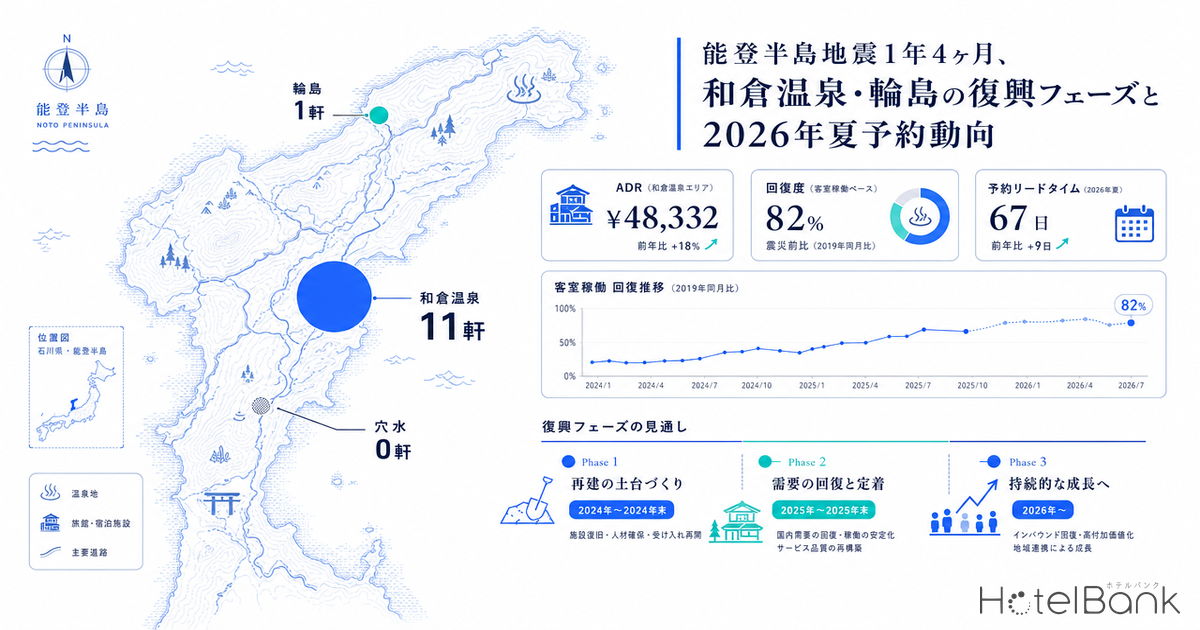
As of May 2026, sixteen months have passed since the Noto Peninsula Earthquake of January 1, 2024, and the accommodation market in the affected areas is following sharply divergent recovery paths depending on the region. In Wakura Onsen, the number of reopened properties has climbed back to 11 from a pre-quake count of 26, and the average daily rate (ADR) has recovered to 85–90% of pre-quake levels. In contrast, Wajima City and Anamizu Town currently have only 1 and 0 properties trackable through MetroEngines Research, respectively, leaving full market recovery still some way off. This article uses OTA-published price data and guest review analysis to provide a multi-dimensional read on the overall recovery phase and Summer 2026 (July–August) booking trends.
Metric Definitions Used in This Article
- Active Property Count: The number of properties tracked by MetroEngines Research that had OTA-published prices in the relevant month. This may not match the physical operational status of the property.
- ADR (Average Daily Rate): The average of OTA-published selling prices, which differs from actual transaction prices. Per-room rate for double occupancy (tax included), averaged across all plan types (room-only through meal-inclusive).
- Sold-Out Rate: The share of plans that had closed reservations on the OTA at the time of the survey. This differs from overall property occupancy.
- Review Score: The weighted average of guest reviews (1–5 scale). Sources are not disclosed and the data is attributed to “HotelBank Editorial Research.”
- Data Sources: MetroEngines Research, Japan Tourism Agency, Noto Peninsula Wide-Area Tourism Association, etc.
The Big Picture of the Recovery Phase — What Has Changed in 16 Months
Organizing the accommodation market trends from the time of the Noto Peninsula Earthquake through May 2026 using MetroEngines Research tracking data, the recovery process can be divided into three broad stages. The first stage is the “devastation phase” from January through August 2024; the second is the “early-reopening phase” from autumn 2024 through spring 2025; and the third is the ongoing “broad-reopening phase” from summer 2025 through May 2026. In Wakura Onsen, 26 ryokan and hotels were selling rooms via OTAs as of December 2023 immediately before the quake, but this temporarily fell to 17 in April 2024 and to just 3 in August 2024. After phased reopenings, 11 properties had resumed sales as of May 2026.
The recovery pace in Wajima City and Anamizu Town has been even slower. In Wajima City, the 16 properties present before the quake had shrunk to 11 in April 2024, 2 in August 2024, and just 1 by May 2026. Anamizu Town was a small market with only 2 properties even before the quake, and since June 2024 the number of properties trackable via MetroEngines Research has remained at zero. This does not mean accommodation capacity in the town has been entirely lost — some properties continue to host guests through the Noto Peninsula Wide-Area Tourism Association’s “lodging management system for relief workers” — but they have yet to return to OTA sales channels for tourists.
Source: MetroEngines Research, compiled by HotelBank Editorial Team
The chart shows trends in active property counts across the three areas. Before the quake in 2023, the three areas combined had roughly 44 properties selling stably, but by August 2024 this had plunged to a combined total of 5. Wakura Onsen has driven the recovery pace, expanding step-by-step from 7 to 11 properties between April 2025 and January 2026. Behind this is the “Wakura Onsen Regional Tourism Revitalization Support Plan integrated with seawall restoration,” formulated by the Japan Tourism Agency in March 2025, which is functioning as a foundation for area-wide regeneration of the hot-spring district.
Wakura Onsen’s Recovery — 11 Reopened Properties and ADR Recovery
Wakura Onsen has seen the staggered reopening of major large-scale ryokan. In November 2024, “Nihon-no-Yado Notoraku” reopened after a 10-month closure, followed by TAOYA Wakura, Kagaya’s sister property Aenokaze (which had remained operational), and Yukemuri-no-Yado Bisuiso, all working through their restoration. According to the Wakura Onsen Ryokan Cooperative Association, 9 properties are scheduled to reopen during 2026, and Kagaya Main Building has announced a full-scale reopening by the end of fiscal 2027. This works out to roughly half of the 20 pre-quake properties (cooperative member basis) returning.
What is notable is the ADR recovery pace. Pre-quake (July–August 2023) average Wakura Onsen ADR was ¥59,700 on weekdays and ¥64,300 on weekends. For July–August 2026 (advance-sale prices at the time of the survey), this stands at ¥48,300 on weekdays and ¥52,600 on weekends — about 81–82% of the pre-quake level. However, this is essentially flat compared to summer 2025 (¥48,800 weekday, ¥54,000 weekend), and the “price-raising momentum” entering 2026 has been limited. A structural factor is that the lineup of reopened properties differs from the pre-quake mix (some luxury ryokan remain closed), which is pulling down the average.
Source: MetroEngines Research, compiled by HotelBank Editorial Team
What should be observed alongside is the movement in the sold-out rate. The May 2026 sold-out rate for Wakura Onsen reopened properties’ sale plans was 25.5% — the highest level recorded since entering the recovery phase. From June onward, the figures settle to 18.5% (June), 12.2% (July), and 11.1% (August), but each represents a clear shift compared with the same period in 2025 when all were at 0%. This is not merely a price phenomenon — it can be read as a signal that “demand has begun to exceed supply” in a context of constrained property availability. For reopened properties, this is a phase in which opportunities for stepwise pricing strengthening are widening.
Summer 2026 (July–August) Booking Trends — Different Temperature on Weekdays vs Weekends
Splitting Wakura Onsen for July–August 2026 into weekdays and weekends reveals stark differences in price structure. Weekday ADR at ¥48,300 is about 9% lower than the weekend ¥52,600, and compared to pre-quake levels the weekday recovery is relatively weaker. This reflects the structure typical of a leisure-driven hot-spring destination, where a roughly 8% weekday/weekend price gap existed even before the quake (weekday ¥59,700 vs weekend ¥64,300). The ratio has not changed much, but absolute levels are both down by roughly ¥10,000.
→ Summer 2026 Top 5 Resort Areas | ADR, Sold-Out Rate, and YoY Comparative Analysis
The weekend sold-out rate runs 2–3pt higher than weekdays, hovering in the 12–13% range. In August, some properties are pushing prices to ¥49,300 on weekdays and ¥52,600 on weekends, with sold-out plans concentrated around the Obon holiday period (around August 14) at the time of the survey. Given the limited room inventory of reopened properties, we are entering a phase where peak-demand periods could see selling prices approach pre-quake levels.
Source: MetroEngines Research, compiled by HotelBank Editorial Team
Where Wajima & Anamizu Stand — Tourist-Channel Return Is Still Ahead
In Wajima City, only one property has been trackable by MetroEngines Research since February 2026, with ADR fixed at ¥55,000. This is a “reference price for the property continuing sales” and does not reflect the dynamics of the broader market. The ryokan district around Wajima Morning Market suffered renewed damage in the September 2024 Oku-Noto torrential rains, and many operators have had to make business decisions in parallel with restoration work. Multiple flagship properties such as Wajima Onsen Yashio, Hotel Koshuen, and Hotel Route Inn Wajima are at the planning stage of phased reopening while leveraging the Japan Tourism Agency’s recovery support programs and Ishikawa Prefecture’s tourism revitalization support.
Turning to Anamizu Town, the number of properties trackable via MetroEngines Research has remained at zero since June 2024. While the Anamizu Maimon Festival “Winter Edition: Oyster Festival” ran from January 3 through May 6, 2026, and serves as a regional draw, accommodation channels are largely centered on the special operations of the Noto Peninsula Wide-Area Tourism Association’s “lodging management system for relief workers.” The genuine return as a tourist-facing OTA sales market is expected to be a challenge from the second half of 2026 onward.
Source: MetroEngines Research, compiled by HotelBank Editorial Team
Review-Score Analysis — The “Quality Recovery” Trajectory of the Recovery Phase
Aggregating guest reviews (cumulative 59,562 reviews) across 27 reopened Wakura Onsen properties reveals how the center of gravity of ratings has shifted between pre- and post-quake periods. Pre-quake (before December 2023, N=6,155 reviews), the overall score averaged 4.26. Looking at monthly trends after reopening, scores plummeted to the 1.0–2.6 range from April through October 2025. This reflects the limited service offering during restoration (simplified meal styles, restricted onsen bathing, partial room availability, etc.).
The turning point arrived from December 2025. Monthly average scores recovered rapidly: 2.58 → 2.86 → 3.46 → 4.19 → 4.40, returning to 4.40 by April 2026. This figure exceeds the pre-quake level (4.26) and suggests that reopened properties have advanced from the “restoration” phase to the “normal operations plus enhanced hospitality” phase. It can be considered a juncture where operator structures are in place and guest expectations are once again aligning with actual experience.
Source: Guest review data (HotelBank Editorial Research)
By category, the differential trends between pre- and post-quake are interesting. The core ryokan experience categories of “Dinner,” “Breakfast,” “Room,” and “Service” largely maintain pre-quake levels (differentials of -0.02 to -0.14), demonstrating that reopened properties have succeeded in maintaining quality. On the other hand, “Bath/Onsen” (-0.23) and “Location” (-0.18) have seen ratings decline relative to pre-quake. The former can be interpreted as reflecting physical constraints such as the ongoing restoration of hot-spring sources and bathing-time restrictions, while the latter reflects the reduced bustle of the hot-spring district overall and the impact of surrounding construction work.
| Category | Pre-Quake Score | Post-Quake Score | Differential |
|---|---|---|---|
| Dinner | 4.39 | 4.38 | -0.02 |
| Breakfast | 4.28 | 4.29 | +0.01 |
| Room | 4.22 | 4.20 | -0.02 |
| Bathroom | 4.21 | 4.21 | ±0.00 |
| Service | 4.29 | 4.15 | -0.14 |
| Cleanliness | 4.25 | 4.18 | -0.08 |
| Location | 4.45 | 4.27 | -0.18 |
| Facilities & Amenities | 4.08 | 3.88 | -0.20 |
| Bath / Onsen | 4.57 | 4.33 | -0.23 |
Source: Guest review data (HotelBank Editorial Research)
The areas where reopened properties should focus going forward are clear. Since core experience elements such as cuisine, rooms, and service have returned to pre-quake levels, future differentiation hinges on “restoring the onsen experience” and “regenerating the bustle of the hot-spring district overall.” The “Wakura Onsen Recovery Tour” being conducted by the Wakura Onsen Tourism Association from March through November 2026 functions precisely as an initiative addressing the latter.
Shifting Demand Structure in the Recovery Phase — A Window for Stepwise Pricing
Reading the summer 2026 sales status of Wakura Onsen reopened properties chronologically reveals shifts in demand structure across three axes. First, the limited active property count is functioning as a “supply constraint against demand.” With supply at 11 properties (versus 26 pre-quake), the fact that June–August sold-out rates are running at 11–18% signals a concentration of bookings on specific dates (Obon, weekends). Second, the rapid recovery in review scores (from the 2.0 range in April 2025 to the 4.4 range in April 2026) indicates that guest satisfaction is exceeding pre-quake levels, providing a basis for raising prices. Third, the review counts at reopened luxury ryokan (Kagaya’s sister property Aenokaze, Hotel Kaibo, Niji-to-Umi, and others) are again on an upward trend, indicating that the review-driven repeat-customer acquisition cycle is recovering.
Considering these factors, this phase can be viewed as one in which opportunities for stepwise pricing strengthening are widening for reopened properties. Specifically, possible approaches include: (1) raising weekday prices to 85–90% of weekend levels, (2) implementing ¥3,000–5,000 stepwise increases starting 2–3 weeks ahead for dates with sold-out rates exceeding 15%, and (3) embedding value-added plans (local sake pairings, Noto experience packages, etc.) as price-uplift elements while repeat-customer rates rise. To bring ADR back to pre-quake levels (around ¥60,000 on weekdays), differentiation that can articulate a recovery story in product design will be the key, alongside stable occupancy.
Implications for Operators and Local Authorities Heading into Summer (July–August 2026)
Looking at the July–August 2026 booking trends and medium-term demand recovery, the following points emerge for each stakeholder.
For operators (already reopened properties), a window for assertive pricing has arrived. Sold-out rates trend higher around the Obon holiday period (mid-August), and there appears to be market headroom to raise the average weekend ADR of ¥52,000 to the ¥55,000–58,000 range. At the same time, since maintaining/improving the 4.4 review score will be the starting point for the next acquisition cycle, an operating structure that avoids the dilution of service quality accompanying sharp occupancy spikes is essential.
For operators (preparing to reopen), there is significant strategic value in reopening while the market is in a supply-constrained period. After the planned full reopening of Kagaya Main Building in fiscal 2027 and the reopening of Niji-to-Umi in the second half of fiscal 2026, supply capacity in the Wakura Onsen area will expand rapidly. As prices may temporarily adjust, it is reasonable to position the intervening period as a “golden time for brand rebuilding.”
For local authorities and tourism associations, supporting the OTA-channel return of accommodation functions in Wajima, Anamizu, and Noto Town remains a challenge. While the Japan Tourism Agency’s recovery support programs and Ishikawa Prefecture’s tourism revitalization support have been delivering incremental results, support for OTA channel registration, marketing to foster post-restoration guest reviews, and continued rollout of recovery tour products will be the focus areas for the next 3–6 months.
Summary — What Has Progressed in 16 Months, and How to Reach the Next Stage
As of May 2026, sixteen months after the Noto Peninsula Earthquake, Wakura Onsen has seen half of its supply restored, ADR has recovered to 80–85% of pre-quake levels, and review scores have improved beyond pre-quake levels. This can be positioned as a phase resulting from the Japan Tourism Agency’s support integrated with seawall restoration, the Wakura Onsen Ryokan Cooperative Association’s phased reopening strategy, and the restoration efforts of individual operators. Meanwhile, the OTA sales markets in Wajima and Anamizu remain in a pre-full-recovery state, and whether tourist-channel return progresses over the next 3–6 months will determine the recovery pace of Noto tourism overall through late 2026 and 2027.
Summer 2026 will be a critical period for Wakura Onsen reopened properties to test “how far they can push demand and prices.” With sold-out rates beginning to exceed 10%, the balance between pricing flexibility and service-quality maintenance will be the watershed determining post-recovery business sustainability.
⚠ Note on Future-Date ADR: The ADR figures in this article are averages of OTA-published selling prices at the time of the survey, and they fluctuate as the check-in date approaches. Currently elevated prices may decline through last-minute discounting, or conversely may be raised in response to sell-outs. Because the Noto Peninsula remains in the midst of supply recovery, please note that demand trends have a particularly strong impact.
Related Reading
- One Month Into Fukushima DC: Did Bookings Move? — Verifying Campaign Effectiveness with OTA Actual Prices
- National Average ADR Hits Record ¥32,340 (May 2026) | The Structural Breakdown of “+19% Over 3 Years” Driven by Inflation × Labor-Cost Pass-Through
- Up to 44% Off After Golden Week | The Complete Guide to Mid-May Hotel “Rock-Bottom” Prices [2026 Data Analysis]
- [April 2026 Update] In-Depth Analysis of Atami’s Ryokan | Market Structure of 76 Properties & 2,508 Rooms and ADR Trends
- Hokkaido in June, Beyond the Rainy Season: How Hotel Prices Move | 6-City ADR Comparison 2026
- [Summer 2026] In-Depth Hotel Price Comparison: Okinawa, Hokkaido, Kyoto | What’s the Best Booking Timing?
Reference Links
- Japan Tourism Agency, “Wakura Onsen Regional Tourism Revitalization Support Plan integrated with seawall restoration” (March 2025)
- Wakura Onsen Tourism Association & Wakura Onsen Ryokan Cooperative Association
- Noto Peninsula Wide-Area Tourism Association “Hospitality Peninsula Noto”
- Noto Stay “Accommodations Currently Open in Oku-Noto (Wajima City, Suzu City, Anamizu Town, Noto Town)”
- Ishikawa Prefecture Reiwa 6 (2024) Noto Peninsula Earthquake & Oku-Noto Torrential Rain Restoration & Recovery Headquarters