

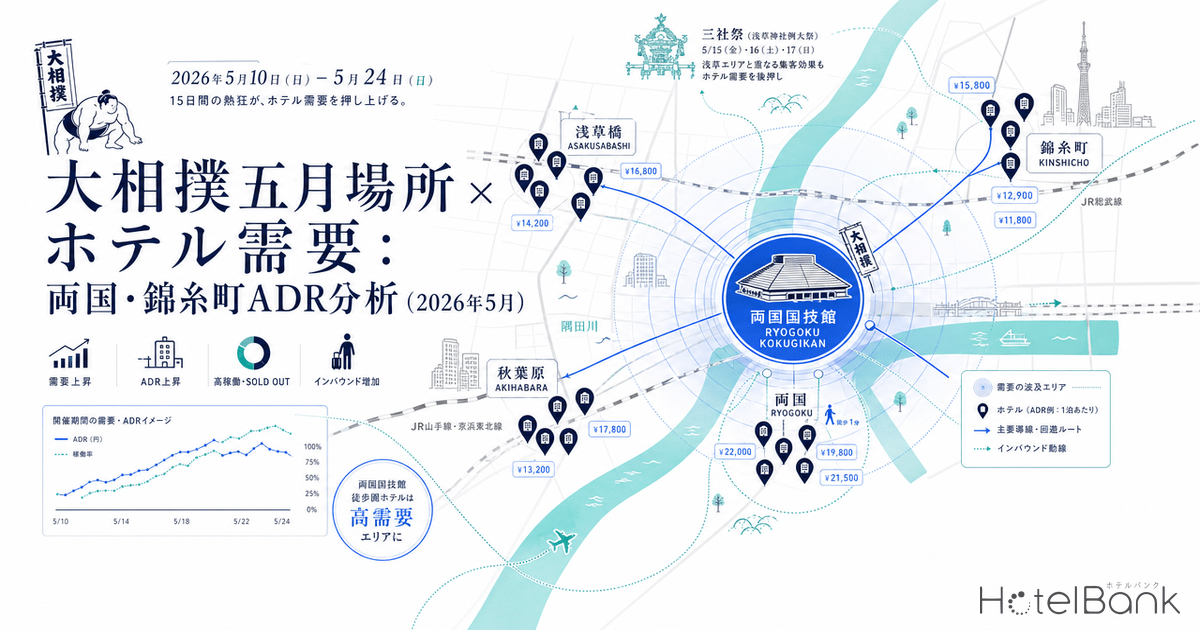
The Grand Sumo May Tournament (Natsu Basho) will be held at Ryogoku Kokugikan from Sunday, May 10 through Sunday, May 24, 2026. How does a 15-day consecutive mega-event reshape lodging demand? Targeting hotels within walking distance of Ryogoku, Kinshicho, Asakusabashi, and Akihabara, we analyzed daily OTA public-rate data compiled by MetroEngines Research. We also unpack the structural drivers — overlapping with Sanja Matsuri in Asakusa (May 15–17), the inbound boom in sumo tourism, and the scarcity of viewing-ticket-bundled hotel packages.
Metric Definitions Used in This Article
- ADR (Average Daily Rate): Average of public sales rates listed on OTAs etc. Differs from actual transaction prices (tends to run +25–30% higher on average than the transaction ADR disclosed by REITs, due to unsold high-end plans persisting on OTAs and pushing the average up). Per-room rate for double occupancy (tax included), averaged across all plans (room-only through meal-inclusive).
- Sellout Rate: Share of plans that had stopped accepting OTA bookings at the time of survey. Different from each property’s room occupancy rate.
- Target Areas: Ryogoku Kokugikan walking zone (around Ryogoku Station, ~500m radius) N=4 properties, Kinshicho Station walking zone (~500m radius) N=8–9, Asakusabashi/Kuramae area N=11, Akihabara Station walking zone (~700m radius) N=16, Asakusa/Sanja Matsuri area N=20.
- Data Source: MetroEngines Research (continuous collection of public rates from properties confirmed active on OTAs).
15 Consecutive Event Days Push Up Daily ADR
The Grand Sumo May Tournament runs 15 straight days, May 10–24, 2026, at Ryogoku Kokugikan. Tracking daily ADR across the 4-property cluster within walking distance of Ryogoku Station, clear demand pressure is visible throughout the tournament. Against ¥20,300 on Monday, May 11 (a pre-opening weekday), ADR rises to ¥28,400 on the mid-tournament Friday May 15, and reaches ¥35,800 on Saturday May 23 in the second week.
Of particular note is the ADR level on May 23. It is +5.3% above the previous day’s ¥34,000 (Friday May 22) and +76% versus the pre-opening Monday May 11. The date corresponds to the Saturday before Senshuraku (final day), reflecting demand from spectators staying overnight before the marquee finale matches. By contrast, ADR plunges to ¥19,900 on the Senshuraku day itself (Sunday May 24). This shows a structure where many guests head home right after the final session, shifting lodging demand to the night before.
Source: MetroEngines Research, compiled by HotelBank Editorial Team
The Kinshicho Station walking zone (8–9 properties) trades at a higher level, driven by upper- to high-grade properties such as Tobu Hotel Levant Tokyo, Lotte City Hotel Kinshicho, and Moxy Tokyo Kinshicho. The peak tournament ADR is ¥48,600 on Saturday May 16, and ¥44,300 on Saturday May 23 (the night before Senshuraku). Whereas Ryogoku-area inventory skews economy/budget, Kinshicho’s grade mix attracts middle-class business and leisure travelers, manifesting as the ADR gap.
Demand Intensity by Area
Beyond the Ryogoku walking zone, we benchmark surrounding districts that serve as alternative lodging bases for sumo spectators. Comparing four areas — Asakusabashi/Kuramae on the Sobu Line (11 properties), Akihabara reachable by subway from JR Ryogoku/Kinshicho (16 properties), and the Asakusa area (20 properties) where Sanja Matsuri is concurrently held — reveals geographic dispersion of demand intensity.
Source: MetroEngines Research, compiled by HotelBank Editorial Team
Asakusa stands out sharply. Its tournament-period average ADR of ¥45,800 far exceeds the others, peaking at ¥58,600 on Saturday May 16. On Sunday May 17, when Sanja Matsuri’s main mikoshi (portable shrine) procession takes place, ADR holds high at ¥45,100, confirming a structural uplift from the overlap of sumo and Sanja Matsuri demand. By contrast, Ryogoku walking zone is ¥26,700, Kinshicho ¥38,600, Asakusabashi/Kuramae ¥23,500, and Akihabara ¥29,200 — a gap of nearly 2x across areas.
Weekday vs Weekend ADR Gap
Aggregating tournament-period ADR by day-of-week, the weekend premium emerges clearly. In the Ryogoku walking zone, weekday (Mon–Thu) average ¥25,400 vs weekend (incl. Fri–Sun) ¥28,300 = +11.4%, and in Kinshicho weekday ¥38,500 vs weekend ¥41,400 = +7.5% spread. The largest premium is in Asakusa, where weekday ¥41,300 vs weekend ¥48,400 = +17.1% gap — reflecting Sanja Matsuri’s main events being concentrated on the weekend.
| Area | Avg Weekday ADR | Avg Weekend ADR | Weekend Premium | Period Peak ADR (Date) |
|---|---|---|---|---|
| Ryogoku walking zone | ¥25,400 | ¥28,300 | +11.4% | ¥35,800 (Sat 5/23) |
| Kinshicho walking zone | ¥38,500 | ¥41,400 | +7.5% | ¥48,600 (Sat 5/16) |
| Asakusabashi/Kuramae | ¥22,800 | ¥24,400 | +7.0% | ¥33,600 (Sat 5/16) |
| Akihabara walking zone | ¥27,800 | ¥31,000 | +11.5% | ¥37,300 (Sat 5/16) |
| Asakusa (Sanja Matsuri area) | ¥41,300 | ¥48,400 | +17.1% | ¥58,600 (Sat 5/16) |
Source: MetroEngines Research, compiled by HotelBank Editorial Team
Zooming in on Senshuraku (Sunday May 24), the Ryogoku walking zone falls to ¥19,900 — a -44% drop from the prior night. Spectators strongly favor the “stay-the-night-before, leave-on-the-day” pattern, dragging Senshuraku-day ADR to the lowest level of the tournament. On the same Sunday, Asakusa maintains ¥38,000 and Kinshicho ¥36,800, showing how differential exposure to sumo demand is directly mirrored in daily ADR.
Year-on-Year Comparison vs May 2025 Tournament
The May 2025 tournament ran Sunday May 11 to Sunday May 25, 2025. Comparing same-period ADR across Ryogoku/Kinshicho walking zones (22 properties) between 2025 and 2026 makes the demand-trend shift quantitatively visible. Average tournament-period ADR rose +7.8%, from ¥33,200 in 2025 to ¥35,800 in 2026.
Source: MetroEngines Research, compiled by HotelBank Editorial Team
Notable is the uneven pattern of growth. Mid-tournament weekdays (May 12–15) saw only +6–7% YoY, while the Saturday before Senshuraku (Sat May 24, 2025 → Sat May 23, 2026) was nearly flat at ¥35,000 → ¥35,800. Overall growth is still substantial. This reflects how the broader Tokyo ADR uptrend underway since 2025 (+14.2% YoY) is layering onto sumo-tournament demand.
Tokyo-wide ADR rose from ¥33,000 in May 2025 to ¥37,700 in May 2026 — +14.2% (based on 1,637 Tokyo properties compiled by MetroEngines Research). The +7.8% in the Ryogoku/Kinshicho walking zones is a bit more modest, reflecting the higher share of budget-class properties in these areas. Central Tokyo’s overall uptrend is driven by upper- and high-grade properties (whose rates are more elastic upward), while economy-heavy zones can only partially capture it.
→ National Avg ADR Hits Record ¥32,340 (May 2026): +19% in 3 Years from CPI x Labor Pass-Through
Overlap with Sanja Matsuri & Aoi Matsuri
May 15–17, 2026 sees concurrent celebrations of Sanja Matsuri (May 15 Fri–17 Sun, the grand festival of Asakusa Shrine) and Aoi Matsuri (May 15 Fri, in Kyoto). The same window also falls in the middle of the Grand Sumo May Tournament. Demand concentrates on the eastern Tokyo metropolitan area for the weekend, and ADRs across all areas spike in tandem.
Sanja Matsuri’s impact on lodging demand is particularly large. Asakusa’s sellout rate reaches 71.7% on Saturday May 16, meaning more than half of plans had already ended bookings by the survey time. It stays elevated at 59.2% on Saturday May 23 — a level that stands out across all of May. On Sunday May 17 (the main mikoshi procession day), the sellout rate is 52.4% and ADR ¥45,100 — a textbook event-driven pattern where peak demand concentrates on weekend dates.
Source: MetroEngines Research, compiled by HotelBank Editorial Team
The Aoi Matsuri effect is visible in Kyoto as well. Kyoto’s overall May 2026 ADR is ¥45,700 — +20.4% YoY, exceeding Tokyo’s +14.2%. If weather permits, Aoi Matsuri’s Roto-no-Gi procession on May 15 covers ~8km from Kyoto Imperial Palace to Shimogamo and Kamigamo shrines, drawing crowds and pushing up central Kyoto lodging demand. The simultaneous occurrence of two major spring festivals across the Tokyo and Kansai metropolitan areas creates a national lodging-demand peak in the week of May 15.
Demand Density Seen Through Sellout Rates
The sellout rate of OTA-listed plans is a demand-strength indicator distinct from price levels. Aggregated across the tournament period, each area’s sellout rate averages: Ryogoku walking zone 31.6%, Kinshicho walking zone 28.5%, Akihabara walking zone 33.6%, Asakusa 54.6%.
| Area | Avg Sellout Rate (Period) | Peak Sellout Rate (Date) | N (Properties) |
|---|---|---|---|
| Ryogoku walking zone | 31.6% | 38.8% (5/13) | N=4 |
| Kinshicho walking zone | 28.5% | 35.2% (5/22) | N=8–9 |
| Asakusabashi/Kuramae | 29.5% | 36.1% (5/13) | N=10–11 |
| Akihabara walking zone | 33.6% | 55.4% (5/23) | N=16 |
| Asakusa (Sanja Matsuri area) | 54.6% | 71.7% (5/16) | N=20 |
Source: MetroEngines Research, compiled by HotelBank Editorial Team
Both Ryogoku and Kinshicho see sellout rates rise from mid-tournament into the second week. The Ryogoku walking zone peaks at 38.8% on Wednesday May 13 — second only to the opening day (May 10, 37.7%). This likely reflects sumo fans’ heightened interest from Day 4 onward, when key bouts begin. Kinshicho peaks at 35.2% on Friday May 22, absorbing pre-Senshuraku weekend-entry demand.
Notably, both Ryogoku and Kinshicho sustain ADR growth alongside elevated sellout rates. Rates rise yet bookings still come in — i.e., the demand curve is shifting right. Meanwhile, Asakusa’s 71.7% sellout rate is more than 2x the level of other areas, with inventory absorption nearing capacity from the combined drivers of Sanja Matsuri, adjacent events, and inbound demand.
Scarcity of Viewing-Ticket-Bundled Hotel Plans
To gauge how prevalent “hotel plans bundled with sumo viewing tickets” are on OTAs, MetroEngines Research searched plan names containing “相撲” (sumo), “観戦” (viewing), “国技館” (Kokugikan), or “場所” (tournament) across 60+ properties in Ryogoku, Kinshicho, Asakusabashi, Akihabara, and Asakusa — but found no Ryogoku Kokugikan viewing-ticket bundle. Search hits were almost entirely viewing packages for the Osaka March tournament or Nagoya tournament, or regional ryokan plans like “post-viewing dinner plans” — none related to the May Tokyo Ryogoku tournament.
There is a structural reason. Grand sumo tickets are sold mainly via lotteries on the Japan Sumo Association’s official website and Ticket Osumo, and frequently sell out before the tournament starts. Meanwhile, viewing-ticket-bundled packages are typically sold by travel agencies (KNT, VIP Tour, etc.) that secure their own allotments. They do not flow through hotel-booking OTAs. Spectators arrange their tickets and hotels via separate channels, and the bundled-plan market is effectively concentrated in travel agencies’ offline distribution.
This points to a revenue opportunity for hotel operators. If hotels in the Ryogoku Kokugikan walking zone designed value-added plans combining viewing support (venue guidance at check-in, ticket-holding services, Japanese-style breakfast, post-viewing light meals, etc.), price-level differentiation becomes feasible. In fact, the Ryogoku walking zone’s ADR (¥25,400–¥35,800) trends below adjacent Kinshicho (¥38,500–¥48,600), leaving headroom to further capture the location premium. Packages integrating the viewing experience could be an upside lever for further ADR uplift on the night before Senshuraku.
Capturing Inbound Sumo Spectators
Sumo has become one of the most spotlighted content categories for inbound visitors in recent years. According to JNTO (Japan National Tourism Organization), 2026 is showing pronounced “high-value-added” trends in Western and Australian markets, with rising willingness to pay for cultural experiences. Ryogoku Kokugikan’s overseas-spectator ticket window sells roughly 3,000 tickets per tournament, and JTB’s morning-keiko (training) tour reportedly saw bookings surge 5x month-over-month after the new Yokozuna promotion.
A London exhibition is scheduled for October 2025, and a Paris exhibition for June 2026 — Western brand awareness is becoming a structural tailwind. The Japan Sumo Association’s overseas tour will be the first since Las Vegas (2005), and JNTO has announced plans for inbound promotional campaigns in France timed to the Paris exhibition.
The recent performance of REITs with Tokyo as a key market corroborates this trend. Japan Hotel REIT (8985) reported March 2026 occupancy 85.1% (+3.1pt YoY), ADR ¥20,800 (+5.0%), RevPAR ¥17,700 (+9.0%) — all at high levels. Invincible Investment Corporation (8963) also posted occupancy 87.6% (+2.8pt), ADR ¥14,500 (+6.0%), RevPAR ¥12,700 (+9.0%) — near-double-digit growth continues. Both REITs hold multiple Tokyo properties, and strong inbound demand is reflected in their performance.
→ JTA Jan 2026 Deep Dive: Tokyo’s Foreign Guest Ratio Locks in 50%+ as Domestic Demand Thins
Source: REIT monthly operating data, compiled by HotelBank Editorial Team
* REIT-disclosed ADR reflects transaction prices (actuals); the OTA ADR in this article reflects sales prices (average of public rates). Absolute levels cannot be compared directly. Only YoY trend direction is shown for reference.
Considering inbound access to Ryogoku Kokugikan, lodging demand spreads broadly — not just to budget/economy hotels within walking distance of Ryogoku Station, but also to middle- and upper-class properties in Kinshicho and Akihabara, plus visits from Tokyo Station and the Asakusa area. Inbound spectators often combine “sumo viewing” with other sightseeing (Sensoji Temple, Skytree, Akihabara Electric Town), and the cross-area lodging-rate uplift is observed not only during the May tournament but similarly during the March (Osaka), July (Nagoya), September (Tokyo), and November (Fukuoka) tournaments.
RM Perspective: Revenue Opportunity in the Ryogoku Area
The four properties in the Ryogoku walking zone (Ryogoku View Hotel, Pearl Hotel Ryogoku, Ryogoku River Hotel, Dai-Ichi Hotel Ryogoku, etc.) skew economy/budget but enjoy the rare location of being 3–5 minutes’ walk from Kokugikan. Tournament-period ADR runs ¥25,400 (weekday) to ¥35,800 (peak), with headroom to further realize the location premium.
Three directions for proposals: (1) design a “Sumo Viewing Package” highlighting the night before Senshuraku (Sat 5/23), (2) compound-positioning the May 15–17 weekend (overlapping Sanja Matsuri and Aoi Matsuri) as a “Tokyo Spring Festival Stay,” and (3) strengthening multilingual support for inbound. Given that Kinshicho’s upper-class properties — Lotte City Hotel Kinshicho and Tobu Hotel Levant Tokyo — already price in the ¥40,000s, the Ryogoku walking zone has room for gradual pricing adjustments into the low ¥30,000s. With viewing-experience-integrated plans on top, creating an ADR ¥40,000-class segment also comes into view.
Caveat on Future-Date ADR: ADRs in this article are averages of sales rates publicly listed on OTAs at the time of survey, and fluctuate as check-in dates approach. Rates currently set high may fall via late-stage discounts, and additional inventory appearing as sellout rates rise may trigger further price recalibration.
Summary
The 2026 Grand Sumo May Tournament (May 10–24) is imposing 15 days of consecutive demand pressure on hotels within walking distance of Ryogoku, Kinshicho, Asakusabashi, Akihabara, and Asakusa. Tournament-period ADR is +7.8% YoY (Ryogoku/Kinshicho walking-zone basis) — slightly below Tokyo’s overall +14.2% trend — but peak levels are clearly elevated, including ¥35,800 on the Saturday before Senshuraku and ¥48,600 in Kinshicho. On the weekend that overlaps with Sanja Matsuri (May 15–17), Asakusa’s sellout rate reaches 71.7%, confirming a structure where sumo, Sanja Matsuri, and inbound demand converge on eastern Tokyo.
The near-total absence of viewing-ticket-bundled hotel plans on OTAs signals clear differentiation and revenue headroom for Ryogoku walking-zone hotels. The inbound-spectator expansion trend is poised to strengthen structurally through the 2025 London and 2026 Paris exhibitions, and sumo-tourism-driven lodging demand merits attention as a year-round upward force on eastern Tokyo lodging demand — not just during the May tournament.
Related Articles & References
- HotelBank: Lodging Market Trends
- Japan Sumo Association Official Site: Reiwa 8 May Tournament Viewing Guide
- Asakusa Shrine Hosankai: Official Sanja Matsuri Information
- Kyoto City Official Tourism Navi: Aoi Matsuri
- JNTO: Inbound Visitor Statistics
Related Reads
- GW2026 Last-Minute Demand: Lead-Time ADR Analysis Across 4 Cities
- JTA Jan 2026 Deep Dive: Tokyo’s Foreign Guest Ratio Locks in 50%+ as Domestic Demand Thins
- GW2026 Hotel ADR YoY Analysis: Kyoto +20%, Tokyo +17% Drivers in 6 Cities
- Weekday ADR in Tokyo, Nagoya, Osaka & Fukuoka: Business Demand Recovery Visualized
- Up to 44% OFF After Golden Week | Mid-May Hotel Bottom Pricing Guide 2026
- Post-GW Valley Recovers in 3 Days: 4-City Daily ADR & Mother’s Day Effect (May 2026)
- May 2026 Inbound Trends: Western & SE Asian Demand Lifts Regional ADR