

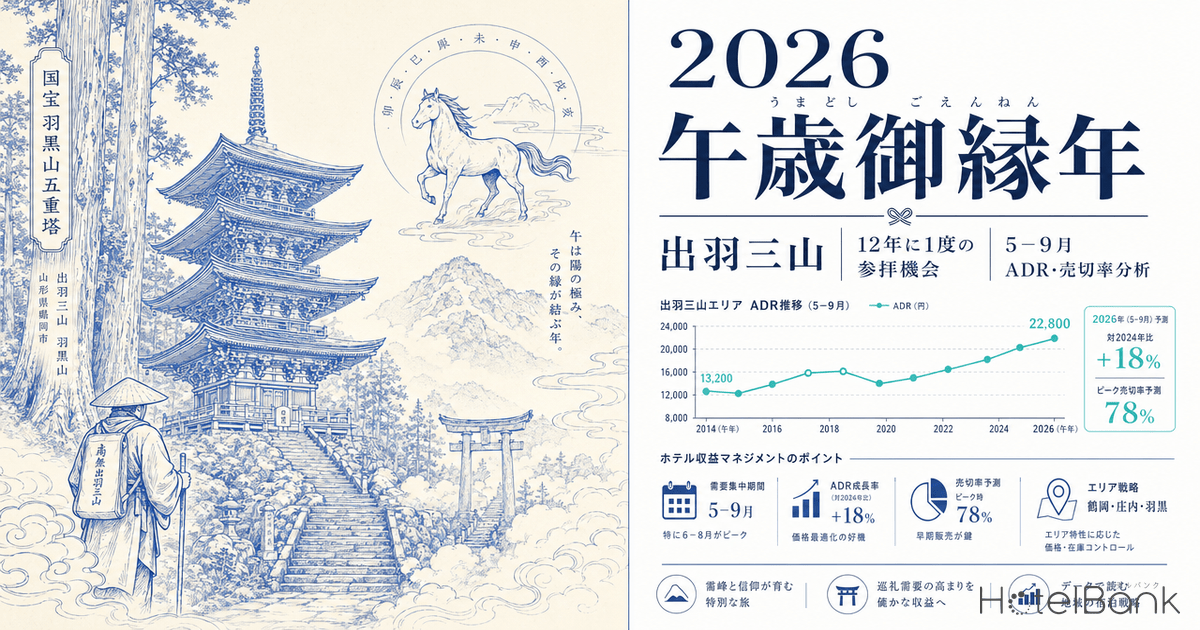
2026 (Reiwa 8) marks the once-in-12-years “Uma-doshi Goennen” (Year of the Horse Sacred Anniversary) for Mt. Haguro, one of the three sacred peaks of Yamagata’s Dewa Sanzan. Each of the three mountains is associated with a zodiac year — Mt. Haguro with the Horse, Mt. Gassan with the Rabbit, and Mt. Yudono with the Ox — and pilgrimages made during these special years are believed to bestow 12 years’ worth of spiritual merit. For accommodation operators in Tsuruoka City and the broader Shonai area, this represents a once-in-several-years demand opportunity. However, OTA published-price data compiled by MetroEngines Research reveals that ADR (Average Daily Rate) and sold-out rates are diverging significantly by area, category, and property type. This article analyzes ADR trends across Tsuruoka, Shonai, and the Haguro district during the May–September peak demand period, and offers a practical perspective for regional hotel operators on how to translate this “once-in-12-years opportunity” into actionable pricing strategy.
Metric Definitions Used in This Article
- ADR (Average Daily Rate): The average of published prices on OTAs and similar channels. This differs from actual transaction prices. Per-room rate (tax included) for two guests sharing a room, averaged across all plan types (room-only through meal-inclusive).
- Sold-out rate: The proportion of plans on OTAs that had closed reservations at the time of survey. This differs from the property’s overall room occupancy rate.
- Data source: MetroEngines Research
What is “Uma-doshi Goennen” — A Once-in-12-Years Demand Surge
“Goennen” refers to a special year in which the zodiac sign associated with a shrine or temple’s founding aligns with the calendar’s zodiac. In the case of Dewa Sanzan, each of the three peaks has its own zodiac year — Horse for Mt. Haguro, Rabbit for Mt. Gassan, and Ox for Mt. Yudono — and pilgrimages made in these years are traditionally believed to confer “12 years’ worth of spiritual merit.” The previous Mt. Haguro Year of the Horse was 2014 (Heisei 26), and before that 2002. For regional economies and tourism industries, this represents a clearly foreseeable demand peak.
2026 is particularly significant because Tsuruoka and the Shonai region have been selected as a JR East summer campaign area, and the annual “National Treasure Mt. Haguro Five-Story Pagoda Light-Up” will feature special Goennen programming. With promotional tailwinds aligning with pilgrimage demand, the upward pressure on regional ADR has already begun reflecting in OTA published prices since the start of the year, as the data clearly indicates.
Tsuruoka City ADR Trends — YoY Change During May–September Peak
First, let us examine the overall ADR trend for Tsuruoka City, the gateway to Dewa Sanzan. According to MetroEngines Research data covering all property categories within Tsuruoka City (business hotels, ryokan, resort hotels, etc.), ADR rose from ¥38,600 in May 2025 to ¥42,100 in May 2026 — a YoY increase of +9.1%. The gap continued to widen through the peak season: June +11.3%, July +15.3%, August +21.0%, and September +19.8%.
Source: MetroEngines Research, compiled by HotelBank Editorial Team (Tsuruoka City all-category average, per-room rate for two-guest occupancy)
Particularly noteworthy is the sold-out rate (the share of plans that had closed reservations at survey time). While Tsuruoka City registered a 0.0% sold-out rate across May–September 2025, 2026 saw rates of 13.7% in May, 10.0% in June, 8.5% in July, 8.8% in August, and 8.3% in September — meaningful inventory absorption. In regional cities, annual sold-out rates typically range from 0% to a few percent, so double-digit sold-out rates are a distinct signal of peak-period demand. For broader context on the May–September 2026 regional resort demand environment, our Summer 2026 Hotel Market: 5-Region OTA Analysis also confirms nationwide sold-out rate growth.
Category Breakdown — Ryokan and Resort Hotels Lead
Splitting Tsuruoka City accommodations by category and comparing May–September 2025 vs May–September 2026 reveals which segments are driving the price gains. Ryokan (N=33 properties) saw ADR rise from ¥50,600 to ¥56,100, a +10.9% increase, while resort hotels (N=3) climbed from ¥39,600 to ¥48,700 (+23.1%) and minshuku (N=5) jumped from ¥15,600 to ¥19,400 (+24.1%) — all double-digit gains. Business hotels (N=9), by contrast, rose from ¥16,700 to ¥17,400 (+3.8%), showing a clear divergence by accommodation type.
Source: MetroEngines Research, compiled by HotelBank Editorial Team (Tsuruoka City, May–Sep 2025 vs May–Sep 2026)
This suggests that Goennen pilgrimage demand is concentrating on “experience-driven, stay-focused accommodation types.” Packages featuring goshuin (shrine seal stamps), shojin ryori (Buddhist vegetarian cuisine), and shukubo (temple lodging) experiences are typically built around ryokan and resort hotels, so the demand structure itself is shifting in a different direction from the business hotel segment. Business hotels, supported by steady demand from local business travel and construction-related guests, see limited upside from peak-period surges. For regional hotel operators, the first step is to assess one’s own positioning: is this a property that can ride the Goennen surge, or one that depends on baseline demand? For a deeper category-level analysis of the ryokan segment, see Atami Ryokan Market 2026: 76 Properties, 2,508 Rooms ADR Analysis.
Obon Period in August — Ryokan ADR Reaches ¥78,000 Range
Looking at the Obon period (August 8–15), when demand is most concentrated within the May–September window, daily ADR and sold-out rates for Tsuruoka City ryokan reveal the contours of pricing strategy with even greater clarity. Aug 8 (Sat) ¥78,400, Aug 9 (Sun) ¥76,700, Aug 10 (Mon) ¥77,900 — Obon peak days saw ryokan ADR in the ¥76,000–¥78,000 range, more than 30% above the May–September average of ¥56,000. Sold-out rates during the same period reached 14–16%, nearly double the typical level.
Source: MetroEngines Research, compiled by HotelBank Editorial Team (Tsuruoka City ryokan category, daily August 2026)
Conversely, August weekdays held in the ¥54,000–¥61,000 range with sold-out rates of just 4–7%, confirming that demand is highly day-of-week dependent. The takeaway for operators is clear: while Obon peak-day pricing has already been set quite aggressively, weekdays in late August (after Aug 22) still show roughly 5% remaining sold-out capacity. Rather than pushing prices further, length-of-stay strategies such as “weekday 2-night packages with bonus inclusions” or “guided pilgrimage add-ons” would be more effective for boosting occupancy.
Around Dewa Sanzan — Haguro District Shukubo ADR and “Opportunity Loss Risk”
The center of Dewa Sanzan pilgrimage activity is the cluster of shukubo (temple lodgings) around the Mt. Haguro Zuishinmon gate. Looking at shukubo and ryokan within a 3 km radius of the Haguro Sanjin Gosaiden shrine reveals an interesting picture. The table below summarizes ADR and sold-out rates for six major properties during May–September 2026.
| Property Name | Type | Distance to Mt. Haguro Zuishinmon | ADR (May–Sep) | Sold-Out Rate |
|---|---|---|---|---|
| Kyukamura Shonai-Haguro | Resort Hotel | 1.8 km | ¥36,000 | 0.0% |
| Shukubo Kanbayashi Katsukane | Shukubo | 2.0 km | ¥19,500 | 0.0% |
| Mt. Haguro Sankoin | Shukubo | 2.3 km | ¥22,000 | 0.0% |
| Shukubo Daishinbo | Shukubo | 2.3 km | ¥24,200 | 0.0% |
| Ryokan Hagurokan | Ryokan | 2.4 km | ¥21,100 | 0.0% |
| Ryokan Tamonkan | Ryokan | 2.4 km | ¥20,900 | 0.0% |
Source: MetroEngines Research, compiled by HotelBank Editorial Team
The data reveals a clear two-tier structure. One key fact: the five Haguro-district shukubo cluster ADRs in a narrow ¥19,500–¥24,200 range, and all post 0.0% sold-out rates throughout the May–September period. This suggests that, due to the structural nature of shukubo as a category, many operate on fixed annual pricing and have not implemented dynamic price adjustments in response to Goennen demand. Considering that the average Tsuruoka City ryokan ADR is ¥56,000, there is substantial untapped revenue potential (revenue management headroom) on the shukubo side based on price elasticity.
That said, shukubo have historically functioned as “lodgings of Shugendo” and carry the character of religious practice spaces. Aggressive price increases could disrupt the balance with their religious and cultural value. From a practical standpoint, “value-added pricing as experience packages” — incorporating Goennen-exclusive shojin ryori plans or early-morning prayer experiences — would more easily capture revenue opportunities while preserving local cultural consensus. Meanwhile, Kyukamura Shonai-Haguro (resort category), located slightly outside the Haguro district, is already priced at a higher ¥36,000, indicating that property positioning is differentiating naturally.
Around Mt. Gassan (Nishikawa Town) — High Price Tier and 10%+ Sold-Out Rates
Nishikawa Town (encompassing Mt. Gassan Shizu Onsen, Mt. Gassan Ubasawa, Mt. Gassan Yumihari Plateau, and others), close to Mt. Yudono and Mt. Gassan, has long served as a pilgrimage base for Dewa Sanzan. Looking at Nishikawa Town’s ADR trend, the May–September 2025 average was ¥53,600, while the May–September 2026 average is ¥52,700 — essentially flat YoY. However, the sold-out rate has risen sharply from 0.0% in 2025 to 10–15% in 2026.
Source: MetroEngines Research, compiled by HotelBank Editorial Team (Nishikawa Town, May–Sep)
This can be read as a phase in which prices are holding at prior-year levels while demand (booking conversions) is quietly building. From a management perspective, the current 10–15% sold-out rate can be viewed as “the pre-stage of price increases.” After enhancing product design and distribution channels to absorb additional demand, there is ample room to layer in 5–10% staged price increases ahead of the June peak. Conversely, failure to correctly read the rising sold-out signal would risk the classic opportunity-loss case: filling out a once-in-12-years demand window with unchanged ADR.
Access from Tokyo and Sendai — Travel Time and Price Sensitivity
Mapping inbound visitor flows by point of origin gives a more three-dimensional view of pilgrimage targeting strategy. The straight-line distance to Mt. Haguro’s Zuishinmon gate is 337 km from Tokyo Station, 92 km from Sendai Station, 60 km from Yamagata Station, 21 km from Shonai Airport, and 14 km from Tsuruoka Station. Actual travel times and primary modes of transport are summarized below.
| Origin | Primary Transport | Approximate Travel Time | Straight-Line Distance | Target Customer Profile |
|---|---|---|---|---|
| Tokyo | Joetsu Shinkansen + Limited Express Inaho / Flight (Haneda–Shonai) | 3.5–4.5 hours | 337 km | 2-night/3-day experience travelers |
| Sendai | Express bus / private vehicle (Tohoku Chuo Expressway) | 2.5–3 hours | 92 km | 1-night/2-day or day-trip |
| Yamagata | JR Rikuu West Line / private vehicle | 2 hours | 60 km | In-prefecture / nearby repeat visitors |
| Shonai Airport | Rental car / route bus | 30 min | 21 km | Air travelers from Kansai/Chukyo regions |
Travel times reflect standard durations as of April 2026. Source: HotelBank Editorial Team research
For reference, Sendai Aoba-ku ADR is also worth examining. The May–September 2025 average of ¥23,900 rose to ¥26,400 in the May–September 2026 average, a YoY increase of +10.5%, while the sold-out rate jumped from 0.0% in 2025 to the 20–30% range in 2026. This indicates that Sendai functions as a “Tohoku-wide accommodation hub” and serves as a staging point for pre-pilgrimage stays and stopovers en route to Dewa Sanzan. With a feasible itinerary of “overnight in Sendai, then express bus to Tsuruoka the following day,” there is significant potential for designing 2-night/3-day round-trip packages spanning Sendai and Tsuruoka.
Source: MetroEngines Research, compiled by HotelBank Editorial Team
For Tokyo origins, the 3.5–4.5 hour journey means even within the same domestic origin–destination market, “2 nights or more” is a baseline assumption. For regional hotels, building multi-night discounts, two-meal-included plans, and guided pilgrimage packages is a realistic scenario for maximizing per-guest revenue × length of stay. Meanwhile, short-haul guests from Sendai and Yamagata are primarily 1-night/2-day with somewhat higher price sensitivity. The optimal approach is to design separate weekday-focused short-stay products while monitoring day-of-week and daily ADR/sold-out data. Note that the Silver Week in September (a 9-day stretch for the first time in 11 years) may also support demand in the area; our Silver Week 2026: First in 11 Years — ADR & Booking Curve Analysis tracks the booking curve dynamics in detail.
Inventory Absorption by Price Tier — Higher Tiers Sell Out First
Aggregating Tsuruoka City ryokan plans for May–September 2026 by price tier confirms an industry pattern that may seem obvious in hindsight: higher price tiers sell out faster. Specifically, the top tier of ¥80,000+ posts a 15.7% sold-out rate, the ¥60,000–¥80,000 tier 8.4%, the ¥40,000–¥60,000 tier 7.2%, the ¥20,000–¥40,000 tier 7.0%, and below ¥20,000 just 2.3%.
Source: MetroEngines Research, compiled by HotelBank Editorial Team (Tsuruoka City ryokan, May–Sep 2026, price tiers based on N=11,318–126,905 plans)
This pattern signals a qualitative feature of Goennen demand: “plans with special experiential value sell out earlier” rather than the conventional “cheapest plans sell first” dynamic. The implication for regional hotel operators is that during peak periods, prioritizing Goennen-exclusive premium plans (rooms with private open-air baths, authentic shojin ryori, monk-accompanied pilgrimage guides, etc.) as flagship products is more likely to maximize revenue than broadening market reach via low-priced plans.
Pilgrimage Tours and Package Product Trends
While comprehensive data on package product inventories listed on OTAs is hard to capture, looking at publicly available tour offerings from major travel agencies, 2026 is clearly seeing a marked increase in Dewa Sanzan-related tours compared to the prior year. Major operators including Hankyu Travel and JTB, as well as the local Shonai Tourism & Convention Bureau, have published official model courses such as “Dewa Sanzan Formal Pilgrimage 2-Night/3-Day,” and product supply preparation has visibly thickened versus the prior year.
From a practical standpoint, regional hotel operators can enhance their visibility in tour searches by including keywords such as “official pilgrimage course compatible,” “white pilgrim attire rental included,” and “sendatsu (pilgrimage guide) coordination” in their OTA plan descriptions. Additionally, partnering with local tourism associations, shrines, taxi companies, and guide associations to commercialize “non-hotel-only pilgrimage flows” is an approach that drives both ADR and length of stay.
Comparison with 2014 (the Previous Uma-doshi Goennen)
The previous Mt. Haguro Year of the Horse Goennen was 2014 (Heisei 26). According to the Japan Tourism Agency’s “Accommodation Travel Statistics Survey,” Yamagata Prefecture’s ryokan room occupancy rates at the time were 31.9% in July 2014, 39.8% in August, and 24.0% in September — broadly tracking 20–40% during the May–September window. Our OTA price data only extends back to 2017, so direct ADR comparisons with 2014 are not possible, but Tourism Agency statistics show no record of a meaningfully higher occupancy rate than in surrounding years.
By contrast, in 2026, comparing against the entire data history since 2017, Tsuruoka City ryokan ADR has reached a record-high level (May–September average around ¥56,000). The drivers include (1) the structural recovery in post-COVID inbound and domestic travel demand, (2) JR East’s campaign area designation, (3) increased awareness of Goennen, (4) intensified events such as the Five-Story Pagoda light-up, and (5) the broader inflationary trend in nationwide hotel ADR. While direct numerical comparison with 2014 is not feasible, the demand environment is likely to deliver a demand opportunity far exceeding the previous Goennen in scale.
Summary — How to Translate Once-in-12-Years into Pricing Strategy
For regional hotel operators, translating the once-in-12-years Goennen into actionable revenue opportunity requires segmenting pricing strategy by property type. The data-driven points are summarized in the table below.
| Property Type | Current Status | Recommended Strategy |
|---|---|---|
| Haguro District Shukubo | ADR ~¥20k, sold-out rate 0% | Value-added pricing via experience packages (Goennen-exclusive shojin ryori, prayer experience, etc.) |
| Tsuruoka City Ryokan | YoY +10.9%, sold-out rate 8.5% | Hold aggressive Obon peak pricing; secure weekday occupancy via multi-night discounts |
| Nishikawa Town (Mt. Gassan) | ADR flat, sold-out rate 10–15% | Read demand signals; layer in 5–10% staged price increases ahead of June peak |
| Tsuruoka Business Hotels | YoY +3.8% | Differentiate via early-morning checkout for pilgrims and Shonai Airport shuttle service |
| Sendai Stopover | YoY +10.5%, sold-out rate 20–30% | Co-design Sendai–Tsuruoka 2-night/3-day round-trip products |
The essence of Goennen demand is a phase in which pricing power temporarily tilts toward sellers. However, in regional religious tourism, pricing decisions inherently involve dialogue with local culture. Reconciling data-driven quantitative pricing judgment with sensitivity to local cultural context is the prerequisite for harnessing this once-in-12-years opportunity as a sustainable revenue opportunity. The next Year of the Horse Goennen will be 2038. The pricing design and customer experience delivered during this peak window will likely be reflected in repeat visitation rates 12 years from now.
Note on future-dated ADR: The ADRs cited in this article reflect average published prices on OTAs at the time of survey and will fluctuate as check-in dates approach. Currently elevated prices may decline through last-minute discounting. Please interpret accordingly.
Related Articles & Reference Links
- Dewa Sanzan Shrine Official Website
- Tsuruoka Tourism Navi (DEGAM Tsuruoka Tourism Bureau)
- Japan Tourism Agency — Accommodation Travel Statistics Survey
Recommended Reading
- Summer 2026 Hotel Market: 5-Region OTA Analysis (Nagano +14.4%, Okinawa +10.4%)
- May 2026 Inbound Trends: Western & SE Asian Demand Lifts Regional ADR
- Silver Week 2026: First in 11 Years — ADR & Booking Curve Analysis
- Summer Resort 3-Region Comparison 2026: Niseko, Okinawa, Karuizawa ADR & FX Sensitivity
- FY2026 Tourism DX Subsidy Guide for Hotels: 7 Programs for PMS & Smart Check-In
- Atami Ryokan Market 2026: 76 Properties, 2,508 Rooms ADR Analysis
- Summer 2026 Festival Hotel Pricing: Daily ADR & Sold-Out at Fuji Rock, Summer Sonic
- 2026 Japan Beach Opening Calendar — How Beach Area ADR & Sellout Rates Shift
- GW2026 Hokkaido Hotel Price Analysis: Niseko +29%, Sellout Rate Surge