

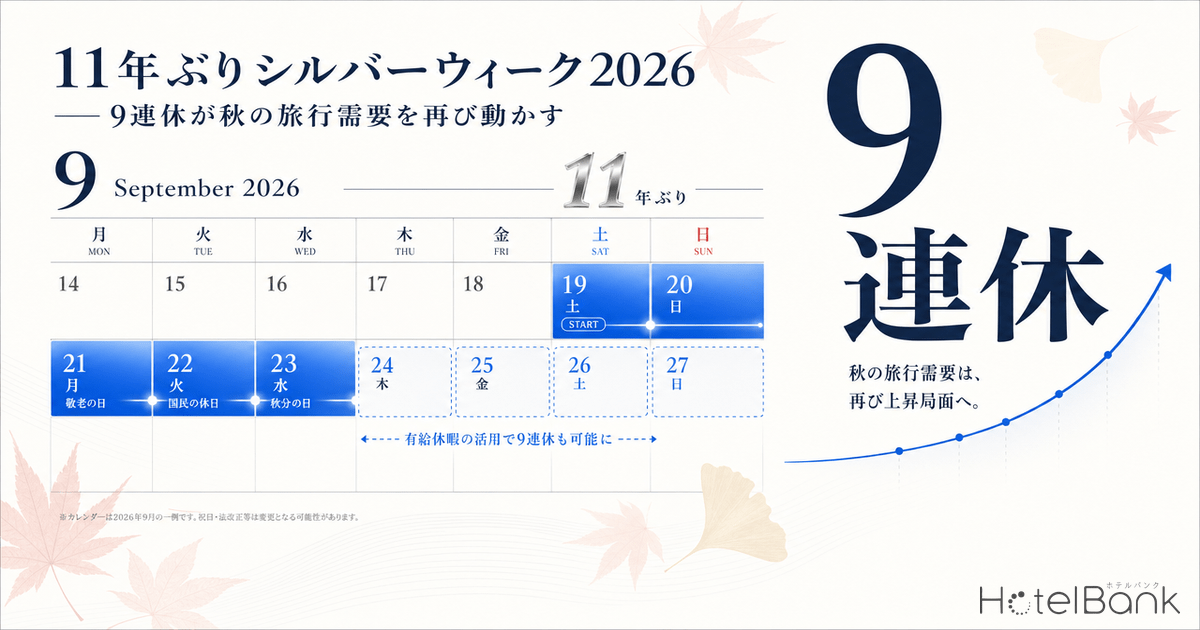

In September 2026, Japan’s “Silver Week” (SW) will materialize for the first time in 11 years on the calendar. The 5-day holiday from Saturday September 19 to Wednesday September 23 (Autumnal Equinox Day) is enabled by Tuesday September 22 becoming a “Citizen’s Holiday” under the Public Holidays Law — sandwiched between Respect for the Aged Day (Monday the 21st) and the Autumnal Equinox (Wednesday the 23rd). The last time this configuration occurred was 2015. By taking paid leave on the 24th (Thu) and 25th (Fri), travelers can extend the holiday into the following weekend (26-27) for up to 9 consecutive days off. In this article, drawing on lodging price data collected by MetroEngines Research (メトロエンジンリサーチ), we analyze sales trends for Silver Week 2026 across major autumn resort destinations, the early sellout phenomenon at high-end properties, and reservation strategies looking ahead to the next occurrence in 2032.
• OTA ADR = the average of publicly listed sales prices on major Japanese OTAs (tax-included, double occupancy). Includes all plans from room-only to meal-inclusive. Note that this is not actual transaction price.
• Source: MetroEngines Research (continuously tracks OTA-listed prices for approximately 168,000 domestic properties, of which approximately 27,000 are confirmed operating)
The Calendar Structure Behind the First Silver Week in 11 Years
The basis for Silver Week 2026’s existence lies in Article 3, Paragraph 3 of the Public Holidays Law (National Holidays Act), which stipulates that “a weekday sandwiched between two public holidays shall be treated as a holiday.” Specifically, Monday September 21 is Respect for the Aged Day and Wednesday September 23 is the Autumnal Equinox, so the Tuesday in between (September 22) automatically becomes a holiday. Combined with the preceding weekend (the 19th and 20th) and the Autumnal Equinox itself, this produces a 5-day holiday running Saturday through Wednesday.
For these conditions to align, “exactly one weekday must fall between Respect for the Aged Day and the Autumnal Equinox.” Because Respect for the Aged Day (the third Monday of September) and the Autumnal Equinox (which falls on the 21st, 22nd, or 23rd depending on the year) shift independently, the alignment varies significantly year to year. The previous occurrence was in 2015, when the 5-day SW generated significant excitement in the travel industry. The next occurrence is projected for 2032, six years after 2026, making 2026 a particularly rare autumn holiday year.
If paid leave is added on Thursday September 24 and Friday September 25, the holiday can be extended through Saturday September 26 and Sunday September 27 — yielding up to 9 consecutive days off. With weekends bookending both ends, this structure rivals Golden Week in scale and is highly conducive to long-distance domestic travel and overseas trips.
Daily ADR & Sellout Rate Trends Across the 9-Day Holiday
Aggregating MetroEngines Research’s lodging price data across 7 major autumn resort prefectures (Kanagawa, Nagano, Shizuoka, Tochigi, Gunma, Oita, and Kumamoto) for the 9 days from September 19 to 27 reveals a pronounced step-wise structure in pricing and sales. During the first half of the SW core (September 19-21), nightly rates run high at ¥67,000-¥69,000, while in the latter half — the recommended paid-leave days (September 24-25) — they fall to ¥47,000-¥50,000. The trailing weekend (26-27) reverts to typical resort weekend levels of ¥48,000-¥59,000.
Source: Compiled by HotelBank Editorial Team from MetroEngines Research data (N=4,400-4,740 properties, daily aggregation)
What stands out is that during the first three days of the SW core, sellout rates remained elevated at 13.1-14.2%. This is roughly 3-4 percentage points higher than typical weekend levels (discussed below), suggesting that demand is already concentrating on the Saturday-Sunday-Monday core of the 5-day holiday. By contrast, the sellout rate on Thursday September 24 drops to 8.9%, meaning travelers willing to take paid leave to extend their holiday still have relatively more inventory choices available.
ADR Comparison Across 8 Major Autumn Resort Areas
Comparing the 5-day average ADR over the SW core (September 19-23) by area, Shizuoka (Izu and Atami) and Kanagawa (Hakone) — both densely populated with luxury properties — top the list at ¥67,000. Nagano (Karuizawa and Shiga Kogen) follows at ¥65,600, then Oita (Yufuin and Beppu) at ¥65,600, with Tochigi (Nasu and Nikko) and Gunma (Kusatsu and Ikaho) in the ¥62,000-¥64,000 range. The lowest, Kumamoto (Aso), comes in at just ¥40,300 — meaning the price spread between top and bottom areas reaches roughly 1.7x.
Source: Compiled by HotelBank Editorial Team from MetroEngines Research data (N=441-1,129 properties, aggregated 9/19-9/23)
This inter-area gap reflects each region’s property mix (the share of luxury ryokan and resort hotels) and locational brand strength. Hakone and Izu are within short Shinkansen and conventional rail commutes from Tokyo, anchoring deep repeat demand from affluent and inbound travelers. Karuizawa has a long history as a summer retreat, with Hoshino Resorts (星野リゾート) and other premium properties pushing nightly rates higher. Yufuin has rapidly risen on the inbound radar in recent years and now commands an exceptional price level within Kyushu. Aso, by contrast, centers on its dramatic natural scenery, and travel spend there structurally tilts toward day-trip tourism rather than overnight rates.
September YoY ADR — Double-Digit Increases Across All Resort Prefectures
Compared with September 2025, ADR in September 2026 is up double digits in all 7 target prefectures, ranging from +9.8% to +23.5% YoY. The biggest gain is Shizuoka at +23.5%, followed by Gunma at +22.4%, Oita at +22.2%, and Kanagawa at +22.0%. With September 2025 being a non-SW year, this gap appears to reflect both the demand stimulus from SW’s existence and properties’ early upward price adjustments in response.
Source: Compiled by HotelBank Editorial Team from MetroEngines Research data (vs. September 2025, N=459-1,149 properties)
| Area | Sept 2025 ADR | Sept 2026 ADR | YoY | N (properties) |
|---|---|---|---|---|
| Shizuoka (Izu, Atami) | ¥42,300 | ¥52,300 | +23.5% | 1,104 |
| Gunma (Kusatsu, Ikaho) | ¥40,600 | ¥49,700 | +22.4% | 459 |
| Oita (Yufuin, Beppu) | ¥44,600 | ¥54,500 | +22.2% | 564 |
| Kanagawa (Hakone) | ¥44,600 | ¥54,500 | +22.0% | 656 |
| Nagano (Karuizawa, Shiga Kogen) | ¥43,800 | ¥52,700 | +20.3% | 1,149 |
| Tochigi (Nasu, Nikko) | ¥40,700 | ¥47,900 | +17.7% | 508 |
| Kumamoto (Aso) | ¥31,400 | ¥34,500 | +9.8% | 483 |
Source: Compiled by HotelBank Editorial Team from MetroEngines Research data. Prices rounded.
Shizuoka, Nagano, and Oita in particular are positioned to capture an outsized share of the “September resort demand” unlocked by SW. A simple YoY comparison also bundles in other factors (heatwave rebound, inbound recovery, cost-pass-through pricing), so isolating the SW contribution is difficult — but it is reasonable to infer that the calendar effect contributes meaningfully to the single-month demand uplift.
Early Sellouts at Premium Ryokan and High-End Resorts
Comparing sellout rates by property grade across the SW core, the luxury segment is clearly running ahead of all others. Among ryokan and resort hotels classified as luxury across the 7 autumn resort prefectures, sellout rates over the 5-day holiday hit 13.8-16.7%, and for deluxe hotels even higher at 20.1%. By contrast, the high-grade tier comes in at 7.4-10.0% and the upper tier at 2.9-15.8% — a clear stair-step decline as grade falls.
Source: Compiled by HotelBank Editorial Team from MetroEngines Research data (9/19-9/23, 7 prefectures, N=10-569 properties)
This hierarchy reflects a structural feature of the resort market: scarce premium ryokan (one-night-two-meals plans, all rooms with private hot-spring sources, detached villa formats, etc.) tend to fill up early at long lead times in response to special calendar events like SW. Loyal repeat guests and existing customers receive priority outreach, and slots are absorbed during the early-bird discount window.
Furthermore, comparing the SW period with normal weekends (9/12-13 and 10/3-4), the luxury sellout rate runs at 15.2% for the SW core versus 11.4-12.1% for normal weekends — roughly a 3-4 point lift attributable to SW. Meanwhile, the SW back-half paid-leave days (9/24-25) post a luxury sellout rate of 10.9%, slightly below typical weekends, meaning that unless travelers are seeking 4+ night long stays, back-half inventory is still relatively flexible.
Source: Compiled by HotelBank Editorial Team from MetroEngines Research data (7 prefectures, N=362-897 properties)
Happy Monday System and Citizen’s Holiday — Next Occurrence Is 2032
SW’s existence depends on the interaction of two holiday provisions. The first is the Happy Monday System (introduced in 2003), which fixed Respect for the Aged Day to “the third Monday of September” (it was previously fixed at September 15). The second is Article 3, Paragraph 3 of the Public Holidays Law — the “Citizen’s Holiday” rule — which makes any weekday sandwiched between two holidays a holiday. The two only align when Respect for the Aged Day (any of September 15-21) and the Autumnal Equinox (September 22 or 23 depending on the year) are exactly one weekday apart (i.e., separated by September 22).
| Year | Respect for the Aged Day | Sept 22 | Autumnal Equinox | SW Forms? |
|---|---|---|---|---|
| 2009 | 9/21 (Mon) | Citizen’s Holiday | 9/23 (Wed) | Yes — 5-day holiday |
| 2015 | 9/21 (Mon) | Citizen’s Holiday | 9/23 (Wed) | Yes — 5-day holiday |
| 2026 | 9/21 (Mon) | Citizen’s Holiday | 9/23 (Wed) | Yes — 5-day holiday (up to 9 days) |
| 2027-2031 | — | Weekday | — | No |
| 2032 | 9/20 (Mon) | Citizen’s Holiday (projected) | 9/22 (Wed) | Yes — 5-day holiday (up to 9 days) |
Note: The Autumnal Equinox is fixed each year by the National Astronomical Observatory’s calendar tables. 2032 is projected.
Following 2009 and 2015, 2026 marks the third occurrence of SW. From 2027 through 2031 — a 5-year gap — the calendar will not align (Respect for the Aged Day and the Autumnal Equinox will not be exactly one weekday apart), and the next occurrence is projected for 2032. In other words, September 2026 is the only SW-eligible year over the next 6 years — a rare window for properties to lift nightly rates and an “autumn long holiday that cannot wait until 2032” for travelers.
During the 2015 SW, lodging statistics from the Japan Tourism Agency confirmed that overnight stays in September exceeded the prior year — confirming that SW lifts overall autumn travel demand. A similar demand pattern is expected in 2026, but with one key difference: inbound demand from foreign visitors has remained at sustained high levels throughout 2025-2026, layering SW-driven domestic demand on top of an already elevated baseline. This creates a likely “double peak” structure.
Autumn Booking Strategy — Practical Tips for Travelers
Building on the analysis above, this section translates the data into practical reservation strategies for general readers planning to use a domestic autumn resort during Silver Week 2026.
First, if you are targeting a high-end ryokan or resort, book as early as possible — these properties tend to fill rapidly from the moment reservations open. As of this article’s data cut-off, 13-17% of plans in the luxury ryokan segment are already sold out for the 5-day holiday — clearly faster than typical April-stage lead-time pacing for the same month. Specific examples include the main ryokan operated by Hoshino Resorts (星野リゾート), Resort Trust (リゾートトラスト), and Kyoritsu Resort (共立リゾート), as well as independent premium ryokan in Hakone, Yufuin, and Karuizawa.
Second, shifting your stay away from the SW peak (the 19th-21st) toward the middle and back half (the 22nd-25th) gives you more choice and better prices. In particular, the September 24 sellout rate is 8.9% — about 4 points below the core period — and ADR drops to the ¥47,000 range, making it cost-efficient for travelers who can take 1-2 days of paid leave. Shifting your stay by just one night materially changes the perceived price level.
Third, the back-half weekend (September 26-27) reverts to typical weekend levels, making “back-half-only” itineraries an attractive option for those wanting to avoid SW crowds. Travelers wanting to avoid expressway congestion and flight peak loads can reasonably plan a 3-day trip — for instance, departing the evening of Friday September 25 and returning Sunday the 27th — with both pricing and travel logistics on their side.
Fourth, when choosing an area, consider lower-priced alternatives such as Aso (Kumamoto). Hakone, Izu, and Karuizawa are seeing both rising rates and concentrated inbound demand, while Aso, Nasu, and Kusatsu remain in relatively accessible price bands. The tourism propositions differ, so a simple price comparison is not the whole story — but for budget-conscious travelers, these areas are strong alternatives.
Summary
Silver Week September 2026 is a rare large-scale autumn holiday — the first in 11 years, enabled by the Public Holidays Law. Across 7 major autumn resort prefectures, September ADR is up double digits YoY (+9.8% to +23.5%), reflecting how SW-driven demand is being clearly priced in. On a daily basis, sellouts and rate peaks concentrate in the first half of the 5-day holiday (9/19-21), while the recommended paid-leave days (9/24-25) still have relatively flexible inventory. By grade, the luxury segment is far ahead of all others in early sellouts — meaning early action is required for high-end ryokan and resort bookings. The next SW is projected for 2032, making 2026 the only year over the next 6 in which this calendar configuration will appear. Whether you are operating a property, managing reservations, or planning a trip, this autumn calls for a strategic response.
A Revenue Management Perspective — Pricing Strategies Hoteliers Should Implement Now
The previous section addressed booking advice for general travelers. From here, we turn to hotel operators and revenue managers, presenting pricing strategies for Silver Week 2026. The first 9-day holiday in 11 years is a rare opportunity for which “typical 3-day SW” benchmarks do not apply, and relying on automated pricing algorithms based on historical data alone risks meaningful revenue loss.

Source: Compiled by HotelBank Editorial Team and MetroEngines Inc.
1Tiered Pricing Aligned with the Daily Demand Curve
As this article’s data shows, ADR across the 9 days is far from uniform. The first half (9/19-21) is the peak, the middle (22-23) softens slightly, and the back half (24-27) drops sharply. Aligned with this demand curve, at minimum three pricing tiers should be set.
- Tier 1 9/19-21: Highest tier. With high sellout rates, strong pricing is feasible. Reference Golden Week peak ADR and target 1.5-2.0x the standard rate.
- Tier 2 9/22-23: Mid tier. Aim to capture multi-night guests at 80-90% of Tier 1. Use multi-night discounts to encourage stay extensions from Tier 1.
- Tier 3 9/24-27: Standard or slight uplift. With demand falling sharply, prioritize occupancy. That said, you don’t need to revert to fully standard rates — a small “afterglow of the 9-day holiday” premium is feasible.
2High-End Properties: Managing the Risk of Selling Out Too Early
Premium ryokan and resorts are already starting to sell out for the SW period as of April. Filling early is itself a positive sign — but it is worth checking whether you “sold too cheap.” We recommend verifying the following.
- Was the velocity of bookings in the first week after opening reservations faster than last year’s Golden Week or year-end-and-New-Year period? If so, that is a signal that pricing was set too low.
- Cancellation rate trend — if early bookings have low cancellation rates, that audience is price-insensitive (i.e., you could have charged more).
- As a lesson for the future, in the next SW year (2032), it is worth setting opening prices at +30-50% over typical holiday levels.
3Mid-Range Properties: Multi-Night Incentives and Day-of-Week Shifting
Business hotels and city hotels can leverage the “weekday portion (24-26th)” of the 9-day holiday with multi-night plans. Specifically:
- 5+ night discount (10-15% off): Captures long-stay guests during the 9-day holiday. Strong fit with workation demand.
- Back-half-shift plan: A 5-night package checking in 9/22 and out 9/27. Targets price-sensitive guests who want to avoid the front-half peak.
- Late-checkout add-on: 14:00 checkout on the holiday’s final day (9/28) as a differentiator. Addresses the need to avoid return-trip congestion.
4Key Points for Competitive Monitoring
Because this is the first 9-day holiday in 11 years, competing properties are likely also feeling uncertain about their pricing strategy. We recommend monitoring the following weekly.
- Median OTA list-price trend within your area and category — i.e., shifts in the overall market price level.
- Sellout-rate trend — both your own property and the broader area. When the area-wide sellout rate exceeds 50%, it is the “last opportunity to raise prices.”
- Timing of last-minute discounts appearing — observe when competitors begin discounting, then judge whether you can hold your price.
Source: Compiled by HotelBank Editorial Team and MetroEngines Inc.
Booking Curve Analysis — The “Pace” and “Change” of Bookings Are Key to Pricing Decisions
In revenue management, ADR or sellout rate at any given moment is just a “snapshot.” What matters more is the pace at which bookings are accumulating (the booking curve) and how that curve is changing. Because the first 9-day SW in 11 years has limited historical comparators, capturing changes in the booking curve becomes the most reliable basis for pricing decisions.

Source: Compiled by HotelBank Editorial Team and MetroEngines Inc.
What Is a Booking Curve?
A booking curve plots the number of rooms booked (or sellout rate) against the days remaining until check-in (lead time). For example, for a 9/19 check-in, the curve might run “10% at 150 days out, 30% at 90 days out, 60% at 30 days out, 85% at 7 days out.” The curve’s shape and slope reveal the strength of demand.
Three Curve Patterns to Watch for SW 2026
1. Days where the curve “ramps up” early -> Hold strong pricing
The first half of SW (9/19-21) is, as this article’s data shows, already producing high sellout rates. This means the booking curve is ramping up clearly faster than for typical weekends. On days where the curve rises early, raising prices does not depress bookings — that is, price elasticity is low. Discounting on these dates leads directly to lost revenue.
2. Days where the curve enters a “plateau” -> Decision point
At certain lead times the booking pace will slow (the curve flattens). This is the “plateau.” The plateau’s location and length are critical decision inputs.
- Plateau at 60 days out -> Early demand has been absorbed. Bookings from here on are price-sensitive. Rather than discounting, fill remaining inventory through value-added plans (with breakfast, late checkout, etc.).
- Plateau at 30 days out -> Normal booking behavior. Monitor competitors’ prices and sellout rates, and adjust subtly based on area-wide remaining supply.
- Curve still rising at 14 days out -> Demand is significantly outstripping supply. An opportunity for last-minute price increases.
3. Compare the curve’s “shape change” against last year -> Benchmark
Because SW 2026 has no direct prior-year comparator, we recommend using the 2026 Golden Week (4/29-5/6) booking curve as a benchmark. Comparing against the same large-scale holiday’s shape:
- If SW’s curve is faster than GW’s -> autumn resort demand may surpass GW. Hold pricing aggressive.
- If SW’s curve is slower than GW’s -> autumn lacks summer’s urgency. Stepwise price reductions to secure occupancy is the realistic strategy.
- If SW’s curve is the same speed as GW’s -> GW’s actual ADR can be applied directly to SW.
Practical Monitoring Frequency
For booking-curve monitoring up to SW, we recommend the following schedule.
| Period | Frequency | Checkpoints |
|---|---|---|
| 5-3 months out April-June | Weekly | Track initial curve momentum and competitor pricing |
| 3-1 month out July-August | Twice weekly | Detect plateaus and judge price adjustments |
| 1 month out to day-of Late August-September | Daily | Capture last-minute demand and finalize pricing |
The booking curve is a tool that tells you “when to decide.” Whereas ADR and sellout rate tell you “how things are right now,” the curve is the best predictor of “how things will go from here.” Precisely because SW is such a rare 11-year-once holiday, paying attention to the curve’s evolution and making data-driven pricing decisions is the shortest route to maximizing revenue.
Source: Compiled by HotelBank Editorial Team and MetroEngines Inc.
References
- Cabinet Office: “About Public Holidays” (Japanese)
- Japan Tourism Agency: “Lodging Travel Statistics Survey” (Japanese)
- National Astronomical Observatory: “Autumnal Equinox (Calendar Tables)” (Japanese)