

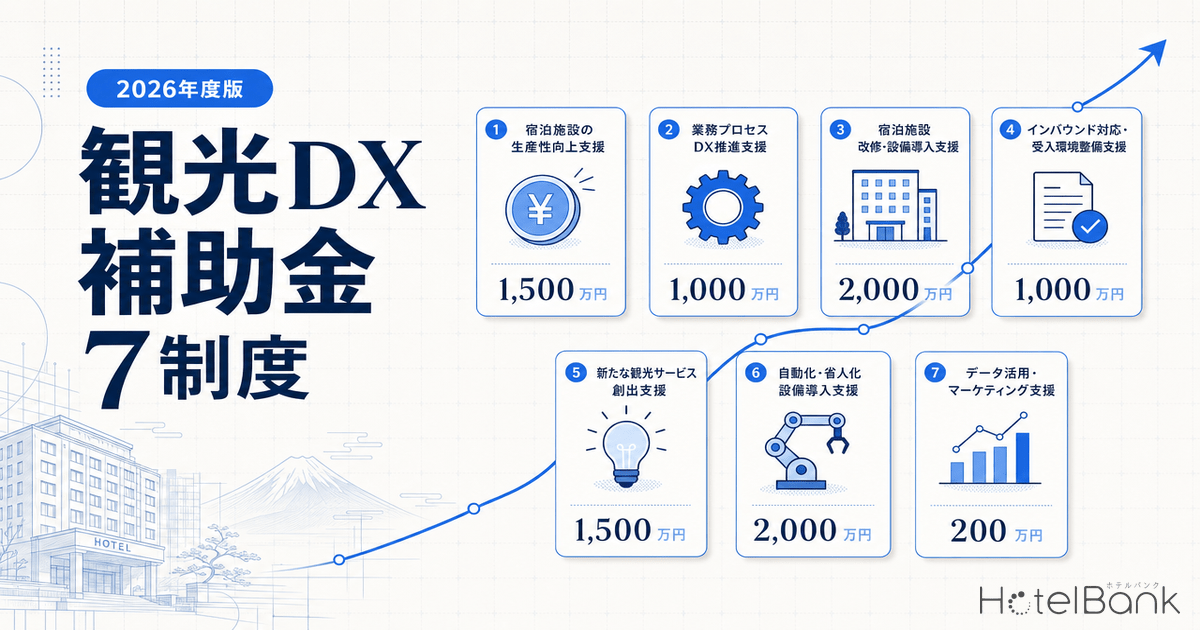
“We want to introduce a PMS or smart check-in system, but the upfront investment is heavy.” “There are too many subsidy programs to figure out which one fits our property.” These are the most common voices heard today from small and mid-sized hotels and ryokans across Japan. The Japan Tourism Agency’s FY2026 budget has expanded to roughly ¥138.3 billion—2.4 times the previous year—and the subsidy cap for labor-shortage countermeasures has doubled from ¥5 million to ¥10 million. Against the backdrop of inbound demand reaching record highs, the lineup of national programs supporting tourism DX investment has become unprecedented in scale. This article organizes the seven major tourism DX programs that small and mid-sized hotel and ryokan owners and managers should be aware of, with details on subsidy rates, ceiling amounts, application timing, and use cases.
Metric Definitions Used in This Article
- ADR (Average Daily Rate): Average of public selling prices on OTAs and other channels. Differs from actual transaction prices. Per-room rate for two guests in one room (tax inclusive), averaged across all plans (room-only through meal-inclusive plans).
- Subsidy Information: Program details, subsidy rates, ceiling amounts, and application timing in this article are based on publicly available information as of May 2026. Always confirm the latest application guidelines on each program’s official website.
- Data Sources: MetroEngines Research, Japan Tourism Agency, Small and Medium Enterprise Agency, JNTO public materials
Why Tourism DX Subsidies Matter Now
Three structural factors have driven the major redesign of tourism DX subsidy programs: first, the rapid recovery of inbound demand; second, the severe labor shortage in the lodging industry; and third, the continued rise in ADR. Let us examine each with data.
According to JNTO (Japan National Tourism Organization) preliminary figures released on April 15, 2026, foreign visitors to Japan in March 2026 totaled 3,618,900—a year-on-year increase of +3.5%. This set a new record for any March, and cumulative visitors for the first three months exceeded 10 million for the second consecutive year. Seven markets including the United States, Vietnam, and the United Kingdom set single-month all-time highs, with notable growth from the Western and Southeast Asian markets.
Meanwhile, the supply side of the lodging industry faces a serious labor shortage. According to the Japan Tourism Agency’s “Survey on the Status of Human Resources Acquisition and Development in the Lodging Industry,” approximately 62% of ryokans and hotels responded that they “received no applications for job openings.” The proportion of business establishments with unfilled job openings in the accommodations and food service industries reaches 67%. As a means of bridging the gap between expanding demand and supply constraints, labor-saving investments such as PMS, smart check-in, automated payment kiosks, and cleaning robots are drawing attention.
This structural shift is also clearly reflected in ADR. Looking at OTA public price data tracked by MetroEngines Research for the six major prefectures with confirmable operational data, April 2026 ADR posted year-on-year growth across all prefectures, with Hokkaido (+12.1%) and Kyoto (+10.7%) showing the largest increases. Looking ahead at October 2026 ADR as a leading indicator, Tokyo is up +61.6% YoY, Kyoto +31.7%, and Osaka +31.1%—record growth that suggests continued room for rate increases heading into the autumn peak season.
Source: MetroEngines Research, compiled by HotelBank Editorial Team
→ Related article: National Average ADR Hits Record ¥32,340 (May 2026): Decoding the “+19% in 3 Years” Built by Inflation and Wage Pass-Through
Against the recovery in demand, DX investment to relieve supply-side bottlenecks is shifting from being “a forward-looking investment” to being “a prerequisite for business continuity.” This is precisely why the government is allocating ¥138.3 billion to tourism-related budgets to accelerate DX adoption among lodging operators.
FY2026 Tourism DX Subsidies: Quick Reference of 7 Major Programs
Let us first review the overall picture in a single table. The chart below organizes the seven major programs that small and mid-sized hotels and ryokans can readily leverage for DX investment, along with subsidy ceilings, rates, and supervising agencies. It is essential to use these programs strategically based on property scale and investment size.
| Program Name | Cap | Rate | Agency | Typical Use Cases |
|---|---|---|---|---|
| Tourism DX Promotion Program | ¥15M | 1/2 | Japan Tourism Agency | PMS, RM, integrated booking management, AI chatbots |
| Labor-Saving Investment Subsidy (JTA) | ¥10M | 1/2 | Japan Tourism Agency | Self check-in kiosks, cleaning robots, food delivery robots |
| SME Labor-Saving Investment Subsidy (Catalog/General) | ¥10M | 1/2 | SME Agency | Labor-saving equipment, smart locks, booking management |
| SME New Business Expansion Subsidy | Up to ¥90M | 1/2 | SME Agency | High-value-added new rooms, experiential facilities, building investment |
| Digitalization & AI Adoption Subsidy (formerly IT Adoption Subsidy) | ¥4.5M | 1/2 to 4/5 | SME Agency | PMS, booking sites, cashless payment, accounting software |
| Lodging Facility Sustainability Reinforcement Program | ¥10M | 1/2 | Japan Tourism Agency | Energy-efficient HVAC, solar power, decarbonization equipment |
| Monozukuri (Manufacturing) Subsidy | Up to ¥40M | 1/2 to 2/3 | SME Agency | Innovative service development, capital investment |
Source: Japan Tourism Agency, SME Agency, compiled by HotelBank Editorial Team (as of May 2026)
Source: Japan Tourism Agency, SME Agency, compiled by HotelBank Editorial Team
Program 1: Tourism DX Promotion Program (JTA, up to ¥15M)
This is the flagship program among FY2026 tourism DX subsidies. Directly administered by the Japan Tourism Agency, it includes a “Tourism Industry Revenue and Productivity Improvement” track designed for lodging operators. The subsidy rate is 1/2 of eligible expenses, with a ceiling of ¥15 million. A distinctive feature is that up to ¥8 million in additional funding is available separately for expenses related to expert-led implementation support for tourism DX planning, deployment, and utilization.
Eligible expenses include a wide range of digital tools that directly contribute to improving lodging operators’ revenue and productivity, including PMS (Property Management Systems), revenue management systems, integrated booking management, AI chatbots, and multilingual website development. A practical highlight is that for monthly or annual subscription products, up to two years of usage fees qualify for subsidy.
The FY2026 application schedule runs from April 17 to May 22, 2026 for participation registration, and from April 24 to May 29, 2026 for plan submission. Because the document review process requires participation registration and plan submission to flow consecutively, application preparation should be completed by early May.
→ Related article: Tourism DX Promotion Program (Up to ¥15M): A Step-by-Step Application Guide for Lodging Operators
Program 2: Labor-Saving Investment Subsidy (JTA, up to ¥10M)
The former “Labor Shortage Countermeasure Program” was renamed the “Labor-Saving Investment Subsidy” beginning in FY2026, and the subsidy ceiling was doubled from ¥5 million to ¥10 million. Administered by the Japan Tourism Agency at a 1/2 subsidy rate, this program is the most directly responsive to actual on-the-ground needs given the severity of the lodging industry’s labor shortage.
Eligible operators are those licensed under Article 3, Paragraph 1 of the Hotel Business Act; minpaku (private home stays under the Housing Accommodation Business Act) are excluded. Additionally, applicants must collaborate with regional DMOs or local governments and implement specific initiatives addressing labor shortages. Eligible expenses include front desk automation equipment (self check-in kiosks, automated payment terminals), cleaning robots, food delivery robots, PMS, and shift management systems.
The application period runs from March 27 to May 22, 2026 for participation registration, and from March 27 to May 29, 2026 for the public call. Because the project completion deadline is January 8, 2027, planning must work backward from equipment procurement and construction lead times. Note that the program closes when the budget is exhausted, so early application is recommended.
Program 3: SME Labor-Saving Investment Subsidy (SME Agency, up to ¥10M)
Separate from the Japan Tourism Agency’s Labor-Saving Investment Subsidy, the SME Agency administers a cross-industry labor-saving subsidy for small and medium enterprises. The subsidy rate is 1/2, and the ceiling varies by employee count: ¥2 million for 5 or fewer employees, ¥5 million for 6–20 employees, and ¥10 million for 21 or more.
The program offers two tracks: a “Catalog” type and a “General” type. The former is a streamlined application track where applicants choose from secretariat-certified catalog products (self check-in kiosks, cleaning robots, PMS, etc.); the latter supports the introduction of customized products tailored to a company’s specific needs. For small and mid-sized hotels and ryokans, the catalog track involves lighter procedures and is reportedly approved at a higher rate, making it the first option to consider.
Application requirements include preparing a 3- to 5-year business plan that incorporates an annual average growth rate of +4.0% or higher in labor productivity and +3.5% or higher in average wages per employee. Because wage-increase targets are built into the program, it is essential to design the plan in tandem with personnel cost projections.
Program 4: SME New Business Expansion Subsidy (Up to ¥90M)
Newly established in FY2025 as the successor to the “Business Restructuring Subsidy” that ended in FY2024, this program supports entry into new markets and high-value-added businesses. In the lodging sector, it can be used for large-scale investments involving construction costs, such as new glamping facilities, machiya (traditional townhouse) renovations, and conversions to experiential facilities.
The subsidy rate is 1/2, with ceilings stepping up by employee count: ¥25 million (¥30 million with special exemption) for 20 or fewer employees, ¥40 million (¥50 million) for 21–50, ¥55 million (¥70 million) for 51–100, and ¥70 million (¥90 million) for 101 or more. Eligible expenses cover a broad range including building costs, machinery and equipment, system development, cloud usage fees, and outsourcing costs. Approximately four application rounds are scheduled by the end of FY2026.
For example, according to MetroEngines Research, as of April 2026 the ADR for glamping is ¥50,800 (N=300 properties) and for machiya is ¥48,200 (N=458 properties)—more than triple the ADR of business hotels (¥14,800). Conversion to high-value-added formats using the New Business Expansion Subsidy can be positioned as a strategic option for a structural lift in per-room rates.
Source: MetroEngines Research, compiled by HotelBank Editorial Team (April 2026)
Program 5: Digitalization & AI Adoption Subsidy (formerly IT Adoption Subsidy, up to ¥4.5M)
From FY2026, the “IT Adoption Subsidy” was renamed the “Digitalization & AI Adoption Subsidy,” with generative AI tools added to the list of eligible products. For small and mid-sized hotels and ryokans, this is the most accessible and versatile DX subsidy available.
The standard ceiling is ¥4.5 million, with a base subsidy rate of 1/2 that can be raised to 2/3 if certain conditions are met. Within the Invoice category (Invoice-Compliant track), the cap is ¥500,000 if a product has only one of accounting, order management, or payment functions, and ¥3.5 million if it has two or more functions. The subsidy rate is highly favorable: 3/4 (or 4/5 for micro-enterprises) on the portion up to ¥500,000.
Eligible expenses include PMS, booking management, channel managers, revenue management tools, CRM, accounting software, and cashless payment terminals—making this the most accessible entry point for DX in the lodging industry. Cloud usage fees are eligible for up to two years. Compared with the Tourism DX Promotion Program (up to ¥15 million), the procedures are simpler, and the requirement to apply jointly with a certified IT Adoption Support Provider makes it well-suited to first-time subsidy applicants.
Program 6: Lodging Facility Sustainability Reinforcement Program (Up to ¥10M)
This is a Japan Tourism Agency program supporting decarbonization and environmental compliance at lodging facilities. The subsidy rate is 1/2 with a ceiling of ¥10 million. While not a direct DX subsidy, it can be combined with DX investments such as IoT-based energy management and electricity consumption visualization in the context of ESG initiatives.
Eligible expenses include energy-efficient HVAC equipment, solar power generation, energy storage equipment, and greenhouse gas emissions measurement systems. As inbound travelers from Western and Southeast Asian markets increasingly prioritize sustainability, “environmental compliance” is poised to become a differentiator for properties targeting these segments. Note that a Hotel Business Act license is a strict prerequisite.
Program 7: Monozukuri (Manufacturing) Subsidy (Up to ¥40M)
The official name is “Monozukuri, Commerce and Service Productivity Improvement Subsidy.” Despite its strong manufacturing connotation, the lodging industry is also eligible. The program supports capital investment for innovative service development, prototype development, and production process improvements. Subsidy rates range from 1/2 to 2/3, with ceilings reaching up to ¥40 million (Labor-Saving System category).
Use cases in the lodging sector include developing AI-driven proprietary booking optimization systems, IoT sensor-based room management platforms, and bespoke smart check-in hardware. For introducing off-the-shelf tools, the Digitalization & AI Adoption Subsidy or Labor-Saving Investment Subsidy mentioned earlier are better fits, while the Monozukuri Subsidy is suited to in-house development and highly customized investments.
Choosing by Investment Size: Which Subsidy Fits Your Property?
To address the common concern that there are too many programs to choose from, the table below organizes recommended programs by investment size. Depending on property scale, investment content, and organizational capacity, starting from one of the following is a realistic approach.
| Investment Size | Recommended Program | Typical Use Case |
|---|---|---|
| Up to ¥5M | Digitalization & AI Adoption Subsidy | Stand-alone PMS, booking site, or cashless payment deployment |
| ¥5M to ¥10M | Labor-Saving Investment Subsidy (JTA / SME Agency) | Self check-in kiosks, cleaning robots, integrated PMS deployment |
| ¥10M to ¥15M | Tourism DX Promotion Program | Comprehensive deployment of PMS + RM + AI chatbot + multilingual support |
| ¥15M+ | SME New Business Expansion Subsidy / Monozukuri Subsidy | Format conversion, building investment, proprietary system development |
Source: Compiled by HotelBank Editorial Team from official subsidy program information
For example, when a 30-room mid-sized hotel deploys PMS, self check-in kiosks, and cleaning robots simultaneously, the total investment often runs ¥7–10 million. In this case, a two-tiered approach using the Japan Tourism Agency’s Labor-Saving Investment Subsidy as the primary program, supplemented by the Digitalization & AI Adoption Subsidy, is effective. On the other hand, for a 100-room property pursuing comprehensive DX investment including multilingual AI concierge, RM tools, and integrated booking management (totaling around ¥25 million), combining the Tourism DX Promotion Program (¥15 million) with the implementation support track (¥8 million) is optimal.
Application Tips and Practical Considerations
While each program has its own specific rules, here are common practical considerations that hotels and ryokans should keep in mind when applying.
First, subsidies are paid in arrears as a rule. Even after approval, applicants must complete equipment purchases, construction, and payments before submitting performance reports. Disbursement of the subsidy typically takes another six months to a year. From a cash flow perspective, self-funding or bridge financing from a financial institution must be factored in.
Second, an increasing number of programs include wage-increase requirements. The SME Labor-Saving Investment Subsidy and others require business plans achieving annual average growth of +4.0% in labor productivity and +3.5% in wages. Failure to meet these targets can result in subsidy clawback, making it essential to design personnel cost plans and DX investment plans together as one integrated package.
→ Related article: Wage Pass-Through and Bankruptcy Risk in the Lodging Industry: Reading the Sustainability Inflection Point from ADR Data
Third, there are restrictions on combining multiple programs. As a rule, multiple subsidies cannot be combined for the same expense. However, splitting expenses across applications is allowed—for example, “PMS through the Digitalization & AI Adoption Subsidy, cleaning robot through the Labor-Saving Investment Subsidy” is typically accepted. Confirming with each program’s secretariat in advance is recommended.
Fourth, consider leveraging certified support institutions and IT Adoption Support Providers. The Tourism DX Promotion Program offers up to ¥8 million in separate funding for expert implementation support, and the Digitalization & AI Adoption Subsidy is structured around joint applications with certified IT Adoption Support Providers. Selecting an experienced partner early is a major determinant of approval rates.
Fifth, consider stacking with local government subsidies. Local programs run parallel to the national ones—including Tokyo’s “Inter-Operator Collaboration Model Creation Project through Tourism DX,” Kyoto Prefecture’s “Tourism DX Promotion Subsidy,” and various municipal “Tourism-Related Equipment Improvement Subsidies.” Combining national and local subsidies can in some cases minimize the operator’s own contribution.
DX Investment Pays Off in Both Higher Rates and Lower Costs
The impact of DX investment must be measured on both fronts: revenue (sales) and cost (labor). On the revenue side, RM tools, integrated booking management, and multilingual sites are expected to lift ADR; on the cost side, self check-in, cleaning robots, and automated payment systems are expected to compress labor costs.
According to MetroEngines Research tracking data, all six major cities maintained YoY-positive ADR growth from May 2025 through October 2026. Osaka in particular shows +31.1% in October 2026, and Tokyo +61.6%—record growth indicating that, in a strong-demand environment, there is continued room for revenue management strategies that “go after price.”
Source: MetroEngines Research, compiled by HotelBank Editorial Team
Compressing the upfront investment with subsidies while simultaneously driving rate growth and labor savings through DX tools is the realistic path to expanding revenue under labor shortage conditions. With the Japan Tourism Agency budget expanding to 2.4 times the previous year, now is precisely the time to “use what is available while it’s available.”
Conclusion: Combine Programs to Capture the Growth Opportunity
FY2026 tourism DX-related subsidies form layered programs across the Japan Tourism Agency, the SME Agency, and local governments. Depending on the combination, more than half of an investment can often be covered by subsidies. Below are the key takeaways from this article.
- The Japan Tourism Agency budget is up 2.4x year-on-year to ¥138.3 billion, with the labor-shortage countermeasure cap doubling to ¥10 million
- For first-time subsidy applicants, start with the “Digitalization & AI Adoption Subsidy” (up to ¥4.5M, subsidy rate 1/2 to 4/5)
- For full-scale DX investment, the “Tourism DX Promotion Program” (up to ¥15M + ¥8M implementation support) is optimal
- For format conversion or building investment, the “SME New Business Expansion Subsidy” (up to ¥90M) is an option
- Subsidies are paid in arrears, often include wage-increase requirements, and have combination restrictions—watch for these practical pitfalls
- Stacking with local government subsidies can further compress the operator’s own contribution
Amid two structural shifts—demand growth and labor shortages—DX investment is no longer a forward-looking option but a prerequisite for business continuity. We hope this article serves as a starting point for selecting programs that match your property’s scale and challenges, and for advancing application preparations.
Note: The subsidy information in this article is based on publicly available information as of May 2026. Program details, subsidy rates, ceilings, and application timing are subject to change without notice. Always confirm the latest application guidelines on each program’s official website (Japan Tourism Agency, SME Agency, Digitalization & AI Adoption Subsidy Secretariat, etc.).
Related Articles
- Tourism DX Promotion Program (Up to ¥15M): A Step-by-Step Application Guide for Lodging Operators
- National Average ADR Hits Record ¥32,340 (May 2026): Decoding the “+19% in 3 Years” Built by Inflation and Wage Pass-Through
- Wage Pass-Through and Bankruptcy Risk in the Lodging Industry: Reading the Sustainability Inflection Point from ADR Data
- The Succession Crisis Facing Long-Established Ryokans: Decoding 89 Bankruptcies and 30% Without Successors
- The Dual-Brand Strategy of Tokyu Stay × Mercure Hiroshima: A New Opening Format for Mid-Sized Cities