

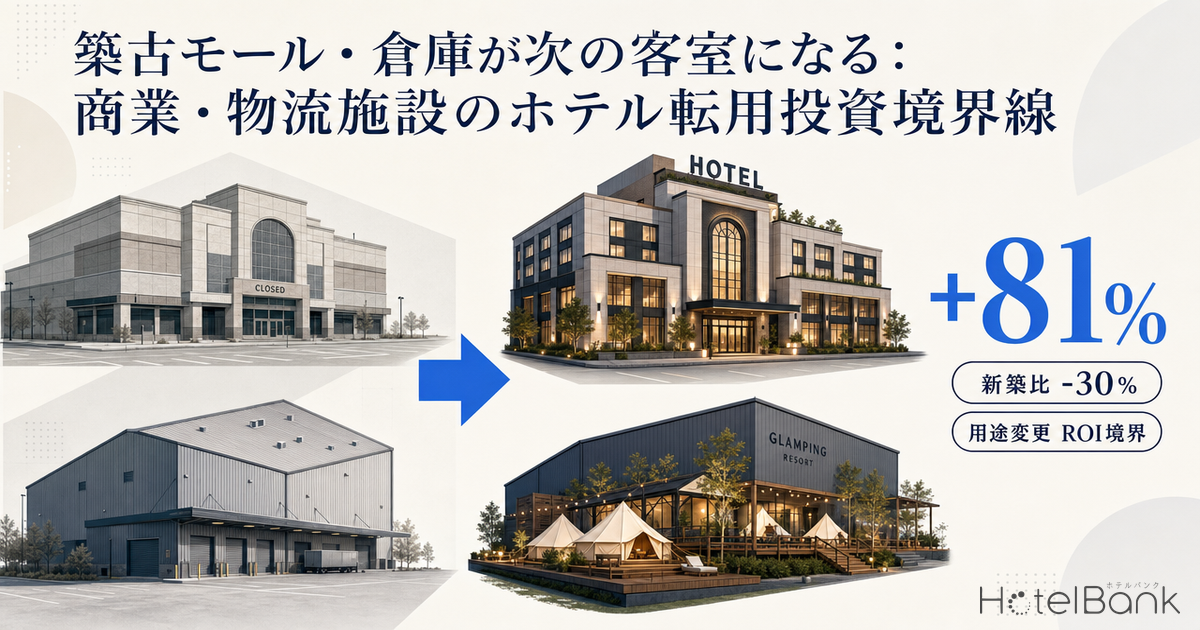
Soaring construction costs and intensifying land acquisition competition have pushed the investment hurdle for new hotel development to record-high levels. Meanwhile, in regional cities, shuttered general merchandise stores (GMS), aging malls, and obsolete suburban logistics warehouses remain as “boxes with a price tag.” This article examines conversion investment that repurposes non-residential aging assets — commercial and logistics buildings — into guest rooms, verifying the viability conditions along three axes: construction costs, change-of-use costs, and projected NOI. While prior articles have focused on office-to-hotel conversion, this article narrows the lens to “suburban x non-residential” assets.
Metric Definitions Used in This Article
- ADR (Average Daily Rate): Average of publicly listed prices on OTAs. Differs from actual transaction prices. Per-room rate (tax included) for double occupancy, averaged across all plans (room-only to meal-inclusive).
- NOI (Net Operating Income): Profit after deducting operating and maintenance expenses from room revenue. In this article, simplified estimates use “ADR x OCC x 365 days x room count x GOP ratio.”
- Change-of-Use Conversion: Changing the building’s designated use under the Building Standards Act and renovating the interior and equipment of an existing structural frame to repurpose it as a hotel or similar. Buildings exceeding 200m² require a building confirmation application (2019 legal revision).
- Data Source: MetroEngines Research & Consulting
Market Size of Non-Residential Aging Asset Regeneration — Hotel Investment Up 81% Q1, New Builds Hit Wall with 41% Cost Surge
Domestic hotel investment in Q1 2025 reached ¥173 billion, up 81% YoY. According to a tally by Nikkei, this has become a primary battleground for investment capital alongside condominiums and land, with competition for properties offering favorable acquisition prices and low yields intensifying.
Meanwhile, the cost of new hotel development is rising at an accelerating pace. According to Mitsubishi Estate Real Estate Services, the per-tsubo construction cost for hotels jumped from ¥1.383 million in 2022 to ¥1.950 million in 2024 — a 41.1% increase in just two years. This reflects the compounding effects of rising labor costs, the mandatory adoption of high-performance equipment to comply with energy conservation standards, and persistently high materials costs.
Amid this supply-demand gap, renovation and conversion (change of use) are gaining attention as alternatives to new construction. According to the Construction Research Institute, renovation can typically reduce total construction costs by 20–30% compared to new builds, and conversion offers room for further reductions depending on the extent of structural frame reuse. PwC’s “Emerging Trends in Real Estate® Asia Pacific 2026” also notes that the regeneration of aging assets is becoming mainstream across the Asia-Pacific region.
Source: Compiled by HotelBank Editorial Team from Nikkei and Mitsubishi Estate Real Estate Services
On the demand side, of the approximately 27,000 facilities with verifiable operations tracked by MetroEngines Research, categories with “high affinity for aging non-residential asset regeneration” — such as glamping, cottages, and vacation rentals — are expanding. The number of glamping facilities grew from 279 in April 2024 to 331 in April 2026 (+18.6%), and although ADR has dipped slightly, it remains at the ¥51,000 level. Large flat-floor buildings such as warehouses and former GMS sites are well suited for conversion into cottage, glamping, and roadside hotel formats.
Closed Malls and Former GMS Sites to Hotels — Three Conditions for Successful Change of Use
The wave of closures of regional department stores and GMS continues. According to the “List of Post-Closure Status of Regional Department Stores” published by the Tokyo Economic Research Institute, over 20 cases of former department store sites closed in the past 20 years have been incorporated into mixed-use redevelopments that include hotel functions. Recent examples include the former Seibu Department Store site in Asahikawa (planned redevelopment with attached hotel), the former Ito-Yokado site in Tsudanuma (reopened as AEON MALL Tsudanuma South in March 2026), and the former Ito-Yokado site in Kasukabe (redevelopment in progress), demonstrating that even suburban regional locations are seeing concrete project initiatives.
Below is a summary of major cases where mixed-use redevelopment including hotel functions has been confirmed or planned at former department store and GMS sites closed in the past 20 years.
| # | Location | Former Store | Year Closed | Redevelopment Outline (Hotel Component) | Status |
|---|---|---|---|---|---|
| 1 | Hakodate, Hokkaido | Boniya | 2019 | 11-story hotel tower (Ken Corporation) + 25-story condo + retail. Total floor area 38,240m² | Construction start Nov 2025, completion 2029 |
| 2 | Asahikawa, Hokkaido | Seibu Asahikawa Bldg A | 2016 | Acquired by Tsuruha. Commercial + hotel mixed-use building planned | In planning |
| 3 | Asahikawa, Hokkaido | Seibu Asahikawa Bldg B | 2016 | Maeda Jusetsu planning hotel-led 15-story mixed-use (over ¥5 billion investment) | Demolished, in planning |
| 4 | Sendai, Miyagi | Sakurano Department Store Sendai | 2017 | 150m + 130m ultra-high twin tower (office + hotel) | Cancelled due to cost surge, under review |
| 5 | Shibuya, Tokyo | Tokyu Department Store Main | 2023 | 36 floors above ground. Floors 8-17: Swire Hotels “The House Collective” — first Japan entry | Completion expected FY2027 |
| 6 | Nagoya, Aichi | Meitetsu Department Store Main | 2026 | Two 170m+ towers. Hyatt’s “Andaz” ~150 rooms + retail + office (total project cost ~¥540 billion) | Phase 1 completion expected 2033 (under review) |
| 7 | Kumamoto, Kumamoto | Kenmin Department Store | 2015 | SAKURA MACHI Kumamoto: 162,440m² floor area. Hotel Trusty Premier Kumamoto + retail + bus terminal + Kumamoto Castle Hall (total cost ¥75.5 billion) | Opened 2019 |
| 8 | Tokushima, Tokushima | Sogo Tokushima (vicinity) | 2020 | Shinmachi-Nishi redevelopment: hotel tower + retail + 148 residences + river station. Prefecture’s first mixed-use redevelopment | Completion expected 2027 |
| 9 | Hiroshima, Hiroshima | Tenmaya Hatchobori + Hiroshima Mitsukoshi | In planning | Ebisu-cho 5-chome redevelopment: stores, offices, hotel mixed-use. Fujita + Mitsui Fudosan involved | Prep council established, early 2030s target |
| 10 | Toyonaka, Osaka | Senri Hankyu Dept + Senri Selcy | In planning | Integrated redevelopment with Senri Hankyu Hotel site. 100,000m²-class retail + community facilities | Demolition start 2025, completion 2032 |
| 11 | Chuo, Tokyo | Matsuzakaya Ginza | 2013 | GINZA SIX (13 floors): 241 retail stores + offices + cultural facilities. Kanze Noh Theater attached | Opened 2017 |
| 12 | Mitsukoshi Isetan | Isetan Shinjuku Main | In planning | Mixed-use development with hotel planned (Nikkei reports) | FY2030 construction start target |
| 13 | Mitsukoshi Isetan | Mitsukoshi Nihombashi Main | In planning | Mixed-use development with hotel planned (Nikkei reports) | Planning stage |
| 14 | Mitsukoshi Isetan | Mitsukoshi Sapporo | In planning | Regional store mixed-use redevelopment (incl. hotel) under review (Nikkei reports) | FY2030 construction start under review |
| 15 | Chiba, Chiba | Mitsukoshi Chiba | 2017 | 23-story condo + retail mixed-use redevelopment | Completion expected August 2026 |
| 16 | Funabashi, Chiba | Seibu Funabashi | 2018 | Redevelopment plan including 51-story high-rise tower | In progress |
| 17 | Sagamihara, Kanagawa | Isetan Sagamihara | 2019 | Proud Tower Sagami-Ono Cross: 41 floors, 152m + retail. Existing frame reuse cuts CO2 by 80% | Completion expected November 2025 |
| 18 | Toshima, Tokyo | Seibu Ikebukuro Main | 2023 (sold) | Acquired by Fortress/Yodobashi. Department store halved, luxury-focused renovation | Phased opening from summer 2025 |
| 19 | Kure, Hiroshima | Sogo Kure | 2013 | Regeneration plan as part of Kure Station area redevelopment | Operator selected |
| 20 | Gifu, Gifu | Gifu Takashimaya + Gifu Ikuto | 2024 | Meitetsu Gifu Station area redevelopment policy | Planning stage |
Source: Compiled by HotelBank Editorial Team from Tokyo Economic Research Institute “List of Post-Closure Status of Regional Department Stores,” Nikkei, and municipal redevelopment plan disclosures (as of May 2026)
Source: Compiled by HotelBank Editorial Team from municipal redevelopment plans, Nikkei, and company press releases (as of May 2026)
Looking across these 20 cases, three structural patterns emerge.
First, the “hotel + condominium + retail” triad model has become mainstream. Common to the Hakodate, Tokushima, Kumamoto, and Shibuya cases is a structure where, because single-use projects cannot achieve viability, the magnetism of the hotel, the stable income of condominiums, and the cash flow of retail are combined into a mixed-use scheme that clears both landowner consensus and lender financing. The former Boniya site in Hakodate (38,240m² floor area, completion 2029) and the Shinmachi-Nishi redevelopment in Tokushima (hotel + 148 residences + river station) have become typical models of mixed-use redevelopment in cities of 200,000–300,000 population.
Second, soaring construction costs are causing project delays and cancellations. As seen in the Sakurano Department Store Sendai (plan shelved in 2025) and the Meitetsu Department Store Nagoya Station district (review announced end of 2025, total project cost ¥540 billion expected to inflate further), construction costs at the ¥1.95 million-per-tsubo level create a “stagnation risk” where projects fail to break ground even five-plus years after closure. The Sendai project, originally scheduled for FY2024 start and FY2027 completion, was completely shelved when materials inflation made viability impossible. This paradoxically signals the advantage of conversion investment that reuses existing structural frames over new construction. The Proud Tower Sagami-Ono Cross on the former Isetan Sagamihara site (more than 80% CO2 reduction via existing frame reuse) has emerged as a pioneering success model in both environmental and cost dimensions.
Third, foreign hotel brand entry is accelerating. Like Shibuya’s Swire Hotels (The House Collective, Hong Kong-origin contemporary luxury), Nagoya’s Hyatt (Andaz, ~150 rooms), and Kumamoto’s Resort Trust (Hotel Trusty Premier), large lots at former department store sites combine the lot size (100–300 rooms) and prime station-front location suited to foreign luxury brand deployment, making them landing pads for international brand entries into Japan. The hotel-attached mixed-use developments planned by Mitsukoshi Isetan HD at three locations — Isetan Shinjuku, Mitsukoshi Nihombashi, and Mitsukoshi Sapporo (Nikkei report, May 2024) — are also notable as a strategy that simultaneously targets structural transformation of the department store business and capture of hotel demand.
However, not every mall or GMS site is suited to hotel conversion. The viability conditions can be summarized as three points.
| Condition | Specific Thresholds / Requirements | Failure Risk |
|---|---|---|
| (1) Zoning Permissibility | Commercial, neighborhood commercial, or quasi-industrial zones. Category 1 residential zone limited to 3,000m². Category 2 residential zone limited to 10,000m². | Not permitted in urbanization control areas or Category 1 low-rise residential zones |
| (2) Structural Frame Compliance | Buildings of 3+ floors require fireproof construction. Compliance with new seismic standards (post-June 1981) preferred. RC or steel construction with 7m+ column spacing is advantageous for guest room layout flexibility. | Old seismic-standard buildings add ¥100,000–200,000/tsubo for retrofit |
| (3) Retroactive Fire Safety Requirements | Sprinklers mandatory for 11+ floors or 6+ floor lodging uses. Auto fire alarms, guidance lights, extinguishers, flame-retardant curtains, etc. on guest room floors are subject to retroactive application | Equipment retrofit costs can reach ¥30 million to several hundred million yen |
Source: Compiled by HotelBank Editorial Team from Building Standards Act and Fire Service Act
The 2019 amendment to the Building Standards Act eased the floor area threshold requiring a building confirmation application for change-of-use from “over 100m²” to “over 200m².” This is welcome news for small-scale lodging facilities, but for large buildings such as mall and GMS sites, a confirmation application remains mandatory.
Logistics Warehouses to Glamping/Roadside Hotels — Structural Capacity Is the Deciding Factor
Converting logistics warehouses into lodging facilities involves greater structural constraints than commercial buildings. Warehouses have load designs (live load 1,500–3,000 kg/m²) that are several times more than required for lodging uses, but they offer high ceiling clearances (5–10m) and wide column spacing (10m+ spans) — both advantageous for conversion into glamping or lodge-type guest rooms.
A representative case is the “Trip Base Michi-no-Eki Project” promoted by Sekisui House and Marriott International. Launched in October 2020, as of May 2026 the project operates 2,336 rooms across 29 locations in 14 prefectures. With 50–100 rooms per property, Phase 1’s 1,000-room target represents approximately ¥20 billion in construction demand (around ¥20 million per room), establishing it as a scalable, lodging-focused roadside model.
Family Lodge Hatagoya operates over 70 properties nationwide and achieves an investment of ¥180–200 million per property with its standard format of 12–14 rooms per building and 25m² guest rooms. This is an important precedent for lean hotel development in suburban roadside locations.
Source: Compiled by HotelBank Editorial Team from MetroEngines Research (N=100+ facilities per category)
All three categories — glamping, cottages, and vacation rentals — increased facility counts by 10–20% from 2024 to 2026, and ADR remains elevated in the ¥34,000–¥51,000 band. These categories command ADRs more than double those of ryokans and business hotels, creating the potential for a low investment cost x high ADR ROI structure through warehouse conversion.
Change-of-Use Cost Structure — Fire Safety and Barrier-Free Retrofits Range from Tens of Millions to Hundreds of Millions of Yen
For change-of-use conversions, “retroactive obligation costs” separate from new construction costs determine project viability. Below is a summary of the main cost items.
| Renovation Item | Approximate Cost | Triggering Condition |
|---|---|---|
| New sprinkler installation | ¥30M+ | 11+ floors or 6+ floor lodging use |
| Auto fire alarms / guidance lights | ¥5M–15M | If existing systems are absent or non-compliant |
| Seismic retrofit (old standard buildings) | +¥100K–200K/tsubo | Buildings built before May 1981 |
| Barrier-free conversion (select rooms) | ¥2M–5M/room | 1%+ of rooms must be barrier-free if total exceeds 50 rooms |
| Water/HVAC system update | ¥100K–250K/tsubo | Full piping replacement for retail-to-lodging conversion |
| Evacuation stairs / route renovation | ¥5M–20M | If two-direction evacuation is difficult to ensure |
Source: Compiled by HotelBank Editorial Team from Building Standards Act, Fire Service Act, and renovation cost benchmarks
Adding these together, converting a 3,000m² mall site into a 50-room lodging-focused hotel typically yields a total retrofit cost of ¥500 million to ¥1 billion. Since new construction at the ¥1.95 million-per-tsubo rate would exceed ¥1.8 billion for the same scale, conversion can reduce total investment by an estimated 40–60% versus new construction.
Investment Viability Boundary — Sensitivity Analysis of Acquisition, Renovation, and Projected NOI
We verify investment viability with concrete numbers. The table compares three scenarios for 50-room roadside hotel development in a regional suburban location (city of 200,000–300,000 population).
| Item | A. New Build | B. Mall Site Conversion | C. Warehouse Conversion (Cottage) |
|---|---|---|---|
| Acquisition cost | ¥400M (land only) | ¥600M (with building) | ¥300M (with building) |
| Construction/renovation cost | ¥1.8B (¥1.95M/tsubo) | ¥700M (retrofit) | ¥500M (retrofit) |
| Total project cost | ¥2.2B | ¥1.3B | ¥800M |
| Projected ADR | ¥15,000 | ¥14,000 | ¥35,000 (cottage) |
| Projected OCC | 68% | 65% | 55% |
| Room revenue (annual) | ¥186M | ¥166M | ¥351M (25 units) |
| GOP ratio | 30% | 35% | 25% |
| NOI / Yield | ¥56M / 2.5% | ¥58M / 4.5% | ¥88M / 11.0% |
Source: MetroEngines Research & Consulting (simplified estimates)
In Scenario A’s new-build model, construction cost surges leave a 2.5% yield against a ¥2.2 billion total project cost. This falls well short of the CBRE-tracked expected yield for regional hotels (5.0–6.5%), making it difficult to attract institutional investors.
Scenario B, mall site conversion, can raise yield to 4.5% through reduced retrofit costs and reuse of existing parking and loading infrastructure. This sits within the range achievable by mid-tier city regional bank financing and local real estate operators’ own capital.
Scenario C, warehouse conversion x cottage type, has high per-unit revenue and somewhat lower occupancy, but can potentially achieve an 11% yield through low acquisition and retrofit costs. Given that glamping and vacation rental categories command ADRs around ¥51,000, former warehouses in semi-mountainous areas and around suburban farmland are promising regeneration candidates. For how to geographically interpret yield sensitivity by investment scenario in light of disaster risk and location characteristics, our analysis of disaster risk x ADR x risk-adjusted yield across 10 Pacific coast tourist areas in the era of 80% Nankai Trough probability applies the same framework in detail.
Source: MetroEngines Research & Consulting (simplified estimates based on various statistics)
Recommended Investment Conditions and Practical Checkpoints
From the analysis above, we summarize the boundary conditions under which commercial and logistics facility hotel conversion is viable as an investment.
Condition 1: Total project cost must be held to 50% or less of new construction cost. When the sum of acquisition and retrofit costs exceeds 50% of new-build total project cost, the differentiation from new-build yield erodes and the risk premium of change-of-use becomes difficult to justify.
Condition 2: No fundamental obstacles in the three dimensions of zoning, seismic standards, and fire safety. Projects falling into urbanization control areas, old-seismic-standard buildings of 6+ floors, or sites where sprinkler retrofit is structurally infeasible should be abandoned. Early-stage feasibility studies must always include initial consultations with the municipal building guidance department and fire bureau.
Condition 3: Room type and category selection must align with area demand. Roadside and suburban locations call for lodging-focused business hotels (ADR ¥14,000+), warehouses near tourist destinations for cottage/glamping formats (ADR ¥35,000+), and mall sites in commercial districts for business/family mixed formats — identifying the optimal category for each location is the key to securing yield. Development opportunities at atypical locations through public schemes also extend beyond aging assets; our analysis of investment opportunities for in-park hotel development under the Park-PFI scheme is useful as a complementary investment strategy.
Limitations of this estimate: The yield estimates in this article are simplified models based on published data. Actual project execution requires detailed feasibility studies including individual property structural surveys, compliance checks, consultation with local governments, and operator selection. Zoning, fire prevention districts, and district plans vary by municipality, so prior confirmation is essential.
Conclusion — Escaping Dependence on New Construction and Regenerating Suburban Idle Assets
With construction costs remaining elevated and hotel investment activity continuing, conversion from commercial and logistics facilities to hotels is expected to enter the mainstream as an alternative to new construction investment over the next five years. While previous articles have focused on office-to-hotel conversion, this article extended the analysis specifically to regional suburban x non-residential x large flat-floor buildings.
The market structure features three intersecting trends: (1) new-build per-tsubo costs have risen 41% in a short period, (2) regional GMS and department store closures are creating mass supply of “buildings with a price tag,” and (3) ADRs for PWA conversion and glamping-type categories are holding stable in the ¥30,000–¥51,000 band. For operators able to combine these trends, early quantification of change-of-use costs and viability estimates will be the condition for securing differentiated investment opportunities ahead of competitors. The market impact on the new-build luxury side is summarized in our investor-perspective market impact analysis of six luxury hotels opening in 2026, which should be read as a paired investment opportunity to the conversion investment discussed here.
Related Reading
- Tokyu Stay x Mercure Hiroshima Dual-Brand Strategy — A New Opening Format for Mid-Sized Cities
- [April 2026 Latest] Mid-Sized Facilities Drive Sustainable Supply: Atami’s New Openings
- How Mandarin Oriental Setouchi Will Reshape Regional Luxury — Behind Kagawa’s ADR +17% and Opening Impact Estimates
- Hotel Investment in the Era of 80% Nankai Trough Risk — Disaster Risk x ADR x Risk-Adjusted Yield Analysis of 10 Pacific Coast Tourist Areas
- Nagoya Hotel Investment 2026 — Conrad Opening x Luxury Void x Linear Delay Drawing a New Scenario
- May-June 2026 Opening Cluster: Geography and Structure of 13 Properties, 1,149 Rooms — Reading the Regional Hub Shift
Categories: Investment & Development / Industry Trends
References & Sources
Market Data
- MetroEngines Research & Consulting — OTA listed price data, glamping/cottage category facility count trends (N=27,000 facilities)
Investment / Construction Costs
- Nikkei “Hotel investment booming, Q1 up 80%, competing with condos and land”
- Mitsubishi Estate Real Estate Services “Rising construction costs as seen in data (as of December 2025)”
- Construction Research Institute “Renovation and conversion of public facilities”
- CBRE “Japan Investment MarketView Q3 2025”
- JLL “Japan Hotel Investment Market Outlook 2024”
- archi-book “What is the per-tsubo construction cost of hotels? [2025 edition]”
Laws and Regulations
- Kenchiku Kijunho no Torisetsu “Building Standards Act provisions to note for change-of-use to ryokan/hotel”
- Bureau Veritas Japan “Compliance risks arising from building change-of-use”
- Shuken “Laws related to hotel construction and interior work”
- Zenkoku Shoboten ken.com “What is the cost of installing sprinklers?”
Case Studies / Projects
- Sekisui House / Marriott “Trip Base Michi-no-Eki Project” official site
- TravelVoice “Sekisui House and Marriott launch project to open 3,000 hotel rooms by 2025”
- Family Lodge Hatagoya “Idle land utilization”
- Tokyo Economic Research Institute “List of post-closure status of regional department stores” (PDF)
- Shutten Watch “AEON MALL Tsudanuma South opens March 18, 2026”
- Nikkei “Mitsukoshi Isetan to also redevelop regional stores, Sapporo etc. groundbreaking by FY2030, mixed-use to boost earnings power” (May 2024)
- Real Economy “The remnant of the former Seibu Asahikawa, new momentum begins with Building B demolition”
- Shukan Fudosan Keiei “Hakodate ‘Boniya’ site, hotel and residential development” (September 2024)
- Skyscrapers and Urban Development Institute “Sakurano Department Store Sendai site redevelopment”
- Shibuya Keizai Shimbun “Details announced for Tokyu Department Store Main site redevelopment, 36-story mixed-use with foreign hotel”
- Nagoya Joho “Nagoya Station area redevelopment: Hyatt luxury hotel, bus terminal, etc.”
- Hoosiers HD “Tokushima’s first hotel/retail/residential mixed-use redevelopment: Shinmachi-Nishi First-Type Urban Redevelopment Project” (September 2024)
- AND BUILD HIROSHIMA “Tenmaya building / Mitsukoshi area redevelopment concept, targeting hotel mixed-use facility”
- Wikipedia “SAKURA MACHI Kumamoto” (Kumamoto Sakuramachi redevelopment)
Industry Trend Reports