

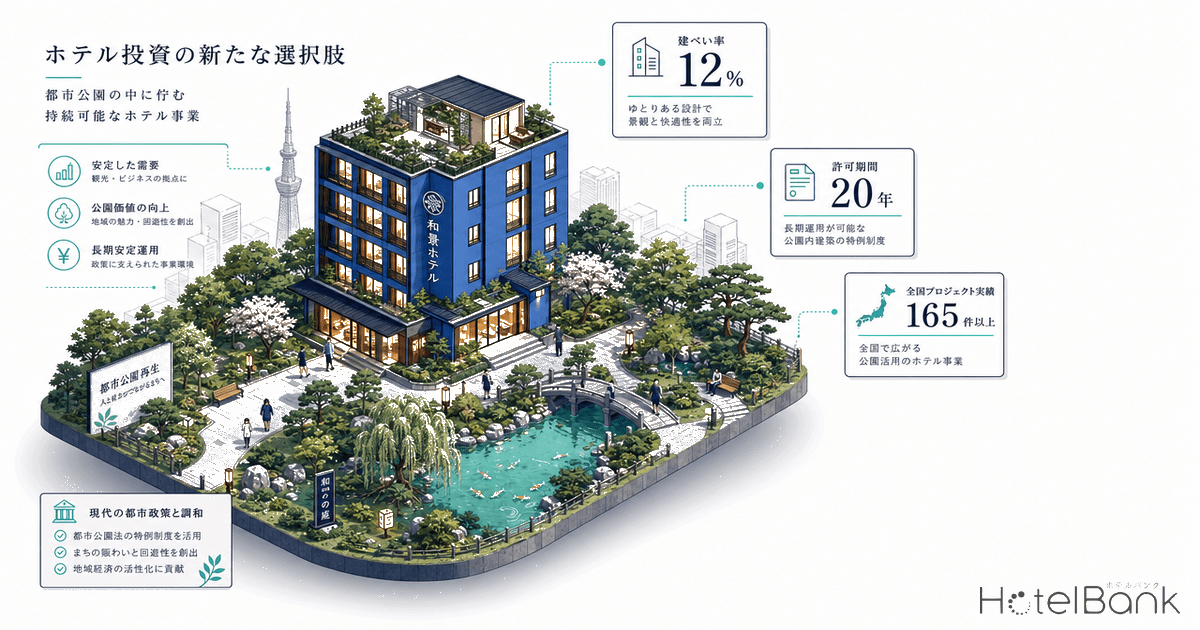
The Park-PFI program (Public Solicitation Establishment and Management System), created by Japan’s 2017 City Park Act revision, has been adopted at 165 locations nationwide as of fiscal year-end 2023, rapidly emerging as a new investment frontier for hotel development. With the building coverage ratio cap expanded sixfold from the standard 2% to a maximum of 12%, and the establishment-management permit period extended from 10 to 20 years, the conditions for park-located hotels to operate as viable businesses are now in place. This article quantitatively examines occupancy performance, ADR levels, and review scores at properties such as INN THE PARK Fukuoka and Laf Okinawa Arena by Vessel Hotels (Okinawa’s first Park-PFI hotel), analyzing the new wave of regional revitalization x hotel investment.
Metric Definitions Used in This Article
- ADR (Average Daily Rate): Average of selling prices publicly listed on OTAs, which differs from actual transaction prices (typically +25-30% higher than transaction ADR, due to a structural pattern where unsold high-priced plans remain listed on OTAs, biasing the public price average above actual sold prices). Per-room rate (tax included) for double occupancy, averaged across all plans (room-only through meals-included).
- Sold-out rate: Share of plans on OTAs that had closed bookings as of the survey date. This is distinct from the property-wide room occupancy rate.
- Park-PFI program: Public Solicitation Establishment and Management System, created by the 2017 City Park Act revision. A framework where private operators selected through public solicitation develop and operate revenue-generating facilities within parks.
- Data sources: MetroEngines Research, Japan Ministry of Land, Infrastructure, Transport and Tourism (MLIT) “Status of Park-PFI Program Adoption” and “Park-PFI Case Studies,” and individual municipal solicitation documents
Park-PFI Regulatory Easing — What the 2% to 12% Coverage Ratio Shift Means
Urban parks are fundamentally public spaces that prioritize green areas and open plazas, so structures within them have historically faced strict constraints. Article 6 of the City Park Act Enforcement Order limits park facility building coverage to 2% in principle — meaning only 200m² of building floor area is permitted per hectare (10,000m²) of park. For an accommodation facility of meaningful room count, this is plainly insufficient.
The Park-PFI program, established in the June 2017 City Park Act revision, raised this coverage cap to a maximum of 12% (with a 10-percentage-point upward exception for solicited park facilities). Furthermore, the establishment-management permit period for amenity facilities was doubled from a maximum of 10 years to 20 years. This shifted the regulatory design to enable large-scale, long-amortization facility investments such as hotels and bathing complexes to achieve viable economics on park sites.
Source: Compiled by HotelBank Editorial Team based on MLIT “Key Points of the City Park Act Revision”
The principal regulatory easing items are summarized below. The expansion of the coverage ratio enables up to 1,200m² of building floor area on a one-hectare park — sufficient to support a mid-scale hotel of 50 to 80 rooms. Indeed, Laf Okinawa Arena by Vessel Hotels opened at a 55-room scale. The 20-year establishment-management permit period aligns well with typical hotel building amortization periods (34 years for steel-frame construction, with effective payback periods of 15-20 years when accounting for impairment).
| Regulatory Item | Previous Regime | Park-PFI | Change |
|---|---|---|---|
| Building coverage cap | 2% (principle) | Max 12% | +10pt (6x) |
| Establishment-management permit period | Max 10 years | Max 20 years | 2x |
| Permitted amenity facility types | Mainly small kiosks | Hotels, bathhouses OK | Major expansion |
| Public infrastructure cost recovery | Municipal burden (principle) | Recoverable from operator revenue | PPP-scheme enabled |
Source: Compiled by HotelBank Editorial Team based on MLIT “Park-PFI Utilization Guidelines for Improving Urban Park Quality”
Park-PFI Adoption Trajectory — From Inception to 165 Sites in 7 Years
The Park-PFI program launched with just 4 adoptions in its first year (FY2017), reached 102 sites by fiscal year-end 2021, and expanded to 165 sites by fiscal year-end 2023. Annual adoptions have stabilized at roughly 20-35 per year, indicating the program is taking root as a leading method for regional revitalization and public space utilization.
Source: Compiled by HotelBank Editorial Team based on MLIT “Status of Park-PFI Program Adoption” (102 sites at FY2021 end, 165 sites at FY2023 end)
By geographic distribution, as of fiscal year-end 2021, 64 municipalities and 2 regional development bureaus had adopted the program — notably without concentration in any single metropolitan area. Adoptions in regional cities of under 200,000 population — including Eniwa (Hokkaido), Mutsu (Aomori), and Ninohe (Iwate) — are common, providing quantitative confirmation of the program’s strong alignment with regional revitalization policy.
Operating Performance of Major Park-PFI Hotels — ADR and Review Comparison
Among properties tracked by MetroEngines Research, we compiled ADR levels and review scores for three principal hotels developed under the Park-PFI program. While these three properties differ substantially in scale and locational characteristics, all are confirmed to capture a premium attributable to their park location.
| Property | Park | Rooms | Reviews | Overall Score | Opened |
|---|---|---|---|---|---|
| INN THE PARK Numazu | Ashitaka Wide-Area Park | 5 | 266 | 4.00 | 2017 |
| INN THE PARK Fukuoka | Uminonakamichi Seaside Park (National) | 17 | 58 | 4.20 | 2022 |
| Laf Okinawa Arena by Vessel Hotels | Koza Sports Park | 55 | 829 | 3.93 | 2023 |
Source: Compiled by HotelBank Editorial Team based on MetroEngines Research
Review scores for all three properties remain elevated at 3.9-4.2, with category-level scores especially strong for “Location,” “Cleanliness,” and “Service” at 4.4-4.8. This quantitatively confirms that the park location itself translates into accommodation experience value. Laf Okinawa Arena’s “Cleanliness” score of 4.79 (N=264) and INN THE PARK Fukuoka’s “Service” score of 4.75 (N=16) significantly exceed the national average (typically around 4.0).
Source: Compiled by HotelBank Editorial Team based on MetroEngines Research (N=266 INN THE PARK Numazu, 58 INN THE PARK Fukuoka, 829 Laf Okinawa Arena)
Golden Week 2026 ADR and Sold-Out Rate at Park-Located Hotels
MetroEngines Research compiled ADR trends across two principal Park-PFI hotels for Japan’s Golden Week 2026 (May 1-6). INN THE PARK Fukuoka had not yet released plans for this period as of April 2026 and was excluded from comparison, but both INN THE PARK Numazu and Laf Okinawa Arena by Vessel Hotels confirm clear price premiums on Golden Week peak days (May 2-4).
Source: Compiled by HotelBank Editorial Team based on MetroEngines Research
INN THE PARK Numazu’s peak Golden Week ADR ranges ¥60,100-61,700, achieving a +31-35% premium over the weekday rate (¥45,800 on May 1). Notably, all OTA plans were sold out for four consecutive days from May 2-5. Even accounting for the limited room count (5 rooms) inherent to a glamping-style facility, this confirms a sustained demand-excess condition.
Laf Okinawa Arena by Vessel Hotels also shows peak Golden Week ADR of ¥48,100-51,500, a +28-37% increase over the May 1 rate of ¥37,500, with all plans sold out on May 2. Considering that Okinawa Prefecture’s overall April 2026 ADR averaged ¥27,300 (+7.0% YoY, N=1,715 properties), the property’s Golden Week pricing under the Koza Sports Park location condition clearly positions it in the upper price range. As for post-Golden Week price dynamics, supply-demand reverses sharply with significant downward movement; this structure is analyzed in detail in our post-Golden Week mid-May hotel price bottom guide.
ADR Trends in Okinawa and Fukuoka and Park-Hotel Positioning
To evaluate Park-PFI hotels’ market positioning, comparison with the prefecture-wide ADR trend of the host prefecture is useful. The 24-month ADR trajectories for Okinawa and Fukuoka show a steady upward trend in both prefectures, indicating that Park-PFI hotel openings are timed to benefit from supportive macro tailwinds.
Source: Compiled by HotelBank Editorial Team based on MetroEngines Research (year-over-year overlay format)
Okinawa Prefecture’s April 2026 ADR was ¥27,300 (+7.0% YoY, N=1,715 properties), and Fukuoka Prefecture’s was ¥29,700 (+5.2% YoY, N=723 properties), with both clearly above the prior-year level. Laf Okinawa Arena’s Golden Week peak price of ¥51,500 is approximately 1.9 times Okinawa’s overall same-month average, confirming that the location characteristic of Koza Sports Park as a sports and entertainment hub translates into a clear price premium. For changes in area-level demand structure within Okinawa Prefecture, our analysis of whether Junglia Okinawa’s opening shifts the northern market to year-round demand drills into ADR and sold-out rates across six areas.
Cost Advantage of Park Locations — Land Rent and Acquisition Cost Structure
Operators’ economic advantage under the Park-PFI program lies not only in ADR premiums but also in the structurally low land cost. Take the Park-PFI project at Tochigi Prefecture’s “Tochigi Wanpaku Park,” for which solicitation began in 2025: minimum-use fees (land rent) for accommodation functions are set at ¥360 per m² per year, recreation functions at ¥120, and forest belts at ¥60. For a 20-year project term and 1,500m² of accommodation floor area, cumulative 20-year rent comes to ¥10.8 million — a remarkably low ¥540,000 per year.
This is orders of magnitude below typical leasehold rates for urban commercial sites (several thousand to several tens of thousands of yen per m² per year). However, since costs of solicited park facilities are borne by the operator, project plan design that balances this against initial capital burden becomes essential.
| Location Condition | Indicative Land Rent (annual/m²) | 20-Year Cumulative (1,500m²) |
|---|---|---|
| Park-PFI (Tochigi Wanpaku Park, accommodation) | ¥360 | ~¥10.8M |
| Regional/suburban commercial (general lease) | ¥3,000-6,000 | ~¥90M-180M |
| Major-city/station-front (general lease) | ¥10,000-30,000 | ~¥300M-900M |
Source: Compiled by HotelBank Editorial Team based on Tochigi Prefecture’s “Tochigi Wanpaku Park PFI Solicitation Documents,” with general land rent levels from real estate appraisal references
This rent differential represents an operating cost compression of several hundred million yen on a 20-year cumulative basis. Behind INN THE PARK Numazu’s ¥60,000 ADR level and Laf Okinawa Arena’s ¥51,500 ADR level lies this structural land rent advantage. However, Park-PFI operators are obligated to “redirect a portion of revenue from solicited park facilities to the development of designated park facilities (such as paths and plazas — public components).” How this trade-off is designed becomes the key to project viability assessment.
Pipeline from 2026 Onward — Tochigi Wanpaku Park as a Next-Generation Park-PFI Anchor
In April 2025, Tochigi Prefecture launched solicitation procedures for a Park-PFI project at “Tochigi Wanpaku Park.” The project targets a March 2027 service start, with planned solicited park facilities comprising accommodation and recreation functions (combined building area cap: 2,748m²). This is likely to mark a turning point — extending park-located hotel development from Reiwa-era major metropolitan areas (Okinawa City, Fukuoka City, etc.) outward to regional cities as a second wave.
Regional distribution of prior Park-PFI adoptions from FY2019 through FY2021 shows Tohoku (Mutsu, Ninohe, Morioka, Yamagata, Sukagawa), Hokkaido (Eniwa), Hokuriku (Kaga, Katsuyama, Komoro), Kansai (Sakai, Higashiosaka, Kashihara), and Kyushu (Kitakyushu, Fukuoka Pref., Beppu, Sasebo, Shingu, Kagoshima) — a notably nationwide distribution. This suggests program adoption is concentrated in “regional core cities with viable tourism/MICE demand.”
Source: Compiled by HotelBank Editorial Team based on MLIT “Status of Park-PFI Program Adoption” (102 sites at FY2021 end)
From a regional dispersion perspective, Park-PFI adoptions are not biased toward Tokyo or Osaka metropolitan areas; they extend broadly into Kyushu, Tohoku, and Hokuriku. This reflects the program’s decentralized design, where municipalities themselves conduct solicitations on their own urban parks, allowing local government initiative to play a leading role. For investors and operators, this means regional core-city parks are emerging as new candidate sites for hotel development. For trends in new property formats in regional core cities, see also our analysis of the Tokyu Stay x Mercure Hiroshima dual-brand strategy.
Investment Considerations — Risks and Returns of Park-PFI Hotel Investment
The principal points for evaluating the economics of hotel investment under the Park-PFI program can be distilled into three:
First, upside from location-based differentiation. All three case studies in this article maintain elevated overall review scores of 3.9-4.2, with particularly high “Location,” “Cleanliness,” and “Service” category scores of 4.4-4.8 — well above the national average. ADR premiums exceeding +30% over weekday rates have been confirmed during Golden Week peaks, and during demand-excess periods, multiple consecutive sold-out days have been recorded. The non-substitutable spatial character of a park functions as a clear differentiation vector against competing properties — and this is quantitatively borne out.
Second, structural cost advantage. Land rent levels are orders of magnitude below typical leasehold rates, with expected operating cost compression of several hundred million yen on a 20-year cumulative basis. On the other hand, costs and operational burdens absent from typical hotel development arise — including obligations to develop designated park facilities, design constraints to ensure public character, and ongoing coordination burden with park managers. These trade-offs must be precisely incorporated at the project planning stage.
Third, demand forecasting uncertainty. Many Park-PFI hotels opened from 2022 onward, and long-term operating performance data has yet to accumulate. INN THE PARK Numazu (opened 2017) has a relatively long track record but is a 5-room glamping format, with a demand structure substantially different from city-hotel-format Laf Okinawa Arena (opened 2023). Investment decisions require careful evaluation of the host park’s visitor characteristics (annual visitor count, catchment area, stability of tourism/MICE demand).
Note on future-dated ADR: ADRs in this article reflect average selling prices listed on OTAs as of the survey date and fluctuate as check-in dates approach. Prices currently set high may be discounted close to arrival. Across Park-PFI hotels generally, properties with limited room counts tend to sell out during demand-excess periods; conversely, the limited operating period (max 20 years) and the associated exit strategy considerations also become important investment decision factors.
Conclusion — Park-Located Hotel Development as a New Crossroads of Regional Revitalization x Hotel Investment
Through regulatory easing — expanding building coverage from 2% to 12% and extending the establishment-management permit period to 20 years — the Park-PFI program elevated park-located hotel development to a level where it is practically viable. Adoptions have expanded to 165 sites nationwide as of fiscal year-end 2023, and pioneering cases such as INN THE PARK Fukuoka and Laf Okinawa Arena by Vessel Hotels demonstrate clear competitiveness on both ADR and review-score dimensions.
Beginning with “Tochigi Wanpaku Park” — slated for service start in 2027 — second-wave projects in regional cities are now in motion. The combination of three elements — land rent levels orders of magnitude below typical leasehold, ADR premiums from the non-substitutable spatial character of parks, and institutional alignment with regional revitalization policy — positions park-located hotel development as a notable area at the new crossroads of regional revitalization and hotel investment, attracting attention from investors, government, and operators alike.
That said, structural caveats also exist: exit strategy after the 20-year project term, operator burden for designated park facility development, and ongoing coordination with park managers. The next analytical agenda is to accumulate visitor performance data by region for regional core-city parks and to quantify the correlation between location characteristics and ADR/occupancy performance.
Related Resources
- MLIT: Park-PFI (Public Solicitation Establishment and Management System) — Official
- PPnet Park-PFI Promotion Support Network (External)
- Status of Park-PFI Program Adoption (PDF, MLIT)
- Park-PFI Case Studies (PDF, MLIT)
Related Reading
- Will Junglia Okinawa’s Opening Shift the Northern Market to Year-Round Demand — A Six-Area ADR and Sold-Out Rate Analysis
- Tokyu Stay x Mercure Hiroshima: A Dual-Brand Strategy — A New Property Format for Mid-Sized Cities
- The Inflection Point in Kansai Luxury Hotel Supply-Demand — Reading 2026 via DBJ Estimates and OTA Reality
- The True Identity of Labor-Cost Pass-Through ADR Increases | Reading 2026 Hotel Price Structural Change via OCC-ADR Divergence
- In-Room and On-Premise Sauna Hotel Premium Verification — Reading 2026 “Year of the Bath” via 1,500 Properties’ ADR
- Up to 44% Off Post-Golden Week | Mid-May Hotel “Bottom Price” Complete Guide [2026 Data Analysis]
- Hokuriku Shinkansen Tsuruga Extension Year 3 | Fukui, Tsuruga, Komatsu, Kanazawa Four-City ADR Comparison and Courtyard Fukui Price Trends
- Tokyo, Nagoya, Osaka, Fukuoka Weekday ADR Analysis | Visualizing Business Demand Recovery