


We extracted the top 100 hotels and ryokan whose kids’ facilities — kids’ rooms, play areas and the like — are praised in guest reviews. Positive mentions over the latest 24 months totaled 33,021. Chiba Prefecture accounts for the most properties (18), followed by Shizuoka (8) and Osaka (7). Large existing resorts that were renovated or rebranded for families stand out near the top. This article compares the rates of these 100 properties against the median estimated settled ADR of their municipality, then converts the cost of building a new playroom — based on a published upper-limit estimate — into a per-room-night figure as a benchmark for owners weighing a renovation.
• ADR (average daily rate) = an estimated settled rate (tax-excluded equivalent), calculated by applying a segment-specific adjustment factor to the lowest-plan price level each property publishes on OTAs (per room, two guests per room, tax included). Checked against property-level results disclosed by listed hotel REITs (91 properties, latest 3 months), the median error is about 7%. These are estimates and differ from each property’s actual transaction prices and accounting figures.
• ADR for an area (prefecture or municipality) is the median estimated settled rate of the properties in that area (the level of a typical property in the area).
• Where listed prices are mentioned, they are per-room rates for two guests per room (tax included).
• OCC (occupancy) = rooms sold as a share of total rooms in the area (an estimate based on OTA sales inventory).
• Source: MetroEngines Research (continuous tracking of OTA published prices for about 168,000 properties in Japan, of which about 27,000 are confirmed operating)
* Review figures: the HotelBank Editorial Team analyzed guest reviews with natural language processing and counted positive mentions of kids’ facilities (kids’ rooms, kids’ spaces, play areas, children’s activities, etc.). Covered properties have at least 20 reviews and at least 10 positive mentions. Mention rate = positive mentions ÷ total reviews.
- — 33,021: total positive mentions of kids’ facilities across the top 100 properties (latest 24 months). By location, Chiba has the most (18), followed by Shizuoka (8) and Osaka (7).
- — Mention rate over mention count: the median room count of the top 20 by mention count is 193, versus 50 for the top 20 by mention rate. Smaller properties built around kids’ facilities rank high on mention rate.
- — 1.28x: the estimated settled ADR of the 78 properties in the rate comparison is 1.28 times their municipality’s median (Nov 2025 – Oct 2026). The tier with a mention rate of 40% or more is at 1.42x, but this is a correlation that also reflects differences in rate structure.
- — ≈¥15–169: the per-room-night add-on needed to recover the cost of a new 26–300㎡ playroom (equipment only) over 5 years at 160 rooms (estimate). Even at 60% occupancy and a 3-year payback, a 100㎡ room comes to about ¥110.
- — 8 owned by J-REITs: Invincible 5, Japan Hotel REIT 2, Hoshino Resorts REIT 1. Hotel Epinard Nasu reported an ADR of ¥33,799 for September 2026.
33,021 Positive Mentions Across the Top 100 — Concentrated in Chiba (18) and Shizuoka (8)
Let us start with the overall picture. Ranked by positive mentions of kids’ facilities, the No. 1 property has 2,025 mentions (mention rate 43.8%), and even No. 100 has 159, for a top-100 total of 33,021. The median mention rate is 17.2%, meaning roughly one in six reviews touches on kids’ facilities. Forty-three properties have a mention rate of 20% or higher.
By prefecture, Chiba stands out with 18 properties: 11 in Urayasu (the Maihama area), 2 in Kamogawa, and one each in Minamiboso, Onjuku, Kujukuri, Kimitsu and Togane — a mix of large hotels around the theme parks and seaside resorts on the Boso Peninsula. Shizuoka follows with 8 (4 of them in Ito), Osaka with 7 (4 in Konohana-ku), and Hyogo, Hokkaido and Okinawa with 6 each. The distribution is skewed toward resort areas within a 2–3 hour drive of the Tokyo and Kansai metropolitan areas and toward the vicinity of theme parks.
Listing the top 20 shows several Grand Mercure properties, rebranded at the same time in resort areas across Japan such as Yatsugatake, Nasu, Minamiboso and Awajishima, and several Anda properties promoting play areas for children in Izu, Yamagata and Osaka. Also notable is that an urban hotel, Richmond Hotel Sendai in central Sendai (799 mentions, 42.0%), makes the list.
| Rank | Property | Location | Type | Positive mentions | Mention rate |
|---|---|---|---|---|---|
| 1 | Grand Mercure Yatsugatake Resort & Spa | Hokuto, Yamanashi | Resort | 2,025 | 43.8% |
| 2 | BUB RESORT Yatsugatake | Hokuto, Yamanashi | Resort | 1,818 | 58.8% |
| 3 | Grand Mercure Nasu Highlands Resort & Spa | Nasu, Tochigi | Resort | 1,195 | 40.6% |
| 4 | Anda no Mori Yamagata Tendo | Tendo, Yamagata | Resort | 1,139 | 59.3% |
| 5 | Mori to Onsen Resort Anda no Mori Izu Ippekiko | Ito, Shizuoka | Resort | 881 | 44.5% |
| 6 | Richmond Hotel Sendai | Aoba-ku, Sendai, Miyagi | Business | 799 | 42.0% |
| 7 | BUB RESORT Tsukuba | Tsukuba, Ibaraki | Other | 769 | 50.9% |
| 8 | Grand Mercure Minamiboso Resort & Spa | Minamiboso, Chiba | Resort | 695 | 24.5% |
| 9 | MAGMA RESORT Shimobe | Minobu, Yamanashi | Resort | 692 | 72.2% |
| 10 | LEGOLAND Japan Hotel | Minato-ku, Nagoya, Aichi | Resort | 572 | 46.1% |
| 11 | Anda no Mori Osaka Tennoji Tower | Tennoji-ku, Osaka | City | 504 | 30.0% |
| 12 | i+Land nagasaki | Nagasaki, Nagasaki | Resort | 502 | 17.3% |
| 13 | Comfort Suites Tokyo Bay | Urayasu, Chiba | Business | 481 | 19.0% |
| 14 | Ryokan Hatsuneso | Ureshino, Saga | Ryokan | 414 | 96.7% |
| 15 | Angel Grandia Echigo-Nakazato Onsen | Yuzawa, Niigata | Resort | 403 | 23.8% |
| 16 | Mitsui Garden Hotel Prana Tokyo Bay | Urayasu, Chiba | Resort | 401 | 10.6% |
| 17 | Hotel Anda no Ouchi Izu Kogen | Ito, Shizuoka | Resort | 382 | 62.4% |
| 18 | Grand Mercure Awajishima Resort & Spa | Minamiawaji, Hyogo | Business | 372 | 6.7% |
| 19 | Hotel Ocean | Shiraoi, Hokkaido | Ryokan | 371 | 37.4% |
| 20 | Hotel Universal Port | Konohana-ku, Osaka | City | 355 | 8.6% |
Guest reviews frequently include comments such as “the kids’ play area was the best,” “the kids’ space by the front desk was great,” “the family room came with toys” and “the With Kids area where children can play is excellent” (193,170 reviews of the top 100 properties compiled by the HotelBank Editorial Team, Nov 2024 – Nov 2026). What guests praise ranges from dedicated playrooms to a kids’ corner in the lobby and toys and picture books in the guest room.
Mention Counts Favor Large Properties — Ranked by Mention Rate, Properties of Around 50 Rooms Rise to the Top
Mention-count rankings need a caveat, however. Large properties with more reviews accumulate more mentions, so the top of a count-based ranking skews toward big properties. Indeed, the median room count of the top 20 by mention count was 193, compared with 50 for the top 20 by mention rate. The table below re-ranks properties by mention rate — positive mentions as a share of total reviews.
| Rank | Property | Location | Type | Total reviews | Mention rate |
|---|---|---|---|---|---|
| 1 | Ryokan Hatsuneso | Ureshino, Saga | Ryokan | 428 | 96.7% |
| 2 | MAGMA RESORT Shimobe | Minobu, Yamanashi | Resort | 959 | 72.2% |
| 3 | Hotel Anda no Ouchi Izu Kogen | Ito, Shizuoka | Resort | 612 | 62.4% |
| 4 | Hotel Green Plaza Tojoko | Kato, Hyogo | City | 437 | 62.0% |
| 5 | Hotel Anda Monogatari Ito | Ito, Shizuoka | Resort | 503 | 61.8% |
| 6 | Anda no Mori Yamagata Tendo | Tendo, Yamagata | Resort | 1,920 | 59.3% |
| 7 | BUB RESORT Yatsugatake | Hokuto, Yamanashi | Resort | 3,094 | 58.8% |
| 8 | Hotel Green Core Main Building | Satte, Saitama | Business | 368 | 52.5% |
| 9 | BUB RESORT Tsukuba | Tsukuba, Ibaraki | Other | 1,512 | 50.9% |
| 10 | Yamashiro Onsen Hoshotei | Kaga, Ishikawa | Ryokan | 356 | 49.4% |
| 11 | Hotel Green Plaza Karuizawa | Tsumagoi, Gunma | Resort | 626 | 49.4% |
| 12 | LEGOLAND Japan Hotel | Minato-ku, Nagoya, Aichi | Resort | 1,241 | 46.1% |
| 13 | Mori to Onsen Resort Anda no Mori Izu Ippekiko | Ito, Shizuoka | Resort | 1,982 | 44.5% |
| 14 | Grand Mercure Yatsugatake Resort & Spa | Hokuto, Yamanashi | Resort | 4,621 | 43.8% |
| 15 | Richmond Hotel Sendai | Aoba-ku, Sendai, Miyagi | Business | 1,900 | 42.0% |
By mention rate, the leaders include Ryokan Hatsuneso in Ureshino Onsen (96.7%), MAGMA RESORT Shimobe in Minobu, Yamanashi (72.2%) and Hotel Anda no Ouchi Izu Kogen in Ito (62.4%). Nearly all of their reviews talk about how the children spent their stay, suggesting these properties are recognized as “family inns.” Even small properties that put kids’ facilities and services at the center can outrank large resorts on mention rate.
Location — Resorts Near Tokyo and Kansai, and Around Theme Parks
Mapping the 94 analyzed properties shows clusters in weekend-getaway resort areas within reach of the big metropolitan areas — the Boso Peninsula, the Izu Peninsula, Yatsugatake, Nasu and Awajishima — and around the theme parks of Maihama and the Osaka Bay area. They also spread to Hokkaido (6), Okinawa (6) and Kyushu (Oita 5, Nagasaki 3, etc.), but density is highest in the weekend zones of the Tokyo and Kansai areas. Circle size represents the mention rate.
Rates Are 1.28x the Municipal Median — Higher Mention-Rate Tiers Carry Higher Multiples
Next, rates. Of the 94 properties, we took the 78 for which an estimated settled ADR could be calculated and whose municipality median is based on at least 5 properties, and compared their average over the latest 12 months (Nov 2025 – Oct 2026) with the municipal median. The median multiple was 1.28x, and 66 of the 78 were above their municipality’s median. In yen terms, the property-side median is about ¥20,800 versus about ¥16,100 for the municipality, a median gap of about ¥5,700.
| Type | Analyzed | In rate comparison | Property ADR (median) | Municipal ADR (median) | Median multiple | Above municipal median |
|---|---|---|---|---|---|---|
| Resort | 51 | 44 | ¥20,600 | ¥17,100 | 1.27x | 37/44 |
| Ryokan | 18 | 17 | ¥20,900 | ¥16,200 | 1.30x | 13/17 |
| City | 12 | 11 | ¥23,800 | ¥15,800 | 1.26x | 10/11 |
| Business | 7 | 6 | ¥22,300 | ¥17,300 | 1.45x | 6/6 |
| Total | 94 | 78 | ¥20,800 | ¥16,100 | 1.28x | 66/78 |
By type, Business shows the highest multiple at 1.45x (N=6), followed by Ryokan at 1.30x, Resort at 1.27x and City at 1.26x. Although the Business group is small, it shows that even limited-service urban hotels sell at rates above the local median when they offer family rooms or kids’ spaces.
By mention-rate tier, the median multiple rises with the mention rate: 1.23x for under 10%, 1.28x for 10–20%, 1.30x for 20–40% and 1.42x for 40% or more. This does not, however, isolate the effect of the facilities alone. Many high-mention-rate properties are all-inclusive or include two meals as standard, so their lowest plans bundle food, drinks and activities and show higher rates. It is more reasonable to read the result as the combined outcome of location, type and rate structure. For one example of how an all-inclusive conversion affected rates, see Toba 72-Room All-Inclusive Rebrand: Aug ADR ¥47.3k, +39.6% YoY.
Renovation and Rebrand Cases — Rates at Five Grand Mercure Properties Rose in Year Two
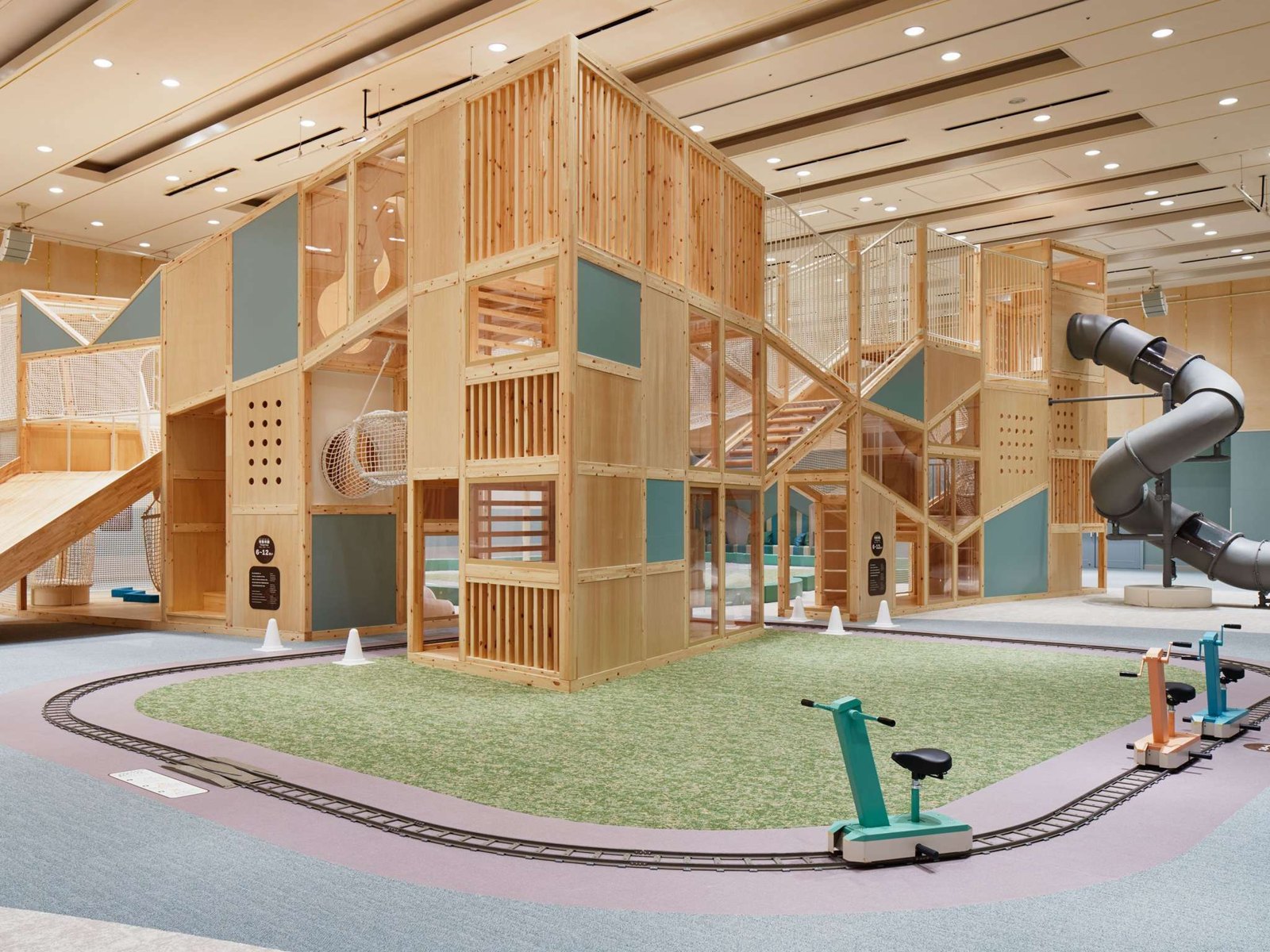
The Grand Mercure properties near the top of the list are Daiwa Resort hotels rebranded by Accor, which opened all at once as Grand Mercure and Mercure on April 1, 2024 (Travel Voice, November 2023). In an April 2025 announcement, Accor described them as “22 all-inclusive resort hotels” and cited plans with half-price or free children’s rates, children’s loungewear and baby baths. The No. 1 property, Grand Mercure Yatsugatake Resort & Spa, has an all-weather activity area, “Mori no 8,” and a Kids Mountain on the first basement floor, a play zone on the third floor, and Executive Family Rooms for up to 6 and Family Suites for up to 9 (hotel’s official website). For the old and new names of each former Daiwa Royal Hotel, see Daiwa Resort Hotels Are Now Grand Mercure & Mercure: 23 Names & Rates.
Because our estimated settled ADR series starts in July 2024, we compared year one after the rebrand (Nov 2024 – Oct 2025) with year two (Nov 2025 – Oct 2026) rather than before and after the rebrand. The average of the five properties in the top 100 (Yatsugatake, Nasu Highlands, Minamiboso, Awajishima and Ise-Shima) rose 4.4% from about ¥20,300 to about ¥21,100, the opposite of the average median of the same five municipalities (about ¥17,600 → about ¥17,400, −1.5%). Likewise, the average of the three Anda properties in Ito that promote play areas for children rose 4.3% from about ¥31,700 to about ¥33,000, outpacing the Ito city median (−1.6%).
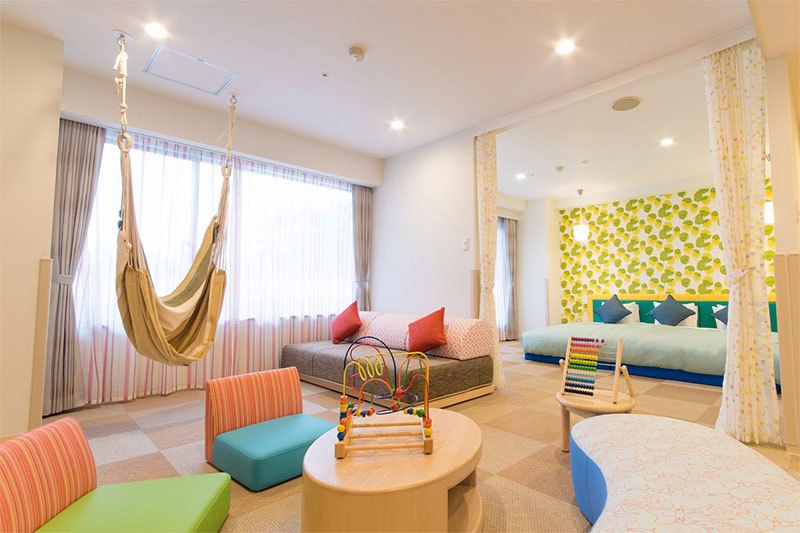
Another way to remake existing rooms for families is illustrated by Hilton Tokyo Bay. Of its 828 rooms (Hilton “Company Overview,” updated August 25, 2026), the hotel converted 197 into “Family Happy Magic Rooms” with bunk beds that sleep up to 6 (Travel Voice, May 2018). This is a “capacity-increase” renovation that raises occupancy per room without reducing the room count, and its payback logic differs from a “combination” renovation that merges two rooms into one.
New Playroom Cost per Room-Night — a ¥15–169 Add-On Pays It Back in 5 Years
So how much does a new playroom cost per room-night? As one example of a published estimate, the specifications for the “Kyoto City Hall Main Building Kids’ Space Play Equipment Installation Contract,” put out to tender by the City of Kyoto in 2026, set an upper contract price of ¥3 million (tax included) for a kids’ space of about 26㎡ (designed for about 8 preschool children and parents), covering procurement and installation of play equipment and toys, decoration and inspection. That works out to about ¥115,000 per ㎡.
Scaling this unit cost in proportion to floor area, and assuming 160 rooms (close to the median room count of the 94 analyzed properties), 70% OCC (assumption) and a 5-year payback, we estimated the per-room-night add-on required. The formula is investment ÷ (rooms × OCC × 365 days × payback years).
| Scenario | Floor area | Investment (tax incl.) | Per room-night | With 1/2 subsidy |
|---|---|---|---|---|
| A. Kids’ corner | 26㎡ | ≈¥3.0M | ≈¥15 | ≈¥7 |
| B. Playroom | 100㎡ | ≈¥11.54M | ≈¥56 | ≈¥28 |
| C. All-weather activity area | 300㎡ | ≈¥34.62M | ≈¥169 | ≈¥85 |
The estimate comes to about ¥15 per room-night for a 26㎡ kids’ corner, about ¥56 for a 100㎡ playroom and about ¥169 even for a 300㎡ all-weather activity area. Each is roughly 0.3–3% of the gap between the analyzed properties and their municipal median (median of about ¥5,700). In practice, interior and HVAC work and the cost of staff to supervise children would be added, but the required add-on can still be estimated by adding those costs to the investment in the same formula.
The table below shows sensitivity to OCC and payback period. For a 100㎡ playroom (about ¥11.5 million), even a conservative 60% OCC and 3-year payback keeps the add-on at about ¥110 per room-night.
| Condition | 3-year payback | 5-year payback | 7-year payback |
|---|---|---|---|
| OCC (assumption) 60% | ≈¥110 | ≈¥66 | ≈¥47 |
| OCC (assumption) 70% | ≈¥94 | ≈¥56 | ≈¥40 |
| OCC (assumption) 80% | ≈¥82 | ≈¥49 | ≈¥35 |
The Japan Tourism Agency’s “Inbound Reception Environment Enhancement Program” lists “improving the environment for travelers with children” among its eligible projects, with kids’ spaces, nursing rooms and diaper-changing tables among the items covered. The subsidy rate is up to one-half of eligible costs (up to two-thirds depending on requirements) (FY2025 application guidelines). However, eligible projects must aim to receive international visitors and be positioned within an enhancement plan for a designated tourist area, so whether a single lodging facility can use it depends on confirmation with the plan’s author and the regional transport bureau.
Family Room Conversions — Capacity-Increase vs. Combination Changes the Payback Math
Family-room conversions fall broadly into two types. The capacity-increase type, as at Hilton Tokyo Bay, adds bunk beds or futon space to raise the number of guests per room; since the room count is unchanged, any rise in the per-room rate flows straight into room revenue. The combination type, which merges two rooms into one, must make up for the lost rooms through rate. To keep room revenue flat at the same OCC, merging two rooms into one requires roughly doubling the rate.
In the Japan Tourism Agency’s “Case Studies of Room Rate Increases Through High-Value-Added Renovation of Lodging Facilities,” the most common renovation among the 15 featured operators was “combining and enlarging guest rooms.” In one featured case, consolidating 6 rooms into 3 raised the room rate from ¥42,919 to ¥77,850 (+81.4%) (2019 vs. end of October 2024). Although not specific to families, it is a useful reference for estimating how far a combination renovation can lift rates.
8 Properties Owned by J-REITs — Epinard Nasu at 97.1% Occupancy in September
From an investment standpoint, 8 of the top 100 properties are owned by J-REITs (ownership master, as of November 16, 2026): Invincible Investment Corporation (8963) owns 5, Japan Hotel REIT Investment Corporation (8985) owns 2, and Hoshino Resorts REIT, Inc. (3287) owns 1.
| Rank | Property (REIT disclosure name) | Owner | Acquired | Acquisition price | Rooms |
|---|---|---|---|---|---|
| 21 | Hotel Epinard Nasu | Invincible Investment Corporation | Mar 2016 | ¥21,002M | 310 |
| 33 | Sheraton Grande Tokyo Bay Hotel (preferred equity securities) | Invincible Investment Corporation | Oct 2017 | ¥14,660M | 1,016 |
| 46 | Oriental Hotel Tokyo Bay | Japan Hotel REIT Investment Corporation | — | ¥19,900M | 511 |
| 63 | OMO7 Osaka | Hoshino Resorts REIT, Inc. | Mar 2019 | ¥29,000M | 436 |
| 66 | Tateshina Grand Hotel Takinoyu | Invincible Investment Corporation | Aug 2023 | ¥8,365M | 160 |
| 80 | Kirishima Kokusai Hotel | Invincible Investment Corporation | Aug 2025 | ¥6,534M | 165 |
| 84 | Kamenoi Hotel Beppu | Invincible Investment Corporation | Oct 2017 | ¥8,870M | 322 |
| 94 | Hilton Tokyo Bay | Japan Hotel REIT Investment Corporation | — | ¥26,050M | 828 |
In Invincible’s property-level results for September 2026, Hotel Epinard Nasu posted OCC of 97.1% (September 2026) and ADR of ¥33,799, and Tateshina Grand Hotel Takinoyu posted OCC of 96.1% (September 2026) and ADR of ¥30,319. Compared with the REIT’s 101 domestic hotels for the same month (OCC 85.2% (September 2026), ADR ¥15,461), both family-oriented resorts combine high occupancy with high rates. Both this article’s estimated settled ADR and the REIT-disclosed ADR are tax-excluded equivalents, but this article’s figures are estimates (median error of about 7% against REIT-disclosed results).
Summary — Three Benchmarks for Planning Off-Season Works
To sum up, properties whose kids’ facilities are praised in reviews cluster in weekend-getaway resorts near the Tokyo and Kansai areas and around theme parks, with rates nearly 30% above their municipal median. For operators and owners considering a renovation, three points can serve as benchmarks.
First, measure impact by mention rate rather than mention count. Large properties accumulate mentions easily, and even a small property can outrank big resorts on mention rate if it puts kids’ facilities and services at its core. Second, based on a published upper-limit estimate, the equipment cost of a new playroom can be recovered in 5 years with an add-on of tens to around a hundred-odd yen per room-night. It is worth running the same formula on the total including interior work and supervising staff, and building the payback plan together with the rate structure (children’s rates, all-inclusive conversion). Third, because the required rate increase differs greatly between capacity-increase and combination room renovations, there is room to start with the capacity-increase type, which keeps the room count intact. Ahead of family demand over the winter and spring school holidays, these figures can help firm up plans for off-season works in 2027.
Related Articles
- Hotel Pool Capex per Room-Night: ¥413–¥1,205; 42 of Top 100 in Okinawa
- Hotel Spa Renovation: ¥60K–¥980K per Room, ¥107–941/Night to Recoup
- Hotel Room TV Reviews: 54% Praise Big Screens, 43-Inch Swap ¥60/Night
- Co-Sleeping Fees at 6 Japan Hotel Chains: Preschoolers Free (Nov 2026)
- Daiwa Resort Hotels Are Now Grand Mercure & Mercure: 23 Names & Rates
- Toba 72-Room All-Inclusive Rebrand: Aug ADR ¥47.3k, +39.6% YoY
- Lobbies Praised at 99 Hotels: ADR 1.54x Local, Renovation Cost/Room
- Free Co-Sleeping Age at Japan Hotels: Up to 18 at Vessel, by Chain
References and Sources
■ Data sources
Positive mentions of kids’ facilities were compiled by the HotelBank Editorial Team through natural language processing of guest reviews (latest 24 months, Nov 2024 – Nov 2026; properties with at least 20 reviews and at least 10 positive mentions). Rates are MetroEngines Research estimated settled ADR (two guests per room, per room, tax-excluded equivalent), with monthly values averaged over Nov 2025 – Oct 2026 and compared with the municipal median (municipalities with at least 5 properties). J-REIT ownership was determined from an ownership master compiled from each investment corporation’s disclosures (as of November 16, 2026).
■ Estimate assumptions
The cost of a new playroom scales the upper limit in the City of Kyoto’s contract specifications (about 26㎡, ¥3 million tax included; about ¥115,000 per ㎡) in proportion to floor area. Per-room-night add-on = investment ÷ (160 rooms × assumed occupancy of 70% × 365 days × 5-year payback). The sensitivity table varies assumed occupancy from 60% to 80% and payback from 3 to 7 years. The subsidized case assumes a 1/2 subsidy rate.
■ Limitations
Mention counts accumulate faster at large properties with more reviews, so the top of the count ranking skews toward size (a selection effect). Six properties whose guest satisfaction appeared to come from neighboring attractions such as theme parks were excluded from the rate analysis. The rate gap is a correlation that includes location, type and rate structure (all-inclusive, etc.), not the effect of the facilities themselves. The renovation cost estimate covers equipment only, pro-rata by floor area, and excludes construction, interior and HVAC work and the labor cost of supervising staff. Estimated settled ADR is an estimate, with a median error of about 7% against REIT-disclosed results.
■ Market data
- MetroEngines Research — Estimated settled ADR (by property and by municipality, Jul 2024 – Oct 2026)
- HotelBank Editorial Team — NLP analysis of guest reviews (positive mentions of kids’ facilities, latest 24 months, 193,170 reviews of the top 100 properties)
■ Government and municipal sources
- City of Kyoto, “Proposal for the Kyoto City Hall Main Building Kids’ Space Play Equipment Installation Contract” (specifications) (in Japanese)
- Japan Tourism Agency, “FY2025 Tourism Promotion Subsidy (Inbound Reception Environment Enhancement Program) Application Guidelines” (in Japanese)
- Japan Tourism Agency, “Case Studies of Room Rate Increases Through High-Value-Added Renovation of Lodging Facilities” (in Japanese)
■ REIT and corporate sources
- Invincible Investment Corporation, “Monthly Operating Results (September 2026)”
- Invincible Investment Corporation, Portfolio List
- Japan Hotel REIT Investment Corporation, Portfolio List
- Hoshino Resorts REIT, Inc., Portfolio List
- Hilton, “Company Overview” (updated August 25, 2026)
- Grand Mercure Yatsugatake Resort & Spa official website (Accor)
- Accor press release (PR TIMES, April 1, 2025) (in Japanese)
■ News