

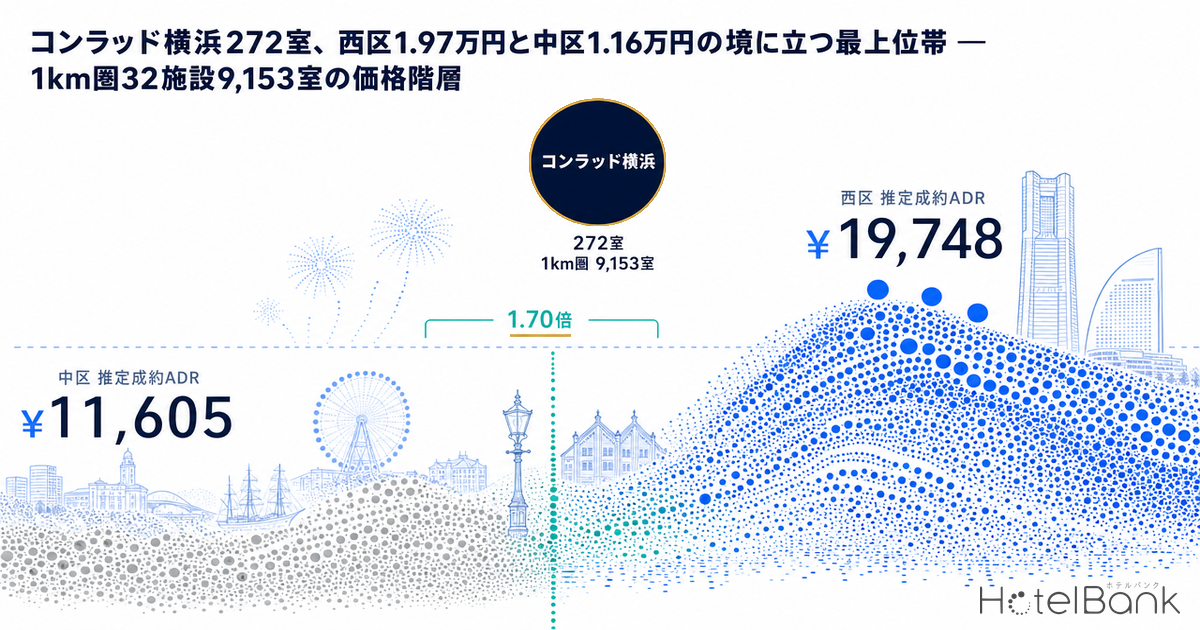
Conrad Yokohama, announced by Hilton in April 2024, is a 272-room luxury hotel that will occupy floors 1-16 of the “(tentatively named) Kitanaka-dori North District A-1/A-2 Project,” a tower owned by Daiwa Jisho and developed jointly with Sumitomo Realty & Development. Hilton’s corporate overview (updated August 25, 2026) lists it in the Japan pipeline with a 2027 opening. The site, at 6-chome Kitanaka-dori in Naka Ward, Yokohama, is about a two-minute walk from Bashamichi Station on the Minatomirai Line and sits right on a ward boundary: estimated settled ADR is ¥19,700 in Nishi Ward (Minatomirai) versus ¥11,600 in Naka Ward (Kannai/Kitanaka), a 1.70x step across a single road. This article inventories the 32 hotels and 9,153 rooms within a 1 km radius property by property and examines four angles – price tiers, inventory absorption on peak dates, land prices and flood risk, and facility mix – to establish which tier Conrad Yokohama will stand in and where the existing hierarchy has gaps.
Metric Definitions Used in This Article
- ADR (Average Daily Rate) = an estimated settled rate (tax-exclusive equivalent), calculated by applying a segment-specific adjustment factor to the lowest published plan rate (per room, 2 guests, tax-inclusive) that each property lists on OTAs and similar channels. Checked against property-level results disclosed by listed hotel REITs (91 properties, most recent 3 months), the median error is about 7%. These are estimates and differ from each property’s actual transaction prices and accounting figures. Area-level ADR is the median of the covered properties (the level of a typical property in the area). Ward-level ADR in this article is the simple average of the 12 finalized months from September 2025 to August 2026.
- Listed price (all-plan average, tax-inclusive) = the average of all published plan prices on OTAs and similar channels (per room, 2 guests). Because its level differs from ADR, it is used only to sort properties into price tiers and is never called ADR.
- OCC (Occupancy) = the share of rooms sold out of total rooms in the area (an estimate based on OTA sales inventory). The booking curves in this article show “occupancy (OTA-listed inventory basis, estimated),” an estimate based on how OTA-sold inventory is absorbed, which differs from a property’s actual overall occupancy. LT (lead time) = days until check-in; early sell-out LT = the lead time at which remaining rooms first reached zero. Curves use LT45 to LT1 only.
- 1 km cohort = 32 hotels and 9,153 rooms within a 1 km radius of the Kitanaka-dori North District reference point (35.4528 N, 139.6366 E), inventoried property by property: operating hotel-type properties whose room count and opening year are known (excluding capsule hotels, simple lodgings and leisure-type facilities). Temporarily closed properties are not included.
- Data sources = MetroEngines Research & Consulting (about 27,000 properties and 1.26 million rooms in Japan with confirmed operations), MLIT Real Estate Information Library, MLIT National Land Numerical Information, MIC/METI Economic Census, and Hilton’s corporate overview (updated August 25, 2026).
- — The local ceiling is ¥33,300 Across the 32 hotels and 9,153 rooms within 1 km, estimated settled ADR (September 2025-August 2026 average) tops out in the low ¥30,000s. Nothing sits between that and the roughly ¥100,000 domestic reference level for Hilton’s luxury brands.
- — A 1.70x gap between wards, 1.39x within the same segment Nishi Ward is at ¥19,700 (N=15-18 hotels) versus ¥11,600 for Naka Ward (N=49-52 hotels). Comparing city hotels only, the figures narrow to ¥30,700 and ¥22,000.
- — Supply impact is +3.0% in rooms Adding 272 rooms takes the 1 km area to 9,425 rooms. The impact lies in the tier structure, not volume: the 150-350 room x ¥40,000+ quadrant is currently empty.
- — Peak dates absorbed down to 0-9% rooms remaining On May 3 and August 24, 2026, nearly all of the 14-17 hotels with OTA allocations of 30% or more reached that level. However, only one property in the above-¥25,000 tier could be observed on both dates.
- — Assess land price gains and flood risk together 2026 official land prices rose 12.6-21.0% YoY at four Naka Ward points. The site lies in zones with projected storm surge inundation of 1-3 m and tsunami inundation of 1-2 m, making the flood-protection plan for the lower floors a due-diligence item.
Conclusion – The Local Price Ladder Stops at ¥33,000, and Conrad Will Stand Alone Above It
The conclusion first. Among the 32 hotels within 1 km, estimated settled ADR is highest at Yokohama Bay Hotel Tokyu (480 rooms) at ¥33,300, followed by InterContinental Yokohama Grand (594 rooms) at ¥31,200 and Mitsui Garden Hotel Yokohama Minatomirai Premier (364 rooms) at ¥28,700; these three are the only properties above ¥25,000. All three stand in Nishi Ward’s Minatomirai, while the highest on the Naka Ward side, New Otani Inn Yokohama Premium (240 rooms), is at ¥23,200. Turning to reference values for the luxury tier Hilton operates in Japan, Waldorf Astoria Osaka (252 rooms) posted a 12-month average estimated settled ADR of ¥102,700, and Conrad Nagoya (170 rooms) recorded ¥98,500 for the single month of August 2026. The local ladder breaks off in the low ¥30,000s while the brand reference sits at three times that level, and not a single property exists in between – the most important observation in this article.
This gap is no accident; it can be read from the structure of the ward boundary. Naka Ward concentrates business hotels in Kannai and Bashamichi, and its estimated settled ADR of ¥11,600 is only 59% of Nishi Ward’s. Yet when the area is tiered by listed price (all-plan average, tax-inclusive), three of the four properties in the top 10% are located in Naka Ward between Kitanaka-dori and Shinko, meaning the Kitanaka pocket forms a separate band detached from the Naka Ward average. Conrad Yokohama joins this Kitanaka band, not the Kannai band. Benchmarking prices against the “Naka Ward average” would be misleading; the right comparison set is “the three full-service hotels in Nishi Ward’s Minatomirai plus the upper band in Kitanaka” – the first implication drawn from the rate ladder across the ward boundary.
On the demand side, on two confirmed peak dates in 2026 – Golden Week (May 3) and the Minatomirai Festival fireworks on August 24 – nearly all of the 14-17 hotels whose OTA allocation was 30% or more of total rooms had absorbed inventory down to 0-9% rooms remaining by the stay date. This confirms that, regardless of price tier, the area approaches full occupancy several times a year. However, only one property in the above-¥25,000 estimated settled ADR tier could be observed absorbing inventory on both dates, so the depth of demand at the top tier has not yet been measured. Conrad Yokohama’s viability rests not on skimming the top of existing local demand but on whether it can attract luxury demand that does not currently come to Yokohama.
The Rate Step Between Nishi and Naka Wards – The 1.70x Gap Is Also a Difference in Segment Mix
First, we pin down ward-level rates using finalized months. Averaging MetroEngines Research’s estimated settled ADR over the 12 months from September 2025 to August 2026 gives ¥19,700 for Nishi Ward (15-18 hotels), ¥11,600 for Naka Ward (49-52 hotels) and ¥14,100 for Kanagawa Prefecture as a whole (542-586 hotels). Because Nishi Ward covers fewer than 20 properties, monthly figures can swing on price changes at just one or two hotels. Year over year, August 2026 was ¥22,100 (+10.7%) in Nishi Ward and ¥11,200 (-16.0%) in Naka Ward, with the prefecture at -7.5% – opposite directions in two adjacent Yokohama wards. In September 2026 (finalized), both wards were back in positive territory: Nishi Ward at ¥23,300 (+33.4%) and Naka Ward at ¥12,400 (+11.2%).
Breaking the gap down by segment, estimated settled ADR for city hotels only is ¥30,700 in Nishi Ward (8-9 hotels) and ¥22,000 in Naka Ward (7-8 hotels), narrowing the gap to 1.39x. In other words, much of the 1.70x ward gap is explained by composition – business hotels cluster in Naka Ward while full-service hotels gather in Nishi Ward – and the gap between like-for-like segments is smaller. For Conrad Yokohama’s location assessment, the relevant benchmark is not the ward average but Nishi Ward city hotels in the ¥30,000s and the room to build on top of them. The rate hierarchy across all 28 wards of Yokohama, Kawasaki and Sagamihara on the same yardstick is analyzed in detail in Yokohama, Kawasaki & Sagamihara: 2.67x ADR Gap Across 28 Wards.
| Area / segment | Est. settled ADR (12-month avg) | Hotels covered | Aug 2026 YoY | Sep 2026 YoY |
|---|---|---|---|---|
| Nishi Ward, all segments | ¥19,748 | 15-18 | +10.7% | +33.4% |
| Nishi Ward, city hotels | ¥30,733 | 8-9 | -20.1% | -0.2% |
| Naka Ward, all segments | ¥11,605 | 49-52 | -16.0% | +11.2% |
| Naka Ward, city hotels | ¥22,034 | 7-8 | -22.7% | -12.5% |
| Kanagawa Prefecture, all segments | ¥14,101 | 542-586 | -7.5% | +5.6% |
Brand Price Tiers – A ¥33,000 Local Ceiling vs ¥100,000 for Hilton’s Luxury Brands
Next, we line up the price tier Conrad Yokohama will belong to on the same estimated settled ADR yardstick. The 12-month averages of the top three properties within 1 km are ¥33,300, ¥31,200 and ¥28,700. Just outside the radius, The Kahala Hotel & Resort Yokohama (146 rooms, 1,040 m away) is at ¥34,100, Hilton Yokohama (339 rooms, 1,388 m) at ¥31,000, and Hilton Garden Inn Yokohama Minatomirai (228 rooms), which opened in April 2026, averaged ¥24,500 over its first five months. Across Minatomirai as a whole, the estimated settled ADR ceiling consistently sits just below ¥35,000.
By contrast, domestic reference values for Hilton’s luxury brands are a 12-month average of ¥102,700 at Waldorf Astoria Osaka and ¥98,500 at Conrad Nagoya for August 2026 alone. Conrad Tokyo (291 rooms) and Conrad Osaka (164 rooms) fall in a segment not covered by the estimated settled ADR calculation, so on a listed-price basis (all-plan average, tax-inclusive) they come in at ¥174,100 and ¥151,200 respectively – above InterContinental Yokohama Pier 8 (173 rooms) at ¥82,300, Kahala Yokohama at ¥103,000 and Yokohama Bay Hotel Tokyu at ¥58,300 on the same listed-price basis. Whichever yardstick is used, there is a 2-3x gap between Yokohama’s top tier and the Hilton luxury reference values, and no property exists in between.
| Property (rooms) | Position | Est. settled ADR (tax-excl. equivalent) | Listed price (all-plan avg, tax-incl.) | Notes |
|---|---|---|---|---|
| Waldorf Astoria Osaka (252 rooms) | Hilton luxury reference | ¥102,652 | ¥167,831 | 12-month average |
| Conrad Nagoya (170 rooms) | Same as above | ¥98,510 | ¥142,726 | August 2026 only (first month observed after opening) |
| Conrad Tokyo (291 rooms) | Same as above | — | ¥174,090 | Segment not covered by est. settled ADR |
| Conrad Osaka (164 rooms) | Same as above | — | ¥151,162 | Same as above |
| The Kahala Hotel & Resort Yokohama (146 rooms) | Outside radius, 1,040 m, Nishi Ward | ¥34,106 | ¥103,023 | 12-month average |
| Yokohama Bay Hotel Tokyu (480 rooms) | Within 1 km, Nishi Ward | ¥33,288 | ¥58,297 | Highest within 1 km |
| InterContinental Yokohama Grand (594 rooms) | Within 1 km, Nishi Ward | ¥31,168 | ¥54,376 | |
| Hilton Yokohama (339 rooms) | Outside radius, 1,388 m, Nishi Ward | ¥31,018 | ¥61,384 | 12-month average |
| Mitsui Garden Hotel Yokohama Minatomirai Premier (364 rooms) | Within 1 km, Nishi Ward | ¥28,677 | ¥44,003 | |
| InterContinental Yokohama Pier 8 (173 rooms) | Within 1 km, Shinko, Naka Ward | — | ¥82,349 | Segment not covered by est. settled ADR |
| New Otani Inn Yokohama Premium (240 rooms) | Within 1 km, Sakuragicho, Naka Ward | ¥23,201 | ¥37,463 | Highest on the Naka Ward side |
Source: Hilton corporate overview (updated August 25, 2026) – room counts of each Hilton-branded hotel
Location Assessment – A Commercial Zone on the Ward Boundary, Land Prices Up 13-21% a Year, 1-3 m Storm Surge and 1-2 m Tsunami Projections
The Kitanaka-dori North District is the block directly above Bashamichi Station, north of Yokohama City Hall. In the zoning data of the MLIT Real Estate Information Library it is a commercial zone (designated floor area ratio 400%, building coverage ratio 80%). Adjacent 2-chome Minatomirai in Nishi Ward is also a commercial zone but with a designated floor area ratio of 800%, so the two sides of the ward boundary differ in permitted density. The project is a mixed-use tower with 40 floors above ground and 2 below, certified by MLIT in May 2023 as an excellent private urban renaissance project plan. For what a structure with residences above and a hotel below means, see our earlier analysis, Residential Mixed-Use Hotels: 1,401 Rooms, 866 Arriving in 2027; this article focuses on the rate hierarchy.
| Zoning | Commercial, FAR 400% / coverage 80% |
| Storm surge inundation (prefecture, 2024) | 1 m to under 3 m |
| Tsunami inundation (prefecture, 2020) | 1 m to under 2 m |
| River flooding (Ooka River, max. assumed) | Point outside the zone |
In the official land price survey, the point closest to the site, Kaigan-dori 4-chome 21 (about 300 m), was ¥1.4 million/m² in 2026, up 16.7% YoY; Minaminaka-dori 4-chome 48-1 et al. in Bashamichi (about 490 m) was ¥2.48 million/m², up 18.1%; and Benten-dori 4-chome 67-1 was ¥1.97 million/m², up 12.6%. On the Nishi Ward side, Minatomirai 3-chome 1-1 et al. was ¥3.75 million/m² (+10.0%), and Onoe-cho 1-chome 4-1 et al. in Kannai was ¥2.48 million/m² (+21.0%), marking three consecutive years of double-digit gains since 2024. Growth rates are higher in Bashamichi and Kannai on the Naka Ward side than at the high-value Nishi Ward point, so in terms of land prices the step across the ward boundary is narrowing.
| Point (distance from site) | 2024 | 2025 | 2026 | 2026 YoY |
|---|---|---|---|---|
| Kaigan-dori 4-chome 21 (about 300 m, Naka Ward) | ¥1,070,000 | ¥1,200,000 | ¥1,400,000 | +16.7% |
| Benten-dori 4-chome 67-1 (about 490 m, Naka Ward) | ¥1,560,000 | ¥1,750,000 | ¥1,970,000 | +12.6% |
| Minaminaka-dori 4-chome 48-1 et al. (about 490 m, Naka Ward) | ¥1,820,000 | ¥2,100,000 | ¥2,480,000 | +18.1% |
| Minatomirai 3-chome 1-1 et al. (about 690 m, Nishi Ward) | ¥3,100,000 | ¥3,410,000 | ¥3,750,000 | +10.0% |
| Onoe-cho 1-chome 4-1 et al. (about 940 m, Naka Ward) | ¥1,750,000 | ¥2,050,000 | ¥2,480,000 | +21.0% |
As for flood projections, the Kitanaka-dori 6-chome point falls within Kanagawa Prefecture’s storm surge inundation zone (2024) of 1 m to under 3 m and its tsunami inundation zone (2020) of 1 m to under 2 m, but not within the Ooka River flood zone (maximum assumed scale). Since the hotel occupies floors 1-16, guest-room floors are above the projected depths, but for the low-rise F&B, banquet and mechanical areas, a flood-protection plan based on those same projected depths will be a due-diligence item for the operator. Convenience directly above Bashamichi Station on the Minatomirai Line and the conditions of waterfront reclaimed land are two sides of the same coin, and investment decisions need to weigh them together.
Looking at resident population by 250 m mesh, the 1.5 km area is projected to grow 6.6% from 59,957 in 2020 to 63,919 in 2040; as long as housing supply continues in Minatomirai and Kitanaka, the local population will not shrink. Employment within 1 km is 158,061, with an office-type share of 36.6% – a solid base for business demand. Note that resident population is a census-based estimate and does not capture daytime or transient population.
Supply Within 1 km – A Jump to 7,500 Rooms in 2019, Then Gradual Additions of 100-600 Rooms a Year
Inventorying hotels within 1 km property by property and stacking those open at each year-end, room stock jumped from 4,765 rooms at 20 hotels in 2016 to 7,517 rooms at 25 hotels in 2019, then reached 7,966 rooms at 27 hotels in 2020, 8,849 rooms at 30 hotels in 2023 and 9,153 rooms at 32 hotels in 2026. The +2,618 rooms in 2019 came from a single 2,311-room property that opened in the Kitanaka-dori South District, which alone accounts for a quarter of the area’s rooms. Since 2020 additions have been gradual at 100-600 rooms a year; adding 272 rooms in 2027 brings the total to 9,425, an increase of just 3.0%. The supply impact in room count terms is small – the impact lies in the tier structure, not in volume.
Note that Yokohama Royal Park Hotel (603 rooms) in Nishi Ward’s Minatomirai has been closed since the end of March 2025 for large-scale renovation, and according to the operator it plans to reopen as a luxury hotel in fiscal 2028. Because this article’s cohort excludes temporarily closed properties, a 600-room-class competitor will join the top tier when that hotel returns in fiscal 2028. The fact that this does not coincide with Conrad Yokohama’s opening year means Conrad will have roughly one year to occupy the tier alone during its ramp-up. Our Yokohama Minatomirai Luxury Hotel Pipeline Investment Analysis, which sets out luxury development projects across Minatomirai chronologically, is also a useful guide to reading supply in this tier.
To tier the area by price, we sorted the 31 properties with 12 months of listed prices (all-plan average, tax-inclusive) into five bands. The ¥60,000+ band has 2 properties with 348 rooms, both located between Kitanaka-dori and Shinko in Naka Ward. The ¥40,000-60,000 band has 4 properties with 1,613 rooms (3 in Nishi Ward, 1 in Naka Ward); ¥25,000-40,000 has 5 properties with 909 rooms, all in Naka Ward; ¥15,000-25,000 has 15 properties with 5,725 rooms, 63% of the area’s rooms; and under ¥15,000 has 5 properties with 508 rooms. The top 10% by listed price (4 properties, 1,003 rooms) splits 3 in Naka Ward and 1 in Nishi Ward: although Nishi Ward is higher on the ward average, the apex of the local price hierarchy lies between Kitanaka and Shinko. Conrad Yokohama will join this apex band, and as a full-service hotel it will add 272 rooms of a different type from the two existing properties in the band (348 rooms combined).
| Listed price band (all-plan avg, tax-incl.) | Properties | Rooms | Nishi Ward | Naka Ward | Median est. settled ADR |
|---|---|---|---|---|---|
| ¥60,000 and above | 2 | 348 | 0 | 2 | — (segment not covered) |
| ¥40,000-59,999 | 4 | 1,613 | 3 | 1 | ¥29,900 |
| ¥25,000-39,999 | 5 | 909 | 0 | 5 | ¥19,000 |
| ¥15,000-24,999 | 15 | 5,725 | 1 | 14 | ¥12,600 |
| Under ¥15,000 | 5 | 508 | 0 | 5 | ¥9,900 |
| Total (31 hotels with prices) | 31 | 9,103 | 4 | 27 |
From an investor’s perspective, J-REIT-owned properties in the area are also worth noting. According to J-REIT property holdings data (as of October 5, 2026), Invincible Investment Corporation (8963) owns 3 of the 32 hotels within 1 km, totaling 686 rooms: APA Hotel Yokohama Kannai (451 rooms, acquired for ¥8,350 million in February 2015), Hotel MyStays Yokohama Kannai (165 rooms, ¥5,326 million, February 2018) and Flexstay Inn Sakuragicho (70 rooms, ¥1,425 million, July 2019). The REIT’s property-level disclosure for August 2026 shows occupancy of 99.2%, 90.8% and 91.5% and ADR of ¥8,889, ¥10,905 and ¥7,686 respectively, indicating that the budget-to-economy tier in Kannai is sustaining occupancy above 90%. A base of the price hierarchy that is stable at high occupancy supports the depth of lodging demand in the area and acts as underpinning when the empty top tier is filled.
| Property (rooms) | Owner REIT | Acquisition price | Acquired | Occupancy (Aug 2026) | ADR (same) |
|---|---|---|---|---|---|
| APA Hotel Yokohama Kannai (451 rooms) | Invincible Investment Corporation | ¥8,350 million | February 2015 | 99.2% | ¥8,889 |
| Hotel MyStays Yokohama Kannai (165 rooms) | Invincible Investment Corporation | ¥5,326 million | February 2018 | 90.8% | ¥10,905 |
| Flexstay Inn Sakuragicho (70 rooms) | Invincible Investment Corporation | ¥1,425 million | July 2019 | 91.5% | ¥7,686 |
Inventory Absorption on Peak Dates – Golden Week and Fireworks Both Drove the Area to 0-9% Rooms Remaining, but Only One Top-Tier Property Was Observable on Both Dates
We test the depth of demand using confirmed peak dates. For May 3, 2026 (Sunday, mid-Golden Week) and August 24 (Monday, fireworks night of the “Minatomirai Festival” held in support of the Yokohama Green Expo), we tracked remaining rooms at each property in the area on a room-count basis. Limiting to properties whose OTA allocation is at least 30% of total rooms gives 17 properties for Golden Week and 14 for the fireworks date (28 properties had observable data on each date; those with OTA allocations under 30% were excluded).
On the fireworks date, 13 of the 14 properties reached zero rooms remaining, and the remaining one absorbed inventory down to 23.4% rooms remaining. By early sell-out LT, Hotel MyStays Yokohama Kannai (165 rooms) hit zero 13 days before the stay date, Flexstay Inn Sakuragicho (70 rooms) 4 days before, Comfort Hotel Yokohama Kannai (243 rooms) 2 days before, and Hotel Terrace Yokohama Sakuragicho (81 rooms) the day before; the other 9 sold out on the day. On the Golden Week date, 6 of 17 properties reached zero: the 2,311-room property 3 days out, and the others at lead times of 0-1 days; the 11 that did not reach zero still absorbed inventory down to 0.4-8.6% rooms remaining (only one was at 28.9%). On a room-count basis, this confirms that the area fills close to capacity several times a year regardless of price tier.
However, in the above-¥25,000 estimated settled ADR tier, only one property could be observed this way on both dates: Mitsui Garden Hotel Yokohama Minatomirai Premier (364 rooms), which reached zero rooms remaining on the day for both the fireworks date and Golden Week. On the fireworks date, Yokohama Bay Hotel Tokyu, InterContinental Yokohama Grand and InterContinental Yokohama Pier 8 all had OTA allocations of only 11-12% of total rooms and fell outside the analysis. On the Golden Week date, Yokohama Bay Hotel Tokyu (31.7% allocation) absorbed down to 0.8% rooms remaining and InterContinental Yokohama Pier 8 (71.7% allocation) down to 6.9%, so both were included, while InterContinental Yokohama Grand was excluded at a 25.1% allocation. The reason for small allocations cannot be determined from public data alone: the possibilities – that non-OTA channels such as official-site direct sales, travel agencies and corporate contracts dominate; that inventory is released in small increments as the stay date approaches; or that contractual allotments are small – all coexist. Low remaining inventory is “what is left within a small OTA allocation” and does not mean the whole property is full. The accurate statement is that the depth of top-tier demand cannot yet be measured from public data.
Prefecture-wide curves point the same way. On the fireworks date, occupancy (OTA-listed inventory basis, estimated) for all segments in Kanagawa (418 hotels / 31,288 rooms, based on major booking site listings) rose from 60.1% at LT45 to 78.0% at LT14 and 90.9% at LT1, while city hotels (28 hotels / 5,477 rooms) were already at 74.0% at LT45 and reached 92.3% at LT1, filling at an earlier stage. On the Golden Week date, all segments (209 hotels / 27,098 rooms) went from 59.2% at LT45 to 95.8% at LT1. City hotels starting 14 points ahead of all segments shows a structure in which higher tiers book earlier, so securing corporate, wedding and MICE blocks early will be key to Conrad Yokohama’s sales strategy as well.
Positioning Map – By Size x Rate, the 150-350 Room x ¥40,000+ Quadrant Is Empty
Plotting the area on two axes, room count and estimated settled ADR, reveals three layers. The densest is the business-hotel-centered band of 40-600 rooms x ¥7,000-16,000, with 18 properties (3,526 rooms). Above it sit three full-service hotels in Nishi Ward at ¥20,000-33,000 and two mid-sized upper properties in Naka Ward. And the 150-350 rooms x ¥40,000+ quadrant contains not a single property. The roughly ¥100,000 reference values of Waldorf Astoria Osaka and Conrad Nagoya lie far above the top of this chart’s vertical axis; even if Conrad Yokohama launched at ¥50,000-60,000, half the brand reference, it would be a solitary point 1.5-1.8x above the area’s existing ceiling.
Dense Occupied zone
¥7,000-16,000 x 40-600 rooms
18 properties and 3,526 rooms, centered on business hotels in Kannai and Sakuragicho. Disclosed occupancy at the three J-REIT-owned properties (August 2026) exceeds 90%; this band forms the foundation of the price hierarchy.
WS1 Top tier (empty)
¥40,000+ x 150-350 rooms
No property in the area. The quadrant Conrad Yokohama’s 272 rooms will enter alone. The 603-room hotel now closed is expected to reopen in fiscal 2028.
WS2 Upper-midscale on the Naka Ward side
¥25,000-33,000 x 300+ rooms
Nishi Ward has three, but Naka Ward has none. Two mid-sized upper properties between Kitanaka and Shinko (348 rooms combined) top the area on listed price.
272 Rooms x About 48 m² x a 360 m² Ballroom – Estimating the Weight of Non-Room Revenue
According to the announcement, Conrad Yokohama will have 272 rooms centered on standard rooms of about 48 m², four F&B outlets including an all-day dining restaurant, a specialty restaurant and a bar, a spa and gym, an indoor pool, an executive lounge, a wedding chapel, and a ballroom of about 360 m² plus multipurpose space. Dividing the hotel floor area of 48,919 m² by 272 rooms gives about 180 m² of floor area per room, meaning 3.7 times the 48 m² room area is taken up by shared and back-of-house space. This is clearly a configuration that earns from F&B, weddings and banquets, distinct from a rooms-focused hotel.
Comparing room sizes with the area’s top tier, press reports put The Kahala Hotel & Resort Yokohama at 146 rooms of 47 m² or more, and travel agency listings put InterContinental Yokohama Pier 8 at 45 m² or more, so a standard room of about 48 m² competes on the same footing as Minatomirai’s luxury and upper-upscale tier. Banquet space, however, works out to 1.3 m² per room (a roughly 360 m² ballroom divided by 272 rooms), not a scale designed to host large international conferences. For MICE promoters, the implication is that Conrad Yokohama will function not as a venue for large conferences but as the “lodging plus receptions and gala dinners” component paired with nearby international convention facilities.
We estimate the weight of non-room revenue using placeholder assumptions. Combining estimated settled ADR of ¥50,000, ¥60,000 and ¥70,000 with occupancy of 65%, 72% and 78%, and assuming a 60:40 ratio of room revenue to F&B, banquet and other revenue, room revenue ranges from ¥3.2 billion to ¥5.4 billion a year and total revenue from ¥5.4 billion to ¥9.0 billion. This ratio is our own assumption based on the configuration of four F&B outlets, a chapel and a ballroom, and differs from any actual operating plan or accounting figures. What matters is not the absolute amount but the structure: how quickly F&B and weddings ramp up affects the range of total revenue more than a +/-10% swing in room revenue.
| Est. settled ADR (assumed) | Occupancy 65% (full-year, assumed) | Occupancy 72% (full-year, assumed) Base | Occupancy 78% (full-year, assumed) |
|---|---|---|---|
| ¥50,000 – room revenue / total revenue (est.) | ¥3.23B / ¥5.38B | ¥3.57B / ¥5.96B | ¥3.87B / ¥6.45B |
| ¥60,000 – same as above | ¥3.87B / ¥6.45B | ¥4.29B / ¥7.15B | ¥4.65B / ¥7.74B |
| ¥70,000 – same as above | ¥4.52B / ¥7.53B | ¥5.01B / ¥8.34B | ¥5.42B / ¥9.03B |
Implications by Reader – Investors, Operators and MICE Promoters
For institutional investors backing Yokohama redevelopment, the question comes down to how to read the fact that the area’s price hierarchy breaks off at ¥33,000. Public data alone cannot determine whether the gap exists “because there is no demand” or “because there has been no supply to reveal it.” But in a location where Naka Ward land prices keep rising 13-21% a year, with 158,000 workers and a projected +6.6% resident population by 2040, the fact that there will be only one top-tier property until the fiscal 2028 reopening gives latitude in pricing during the ramp-up. On the risk side, the 1-3 m storm surge and 1-2 m tsunami projections need to be built into the plans for the lower floors, and the point from fiscal 2028 onward, when the 603-room closed hotel returns and top-tier competition jumps, should be placed on the exit-strategy timeline.
For operators seeking luxury hotel management contracts, the configuration Conrad Yokohama presents (272 rooms of 48 m², 180 m² of floor area per room, four F&B outlets, a 360 m² ballroom) becomes one benchmark for making the top tier work in Yokohama. The fact that the area’s leading city hotels restrict their OTA allocations on peak dates suggests that the top tier presupposes a sales strategy with low OTA dependence, giving an advantage to operators that can combine corporate contracts, weddings and loyalty programs.
For MICE promoters, we would emphasize that a 360 m² ballroom is not a venue for the international conference itself but a building block for packaging “conference plus luxury lodging plus reception.” In Kanagawa, where city hotels fill earlier than all segments – 74% at LT45 – whether top-tier rooms can be blocked as soon as a large conference’s dates are set will directly determine the success of a bid. With the 2027 International Horticultural Expo approaching, an increase in top-tier supply is itself a selling point for Yokohama.
Summary
The 1 km radius around the Kitanaka-dori North District holds 32 hotels and 9,153 rooms. Estimated settled ADR shows a 1.70x step between Nishi Ward (¥19,700) and Naka Ward (¥11,600), which narrows to 1.39x between city hotels, and the top 10% by listed price is concentrated between Kitanaka and Shinko in Naka Ward. The area’s estimated settled ADR breaks off at ¥33,300, with no property between it and the roughly ¥100,000 reference level of Hilton’s luxury brands. On Golden Week and the fireworks date, nearly all properties with OTA allocations of 30% or more absorbed inventory down to 0-9% rooms remaining, but only one top-tier property could be observed doing so on both dates. Conrad Yokohama’s 272 rooms add only 3.0% in room count, but as supply that occupies the apex of the hierarchy alone, it can use the roughly one year until the 603-room reopening in fiscal 2028 as its ramp-up period. The way to read this project is to weigh the depth of the location – double-digit land price gains, 158,000 workers and a +6.6% resident population by 2040 – on the same scale as the projected storm surge and tsunami depths.
Related Articles
- Residential Mixed-Use Hotels: 1,401 Rooms, 866 Arriving in 2027
- 15 Foreign-Brand Hotels, 2,709 Rooms: Japan’s 2026-2031 Pipeline
- Yokohama, Kawasaki & Sagamihara: 2.67x ADR Gap Across 28 Wards
- Yokohama Yusen Building to 52-Room Hotel: Rooms Just 40% of Revenue
- Conrad Kobe on Public Land: Leasehold Cuts Required ADR Only ¥3,100
- Yokohama Minatomirai Luxury Hotel Pipeline Investment Analysis
- Kanagawa Hotel Market 2026: Four Tiers and a ¥15,400 Autumn ADR Gap
- Nagoya Hotel Investment 2026: Conrad Opening, Luxury Gap & Linear Delay
- Canopy by Hilton Tokyo Akasaka: 174 Rooms in 2028, 250K Workers
References and Sources
■ Data Sources
MetroEngines Research & Consulting estimated settled ADR (ward-level figures are the average of the 12 finalized months from September 2025 to August 2026; Nishi Ward N=15-18 hotels, Naka Ward N=49-52 hotels), listed prices (all-plan average, tax-inclusive; 31 properties with available prices), a property-level inventory of 32 hotels and 9,153 rooms within a 1 km radius, property-level remaining-room trends on peak dates (May 3 and August 24, 2026; 28 properties observed, of which 14-17 had OTA allocations of 30% or more), and Kanagawa Prefecture booking curves (LT45 to LT1). Public data: MLIT Real Estate Information Library (official land prices, zoning, inundation zones), National Land Numerical Information (future population estimates by 250 m mesh), and the Economic Census for Business Activity (2021).
■ Estimation Assumptions
The revenue range sets room revenue as “272 rooms x 365 days x occupancy x estimated settled ADR” and back-calculates total revenue using our assumption of room : non-room = 60:40. Occupancy uses three full-year assumptions of 65%, 72% (base) and 78%; estimated settled ADR uses three levels of ¥50,000, ¥60,000 and ¥70,000, equivalent to 1.5-2.1 times the area ceiling of ¥33,300. The roughly 180 m² of floor area per room is the hotel floor area of 48,919 m² divided by 272 rooms, and the banquet space of 1.3 m² per room is the roughly 360 m² ballroom divided by 272 rooms.
■ Limitations and Caveats
Estimated settled ADR is an estimate based on published prices and differs from each property’s actual transaction prices and accounting figures. Nishi Ward covers fewer than 20 properties, so monthly swings are large. Listed price and estimated settled ADR have different definitions and are not used for side-by-side comparison. Peak-date inventory absorption is observed on an OTA-listed inventory basis; properties with allocations under 30% are excluded, and observations of the top tier are limited. Conrad Yokohama’s specifications and opening timing are based on the April 2024 announcement and Hilton’s corporate overview (updated August 25, 2026), and the revenue range is a simplified estimate, not an operating plan. Flood projections are based on published projected inundation zones and do not reflect building-specific measures.
■ Market Data
- MetroEngines Research & Consulting – estimated settled ADR (Nishi Ward N=15-19 hotels, Naka Ward N=49-55 hotels, Kanagawa Prefecture N=542-594 hotels), listed prices, room stock of 32 hotels within 1 km, property-level remaining-room trends, Kanagawa Prefecture booking curves (418 hotels / 31,288 rooms and others)
- J-REIT property holdings data (as of October 5, 2026) – acquisition dates and prices of J-REIT-owned properties
■ Government Statistics and Public Data
- MLIT Real Estate Information Library – official land prices (2024-2026), zoning, storm surge, tsunami and flood inundation zones
- MLIT National Land Numerical Information – future population estimates by 250 m mesh
- MIC/METI Economic Census for Business Activity (2021) – establishments and employees by small area
- MLIT press release – certification of the private urban renaissance project plan (Kitanaka-dori North District A-1/A-2)
■ Company Announcements and REIT Disclosures
- Hilton, “Conrad Yokohama scheduled to open in 2027” (PR TIMES, April 10, 2024)
- Report on Sumitomo Realty & Development and Daiwa Jisho’s announcement of the “(tentatively named) Kitanaka-dori North District A-1/A-2 Project” (Impress Watch, April 10, 2024)
- Yokohama Royal Park Hotel announcement on large-scale renovation and reopening in fiscal 2028
- Invincible Investment Corporation monthly operating results (August 2026, by property)
- Event information for the “Minatomirai Festival” in support of the Yokohama Green Expo, held August 24, 2026
- Press coverage of the opening of The Kahala Hotel & Resort Yokohama (rooms of 47 m² or more)
Source: Hilton corporate overview (updated August 25, 2026)