

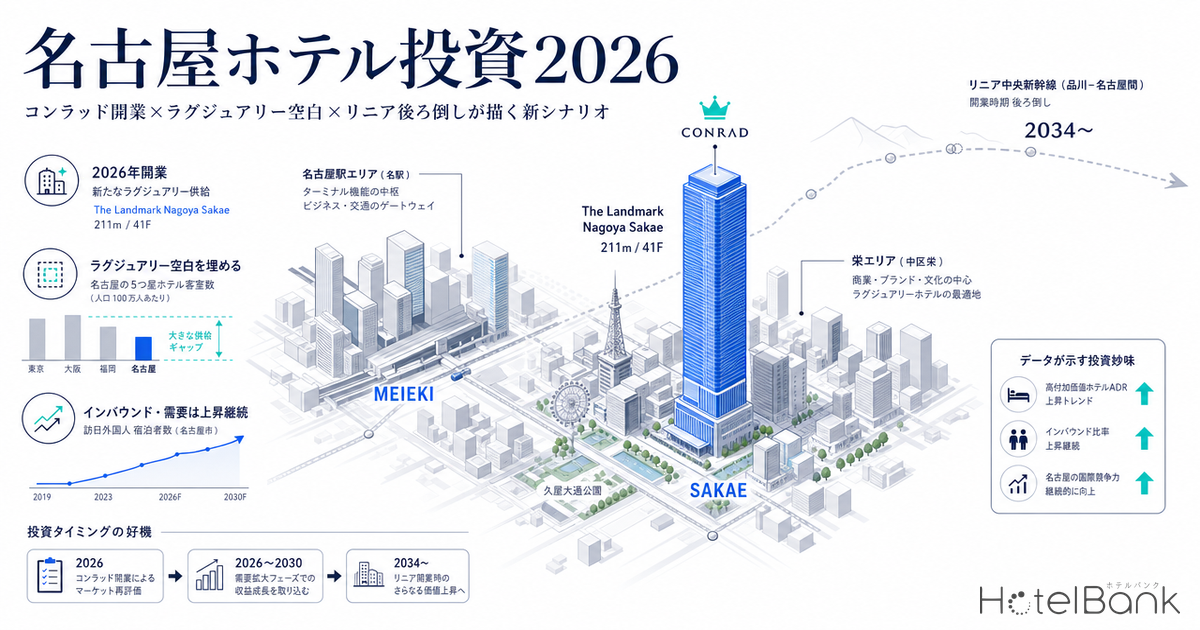
The Nagoya hotel market has reached an inflection point. Aichi prefecture’s ADR (Average Daily Rate) rose +25% year-on-year in April 2026, hitting record-high levels. In the Sakae area, The Landmark Nagoya Sakae (211m, the tallest building in Sakae) opens in June 2026, and on July 31 Conrad Nagoya (170 rooms) will debut as Aichi’s first luxury hotel. However, the Linear Chuo Shinkansen’s planned 2027 launch was abandoned by JR Central and pushed back to “2034 or later,” and the 540-billion-yen Meitetsu Nagoya Station redevelopment was suspended at the end of 2025 due to surging construction costs. This article integrates public-price data (MetroEngines Research), the 2026 land price publication, JTA accommodation statistics, and monthly operating performance from multiple REITs to analyze the current state of Nagoya hotel investment and the timing of the next investment window.
Metric Definitions Used in This Article
- ADR (Average Daily Rate): The average of selling prices publicly listed on OTAs and similar channels. This differs from actual transacted prices (when cross-checked against REIT disclosures, this measure tends to run +25–30% higher than transacted ADR — because unsold high-tier plans linger on OTAs, the average of listed prices skews upward versus realized prices). Per-room rate for double occupancy (tax included), averaged across all plans (room-only through meal-inclusive).
- OCC (Occupancy Rate): The ratio of sold rooms to total rooms in the area (estimated from OTA inventory).
- RevPAR (Revenue Per Available Room): Calculated as ADR × OCC.
- Data Source: MetroEngines Research & Consulting
Executive Summary — A Third Luxury Market Candidate Emerges Alongside Risk Factors
Nagoya has long been the fourth metropolitan area after Tokyo, Osaka, and Kyoto, with sustained growth in lodging demand. In 2026, two structural shifts are unfolding simultaneously. First, the completion of The Landmark Nagoya Sakae (completed March 2026, commercial opening June 11) and the debut of Conrad Nagoya on its top floors (July 31, 2026, 170 rooms) will, for the first time, add luxury-tier supply. Second, a continuous wave of upper-grade openings — including Espacio Nagoya Castle (October 2025, 100 rooms, on the former Nagoya Castle Hotel site) — is underway. On the other hand, the Linear Chuo Shinkansen’s 2027 launch, long viewed as Nagoya’s medium-to-long-term demand catalyst, was officially abandoned by JR Central in March 2024 and pushed back to “2034 or later.” On top of that, the 540-billion-yen Meitetsu Nagoya Station redevelopment was publicly suspended at the end of 2025, leaving Nagoya’s redevelopment clock temporarily stopped. This asymmetric situation — “increasing luxury supply × delayed infrastructure catalyst” — redefines the near-term investment scenario.
Market Trends — Aichi ADR Has Risen Structurally +30% Over the Past 24 Months
Aichi prefecture’s monthly ADR was ¥22,000 in April 2024, but as of May 2026 it stands at ¥31,800 — a structural increase of +44% over 24 months. Year-on-year, 2025 saw a steady range of +5% to +24%, and from the start of 2026 it shifted into a phase of rapid acceleration at +25% to +46% every month. This pace exceeds Tokyo (+8% over the same period) and Osaka (+22%) and, while still below Kyoto’s high ADR level (around ¥48,000), has finally caught up with Osaka in pricing. For weekday ADR trends in the four cities focused on business demand, our analysis in Tokyo, Nagoya, Osaka and Fukuoka Weekday ADR Analysis: Visualizing the Recovery of Business Demand visualizes the data, and reading it alongside this article’s monthly ADR deepens the understanding of demand structure.
What stands out is the acceleration of growth. Aichi’s ADR rose roughly +13% YoY across full-year 2025, but from the start of 2026 it stepped up to +25%–+46%. This contrasts with Tokyo and Osaka, where growth rates have been narrowing in the same period, and reflects Nagoya’s structural demand expansion — particularly the regional dispersion effect following inbound recovery and business demand from the Chukyo region’s manufacturing rebound. At the same time, since luxury-tier supply has been limited prior to the openings of Conrad and Espacio, demand may have concentrated on existing upper-grade properties, pushing rates higher.
Location Analysis — Sakae Commercial Land +5.1%, Meieki +5.0%; Land Prices Keep Rising Despite Stalled Redevelopment
The Sakae area’s (Naka Ward, Nagoya City) commercial land publication price rose a solid +5.12% in 2026. The highest-priced point in Naka Ward is at Sakae 3-5-1 at ¥12.1 million per square meter, making Sakae the highest-priced area in Naka Ward. Meanwhile, the Meieki area (Nakamura Ward) recorded +5.01% for commercial land and +4.73% for all-use average, holding the top growth rate in the prefecture. The highest-priced point is around Midland Square in Nakamura Ward Meieki 4-chome — also the highest-priced point in all of Aichi. According to Nikkei, the 2026 publication price for Aichi commercial land overall rose only +3.2%, decelerating from the previous year’s +5.0%, with reports describing “deceleration tied to the slowdown in Nagoya redevelopment.”
| Central Station | Sakae Stn (Higashiyama / Meijo Lines) |
| Properties in Area | 132 properties |
| Total Rooms in Area | 20,687 rooms |
| Commercial Land 2026 | +5.12% |
| Highest-Priced Point | Sakae 3-5-1 / ¥12.1m/㎡ |
| Key Landmark | The Landmark Nagoya Sakae (211m) |
| Central Station | Nagoya Stn (Tokaido Shinkansen, etc.) |
| Properties in Area | 174 properties |
| Total Rooms in Area | 20,852 rooms |
| Commercial Land 2026 | +5.01% |
| Highest-Priced Point | Nakamura Ward Meieki 4-chome |
| Key Plan | Meitetsu Redevelopment (Suspended) |
While the rate of land price increase decelerated from the previous year, absolute levels in both Sakae and Meieki remain at the top of the prefecture. Sakae has been supported by the completion of The Landmark Nagoya Sakae (March 31, 2026), and Meieki — despite the suspension of the Meitetsu Nagoya Station redevelopment — continues to rise on the back of JR Central’s plans for the area around Nagoya Station and steady demand from existing tenants.
Competitive Landscape — Supply by Grade Concentrated in Mid/Economy Tiers; Upper Tier is Oligopolistic
When we rank the major properties in Sakae and Meieki by ADR, the upper grades are concentrated among a limited set of players: Marriott Associa, Hilton, Nagoya Kanko Hotel, and The Royal Park Hotel Iconic Nagoya. In particular, the ¥80,000+ band is occupied solely by Marriott Associa (¥79,400), and Conrad Nagoya (170 rooms, opening July 31, 2026) will enter as the second player in this tier. We examine the broader investor-perspective market impact of luxury hotels opening in 2026, including Conrad, in detail in Six Luxury Hotels Opening in 2026: Investor-Perspective Market Impact Analysis.
| Major Property | Rooms | ADR | Grade | Location |
|---|---|---|---|---|
| Nagoya Marriott Associa Hotel | 765 | ¥79,400 | Luxury | Meieki |
| Hilton Nagoya | 460 | ¥61,600 | Luxury | Sakae/Meieki midpoint |
| Nagoya Kanko Hotel | 369 | ¥60,200 | Luxury | Sakae |
| The Royal Park Hotel Iconic Nagoya | 246 | ¥57,900 | Luxury | Meieki |
| Nagoya Tokyu Hotel | 564 | ¥49,500 | Luxury | Sakae |
| Nagoya JR Gate Tower Hotel | 350 | ¥48,600 | Upper Midscale | Meieki |
| Meitetsu Grand Hotel | 241 | ¥43,200 | Midscale | Meieki |
| Courtyard by Marriott Nagoya | 360 | ¥42,300 | Upper Midscale | Meieki |
| Mitsui Garden Hotel Nagoya Premier | 295 | ¥36,700 | Luxury | Meieki |
| Conrad Nagoya Opening July 2026 | 170 | ¥80k–120k (forecast) | Luxury | Sakae (Landmark) |
Notably, luxury-tier properties skew toward large-scale assets (Marriott 765 rooms, Tokyu 564, Hilton 460), while mid-scale luxury at around 200 rooms is limited to Nagoya Kanko Hotel, Iconic Nagoya, and Mitsui Garden Premier. Conrad Nagoya’s 170-room scale lands squarely in this gap. On top of that, Espacio Nagoya Castle (opened October 2025, 100 rooms, on the former Nagoya Castle Hotel site) opened on the west side of Nagoya Castle with an ultra-high-end configuration of 70㎡ average per room and 100 rooms plus a club lounge. Effectively, Nagoya’s luxury tier will see a net gain of two properties and two brands (Conrad + Espacio) over the two-year period 2025–2026.
Positioning Analysis — Mapping the Gap by Room Scale × ADR
Plotting the 27 main properties across Sakae and Meieki on a chart of room count (X-axis) by ADR (Y-axis) reveals three distinct zones. First, a “mainstream” zone where mid-/economy-tier properties (200–400 rooms, ADR ¥15,000–¥25,000) cluster densely. Second, a “luxury oligopoly” zone where 8 properties are scattered across the upper tier (ADR ¥40,000–¥80,000). Third, the mid-scale luxury band of ADR ¥80,000–¥120,000 with 100–250 rooms remains almost entirely empty.
DENSE Saturated Zone
ADR ¥15k–¥25k × 200–400 rooms
APA, Route Inn, Tokyu REI, Meitetsu Inn, etc., densely packed. Centered on business demand. New entrants face severe differentiation challenges.
WS① Mid-scale Upper Midscale
ADR ¥40k–¥60k × 200–350 rooms
JR Gate Tower and Courtyard sparsely distributed. Especially under-supplied in Sakae. Rebrand opportunities exist.
WS② Mid-scale Luxury
ADR ¥80k–¥120k × 100–250 rooms
Effectively empty aside from Marriott (765 rooms, large-scale). Conrad Nagoya lands here. Espacio also enters at 100 rooms.
Conrad Nagoya’s 170 rooms and forecast ADR of ¥80,000–¥120,000 land in WS②, an effectively empty band in today’s Nagoya market. As Nagoya’s first Hilton-affiliated luxury brand, it aims to establish itself in the third city after Tokyo (Conrad Tokyo, Atago) and Osaka (Conrad Osaka). With Marriott-branded properties (Marriott Associa, Courtyard) leading in Meieki, Hilton-branded properties (existing Hilton Nagoya, new Conrad Nagoya) will strengthen presence in Sakae, lifting inter-area competition to a new stage. For the supply-demand balance of the adjacent Kansai region’s luxury tier, our analysis in Kansai Luxury Hotel Supply-Demand Inflection Point — Reading 2026 Through DBJ Estimates and OTA Reality provides useful context, and comparing the Keihanshin market clarifies Nagoya’s relative position.
Investment Scenario Estimates — Conrad, The Landmark, and Future Meitetsu Redevelopment
Below we present rough yield estimates for three investment scenarios premised on Nagoya’s major redevelopment and new openings. Note that The Landmark Nagoya Sakae has already been developed by a Mitsubishi Estate-led consortium and is not subject to standalone acquisition; it is included here purely to quantify market impact.
| Item | A. Conrad Nagoya Confirmed | B. The Landmark High-rise Mixed-use Reference | C. Meitetsu Nagoya Stn Redevelopment Suspended |
|---|---|---|---|
| Rooms | 170 rooms | Mixed-use (office+retail+hotel) | ~1,000 rooms (planned) |
| Opening Timing | July 31, 2026 | Completed March 2026 | 2033 → delayed |
| Assumed ADR | ¥85,000–120,000 | Mixed ¥30,000–60,000 band | ¥40,000–70,000 (planned) |
| Year-1 OCC Assumption | 55–65% | Existing properties bundled | Not yet operational |
| Year-1 RevPAR (mid) | ¥56,000 | Use of existing properties | N/A |
| Year-1 Revenue (rough) | ~¥3.4 billion | Calculated for whole tower | Not started |
| Construction Cost | ¥2.0–3.0m per tsubo | ~¥3.0–4.0m per tsubo (whole tower) | Significantly above plan at 2025 suspension |
| Key Risks | Ramp-up OCC, MICE demand | Tenant competition, mixed-use ops | Restart timing unclear |
A. Conrad Nagoya (Based on Confirmed Information)
With 170 rooms, ADR of ¥85,000–¥120,000, and a Year-1 OCC of 55–65%, Year-1 revenue would be on the order of ¥3.4 billion. As a Hilton-affiliated luxury brand, integration of distribution channels with Hilton Nagoya (460 rooms, existing) and leverage of the Hilton Honors loyalty base should support OCC during ramp-up. Looking at JTA accommodation statistics, the latest national city-hotel occupancy for full-year 2024 stands at roughly 80%, with luxury tier expected to run higher. For MICE demand, integration with The Landmark Nagoya Sakae’s banquet halls and conference rooms is expected to capture corporate MICE and international conference bookings.
B. The Landmark Nagoya Sakae (Market Impact)
Developed by a consortium of preferred partners — Mitsubishi Estate, Japan Post Real Estate, Meiji Yasuda Life Insurance, and Chunichi Shimbun — with 41 floors above ground, 4 below, total floor area of approximately 110,000㎡, and a height of 211 meters. Construction began in July 2022, completion was reached on March 31, 2026, the “HAERA” commercial facility opened on June 11, and Conrad Nagoya opens July 31, in a phased opening pattern. As Sakae’s first TOHO Cinemas location and a culture-and-exchange complex, it should lift the Sakae area’s overall draw. Spillover effects on existing hotels in the area include extended stays and higher per-night rates from strengthened retail and MICE functions.
C. Meitetsu Nagoya Station Redevelopment (Future Option, Currently Suspended)
The original plan called for demolition starting in FY2026, new construction starting FY2027, Phase 1 completion in FY2033, and full completion in the early 2040s, but Meitetsu announced suspension at the end of 2025. Cited reasons include surging construction costs and extended construction periods (significantly above original assumptions) and difficulty securing skilled labor. The Meitetsu Department Store flagship closed as planned, but the Meitetsu Grand Hotel reversed its closure decision and continues to operate. The site is approximately 9,890 tsubo with about 157,300 tsubo of total floor area planned, and the integrated retail + office + hotel + rail station + bus terminal concept remains intact. Aligned with the Linear Nagoya Station opening (2034 or later), the project plan is likely to be revisited in the early 2030s, at which point a window for investment participation should reopen.
Macro Environment — The Twin Constraints of Linear Delay and Construction Cost Inflation
The biggest premise change for Nagoya hotel investment is the timing of the Linear Chuo Shinkansen. JR Central abandoned the 2027 launch in March 2024 and announced a delay to 2034 or later. In addition to no clear path for starting work in the Shizuoka section, it has emerged that across all 18 sections, none will be ready by 2027. The latest reports suggest 2035 (Reiwa 17) or later. With this delay, the originally assumed scenarios — “Tokyo–Nagoya in 40 minutes, business demand +25%” and “Kyoto-routed tourism demand +15%” — are pushed out into the late 2030s. For the relationship between current Shinkansen stations and hotel ADR, our comparison of 15 stations including Nagoya in 15 Shinkansen Stations × Hotel ADR: Is There a Real Direct-Connection Premium? serves as material for assessing the value of station-area hotels under the current Linear-free baseline.
Construction-cost overruns also weigh on investment decisions. According to the MLIT “Construction Statistics,” 2024 hotel construction cost averaged about ¥1.95m/tsubo across all structures and ¥1.736m/tsubo for RC, up +41% in just two years from 2022 (about ¥1.38m/tsubo). Furthermore, JLL’s 2025 Japan Hotel Investment Market report shows Japan’s new supply ratio at just 1.5–1.7% versus the APAC average of 6.6%, confirming that surging construction costs are raising the barrier to new development. The suspension of the Meitetsu redevelopment is a symbolic case, with developer balance-sheet strength now under particular scrutiny.
REIT Portfolios — Latest Operating Results for Nagoya Properties
Among the seven major REITs, Invincible Investment Corporation (8963) holds two Nagoya properties: Hotel MyStays Nagoya Nishiki and Hotel MyStays Nagoya Sakae. The latest operating results for both are below.
| Property | OCC | ADR (transacted) | RevPAR |
|---|---|---|---|
| Hotel MyStays Nagoya Nishiki | 92.6% | ¥11,654 | ¥10,791 |
| Hotel MyStays Nagoya Sakae | 68.1% | ¥10,907 | ¥7,433 |
| Invincible Total (91 properties) | 87.6% | ¥14,529 | ¥12,721 |
The total Invincible portfolio (91 properties, operated by MHM) recorded a GOP margin of 38.9% for FY ending December 2024 (vs 39.8% pre-COVID in 2019). These figures are for stabilized existing properties, and industry convention is to set Year-1 of new openings conservatively at around +30%. With Nagoya’s luxury tier (Conrad, Espacio, etc.) now being added, the pool of luxury candidates suitable for REIT inclusion expands, and over the medium-to-long term there is potential for inclusion in upper-tier portfolios such as Mori Trust Hotel Reit (8961) and Japan Hotel REIT (8985).
Sensitivity Analysis — Scenario Resilience to Variations in ADR and OCC Assumptions
Against a base case for Conrad Nagoya (ADR ¥100,000, OCC 60%), we calculate revenue sensitivity for three scenarios: ADR -10%, OCC -5pt, and both downside.
| Scenario | ADR | OCC | RevPAR | Annual Revenue (rough) | Variance |
|---|---|---|---|---|---|
| Base Case | ¥100,000 | 60.0% | ¥60,000 | ¥3.72bn | — |
| ADR -10% | ¥90,000 | 60.0% | ¥54,000 | ¥3.35bn | -10.0% |
| OCC -5pt | ¥100,000 | 55.0% | ¥55,000 | ¥3.41bn | -8.3% |
| Both Downside | ¥90,000 | 55.0% | ¥49,500 | ¥3.07bn | -17.4% |
If ADR or OCC alone misses the base case, annual revenue declines by 8–10%, keeping cash flow positive. Even in the worst case where both miss, the decline stays at -17.4%, leaving a GOP buffer equal to roughly 30% of Conrad’s total operating expenses. Even if business demand growth comes in slower than initially expected due to the Linear delay, inbound recovery and structural luxury-demand expansion should provide downside support.
Conclusion — Nagoya is the Third Luxury Candidate, but the Investment Window Comes in Two Phases (2026–2028 and the 2030s)
First, Nagoya effectively reaches the starting line as the third luxury market candidate in 2026. Conrad Nagoya (170 rooms, Sakae) opens, joined by the earlier debut of Espacio Nagoya Castle (100 rooms, west of Nagoya Castle) and the existing strength of upper-tier players in the ¥50,000–¥80,000 band — Marriott, Hilton, Tokyu, Kanko Hotel, and others — making the choice set in the luxury-to-upper-midscale tiers comparable in scale to Tokyo, Osaka, and Kyoto.
Second, the ADR-growth momentum is expected to continue into 2026. Aichi’s ADR has risen +44% over the past 24 months, and as of May 2026 sits at ¥31,800, +30.9% year-on-year. The Sakae area, currently in the ¥35,000 band, is expected to be revised upward into the ¥40,000 band as Conrad and The Landmark openings take effect. Note that this is the average of public listing prices; transacted ADR sits 25–30% below the listed average, which warrants attention.
Third, the timing of the investment window comes in two phases. Phase 1 (2026–2028): opportunities for stabilization of new luxury assets like Conrad and Espacio, repricing of ADR/OCC, and cap rate compression. Phase 2 (early 2030s): opportunities for redevelopment participation and REIT inclusion once the Linear Chuo Shinkansen’s opening date is confirmed and the Meitetsu Nagoya Station redevelopment restarts. The Linear delay and Meitetsu suspension are short-term negatives, but in the medium-to-long term they also function as a “phased supply-demand adjustment that prevents overheating.”
Fourth, the risk factors are: (1) further delay of the Linear opening (potentially 2035 or later); (2) continued construction-cost inflation slowing new development; (3) MICE demand dispersion to competing cities (Tokyo, Osaka, Kyoto, Fukuoka); and (4) geopolitical fluctuations in inbound demand. These are not Nagoya-specific risks but apply to the Japanese hotel market broadly; however, given Nagoya’s high reliance on the Linear narrative, risk (1) carries particular weight. Investment decisions should include stress tests with assumptions that do not over-rely on the Linear opening.
⚠ Note on Future-Date ADR: ADR figures in this article are the average of selling prices publicly listed on OTAs at the time of research and shift as check-in dates approach. Currently elevated prices may decline due to last-minute discounts, which warrants attention. This is a simplified estimate; actual investment decisions require detailed feasibility studies.
Related Articles
- Six Luxury Hotels Opening in 2026: Investor-Perspective Market Impact Analysis
- Tokyo, Nagoya, Osaka and Fukuoka Weekday ADR Analysis: Visualizing the Recovery of Business Demand
- 15 Shinkansen Stations × Hotel ADR: Is There a Real Direct-Connection Premium?
- Marriott vs Hyatt Japan Expansion Strategy by Data: 122 Properties / 15 Brands vs 22 Properties / 7 Brands — Who Are the Next Foreign Brands to Enter Regional Japan?
- Foreign-Brand Rebrand Strategy: A Faster, Cheaper Path to Brand Status Than New Construction
- Three Hotels Opening in 2026: Pre-empting the Competitive Set — Imperial Hotel Kyoto, Hamamatsu Marriott, Hilton Takayama Resort
- Kansai Luxury Hotel Supply-Demand Inflection Point — Reading 2026 Through DBJ Estimates and OTA Reality
- Impact of Osaka Expo on Hotel ADR: Verified by REIT, OTA, and Other Data
- Sakou 3km-Radius Hotel Market: Current Supply, Pricing, and Outlook
References & Sources
■ Market Data
- MetroEngines Research & Consulting — OTA public-price data (606 properties in Aichi, 1,777 in Tokyo, 860 in Osaka, 1,486 in Kyoto, as of April 2026); Positioning analysis (Sakae + Meieki, N = 27 properties)
■ Government Statistics & Public Data
- JTA “Accommodation Travel Statistics Survey”
- e-Stat “Accommodation Travel Statistics Survey – Room Occupancy Rate” (Statistics ID: 0003313904)
- MLIT “Construction Starts Statistics” (2024 hotel construction cost: all-structure average ¥1.95m/tsubo, RC ¥1.736m/tsubo)
- Nagoya City “Land Price Publication (Residential and Commercial Average Prices)”
- Aichi Prefecture “Land Price Information (Land Price Survey and Publication)”
- Nikkei “Land Price Publication 2026: Aichi Commercial Land Slows to +3.2% — Deceleration Tied to Stalled Nagoya Redevelopment”
■ Project Official Releases
- Mitsubishi Estate “The Landmark Nagoya Sakae Has Been Born” (March 17, 2026)
- Nikkei “The Landmark Nagoya Sakae Completed and Opened to Press — 211m, Tallest in Sakae”
- Hilton Official “Conrad Nagoya Scheduled to Open in Sakae, Nagoya in 2026”
- “Conrad Nagoya to Open July 31, 2026” (170 rooms, Hilton’s top luxury brand)
- Travel Voice “Espacio Nagoya Castle Opens” (Former Nagoya Castle Hotel site, 100 rooms)
■ Redevelopment & Infrastructure
- Nikkei “JR Central Abandons 2027 Linear Opening, No Path to Start in Shizuoka”
- Tokyo Shimbun “Linear Opening Outlook… All 18 Sections Confirmed Not in Time for 2027”
- “What the Stalled ¥540 Billion Meitetsu Redevelopment Means” (Suspended at end of 2025)
- ITmedia “Meitetsu Nagoya Station, ¥540 Billion Redevelopment — How Will ‘4-Track Conversion’ Change the Station?”
■ REIT & Industry Reports
- Invincible Investment Corporation (8963) Monthly Operating Results (March 2026)
- JLL “2025 Japan Hotel Investment Market” (New supply ratio 1.5–1.7% on construction-cost inflation)
- Hotel MyStays Nagoya Nishiki / Sakae property-level results (Invincible Investment Corporation disclosures)