

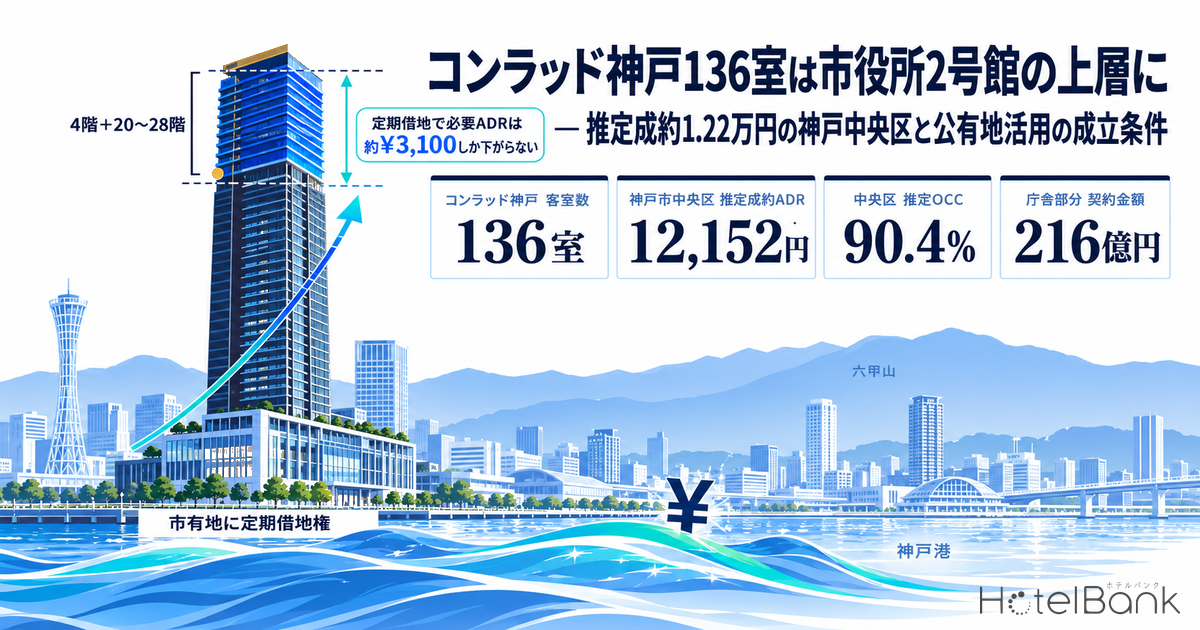
On the site of Kobe City Hall Main Building No. 2, a seven-company consortium led by ORIX Real Estate is building a 29-storey mixed-use tower with approx. 77,000㎡ of gross floor area, and Conrad Kobe (136 rooms) is scheduled to open on its 4th floor and 20th–28th floors in 2030. The land stays city-owned under a fixed-term leasehold; the private consortium develops the entire building and the city buys back the government-office portion. This article tests the conditions under which a top-tier price band can work in Kobe’s Chuo Ward, where the estimated settled ADR is about ¥12,200, in four steps: the public-land project scheme, measured rates and inventory, location, and a simple model of how much “not buying the land” actually moves the required ADR.
Metric Definitions Used in This Article
- ADR (average daily rate): an estimated settled rate (tax-excluded equivalent), calculated by applying segment-specific adjustment factors to the lowest-plan rate each property publishes on major booking sites (per room, 2 adults per room, tax included). Checked against property-level actuals disclosed by listed hotel REITs (184 property-months, April–May 2026), the median error is about 7.5%. These are estimates and differ from each property’s actual settled prices and accounting figures. Area-level ADR is the median of the properties covered (the level of a typical property in the area). Property-level ADR is the simple average of monthly estimates from September 2025 to August 2026 (11 months, excluding November 2025, when property coverage was thin).
- Listed price: the average of all plans published on major booking sites (per room, 2 adults per room, tax included). Because its level differs from the estimated settled ADR, the text always labels which one is meant.
- OCC (occupancy): rooms sold as a share of total rooms in the area (an estimate based on OTA sales inventory). This article uses a fixed cohort of properties that list at least 30% of their total rooms on major booking sites, and states the number of properties and rooms.
- LT (lead time): days before check-in. LT0 = same day. Inventory trends use LT45 and inside only.
- Required ADR: in this article’s model, the average room rate needed for NOI yield on invested capital to reach the target level (5.0%). All assumptions are listed in the assumptions table below.
- Data sources: MetroEngines Research & Consulting; published materials from Kobe City, the Ministry of Land, Infrastructure, Transport and Tourism (MLIT) and Hilton
- — The scheme is “fixed-term leasehold on city-owned land + private development of the whole building + city buyback of the government-office portion.” The contract value for the government-office portion was raised from a ¥11.0bn reserve price to ¥21.6bn. The city places a top-tier brand on its land without selling the land.
- — Kobe Chuo Ward’s estimated settled ADR is ¥12,152 on a 12-month average. January–August 2026 averaged ¥11,151, up 3.4% YoY. Of the 48 properties within 1.5km of City Hall, 5 have an estimated settled ADR of ¥30,000 or more and none exceeds ¥60,000: the price band Conrad will occupy does not exist in today’s market.
- — Supply and demand are tight. Chuo Ward’s estimated OCC (38 properties, 5,475 rooms) was 90.4% in both August and September 2026. On Saturday, September 19, 2026, the four properties with an estimated settled ADR of ¥30,000+ reached room-based occupancy of 89.7–100% at LT14.
- — In a simple model, a fixed-term leasehold at a 4.5% ground-rent yield lowers the required ADR by only about ¥3,100 (4%) versus buying the land. Occupancy and GOP margin matter far more than the weight of the land. The value of the public-land scheme lies not in lowering the rate but in “securing a prime site with views without going through the market, and sharing project costs with the government offices and offices.”
- — 8 projects / approx. 1,290 rooms (6 projects / approx. 990 rooms on a net-new basis) are in the pipeline for Sannomiya, Motomachi and Kobe Port through 2030, but the only top-tier supply is Conrad Kobe’s 136 rooms. Kumoidori 5-chome (approx. 70 rooms) and the new JR Sannomiya Station building (approx. 250 rooms) will fill the upper band just below it.
The Scheme — The City Keeps the Land, the Private Sector Builds, the City Buys Back Only the Offices
To rebuild Main Building No. 2 (completed 1957), Kobe City chose a public-private partnership that puts private revenue-generating uses in the same building, rather than a stand-alone public works contract for the offices. Kobe City’s “Basic Plan for the Redevelopment of Main Building No. 2 (Revised Edition, August 2021)” explicitly lists as candidate methods “the entire building to be developed by a private operator under a fixed-term leasehold” and “the city to occupy the government-office portion by purchase or lease,” and names “a high-class hotel” and “an international business hub” as examples of private functions to be introduced. The tender announced in August 2021 set a reserve price of ¥11.0bn (¥10.5bn for administrative functions and ¥0.5bn for demolition and removal, tax included), and in 2022 a consortium led by ORIX Real Estate was selected.
After an amendment to the project contract reflecting soaring material costs and other factors, the contract value for the government-office portion has been raised to ¥21.6bn (The Daily Engineering & Construction News, May 18, 2026). Full-scale construction began in June 2026, with completion scheduled for September 2029 and the hotel opening in 2030 (ORIX Real Estate et al., announced June 12, 2026). On the same day, Hilton announced it would open Conrad Kobe (136 rooms) in the tower.
| Item | Details | Source |
|---|---|---|
| Project name / location | Kobe City Hall Main Building No. 2 Redevelopment Project / 6-5-1 Kano-cho, Chuo-ku, Kobe | Kobe City, ORIX Real Estate |
| Land tenure | Fixed-term leasehold set on city-owned land; the private operator develops the entire building and hands over the administrative-function portion to the city | Kobe City Basic Plan (Revised), tender notice (published by JETRO) |
| Site / scale | Site approx. 4,900㎡, building area approx. 4,350㎡, GFA approx. 77,000㎡, 2 basement floors / 29 floors above ground / 1 penthouse floor, height approx. 135m, S/SRC/RC structure | ORIX Real Estate, June 12, 2026 |
| Use mix | Lower floors: city offices and public space, 3 retail floors (connected to the underground mall) / Middle floors: offices (typical floor approx. 500 tsubo) / 4F and 20F–28F: Conrad Kobe, 136 rooms (approx. 50㎡ per room) | Same as above; Hilton, June 12, 2026 |
| Contract value, government-office portion | Reserve price ¥11.0bn (announced Aug 2021) → raised to ¥21.6bn | Tender information published by JETRO; The Daily Engineering & Construction News, May 18, 2026 |
| Developers | Lead: ORIX Real Estate / Hankyu Hanshin Properties, Kanden Realty & Development, Daiwa House Industry, Fuyo General Lease, Takenaka Corporation, Yasuda Real Estate | Kobe City, ORIX Real Estate |
| Schedule | Full-scale construction June 2026 → completion September 2029 → hotel opening planned for 2030 | ORIX Real Estate, Hilton |
Three points of this scheme deserve attention. First, the land never goes to market. In open tenders for state or public land, the land acquisition price itself is what bidders compete on; here the private sector does not buy the land but pays ground rent and owns the building. Second, there is a committed buyer for a defined block of floor space: the government offices. Because the city buys the administrative portion of the 77,000㎡ GFA, the floors the private side must sell or lease on the market are limited to retail, office and hotel. Third, uses are separated vertically, and the hotel is placed on the highest floors. As HotelBank has noted in its analysis of the Sannomiya redevelopment tower, office rents barely respond to floor height, while hotel room rates do respond to views. Putting lodging on the top floors, with views of both the sea and the mountains, is a consequence of the financing plan.
Kobe Chuo Ward’s Estimated Settled ADR Is ¥12,200 — Above the Top 5 Properties Lies an Empty Band Over ¥60,000
First, consider where the market Conrad is entering stands today. Kobe Chuo Ward’s estimated settled ADR averaged ¥12,152 over the 12 months from September 2025 to August 2026 (63–64 properties per month, except November 2025, when coverage was thin at 32 properties; the 11-month average excluding that month is ¥11,625). The January–August 2026 average was ¥11,151, up 3.4% from ¥10,780 a year earlier. Hyogo Prefecture as a whole averaged ¥13,167 over the same period (up 2.7% YoY, 536–565 properties), so Chuo Ward sits slightly below the prefectural average. This is because Chuo Ward is a business district dominated by business hotels, while hot-spring ryokan in Arima and Tajima lift the prefectural average.
Next, look at the distribution by property. Splitting the 48 properties within a 1.5km radius of City Hall Building No. 2 for which an estimated settled ADR could be calculated (7,963 rooms in total) by rate band, as the table below shows, 37 properties are below ¥15,000, 5 are at ¥30,000 or more, and none is above ¥60,000. Only 6 properties have a listed price (all-plan average, tax included) of ¥46,800 or more, the top 10%. Because only 17 city hotels are covered, segment-level estimated settled ADR is not used; this article uses figures for the ward as a whole only.
| Est. settled ADR band | Properties | Share | Main segments / characteristics |
|---|---|---|---|
| Above ¥60,000 | 0 | 0% | None (the band Conrad Kobe will create) |
| ¥30,000–60,000 | 5 | 10% | Small to mid-size hotels in Kitano, the Former Foreign Settlement and the waterfront, plus a hot-spring resort (30–323 rooms) |
| ¥20,000–30,000 | 1 | 2% | Large city hotel (468 rooms) |
| ¥15,000–20,000 | 5 | 10% | Newer lodging-focused hotels |
| Below ¥15,000 | 37 | 77% | Mainly business hotels and limited-service hotels |
The five properties at ¥30,000 or more are Kobe Kitano Hotel (30 rooms, est. settled approx. ¥57,600), Hotel La Suite Kobe Harborland (70 rooms, approx. ¥46,700), THE ORIENT in the Former Foreign Settlement, renamed from Oriental Hotel in February 2026 (116 rooms, approx. ¥43,100), Kobe Minato Onsen Ren (90 rooms, approx. ¥36,900), and Kobe Meriken Park Oriental Hotel (323 rooms, approx. ¥33,400). Each has a distinctive asset — views, hot springs or a historic location — and these five have been the ones actually absorbing high-rate demand in central Kobe. Conrad Kobe will create a new, higher band on top of them.
Positioning — 100–300 Rooms × Above ¥60,000 Is Empty; Conrad’s Domestic Listed Prices Run ¥150,000–170,000
Crowded Occupied zone
Below ¥15,000 × 30–340 rooms
37 properties. Business hotels cluster around Sannomiya Station; new entrants must differentiate on something other than price.
WS1 Upper midscale
¥20,000–30,000 × 150–300 rooms
Only 1 property. This is the gap also identified in our five-layer analysis of Hyogo, and the new JR Sannomiya Station building (approx. 250 rooms, opening planned for FY2029) is positioned to target it.
WS2 Top tier
Above ¥60,000 × 100–300 rooms
0 properties. Conrad Kobe (136 rooms) will create this band on its own. With no track record for this band in the city, the reference points are the same brand’s hotels elsewhere in Japan.
According to Hilton’s “Company Overview” (updated August 25, 2026), the Conrad hotels that serve as reference points in Japan are three in operation — Conrad Tokyo (291 rooms, opened 2005), Conrad Osaka (164 rooms, opened 2017) and Conrad Nagoya (170 rooms, opened 2026) — with Conrad Yokohama (272 rooms, opening planned for 2027) and Conrad Kobe (136 rooms, opening 2030) in the pipeline. Hilton operates 37 hotels under 9 brands in Japan and has announced 13 more in the pipeline. In MetroEngines Research’s figures, Conrad Osaka’s listed price (all-plan average, tax included, September 2025–August 2026) is about ¥151,800, and Conrad Tokyo’s about ¥172,500. These are listed levels, not estimated settled ADRs, and even compared with the listed prices of Kobe’s existing top 5 properties (¥58,100–90,300), the gap is roughly twofold.
Source: Hilton, “Company Overview” (updated August 25, 2026)
That Conrad Kobe is planned at 136 rooms, smaller than Tokyo, Osaka and Yokohama, can be seen as a rational design for a market with no existing track record in this band. A configuration of approx. 50㎡ per room, an approx. 500㎡ banquet hall, a spa and an indoor pool assumes substantial revenue from weddings, MICE and restaurants, not just rooms, and 136 rooms is a scale that will not overshoot the total volume of high-rate demand in Kobe. As the next section shows, the city’s upper band fills to around 90% on a room basis on weekends, so the existence of demand itself can be measured.
Measured Inventory — Estimated OCC of 90.4% (Aug & Sep 2026); Top-Band Properties Hit 89.7–100% Room-Based Occupancy at LT14 on a Holiday Saturday
Whether an empty rate band means “no demand” or “no supply” can be told from how fast inventory sells through. Kobe Chuo Ward’s estimated OCC (38 properties, 5,475 rooms, based on major booking-site listings) was 90.4% in August 2026 and again 90.4% in September. On the average booking curve for September, 2,149 rooms remained 45 days before the stay date (61% occupancy against an average of 5,560 total rooms), and this had sold down to 534 rooms (90%) by the day before.
To look by price band, for two past (finalized) dates — Friday, August 14, 2026 (Obon) and Saturday, September 19, 2026 (first day of the Silver Week holidays) — we matched the remaining-room trends of properties listing at least 30% of their total rooms on major booking sites against their estimated settled ADR (August 14: 25 of 32 properties in scope had a calculable rate; September 19: 18 of 25. In both cases, properties with listings below 30% of rooms were excluded from the 175 properties covered).
On Saturday, September 19, the four properties with an estimated settled ADR of ¥30,000 or more reached room-based occupancy of 89.7–100% at LT14, above the 85.4% average for properties below ¥15,000. Kobe Kitano Hotel (30 rooms) had 0 of 30 rooms remaining at LT40, and we observed a cumulative 27 sold-out days before the stay date. On Friday, August 14, the top four ranged from 53% to 90% and properties below ¥15,000 averaged 70.8%: on an Obon weekday, sell-through in the upper band varies from day to day. That the upper band fills first on a holiday Saturday shows that demand willing to pay high rates in central Kobe clearly exists, and that few rooms are available to capture it.
That said, these observations concern only the existing ¥30,000–60,000 band. There is no reference inventory above ¥60,000, and whether Conrad Kobe can fill 136 rooms in that band can only be confirmed by results after opening. Fast sell-through in the upper band is circumstantial evidence of “room to push rates one step higher,” but it does not guarantee a price band twice as high.
Location — South Sannomiya, Commercial Zone with 600% FAR and Land at ¥4.59M/㎡; 141,000 Workers Within 1km
The Building No. 2 site sits on Flower Road, midway between Sannomiya Station and the waterfront. According to the zoning data in MLIT’s Real Estate Information Library, the site is in a commercial zone (designated floor area ratio 600%, building coverage ratio 80%), and the city’s basic plan also lists it as a fire prevention district within the “Zeikansen Endo Minami” district plan. Simply dividing the approx. 77,000㎡ GFA by the approx. 4,900㎡ site gives about 15.7 times (including basement and floor area excluded from FAR), and this scale, far beyond the designated FAR, is achieved under the framework of the Act on Special Measures concerning Urban Renaissance. According to Kanko Keizai Shimbun (May 8, 2026), the project was certified by the Minister of Land, Infrastructure, Transport and Tourism as a private urban renaissance project plan. Nationally, only a small share of the floor area added through urban renaissance FAR bonuses has actually been converted into hotel rooms.
| Zoning | Commercial zone |
| Designated FAR / building coverage | 600% / 80% |
| Fire designation / district plan | Fire prevention district / Zeikansen Endo Minami district |
| Liquefaction tendency (250m mesh) | Natural levee, liquefaction-prone |
| Flood (max. assumed) / storm surge / landslide | Site not in any designated zone |
| Workers within 1km | 141,118 |
| Establishments within 1km | 11,138 |
| Share of office-type workers | 22.0% |
| Residents within 1.5km (2025) | 71,229 |
| Same, 2040 projection | 73,134 |
Land prices are ¥8.0M/㎡ at Sannomiya-cho 1-chome in front of Sannomiya Station (up 9.6% YoY), ¥4.59M/㎡ at Isogami-dori 8-chome near the site (up 11.4%), and ¥3.05M/㎡ at Kyo-machi on the Former Foreign Settlement side (up 5.9%). All points are rising, by 5.9–11.4% YoY, so if a private developer were to buy land for a project of the same scale, land costs would grow heavier every year. In this rising market, a scheme that sets a leasehold on city land has the effect of avoiding competition for land acquisition.
On the demand side, 11,138 establishments and 141,118 workers (22.0% in office-type jobs) are concentrated within 1km of the site. It is a business district where Kobe City Hall, the Hyogo Prefectural Government, financial institutions in the Former Foreign Settlement and port-related companies cluster, so the hotel can capture both weekday corporate demand and weekend leisure and wedding demand. The resident population within 1.5km is projected to edge up from 71,229 in 2025 to 73,134 in 2040, as the return to the city center continues. As the map below shows, residents are concentrated north of the site (the hillside) and to the east (Isogami and Yawata).
Simple Model — Not Buying the Land Cuts Required ADR by About ¥3,100, but Occupancy and GOP Margin Are What Matter
To see how much a fixed-term leasehold on public land helps a top-tier price band work, we compare a 136-room luxury hotel in two cases: “a private developer buys the land and builds” and “a leasehold is set on city land and the developer builds.” All assumptions are disclosed in the table below. The hotel portion’s floor area is set at 14,000㎡ (18.2% of the tower’s GFA), adding banquet, F&B, spa and back-of-house space to the room area of approx. 50㎡ × 136 rooms, and land attribution is apportioned by the same floor-area ratio.
| Item | Assumption | Basis / notes |
|---|---|---|
| Rooms / room size | 136 rooms / approx. 50㎡ | Figures announced by Hilton and ORIX Real Estate |
| Hotel floor area | 14,000㎡ (18.2% of the tower) | Rooms 6,800㎡ + banquet hall approx. 500㎡, F&B, spa and back-of-house. Our assumption |
| Construction cost | ¥3.3M/tsubo → ¥13.98bn | Midpoint of the ¥3.1–3.5M/tsubo benchmark for luxury hotels. Based on MLIT’s “Statistics on Building Construction Starts,” the 2025 average for lodging buildings across all structures was ¥1.952M/tsubo, and ¥2.405M/tsubo for steel frame (1 tsubo ≈ 3.3㎡) |
| FF&E (furniture, fixtures & equipment) | ¥20M per room → ¥2.72bn | Set by us as an initial investment level for the top tier |
| Land price | ¥4.0M/㎡ × 4,900㎡ site × 18.2% → ¥3.56bn | Between Isogami-dori 8-chome (¥4.59M/㎡) and Kyo-machi (¥3.05M/㎡). Counted only in the land-purchase case |
| Ground-rent yield (leasehold case) | 4.5% (sensitivity 2.0–6.0%) | Practical range for fixed-term business-use land leases; the same midpoint used in HotelBank’s 15-city land-lease model |
| Occupancy | 70% (sensitivity 60–80%) | Chuo Ward’s estimated OCC of 90.4% (Aug & Sep 2026, 38 properties) is a cohort figure across all segments, so 70% is used as a conservative first-year value for the top tier |
| Rooms revenue share | 55% (sensitivity 45–65%) | Full-service hotel with banquet, F&B and spa |
| GOP margin | 28% (sensitivity 22–34%) | Upper end of the 10–30% industry benchmark for full-service hotels. Reference: Invincible Investment Corporation’s GOP for its 91 operator-managed properties was 38.9% (fiscal period ended December 2024, including lodging-focused hotels) |
| FF&E reserve / property taxes, etc. | 4% of revenue / building 0.7%, land 1.2% (taxable base 70%) | Conservative setting |
| Target NOI yield | 5.0% | Annual NOI on invested capital (building + FF&E, plus land in the land-purchase case) |
| Item | A. Land purchase + building ownership | B. Fixed-term leasehold on public land + building ownership This project’s model |
|---|---|---|
| Invested capital (building + FF&E) | ¥16.70bn | ¥16.70bn |
| Land (apportioned) | ¥3.56bn | — (ground rent ¥0.16bn/yr) |
| Total invested capital | ¥20.26bn | ¥16.70bn |
| Target NOI (5.0%) | ¥1.01bn | ¥0.83bn |
| Required total revenue | ¥4.83bn | ¥4.63bn |
| Required ADR (70% occupancy) | ¥76,500 | ¥73,300 |
| Required ADR with construction-period inflation (construction cost +7.6%) | ¥80,500 | ¥77,300 |
The results are as follows. At a 4.5% ground-rent yield, the required ADR is ¥76,500 in the land-purchase case and ¥73,300 in the leasehold case. The difference is only about ¥3,100 (4%). The reason is simple: for a top-tier hotel, the building and FF&E are heavy at ¥16.70bn (about ¥123M per room), and the apportioned land of ¥3.56bn is only 18% of invested capital. For a business hotel, land can account for nearly half of invested capital, so a leasehold has a large effect; in luxury, that ratio is reversed. For the upper limit of ground rent that a leasehold can support, back-calculated from the market side, see also Leasehold Hotel Development: 1.38x Land Price Reach Across 9 Markets.
| Variable | Low | Base | High | Range of required ADR (leasehold case) |
|---|---|---|---|---|
| Ground-rent yield (2.0% / 4.5% / 6.0%) | ¥67,500 | ¥73,300 | ¥76,900 | About ¥9,400. At 6.0% ground rent it roughly matches land purchase (¥76,500). The break-even ground-rent yield is about 5.9% |
| Land price (¥3.05M / ¥4.0M / ¥4.59M per ㎡) | ¥70,800 | ¥73,300 | ¥74,900 | About ¥4,100. Land price swings only matter through ground rent |
| Occupancy (60% / 70% / 80%) | ¥85,600 | ¥73,300 | ¥64,200 | About ¥21,400. 10pt of occupancy matters more than the land model |
| GOP margin (22% / 28% / 34%) | ¥97,800 | ¥73,300 | ¥58,700 | About ¥39,100. Operating efficiency is the biggest variable |
| Rooms revenue share (45% / 55% / 65%) | ¥60,000 | ¥73,300 | ¥86,700 | The larger the banquet, F&B and spa revenue, the lower the rate required of rooms |
Because the one-variable sensitivity holds the other variables at base values, the range when occupancy and GOP margin move together is shown in the two-way table below (leasehold case, with the 4.5% ground-rent yield and 55% rooms revenue share held at base values).
Two-way sensitivity of required ADR — occupancy × GOP margin (fixed-term leasehold on public land)
| Occupancy \ GOP margin | 22% | 25% | 28% | 31% | 34% |
|---|---|---|---|---|---|
| Occupancy 60% | ¥114,100 Downside | ¥97,800 | ¥85,600 | ¥76,100 | ¥68,500 |
| Occupancy 65% | ¥105,300 | ¥90,300 | ¥79,000 | ¥70,200 | ¥63,200 |
| Occupancy 70% | ¥97,800 | ¥83,800 | ¥73,300 Base | ¥65,200 | ¥58,700 |
| Occupancy 75% | ¥91,300 | ¥78,200 | ¥68,500 | ¥60,900 | ¥54,800 |
| Occupancy 80% | ¥85,600 | ¥73,300 | ¥64,200 | ¥57,000 | ¥51,300 Upside |
The required ADR is ¥114,100 in the downside scenario (60% occupancy, 22% GOP margin) and ¥51,300 in the upside scenario (80% occupancy, 34% GOP margin), a range of about ¥63,000 around the base of ¥73,300. The difference between leasehold and land purchase (about ¥3,100) is only a few percent of this range, and the two-way table confirms that the two operating variables largely determine the project’s viability.
The ranking shown by the sensitivity tables is clear. GOP margin moves the required ADR the most (a range of about ¥39,100), followed by occupancy (about ¥21,400) and rooms revenue share, with ground-rent yield and land price below them. In other words, Conrad Kobe’s viability depends not on “the land being cheap because it is public,” but on whether it can fill 136 rooms at 70% year-round, generate substantial non-room revenue from the approx. 500㎡ banquet hall, restaurants and spa, and sustain a GOP margin that is high for a full-service hotel. The real value of the public-land scheme lies not in lowering the rate but in securing a prime site that would never come to market, and in sharing the costs of the building’s common areas, foundations and structure with the government offices, offices and retail. The hotel accounts for less than 20% of the 77,000㎡ GFA; the remaining 80% of uses form the backbone of the project.
Supply Through 2030 — 8 Projects / Approx. 1,290 Rooms in Sannomiya, Motomachi and Kobe Port (6 Projects / Approx. 990 Rooms Net New); Conrad Is the Only Top-Tier Addition
Below is the new supply that can be confirmed in the Sannomiya, Motomachi and Kobe Port areas through 2030, when Conrad Kobe opens. We list properties whose openings were confirmed on major booking sites alongside building plans from MLIT’s “Building Activity Statistics Survey” and developers’ published materials.
| Opening (planned) | Property / project | Rooms | Price band / notes | Source |
|---|---|---|---|---|
| April 2025 | Toyoko Inn Kobe Sannomiya Ekimae | 224 | Limited-service | Confirmed on major booking sites |
| December 2025 | Kobe Marriott Hotel (Kobe Port area; rebrand of the former Hotel Crown Palais Kobe) | 186 | Upper upscale | Confirmed on major booking sites; HotelBank on-site coverage |
| February 2026 | THE ORIENT (Former Foreign Settlement; renamed from Oriental Hotel) | 116 | Est. settled approx. ¥43,100 (11-month average including March–August 2026) | Confirmed on major booking sites |
| November 2026 (planned) | BASE LAYER HOTEL KOBE SANNOMIYA | 82 | City hotel | Confirmed on major booking sites |
| Completion July 2027 (planned) | Onoedori 5-chome hotel project (Daiwa House Realty Management) | 223 | 12 storeys, GFA 10,881㎡ | MLIT “Building Activity Statistics Survey” |
| Completion FY2027 (planned) | Kobe Sannomiya Kumoidori 5-chome redevelopment tower, lodging facility | approx. 70 | Floors 23–32 of a 32-storey tower. HotelBank’s earlier analysis estimated a required ADR of about ¥44,000 | MLIT “Building Activity Statistics Survey” |
| Opening FY2029 (planned) | New JR Sannomiya Station building hotel (upper floors) | approx. 250 | Promises high-quality rooms and lobby space. Brand not announced | Kobe Shimbun (March 2022), JR West announcement |
| Opening 2030 (planned) | Conrad Kobe (City Hall Building No. 2 redevelopment tower, 4F and 20F–28F) | 136 | Top tier (luxury) | Hilton “Company Overview” (updated August 25, 2026) |
The total is 8 projects / approx. 1,290 rooms, but THE ORIENT (formerly Oriental Hotel) and Kobe Marriott Hotel (formerly Hotel Crown Palais Kobe) are renamings/rebrandings of existing properties with no net increase in rooms, so on a net-new basis the total is 6 projects / approx. 990 rooms. Excluding Toyoko Inn Kobe Sannomiya Ekimae (224 rooms), which opened in 2025, additions from November 2026 onward are approx. 760 rooms. Of these, the only top-tier supply is Conrad Kobe’s 136 rooms, while the new JR Sannomiya Station building (approx. 250 rooms, FY2029) and Kumoidori 5-chome (approx. 70 rooms, FY2027) are expected to fill the upper band below it. High-rate lodging floors will emerge at roughly the same time at three points around Sannomiya Station — east (Kumoidori), above the station (the new station building) and south (in front of City Hall) — and of these three projects, Conrad is closest to the sea and takes the highest band. At Kobe Port, Hotel Crown Palais Kobe reopened as Kobe Marriott Hotel (186 rooms) in December 2025, already lifting high-rate demand on the waterfront by one notch.
Three properties within 1.5km of City Hall are owned by J-REITs. Kobe Meriken Park Oriental Hotel (323 rooms) is owned by Japan Hotel REIT Investment Corporation (8985), acquired for ¥10.9bn; Hotel Okura Kobe (468 rooms) by MORI TRUST REIT, Inc. (8961), acquired for ¥19.0bn (operating metrics not disclosed due to a fixed-rent contract); and the b Kobe (168 rooms) by Hoshino Resorts REIT, Inc. (3287), acquired in November 2017 for ¥7.02bn (ownership data based on each REIT’s disclosures, as of September 30, 2026, N=3 properties). While listed REITs hold large city hotels and the waterfront in the city center, none yet owns a top-tier property, so Conrad Kobe will also become a price reference point if it comes to the listed market after opening.
Investment Summary — What It Means, and for Whom
| Risk / issue | Assessment | Details |
|---|---|---|
| Market (creating a new rate band) | Medium | A band above ¥60,000 with no reference track record will be created with 136 rooms, on top of the existing top 5 properties at an estimated settled ¥33,000–58,000. Fast sell-through in the upper band on holiday Saturdays (89.7–100% at LT14) is a tailwind, but does not guarantee a rate band twice as high |
| Construction cost | High | As the increase in the government-office contract value from ¥11.0bn to ¥21.6bn shows, rising material and labor costs feed directly into project costs. In the model, inflation pushes the required ADR up by about 5% |
| Demand (business district + tourism) | Low | 141,000 workers within 1km. Chuo Ward’s estimated OCC was 90.4% (Aug & Sep 2026). The opening of Kobe Marriott at Kobe Port is broadening the base of high-rate demand |
| Supply (2027–2030) | Medium | The upper band grows at roughly the same time with Kumoidori 5-chome (approx. 70 rooms) and the new JR Sannomiya Station building (approx. 250 rooms). Conrad is the only top-tier property, so direct competition is limited |
| Institutional (fixed-term leasehold) | Medium | The lease term, ground rent and treatment at expiry depend on the project contract. Without owning the land, exit options are limited to transferring the building or business rights |
| Disasters | Medium | The site mesh is a liquefaction-prone natural levee. The site is not in any designated flood (max. assumed), storm surge or landslide zone. With the hotel on the 20th floor and above, inundation impact is limited |
For local government officers in charge of public land, the implication is that a fixed-term leasehold scheme with an office buyback can be a practical way to “attract a top-tier brand without selling the land.” However, because the private side owns the entire building, its capital burden is large, and unless the project is big enough to split uses among government offices, offices and retail and share project costs, as here (77,000㎡ GFA), it is difficult for a hotel alone to support this band. For developers and general contractors bidding on PPP/PFI projects, the model’s finding that operating conditions (occupancy, F&B share, GOP margin) rather than land conditions determine profitability bears directly on brand selection and the design of operator contracts. For funds investing in luxury development, the 136-room scale in a band with no reference point in the existing market, together with the upper-band supply concentrated nearby in 2027–2030, needs to be built into a three-year post-opening ramp-up assumption.
Conclusion
Conrad Kobe sits at the top of a public-private partnership scheme in which a fixed-term leasehold is set on city land, the private sector develops the entire building, and the city buys back the government-office portion. In Kobe Chuo Ward, with an estimated settled ADR of ¥12,152, there is no band above ¥60,000, and Conrad will create that band on its own. Measured inventory shows that existing upper-band properties fill to around 90% on a room basis first on holiday Saturdays, confirming that high-rate demand exists. In the simple model, a fixed-term leasehold on public land lowers the required ADR by only about ¥3,100 (4%); the main conditions for viability are occupancy, GOP margin and non-room revenue. The value of the public-land scheme lies not in lowering the rate but in securing a prime site that would never come to market and in sharing project costs through mixed use. By the 2030 opening, Kumoidori 5-chome and the new JR Sannomiya Station building will fill the upper band, and central Kobe’s rate tiers will thicken from the bottom up.
⚠ Note on ADR for future dates: The estimated settled ADR for September 2026 onward in this article is an estimate based on selling prices published on major booking sites at the time of research, and will change as check-in dates approach. Please note that prices currently set high may fall through last-minute discounting. In addition, Conrad Kobe’s required ADR is a model estimate, not the developer’s plan figure.
Related Reading
References and Sources
■ Data sources
Estimated settled ADR, estimated OCC and remaining-room trends are estimates compiled by MetroEngines Research & Consulting from published rates and inventory on major booking sites (Kobe Chuo Ward: 32–67 properties per month; within 1.5km of City Hall Building No. 2: N=48 properties / 7,963 rooms; estimated OCC: 38 properties / 5,475 rooms). The project scheme, scale and schedule are from published materials of Kobe City, ORIX Real Estate et al. and Hilton; land prices, zoning and hazard zones are from MLIT’s Real Estate Information Library; employment and residents are from the Economic Census and National Land Numerical Information.
■ Model assumptions
136 rooms; hotel floor area 14,000㎡ (18.2% of the tower); construction cost ¥3.3M/tsubo; FF&E ¥20M per room; land at ¥4.0M/㎡ apportioned by floor-area ratio (land-purchase case only); ground-rent yield 4.5% (leasehold case); occupancy 70%, rooms revenue share 55%, GOP margin 28%; FF&E reserve 4% of revenue; target NOI yield 5.0%. Construction-period inflation is compounded at +5% per year. Sensitivity is shown for single variables (5 variables) and as a two-way occupancy × GOP margin grid.
■ Limitations
The required ADR is a model estimate, not the developer’s plan figure. Because the term and ground rent of the fixed-term leasehold cannot be confirmed from public materials, assumed values are used. Estimated settled ADR and estimated OCC are estimates based on major booking-site inventory and differ from each property’s actual settled prices and occupancy. The band above ¥60,000 has no reference track record in Kobe, and the figures for Conrad hotels elsewhere in Japan are listed prices (not settled ADR). Values for September 2026 onward are based on prices currently on sale and will change.
■ Market data
- MetroEngines Research & Consulting — estimated settled ADR (Kobe Chuo Ward: 32–67 properties per month; Hyogo Prefecture: 424–579 properties; July 2024–February 2027), property-level estimated settled ADR within 1.5km of City Hall Building No. 2 (N=48 properties / 7,963 rooms), estimated OCC and booking curves (Kobe Chuo Ward: 38 properties / 5,475 rooms), property-level remaining-room trends (August 14, 2026 N=25 properties; September 19 N=18 properties), J-REIT ownership data (based on each REIT’s disclosures, as of September 30, 2026)
■ Project documents and press releases
- Kobe City, “Basic Plan for the Redevelopment of Kobe City Hall Main Building No. 2 (Revised Edition)” (August 2021, Japanese)
- Kobe City, “Redevelopment of City Hall Main Building No. 2” (Japanese)
- Kobe City Hall Main Building No. 2 Redevelopment Project tender notice (August 27, 2021, JETRO Government Procurement Database)
- ORIX Real Estate et al., “Full-scale construction begins on the Kobe City Hall Main Building No. 2 Redevelopment Project” (June 12, 2026, Japanese)
- Hilton, Conrad Kobe opening plan press release (June 12, 2026, Japanese)
- Hilton, “Company Overview” (updated August 25, 2026) — 37 hotels in operation and 13 in the pipeline in Japan
- The Daily Engineering & Construction News, “Kobe City to start main construction of Main Building No. 2 (Chuo Ward) redevelopment in June: 29 storeys, 77,000㎡ GFA” (May 18, 2026, Japanese)
- Kanko Keizai Shimbun, “MLIT certifies redevelopment of Kobe City Hall Building No. 2 site” (May 8, 2026, Japanese)
- Kobe Shimbun, “New JR Sannomiya Station building: 32 storeys, the largest in the prefecture, with a hotel on upper floors” (March 2022, Japanese)
■ Government statistics and public data
- MLIT Real Estate Information Library — Land Price Publication (as of January 1, 2026), Prefectural Land Price Survey (as of July 1, 2026), zoning, liquefaction tendency, inundation forecasts, landslide hazard areas
- MLIT “Building Activity Statistics Survey” — building plans (lodging facilities)
- MLIT National Land Numerical Information (future population projections by 250m mesh, 2024 National Spatial Planning and Regional Policy Bureau estimates)
- Ministry of Internal Affairs and Communications / Ministry of Economy, Trade and Industry, “Economic Census for Business Activity (2021)”
- MLIT “Statistics on Building Construction Starts” (2025 estimated construction cost by structure)
■ REITs and industry reports