

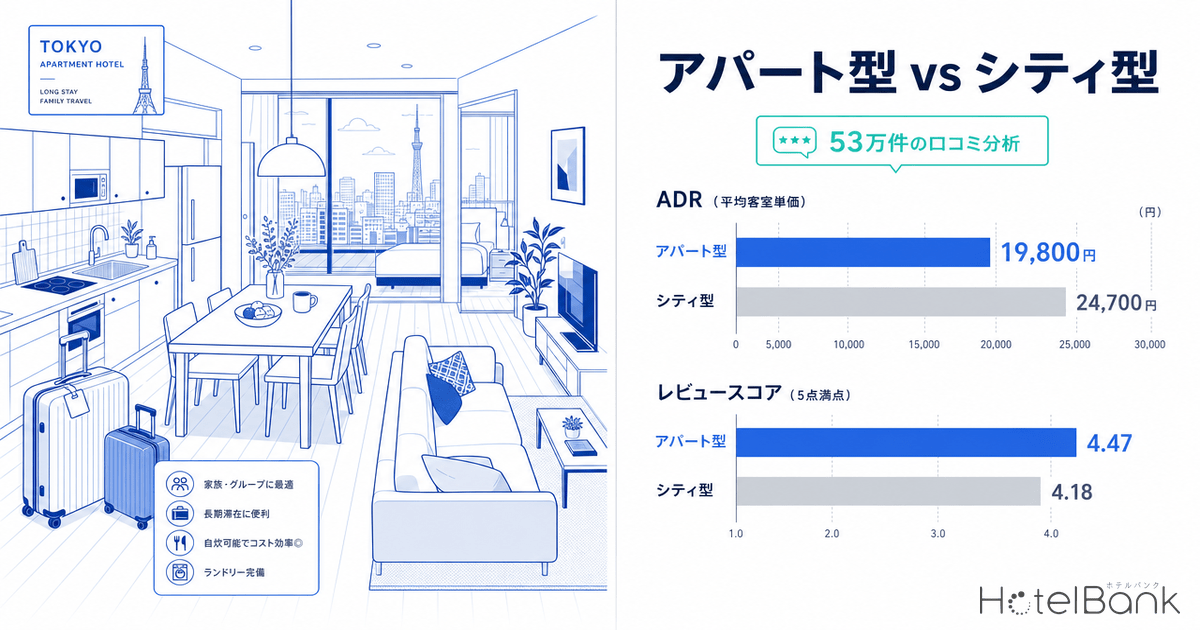
In Mov Inc.’s “Most Popular Hotels & Ryokans Among Inbound Travelers (Tokyo Edition),” released in April 2026, apartment-style hotel brand MIMARU swept the top two spots, with “MIMARU TOKYO NISHIKICHO” at #1 and “MIMARU TOKYO IKEBUKURO” at #2. “Hilton Tokyo,” a staple international city hotel, came in at #3, while “MIMARU TOKYO UENO EAST” took #9 and Villa Fontaine claimed #10 — meaning four of the top ten properties are apartment-style or extended-stay hotels.
Why are foreign travelers choosing kitchen-equipped, larger suite-style rooms? In this article, the HotelBank Editorial Team cross-references over 530,000 guest reviews aggregated from a sample of 40 representative Tokyo properties (20 apartment-style and 20 city-style hotels) with OTA-published price data covering June 15 to July 15, breaking down the structure of brand support with data.
Metric Definitions Used in This Article
- ADR (Average Daily Rate): Mean of selling prices published on OTAs, etc. May differ from actual transaction prices. Per-room rate (tax inclusive) for double occupancy, averaged across all plans (room-only through meal-inclusive). Note that apartment-style suites accommodate 4–6 guests, so face values trend higher than city-hotel twin rooms.
- Sold-out Rate: Share of plans on OTAs no longer accepting bookings at the time of survey. This is not equivalent to property-wide room occupancy.
- Review Score: Weighted average of guest reviews (5-point scale) compiled by the HotelBank Editorial Team. Aggregation period: 2017 through April 2026.
- Data Sources: MetroEngines Research; HotelBank Editorial Team’s own research; Mov Inc., “Most Popular Hotels & Ryokans Among Inbound Travelers 2026 — Tokyo Edition” (released April 2026).
The “MIMARU Surge” Revealed by Mov’s Ranking
Inbound Lab and Kuchikomicom, operated by Mov Inc., analyzed 25,607 Google Maps reviews (16,293 of which were in foreign languages) posted between August 25, 2025 and April 1, 2026 across 200 Tokyo hotels and ryokans, releasing the 2026 Tokyo Edition of its ranking of hotels and ryokans most popular with foreign visitors. According to the survey, MIMARU TOKYO NISHIKICHO collected 581 foreign-language reviews in roughly seven months to take the top spot, with MIMARU TOKYO IKEBUKURO ranked second.
Looking at the top 10 again: four properties are apartment-style or extended-stay hotels, while six are city or international upscale brands. MIMARU, which monopolized first and second place, is an apartment hotel brand operated by Cosmos Hotel Management Co., Ltd., featuring kitchens in every room and locations across Tokyo, Kyoto, and Osaka.
| Rank | Property | Type | Area |
|---|---|---|---|
| #1 | MIMARU TOKYO NISHIKICHO | Apartment | Sumida |
| #2 | MIMARU TOKYO IKEBUKURO | Apartment | Toshima |
| #3 | Hilton Tokyo | City (International) | Shinjuku |
| #4 | Mercure Tokyo Haneda Airport | City (International) | Ota |
| #5 | Hotel Gracery Shinjuku | City | Shinjuku |
| #6 | Shinjuku Washington Hotel Main | City | Shinjuku |
| #7 | Keio Plaza Hotel | City | Shinjuku |
| #8 | Conrad Tokyo | City (International) | Minato |
| #9 | MIMARU TOKYO UENO EAST | Apartment | Taito |
| #10 | Villa Fontaine Grand Haneda Airport | Apartment | Ota |
Source: Mov Inc., “2026 Latest: Most Popular Hotels & Ryokans Among Foreign Travelers — Tokyo Edition” (released April 2026)
The three MIMARU properties — Nishikicho, Ikebukuro, and Ueno East — are kitchen-equipped suites of 34 to 52 sqm, designed for families and groups of 4 to 6 guests. The #10 Villa Fontaine Grand Haneda Airport is also kitchen-equipped and configured for extended stays. Support remains strong for international brands such as Hilton Tokyo (#3), Mercure (#4), and Conrad (#8), but the fact that 40% of the top 10 is apartment-style points to a structural shift.
530,000 Reviews Analyzed: Apartment vs. City Hotels
For this study, we extracted properties located in central Tokyo wards (Chuo, Minato, Taito, Chiyoda, Shinjuku, Sumida, Toshima): 20 apartment-style hotels (5 MIMARU; 10 Villa Fontaine; 5 from Oakwood, Ascott, Centurion, and Citadines combined) and 20 high- to upper-grade city/business hotels. Their aggregated guest reviews total 162,316 for apartment-style and 370,397 for city-style — 532,713 reviews in all.
When overall scores are weighted by review count, apartment-style averages 4.27 and city-style averages 4.25 — essentially even. Yet when we isolate the five MIMARU properties, the overall score climbs to 4.52 (N=13,972), 0.27 points above the city-hotel average — a figure that aligns with MIMARU’s lock on the top two spots in the Mov ranking.
Source: Compiled by HotelBank Editorial Team using MetroEngines Research data
At the brand level, MIMARU’s lead within the apartment-style segment is striking. The five MIMARU properties all score above 4.4: Akasaka 4.78, Ueno Inarimachi 4.59, Ueno NORTH 4.52, Nihombashi Suitengumae 4.50, and Ueno EAST 4.44 — meaning even MIMARU’s lowest-scoring property exceeds the same-area city-hotel high-grade average. Villa Fontaine’s 10 properties span 3.89 to 4.50, with Grand Shiodome topping the brand at 4.50 (N=32,820).
Structural Differences on the Radar — Where Each Format Wins and Loses
Comparing category-level scores (out of 5) brings the contrast in support structure between apartment- and city-style hotels into sharp relief. We extracted only review categories with at least 50 ratings each and compared the two groups by weighted average. The radar chart below shows the result.
Source: Compiled by HotelBank Editorial Team using MetroEngines Research data (N=532,713)
What stands out is the lift in MIMARU’s “Price” score from 3.85 (apartment-style average) to 4.46 (MIMARU). Within the same apartment format, the product power of suites of 35 sqm or more with kitchens converts into a sense of value-for-money. “Breakfast” tells a similar story: against an apartment-style average of 3.26, MIMARU scores 4.66 — its delivery formats (bento-style boxes that can be eaten in-room, light fare in the lobby) earning strong marks.
At the same time, city-style hotels clearly lead in some areas. They take the edge on “Location” (4.24 vs. 4.09), “Comfort” (4.21 vs. 4.12), and “Sleep Quality” (4.02 vs. 3.89), reflecting station-attached or 3-minute-walk convenience plus the quality of bed-making and bedding. Overall, “Breakfast” favors city-style by more than 0.6 points (3.89 vs. 3.26 for apartment-style); narrowed to MIMARU alone, however, the order flips. That tells us “brand differences” can’t be explained by the city-vs.-apartment divide alone.
→ Anniversary-Worthy Hotel Dining: Tokyo, Osaka & Nagoya Luxury Hotel Restaurant Review Rankings
| Category | Apartment | City | MIMARU Only | High Score |
|---|---|---|---|---|
| Room | 4.15 | 4.33 | 4.74 | MIMARU |
| Location | 4.09 | 4.24 | 4.58 | MIMARU |
| Service | 4.23 | 4.32 | 4.62 | MIMARU |
| Cleanliness | 4.34 | 4.39 | 4.65 | MIMARU |
| Value for Money | 4.53 | 4.54 | 4.77 | MIMARU |
| Breakfast | 3.26 | 3.89 | 4.66 | MIMARU |
| Sleep Quality | 3.89 | 4.02 | 4.15 | MIMARU |
| Price (named category) | 3.85 | 3.65 | 4.46 | MIMARU |
| Staff | 4.03 | 3.89 | 4.62 | MIMARU |
Source: Compiled by HotelBank Editorial Team using MetroEngines Research data
Price Data Reveal a Reversal — Apartment Hotels Are Cheaper for 3+ Guests
So how much are guests actually paying? Targeting 31 days from mid-June through mid-July — a key window for Asia-Pacific family travel that overlaps with school holidays in Thailand, Singapore, and Malaysia — we aggregated ADRs across both groups.
The 20 apartment-style properties averaged ¥55,900 per room, while the 20 city-style hotels averaged ¥34,200 — an apparent premium of roughly 63% for apartment-style. But apartment rooms are predominantly suites for 4 to 6 guests, while city hotels are predominantly twins for 2. Convert to per-person and the relationship flips at three guests and beyond.
Source: Compiled by HotelBank Editorial Team using MetroEngines Research data
For two guests, city hotels at ¥34,200 per room (¥17,100 per person) compare with apartment hotels at ¥55,900 (¥28,000 per person) — apartment is roughly ¥10,800 per person higher. At three guests, however, city-hotel travelers need two rooms (totalling ¥68,400), whereas an apartment suite covers everyone for ¥55,900 — a ¥12,500 saving per night for a group of three. The same ¥12,500 advantage holds at four guests; at five and at six guests, the saving widens to ¥46,700. The economic case for choosing an apartment hotel is overwhelming for family or friend group travel.
| Guests | City Rooms Needed | City Total | Apartment Total | Difference (Apt advantage) |
|---|---|---|---|---|
| 2 | 1 room | ¥34,200 | ¥55,900 | −¥21,700 |
| 3 | 2 rooms | ¥68,400 | ¥55,900 | +¥12,500 |
| 4 | 2 rooms | ¥68,400 | ¥55,900 | +¥12,500 |
| 5 | 3 rooms | ¥102,600 | ¥55,900 | +¥46,700 |
| 6 | 3 rooms | ¥102,600 | ¥55,900 | +¥46,700 |
Source: Compiled by HotelBank Editorial Team using MetroEngines Research data / Average ADR for June 15–July 15, 2026 (double occupancy, tax inclusive). Assumes 2 guests/room for city hotels, and a single 4–6 guest suite for apartment hotels.
On top of that, apartment hotels deliver “stay-cost compression” benefits — kitchens for self-catering, in-room laundry, larger refrigerators. The longer the stay, the more those advantages compound, helping cement the brand’s appeal to foreign families and Asian group tours.
Booking Trends, Late June through Early July: Apartment Inventory Is Tighter
For the 31-day window aligned with school-holiday season for Asia-Pacific family travelers (mid-June through early July in Thailand, Singapore, and Malaysia), we compared OTA-listed sales status across both groups.
Source: Compiled by HotelBank Editorial Team using MetroEngines Research data (survey date: May 1, 2026)
The result is clear. On weekdays (Sun–Thu), apartment hotels were 11.3% sold out on average, compared to 0.0% for city hotels. On weekends (Fri–Sat), apartment hotels were 11.5% sold out vs. 3.6% for city hotels — apartment-style outpaces city-style on every day type. Both demand concentration and the relatively smaller inventory (number of available rooms) at apartment hotels are at work. MIMARU TOKYO UENO EAST and Nihombashi Suitengumae had already sold out a portion of mid-June dates by survey time, evidence of family travelers’ early-booking behavior.
Source: Compiled by HotelBank Editorial Team using MetroEngines Research data
Looking at ADR by day, the Friday/Saturday weekend premium is pronounced for both groups. Apartment hotels reach ¥65,000–¥67,500 on Saturdays; city hotels run from ¥41,900 to ¥45,400. Apartment hotels also hold their pricing on weekdays in the ¥52,000–¥57,000 range — strong demand-backed price stability.
Why Foreign Travelers Pick Apartment Hotels — Three Drivers in the Data
Drawing on review and price data together, the rationale for foreign travelers’ preference for apartment hotels boils down to three points.
First, the economic case for families and groups. The product design — one suite for 4 to 6 guests — cuts per-person cost roughly to half of a city hotel for parties of three or more. For typical Asia-Pacific family travel (two parents and 2–3 children), that’s a deciding factor.
Second, functional features: kitchen, washing machine, and a larger living area. For foreign travelers, food and laundry costs during long stays are a heavy burden. MIMARU’s “Price” score of 4.46 and “Room” score of 4.74 reflect how 35-sqm-plus suites and fully equipped kitchens generate a sense of price acceptability.
Third, the operational maturity of the MIMARU brand. Even within the apartment format, MIMARU’s overall score of 4.52 is meaningfully ahead of the 4.21 average for other brands. Reviews repeatedly highlight “child-friendly,” “well-stocked kitchen utensils,” and “staff who provide Japanese cultural experiences.” The “apartment + Japanese cultural experience” concept Cosmos Hotel Management has built since 2018 shows up in the depth of the review scores. On the “child-friendly” angle, the role MIMARU has demonstrated in supporting families with neurodiverse children through its inclusive-stay pilot program also helps frame the brand’s design philosophy.
Where City Hotels Still Lead
This article has highlighted the potential of apartment-style hotels, but city hotels clearly retain advantages in certain areas. Sleep Quality (4.02 vs. 3.89), Location (4.24 vs. 4.09), and Comfort (4.21 vs. 4.12) all go to city-style by a step. Properties like Hotel Niwa Tokyo (4.55), Richmond Hotel Premier Tokyo Schöele (4.54), Shiba Park Hotel (4.52), Tobu Hotel Levant Tokyo (4.47), and Richmond Hotel Premier Asakusa (4.46) all hold ratings above 4.4 with more than 10,000 reviews each — high-grade city hotels with strong, durable support.
For travelers who want short-stay convenience right next to a station, prioritize bed comfort, or are coming for the breakfast buffet, city hotels deliver higher satisfaction. Apartment- and city-style hotels are better understood as complements segmented by use case, length of stay, and party size — not direct substitutes.
Conclusion: The Winning Apartment-Hotel Playbook MIMARU Defined
MIMARU’s lock on Mov Inc.’s top two ranking spots is corroborated by HotelBank Editorial Team’s analysis of more than 530,000 reviews. The five MIMARU properties post an overall score of 4.52, well above the city-style average of 4.25, and exceed the city-style average across all nine major categories.
On price, apartment hotels are pricier than city hotels for parties of two but offer a per-person saving of roughly ¥3,000 to ¥9,000 for parties of three or more. For Asia-Pacific families visiting Tokyo during the mid-June to early-July school holidays, apartment hotels are the budget-optimal choice once a group reaches four people.
The implication for hotel operators and investors is clear. Aiming for the top of inbound popularity rankings, the standard city-hotel product design — “two guests in a private twin” — won’t reach every customer. The model MIMARU has been refining since 2018 — 35-sqm-plus suites, kitchens, and family experience programs — has crystallized into a credible playbook for inbound demand. Folding apartment-style rooms into the unit mix at new builds and rebrands is well worth serious consideration.
Note on forward-dated ADRs: ADRs in this article for June 15 to July 15 are averages of selling prices published on OTAs at the time of the survey (May 1, 2026), and will fluctuate as check-in approaches. Currently elevated prices may decline through last-minute reductions, while sold-out inventory may push remaining-room pricing higher — readers should bear both possibilities in mind.
Related Articles & Data Sources
- Mov Inc., “2026 Latest: Most Popular Hotels & Ryokans Among Foreign Travelers — Tokyo Edition: #1 Goes to MIMARU TOKYO NISHIKICHO!” (April 2026)
- APARTMENT HOTEL MIMARU Official Site (All Properties)
- Japan Tourism Agency, “Accommodation Travel Statistics Survey”
- HotelBank: Lodging Market Trend Data
Related Reading
- Long-Stay Hotel Market Takes Off — Mitsubishi Estate’s WAYPOINT and Hilton’s Entry Reshape Tokyo Lodging
- JTA January 2026 Flash Report Deep-Dive: Tokyo Settles Into 50%+ Foreign Guest Ratio While Domestic Demand Recedes
- Anniversary-Worthy Hotel Dining: Tokyo, Osaka & Nagoya Luxury Hotel Restaurant Review Rankings
- Supporting Families with Neurodiverse Children: How MIMARU’s Pilot Demonstrates a New Role for Hotels
- Hotels with In-Room Slides: Market Analysis of Family-Differentiating Rooms and Revenue Contribution
- Business Hotel ADRs Climbing — National Analysis and Top 10 Cost-Performance Prefectures for Business Travel