

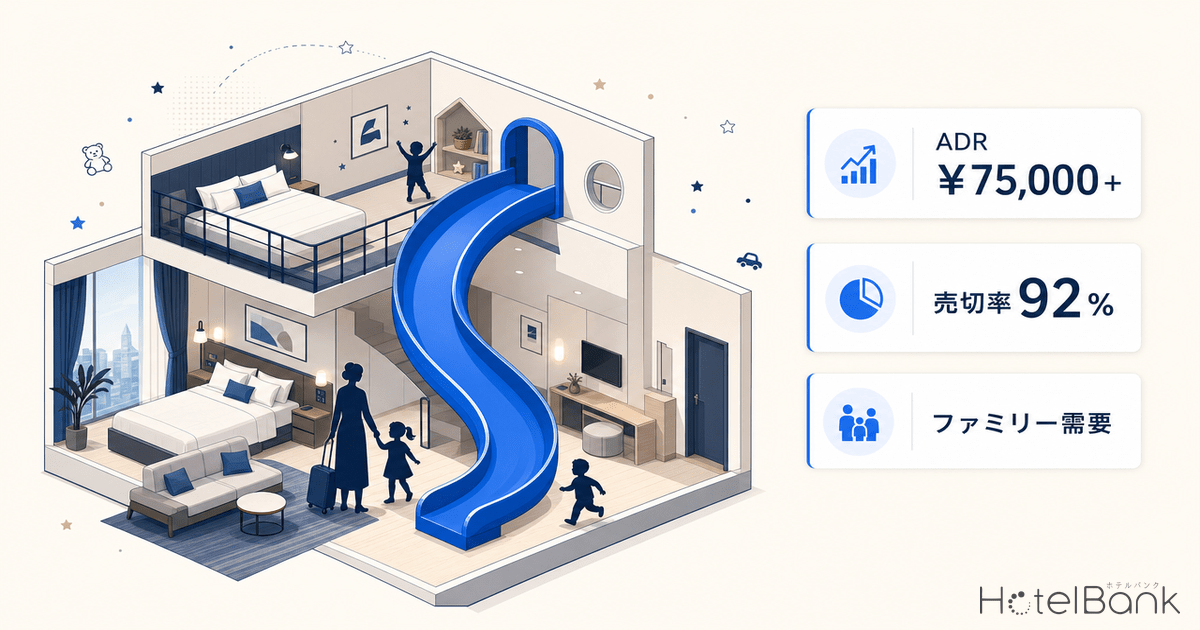
“The moment my child stepped into the room, their eyes lit up.” Family-oriented “play rooms” — guestrooms equipped with in-room slides and indoor playground equipment — have established a firm category in family travel. Drawing on MetroEngines Research’s tracked OTA pricing data and guest review data, this article examines the ADR levels, demand intensity, and customer satisfaction of hotels offering experiential family rooms, and considers their revenue contribution as a differentiation strategy from an industry perspective.
Metric Definitions Used in This Article
- ADR (Average Daily Rate): Average of public listing prices on OTAs and similar channels. Differs from actual booked rates (cross-referencing with REIT disclosure data shows OTA-listed averages run roughly 25–30% higher than booked ADR, since unsold high-tier plans tend to remain visible on OTAs and inflate the average). Per-room rate based on double occupancy (tax included), averaged across all plan types (room-only through meal-inclusive).
- Sellout Rate: Share of plans on OTAs that had stopped accepting reservations as of the survey date. Differs from a property’s overall room occupancy rate.
- Review Satisfaction: Average of guest reviews on a 5-point scale.
- Data Source: MetroEngines Research
Three Market Conditions That Sustain “Play Rooms”
Family-specialized guestrooms with permanent in-room slides and play equipment are no longer a niche curiosity. Behind their rise lies the increase in dual-income households and the emergence of “time-rich, cash-rich” families who place value on the lodging experience itself near major theme parks.
First, demand has expanded for “fully indoor entertainment” that keeps children engaged regardless of rain or extreme heat. Second, families traveling with preschool-age children spend limited time inside the theme parks, making the hotel stay itself a central part of the trip. Third, photogenic guestrooms generate strong word-of-mouth on social media and function as a powerful organic acquisition channel for hotels.
The Maihama / Shin-Urayasu area is a representative market where these conditions converge. Looking at MetroEngines Research’s tracked ADR by guestroom category in Chiba Prefecture (August 2026), resort hotels average ¥64,000 — roughly 3.8 times the ¥16,800 of business hotels. This price gap is precisely the market soil in which family-specialized properties take root.
Source: MetroEngines Research, compiled by HotelBank Editorial Team
Representative Properties Analyzed: Hotels with “Play Rooms”
This article analyzes six properties that clearly market guestrooms equipped with in-room slides, indoor play equipment, or themed décor designed for children: four Disney-area hotels in Maihama / Shin-Urayasu, plus two properties from the Hoshino Resorts Risonare brand. Room counts and guest review satisfaction for each are summarized below.
| Property | Area | Rooms | Reviews | Overall Satisfaction | Family Differentiation |
|---|---|---|---|---|---|
| Hotel Emion Tokyo Bay (ホテルエミオン東京ベイ) | Chiba / Shin-Urayasu | 583 | 25,816 | 4.53 | Kids Pleasure Room (slide, large drawing board, etc.) |
| Hilton Tokyo Bay (ヒルトン東京ベイ) | Chiba / Maihama | 828 | 52,209 | 4.18 | Happy Magic Room (enchanted forest theme, bunk beds) |
| Tokyo Bay Maihama Hotel First Resort (東京ベイ舞浜ホテル ファーストリゾート) | Chiba / Maihama | 696 | 36,821 | 3.82 | Themed guestrooms (Wild West, castle, etc.) |
| Hoshino Resorts Risonare Atami (星野リゾート リゾナーレ熱海) | Shizuoka / Atami | 81 | 2,206 | 4.86 | Experiential family resort with “Kusu Kusu” treetop play base and more |
| Hoshino Resorts Risonare Yatsugatake (星野リゾート リゾナーレ八ヶ岳) | Yamanashi / Hokuto | 172 | 7,155 | 4.61 | In-resort experiences for families such as “Piiman Street” |
| Rihga Royal Hotel Tokyo (リーガロイヤルホテル東京) | Tokyo / Waseda | 131 | 12,677 | 4.28 | Character-collaboration rooms and parent-child packages |
Source: MetroEngines Research, compiled by HotelBank Editorial Team (N=136,884 guest reviews)
Worth noting is that the smallest operator in the cohort — Hoshino Resorts Risonare Atami at 81 rooms — earned the highest overall satisfaction score of 4.86 across the six properties. The pattern suggests that smaller room counts allow tighter execution of family-focused operations, hinting at a clear relationship between scale and guest experience.
Golden Week 2026 ADR and Demand Intensity — A Dual Premium of Pricing Power and Sellout
Looking at the ADR trajectory of each property over Golden Week 2026 (April 29 – May 6), every property more than doubled its baseline rate at the May 3 (Saturday/Holiday) peak. The widest swing belongs to Hotel Emion Tokyo Bay, which rose from ¥27,800 on April 29 to ¥77,800 on May 3 — a 2.8x price elasticity within just four days.
Risonare Atami climbed to ¥259,800 on May 3, sharpening the high-end positioning of the Hoshino Resorts brand. On the same day Risonare Atami was already in a state of “near-total plan sellout” at the time of the survey, illustrating a structure in which demand outstrips supply even after meaningful price increases — a regime in which “supply constraint becomes the bottleneck for profit maximization at peak.”
Source: MetroEngines Research, compiled by HotelBank Editorial Team
The industry implication: family-specialized rooms enjoy a dual revenue management advantage — strong price elasticity at the peak combined with rapid sellout at the peak. For ordinary city hotels or undifferentiated resort hotels, the ceiling on peak pricing is set by supply-demand forecasting, but clearly differentiated products have few benchmarks, allowing the market itself to discover the price ceiling. This is the source of the revenue contribution generated by family-specialized strategies.
Long-Stay Summer Demand — Stable Revenue Visible in Shallow Weekday Drops
Across the summer holiday period (July 25 – August 16, 2026), all six properties form a clear demand peak from August 8 (Saturday) onward through Obon. The remarkable feature is the shallowness of the weekday dip.
For example, Risonare Atami slipped only about 20% from ¥168,000 on July 25 (Saturday) to ¥134,400 on Tuesday, July 28. Risonare Yatsugatake held ¥153,000 even on weekdays — only about 26% below the Obon peak of ¥206,000. By contrast, ordinary city hotels typically show a 40–50% gap between weekdays and weekends. This compression of the weekday-weekend gap is precisely the mechanism by which family-specialized properties stabilize their monthly revenue.
Source: MetroEngines Research, compiled by HotelBank Editorial Team
The behavior is rooted in family travel’s inherent flexibility around weekdays. Because the long children’s summer break is the underlying premise, families freed from a fixed work calendar tend to deliberately book weekdays when prices soften. The result is a structure in which weekday occupancy stays close to weekend levels.
Review Analysis — Where Does High Satisfaction Come From?
Breaking down the 136,884 guest reviews aggregated by the HotelBank Editorial Team across the six properties by category reveals the source of family-specialized satisfaction. The most striking data point is Hotel Emion Tokyo Bay’s “Room” score of 4.58 (13,922 reviews). In the same area, Hilton Tokyo Bay scored 4.39 (12,319 reviews) and Tokyo Bay Maihama Hotel First Resort scored 4.01 (18,416 reviews) — Emion stands a clear head above on the in-room experience.
The gap suggests that Emion’s commitment to a clearly defined “parent-and-child room design” — including the slide-equipped Kids Pleasure Room — translates directly into guest evaluations. Leisure-purpose visitors at the same property post an exceptional 4.63 across 953 reviews, well above the 4.22 from just nine business-purpose stays. The clearer the answer to “for whom is this room designed?”, the higher the satisfaction of that target segment — a textbook example of segment specialization.
Source: MetroEngines Research, compiled by HotelBank Editorial Team
It is also intriguing that Risonare Atami’s “Location” score of 4.13 sits relatively low compared to its other categories (Room 4.53, Atmosphere 4.56). The fact that a property hampered by location can still achieve an overall satisfaction of 4.86 through room and atmosphere is encouraging evidence that mid-sized regional resorts can succeed via experiential differentiation.
Satisfaction Trends — Room for Improvement and Re-Evaluation Cycles
Hotel Emion Tokyo Bay’s monthly satisfaction trend (May 2024 – April 2026, N=4,627) shows a distinctive pattern: a temporary dip from the 4.6 range to the 3.8 range from late 2024 through mid-2025, followed by a recovery above 4.4 entering 2026. Several factors may overlap here, including seasonal shifts in guest mix, in-house service renovations, and changes in the reviewer composition.
Source: MetroEngines Research, compiled by HotelBank Editorial Team
The signal for industry practitioners is that even properties with specialized rooms must contend with ongoing operational themes such as wear-and-tear of equipment and service standards keeping pace with rising guest expectations. Slides and play equipment require durable engineering tuned to children’s body weights and movement, and demand more frequent cleaning and disinfection than ordinary rooms. Differentiation strategies hinge not only on initial CAPEX but on continuous OPEX investment.
Industry Implications — Revenue Opportunities and Deployment Strategies for Family Differentiated Rooms
This analysis quantitatively confirms that properties offering family-specialized “play rooms” enjoy three revenue opportunities.
First, peak pricing power is high. During concentrated demand windows like Golden Week, Obon, and the New Year period, the scarcity of market benchmarks allows freer price discovery. Second, weekday revenue declines are gentle. This directly stabilizes monthly RevPAR and reduces full-year volatility. Third, target-segment review scores are exceptionally high. This both lowers new-customer acquisition cost (organic word-of-mouth inflows) and lifts repeat-visit rates.
That said, “build a slide-equipped room and revenue will follow” is not a universal recommendation. Every property in this analysis benefits from three preconditions: location (proximity to theme parks or hot-spring destinations), scale (mid-to-large properties operable at the floor-block level), and operational depth (staffing and know-how to handle families). For properties without these prerequisites, the return on guestroom renovation investment may be diluted.
Rather, properties that have already proven their family-attraction power stand to gain the most upside by converting a portion of their inventory (10–20 rooms) into experiential family rooms, generating synergies with existing in-house services. Even at equivalent occupancy, a 30–50% lift in ADR can bring the renovation payback into a realistic 2–4 year window in many cases.
⚠ Note on forward-dated ADR: The ADRs in this article reflect the average of public OTA prices as of the survey date and will fluctuate as check-in approaches. Note that prices currently set high may decline through last-minute discounting.
Conclusion
Guestrooms with in-room slides and play equipment are no longer a mere differentiation slogan; they function as revenue devices that generate three concrete benefits — high guest evaluations, the breaking of peak-period price ceilings, and stabilized weekday revenue. With demand currently concentrated in the Maihama / Shin-Urayasu area, there is meaningful upside in extending the model to mid-sized regional resorts and urban hotels.
For industry practitioners, the key strategic theme over the next three to five years will be balancing renovation cost and operational load against each property’s family-attraction power and locational fit, and designing a “realistic introduction scale” suited to each context.