

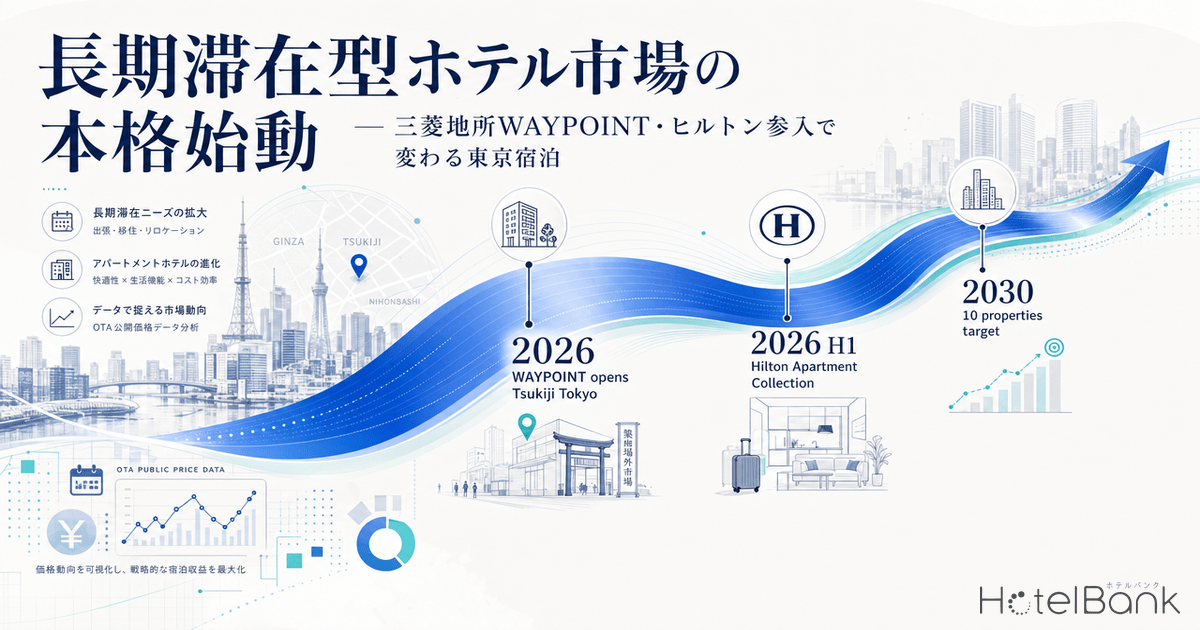
On April 1, 2026, Mitsubishi Estate Hotels & Resorts opened the first property of its new “WAYPOINT” brand in Tsukiji, Tokyo. The company plans to expand to 10 properties by 2030, while Hilton has partnered with U.S.-based Placemakr to launch “Apartment Collection by Hilton,” with reservations opening in the first half of 2026. Japan’s apartment-hotel market is entering a new phase as major brands move in. Drawing on OTA list-price data, this article examines the price structure of the Tsukiji and Ginza area, the fact that apartment-style categories are growing in the Tokyo market, and the business-model advantages of this format.
Mitsubishi Estate’s “WAYPOINT” and Hilton’s “Apartment Collection”: Major Players Enter in Quick Succession
In February 2026, Mitsubishi Estate and Mitsubishi Estate Hotels & Resorts announced the launch of “WAYPOINT,” a new brand designed to meet long-stay demand, marking their full-scale entry into the apartment-hotel business. The first property, “WAYPOINT TSUKIJI TOKYO,” is located in Tsukiji 2-chome (about a one-minute walk from Tsukiji Station on the Tokyo Metro Hibiya Line), with a site area of approximately 368 m², nine stories, and 52 rooms in total. The company aims to open 10 properties by 2030.
The two room types are 37.28 m² Deluxe Bunk Rooms (sleeping four, from ¥11,000 per person) and 68.28 m² Suite Bunk Rooms (sleeping six, from ¥12,833 per person), all designed for long stays with mini-kitchens and washer-dryers. The brand concept is “The Urban Basecamp,” with groups and multi-night travelers as the primary target.
Meanwhile, Hilton Worldwide Holdings has partnered with U.S. apartment-style accommodation operator Placemakr to launch “Apartment Collection by Hilton.” The brand offers furnished units ranging from studios to four-bedroom apartments, and sales will begin via Hilton’s reservation channels in the first half of 2026. Plans call for incorporating up to 3,000 units, with integration into Hilton Honors.
Behind these two majors’ rapid moves lies a behavioral shift among inbound visitors to Japan. As stays grow longer, travelers are shifting from short visits centered on shopping to longer stays that emphasize accommodation, dining, and experiential consumption. According to Japan Tourism Agency surveys, among visitors staying two weeks or more the share of spending on shopping drops to roughly 30%, while shares for accommodation, dining, and entertainment services rise.
→ Tokyu Stay × Mercure Hiroshima: A Dual-Brand Strategy Reshaping Mid-Sized City Openings
Tsukiji and Ginza: A Mid-Tier Pricing Zone Within Central Tokyo
Let us compare the price level of Chuo Ward, where WAYPOINT TSUKIJI TOKYO is located, against other major wards in central Tokyo. According to MetroEngines Research data on May–June 2026 list prices (double occupancy), the average list price in Chuo Ward is roughly ¥31,000 — clearly lower than high-priced wards such as Shibuya (¥67,500), Chiyoda (¥53,300), and Minato (¥50,400).
Source: Compiled by HotelBank Editorial Team from MetroEngines Research (May–June 2026, N=2,275 properties)
The gap is not easily explained by a simple “location hierarchy.” Chuo Ward has roughly 996 hotels registered (May), about 4.7× as many as Minato (210) and roughly 14× as many as Shibuya (71). On top of supply abundance, the ward encompasses a diverse mix of areas including Ginza, Kyobashi, Hatchobori, Ningyocho, and Tsukishima, structurally pulling the average down.
In other words, Tsukiji is a location that is “in central Tokyo yet keeps room rates compact.” This makes it highly attractive to WAYPOINT’s target — inbound visitors traveling in groups for multiple nights. The pricing of ¥11,000+ per person works out to roughly ¥44,000 per room when occupied by four — about 40% above the Chuo Ward average (¥31,000), but on a per-person basis with four guests sharing a room, the cost is on par with or below a single-occupancy stay at a major city hotel.
Chuo Ward: ¥15,000–25,000 Is the Largest Price-Band Cluster
To zoom in on where WAYPOINT’s pricing sits within the Tsukiji-area market, we distributed mid-May 2026 sales plans by price band. In Chuo Ward, the ¥15,000–25,000 band has the largest number of plans, at roughly 296,800 — about 30% of the total. By contrast, Chiyoda and Minato Wards — home to the Hilton Tokyo and Imperial Hotel — show large shares in the ¥40,000+ bands, reflecting an upper-class-skewed structure.
Source: Compiled by HotelBank Editorial Team from MetroEngines Research (May 15–21, 2026, N=1.29 million plans across the three wards)
WAYPOINT TSUKIJI TOKYO’s published rates (from ¥11,000 per person, ¥44,000 per room for four) fall within Chuo Ward’s ¥40,000–60,000 band (about 14.8% of plans). Within Chuo Ward this is “somewhat upper-tier,” but compared with the share of the same band in Chiyoda (about 16.0%) and Minato (about 20.6%), WAYPOINT operates in a relatively less crowded zone. Larger room types catering to multi-person groups are limited within Chuo Ward, leaving supply thin relative to demand.
Tokyo ADR by Category: Apartment-Style Categories Show Strong Growth
Next we look at year-on-year list prices by hotel category in Tokyo. Comparing May 2026 sales data against May 2025 reveals an interesting structural shift.
Source: Compiled by HotelBank Editorial Team from MetroEngines Research (Tokyo, May 2025 and May 2026)
What stands out is movement in the categories adjacent to the apartment-style and long-stay format. “Vacation rentals” (whole-property rentals registered as simple lodging, including detached houses and condo units) rose +12.6% YoY, and “Hostels” (the category to which WAYPOINT is classified) climbed +19.2% — both posting double-digit gains. By contrast, the conventional “City Hotel” category fell −9.8%, suggesting that the market’s center of gravity is shifting toward apartment-style formats.
This cannot be explained by simple supply–demand mismatches alone. The City Hotel category has raised prices sharply over the past two years and is likely now entering a 2026 correction phase. The growth of vacation rentals, hostels, and adults-only categories, meanwhile, can be read as a sign that inbound visitors are starting to prioritize “the total cost of the stay experience” (per-person burden across multiple nights and travelers) over the headline room rate.
Monthly ADR in Tokyo: From a City-Hotel-Led Peak to a Plateau
Monthly ADR trends across all of Tokyo also show an inflection in the upward cycle. Through 2025 ADR moved within ¥29,000–¥36,000, then hit ¥41,000 in January 2026 and peaked in the ¥42,000s in April. The most recent figures — ¥37,700 in May and ¥34,800 in June — point to a post-peak adjustment phase.
Source: Compiled by HotelBank Editorial Team from MetroEngines Research (Tokyo, monthly average)
With city hotels and other high-rate segments now in a price-correction phase, formats like WAYPOINT — which sell on “per-person cost rather than per-room rate” — gain relative competitiveness. Room designs that fit four to six guests in one unit offer strong appeal to families and small groups of inbound travelers as an alternative to booking four separate single rooms.
WAYPOINT’s Place Among Tokyo’s New Hotel Openings in April 2026
Within the scope tracked by MetroEngines Research, seven hotels with 30 or more rooms have opened (or are scheduled to open) in Tokyo in 2026. Of these, three opened in April 2026, including WAYPOINT TSUKIJI TOKYO.
| Property | Rooms | Opening Date | Category |
|---|---|---|---|
| Tokyu Stay Shibuya Ebisu | 77 | 2026/03/17 | Business Hotel |
| Hotel Metropolitan Oimachi TRAX | 285 | 2026/03/28 | City Hotel |
| Hotel Oriental Express Ginza West | 220 | 2026/04/01 | Business Hotel |
| WAYPOINT TSUKIJI TOKYO | 52 | 2026/04/01 | Hostel |
| TABI Ueno | 35 | 2026/04/10 | Business Hotel |
| Toranomon Holic Hotel | 49 | 2026/04/24 | Business Hotel |
| Hotel Kinoshita Akasaka | 74 | 2026/12/31 | Business Hotel |
Source: Compiled by HotelBank Editorial Team from MetroEngines Research (30+ rooms, within MetroEngines Research’s tracking scope)
Of the seven new openings, five are business hotels, one is a city hotel, and only WAYPOINT is registered as a hostel (apartment-style). Hotel Oriental Express Ginza (220 rooms), which opened on the same day, is a textbook example of a large-scale business hotel, while WAYPOINT (52 rooms) clearly chose a different segment design. Two openings on the same day in the same Chuo Ward area, with separate target customers and revenue models, point to a market that has moved from “inter-category competition” into a phase of “intra-segment differentiation.”
The Apartment-Hotel Business Model: Labor-Cost Structure Drives Margins
The single biggest driver of apartment hotels’ profitability is their labor-cost structure. Equipping rooms with mini-kitchens, washer-dryers, and other living infrastructure dramatically reduces the frequency of housekeeping and the need for F&B staffing (e.g., breakfast buffet operations).
A typical city hotel must staff numerous ancillary departments outside room revenue — restaurants, bar lounges, bell desks, concierge, housekeeping, and banquet operations. Apartment hotels, by contrast, keep front-desk functions to a minimum and often reduce cleaning for repeat-night guests to roughly every three days. Because multi-night, multi-person stays are the premise, labor input per room per day can reportedly be compressed to about 30–40% of a city hotel’s level.
In addition, equipping units with mini-kitchens and laundry is a strategy that maximizes per-room “occupied hours” in exchange for giving up ancillary-department revenue. Multi-night guests dine out less and have the option of in-room breakfast and dinner, which tends to shorten time spent away from the property. The result is a different revenue structure from city hotels, built on the total of room rate × length of stay.
Of course, apartment hotels have downsides too. Capturing short-stay guests is harder, and occupancy does not climb as quickly as for high-turnover hotels. Maintaining average length of stay (ALOS) above a certain threshold is therefore a hard prerequisite for the model to work. WAYPOINT’s tightly focused targeting of inbound family and group travelers is precisely a targeting strategy designed to satisfy that prerequisite.
Investment Angle: Conversion Potential from Existing Hotels and Foreign Capital Moves
Given Mitsubishi Estate’s plan to roll out 10 properties by 2030, conversions (rebrandings) of existing buildings rather than new builds are likely to be the main approach. WAYPOINT TSUKIJI TOKYO itself opened as a renovation of an existing facility, an investment-efficient method. Japan has a meaningful inventory of small- and mid-sized city hotels, serviced apartments, and corporate dormitories with weak occupancy or profitability — viable conversion candidates for the apartment-hotel format.
Foreign-capital moves are also worth watching. While Hilton makes its full entry through the Placemakr partnership, U.S.-based Blackstone has continued large-scale investments in Japanese real estate, including its 2024 acquisition of Tokyo Garden Terrace Kioicho from Seibu Holdings for approximately ¥400 billion. Blackstone has signaled plans for an additional ¥2 trillion of Japan investment going forward, with hotel assets in scope. The apartment-hotel category leaves substantial room to import overseas operating know-how and is an area where global PE funds can readily envision “operational synergies with multifamily assets.”
For reference, Japan Hotel REIT Investment Corporation (3472), which holds many properties in central Tokyo, recorded average occupancy of 86.8% and average ADR of ¥25,000 as of February 2026. The REIT owns both residential-style assets (rental housing and serviced apartments) and conventional hotels, with the apartment-hotel space sitting in between. As a hybrid business model that captures both “residential demand” and “short-term lodging demand” within the same property, it is likely to attract increasing institutional investor attention.
Conclusion: Apartment Hotels Are Competing on “Demand Structure,” Not Price
Mitsubishi Estate’s WAYPOINT and Hilton’s Apartment Collection entering at scale could mark the inflection point at which the long-stay hotel market moves from “niche” to “mainstream.” The Tokyo OTA price data discussed here show that while the City Hotel category enters a price-correction phase, vacation-rental and hostel categories — close cousins of the apartment format — keep posting double-digit gains, confirming a shift in the market’s center of gravity.
Chuo Ward, where WAYPOINT TSUKIJI TOKYO sits, manages to keep room rates in the mid-tier (around ¥31,000) despite being part of central Tokyo, making it easy to compress per-person costs across multi-person, multi-night stays. WAYPOINT’s “from ¥11,000 per person” pricing achieves a per-person burden roughly on par with the Chuo Ward average when four guests share a room — a clearly attractive option for inbound family and group travelers.
The questions going forward are: (1) Where will Mitsubishi Estate locate the rest of its 10 planned WAYPOINT properties? (2) When and where will Hilton’s Apartment Collection enter the Japanese market? (3) Will conversion investments by global PE funds into existing hotels begin to surface? HotelBank will continue to track list-price data and quantitatively follow these structural shifts.
Related Articles & References
- Mitsubishi Estate “Full-scale Entry into the Apartment-Hotel Business” (Press Release, February 2, 2026)
- Hilton Official Release: “Apartment Collection by Hilton”
- Japan Tourism Agency: Survey on Overnight Travel Statistics