
“When I go to Japan, I want to stay in a tatami room at least once.” In inbound marketing, the washitsu — the traditional Japanese-style room — remains a standard headline feature. But how much do guests actually write about it in their own words? In this article, we take 24 months of semantically analyzed guest-review tag data, aggregate it prefecture by prefecture across all 47 prefectures, and map where — and how many — properties are genuinely being talked about for their Japanese-style rooms. We then compare this with the Japanese-Western hybrid room (washitsu-yoshitsu), examine how interest varies by the language a review is written in, and overlay the June 2026 inbound demand figures published by the Japan National Tourism Organization (JNTO) to establish where the washitsu as a product actually stands.
Metric Definitions Used in This Article
- Mention rate: The share of a property’s total reviews posted during the study period (the most recent 24 months) in which the Japanese-style room (tatami, futon, zashiki — expressions referring to the washitsu itself) is mentioned in a positive context. This is not a rating score (star level). A high mention rate indicates that the Japanese-style room is a frequent topic of conversation; it does not imply that the property is superior or inferior overall.
- Review language: The language in which a review was written — not the reviewer’s nationality. Because the data includes, for example, Taiwan residents writing in English and foreign residents of Japan writing in Japanese, the language-based composition does not match a nationality-based composition.
- ADR (average daily rate): An estimated settled rate (tax-exclusive equivalent) calculated by applying category-specific adjustment coefficients to the lowest published plan level each property lists on OTAs (double occupancy, per-room rate, tax-inclusive). Cross-checked against property-level results disclosed by listed hotel REITs (91 properties, most recent three months), the median error is approximately 7%. These are estimates and differ from each property’s actual transacted prices or accounting figures. Area-level ADR is the median across the target properties (the level of a typical property in that area).
- Data sources: Review metrics = HotelBank Editorial Team research (semantic analysis of guest reviews, last updated 20 July 2026) / price metrics = MetroEngines Research
- — 33 properties across 21 prefectures nationwide — the total number of properties whose Japanese-style rooms are repeatedly discussed in guest reviews. This is the result of aggregating, prefecture by prefecture across all 47 prefectures, properties with at least 20 reviews and at least 10 positive washitsu mentions in the most recent 24 months. The remaining 26 prefectures returned zero.
- — Only 5 properties for hybrid rooms — under identical criteria, properties where the Japanese-Western hybrid room becomes a topic in its own right number less than one-sixth of the washitsu-only count. The two are not substitutes; they play different roles in how guests talk about them.
- — Outside the top 30 in all 8 languages — tags denoting the Japanese-style room do not rank among the top 30 tags in Japanese, English, Traditional Chinese, Korean, French, Spanish, Simplified Chinese, or German. The washitsu is not a primary axis of choice.
- — “Room size” mentioned roughly twice as often as in Japanese — mention rates run 19.94% in German, 18.95% in Spanish, and 18.87% in Traditional Chinese, against 10.18% in Japanese. This is where the spatial answer that tatami and futon provide connects.
- — 18.6% foreign-language share; 5 properties exceed 50% — Kawaguchiko Hotel at 90.5% and Miyajima Grand Hotel Arimoto at 64.5% show that washitsu capacity concentrates at hubs along inbound touring routes.
The demand backdrop — 3.15 million inbound visitors in June 2026, with 15 markets at record June highs
First, the shape of demand. According to JNTO estimates, inbound arrivals in June 2026 totalled 3,148,600, down 6.8% year on year, while the first-half cumulative total for January to June was 21,084,800, down 2.0% year on year. The headline total has now fallen below the prior year for three consecutive months, but the cause is concentrated in a single market: China, at 340,700 visitors (down 57.3% year on year).
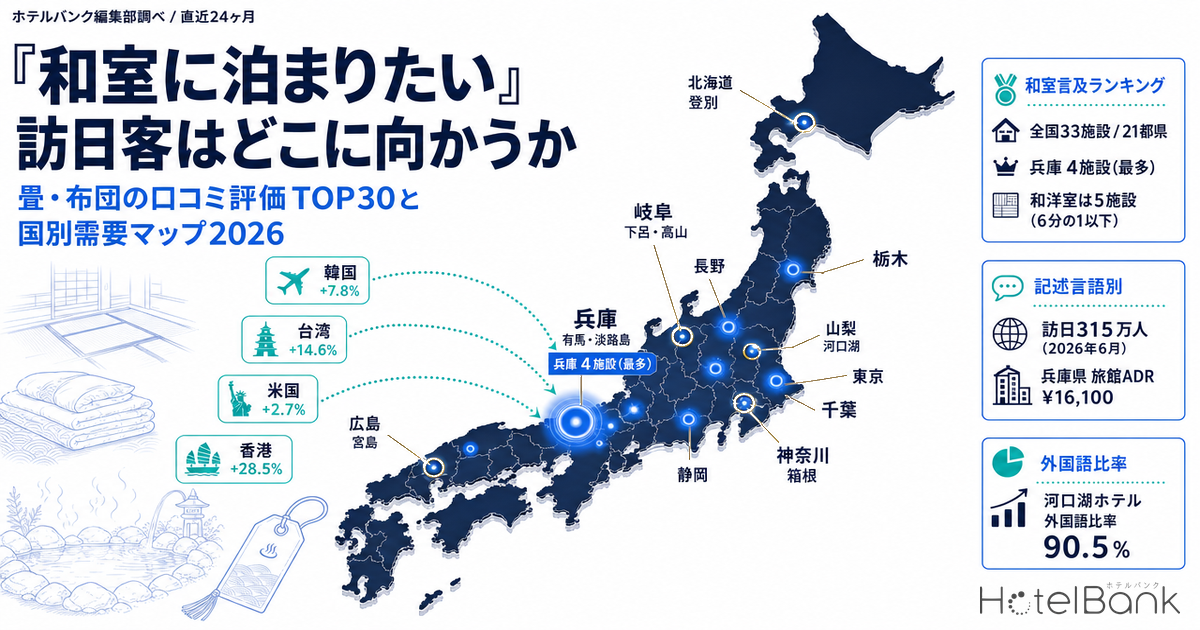
Meanwhile, neighbouring East Asian markets and Western markets are growing. Korea recorded 787,100 (up 7.8% year on year), Taiwan 670,400 (up 14.6%), the United States 354,500 (up 2.7%), and Hong Kong 214,300 (up 28.5%). JNTO reported that 15 markets — including Korea, Taiwan, the United States and India — set record highs for the month of June. In other words, inbound demand has not so much shrunk in volume as changed in composition. For a distinctly Japanese product like the washitsu, that compositional shift is far from irrelevant.
Source: Compiled by the HotelBank Editorial Team from the Japan National Tourism Organization (JNTO), “Foreign Visitors to Japan (June 2026 estimates)”
Only 33 properties nationwide are talked about for their washitsu — the result of aggregating all 47 prefectures one by one
Next, the supply side: identifying the properties whose Japanese-style rooms are actually being praised. Against semantically analyzed guest-review tag data (32.83 million tags in total, last updated 20 July 2026), we retrieved property rankings using tags that denote the washitsu itself. The extraction criteria were at least 20 total reviews in the most recent 24 months and at least 10 positive mentions of the Japanese-style room. We queried each of the 47 prefectures individually and in turn, and received responses from all 47 (population = 47/47 prefectures).
The result: 33 properties nationwide met the criteria, distributed across just 21 prefectures. The remaining 26 prefectures returned zero. It may seem counterintuitive that Kyoto, Osaka, Nara, Ishikawa and Okinawa — regions with a strong traditional image, or regarded as primary inbound destinations — all line up at zero. But this does not mean there are no Japanese-style rooms there. It means there is no density of properties meeting the criteria where the washitsu is repeatedly written about as a topic in its own right. In urban areas, guests write about location and cleanliness; in Kyoto, they write about machiya townhouses and gardens. For the word “washitsu” to become the subject of a sentence, a tatami room has to sit at the centre of that property’s experience.
Source: HotelBank Editorial Team research (N=33 properties across 21 prefectures, most recent 24 months, all 47 prefectures aggregated individually)
Hot-spring destinations sit at the centre of the distribution. Hyogo has 4 properties (Arima, Awaji Island, Kobe), followed by Gifu with 3 (Gero, Takayama), and then Chiba (Tokyo Bay, Kamogawa), Hokkaido (Noboribetsu, Hakodate), Yamanashi (Lake Kawaguchi and others), Tokyo (Kanda, Nihonbashi), Nagano (Bessho, Kami-Suwa), Shizuoka (Atami, Shimoda) and Tochigi (Kinugawa, Nikko) with 2 each. Capacity skews toward hot-spring areas close to the Tokyo metropolitan region and toward the toji (hot-spring cure) cultural belt from central Japan eastward, with a small number of Japanese-style urban properties added on top.
Top 30 washitsu mention ranking — a two-tier structure of hot-spring ryokan and urban Japanese-style inns
Below are the top 30 properties ranked by the number of positive mentions of the Japanese-style room. “Mentions” is the count of reviews in the most recent 24 months in which the washitsu was discussed positively; “mention rate” is that count as a share of the property’s total reviews; and “foreign-language share” is the proportion of reviews in the same period written in a language other than Japanese. To repeat: the mention rate is not a rating score but a measure of how far the washitsu became the centre of the conversation.
| Rank | Property | Prefecture | Total reviews | Washitsu mentions | Mention rate | Foreign-language share |
|---|---|---|---|---|---|---|
| 1 | Gero Onsen Suimeikan (下呂温泉 水明館) | Gifu | 2,800 | 31 | 1.11% | 20.8% |
| 2 | Kawaguchiko Hotel (河口湖ホテル) | Yamanashi | 1,060 | 18 | 1.70% | 90.5% |
| 3 | Hotel Emion Tokyo Bay (ホテルエミオン東京ベイ) | Chiba | 2,879 | 18 | 0.63% | 6.9% |
| 4 | Kobe Port Tower Hotel (神戸ポートタワーホテル) | Hyogo | 1,784 | 17 | 0.95% | 4.4% |
| 5 | Dai-ichi Takimotokan (第一滝本館) | Hokkaido | 2,382 | 16 | 0.67% | 53.9% |
| 6 | Ochanomizu Hotel Shoryukan (お茶の水ホテル 昇龍館) | Tokyo | 444 | 15 | 3.38% | 9.7% |
| 7 | Hotel Kusakabe Armeria (ホテルくさかべアルメリア) | Gifu | 1,541 | 15 | 0.97% | 4.6% |
| 8 | Imagine Hotel & Resort Hakodate (イマジン ホテル&リゾート函館) | Hokkaido | 1,337 | 15 | 1.12% | 3.2% |
| 9 | Aizu Higashiyama Onsen Onyado Toho (会津・東山温泉 御宿 東鳳) | Fukushima | 1,513 | 14 | 0.93% | 2.5% |
| 10 | Grandia Housen (グランディア芳泉) | Fukui | 1,090 | 14 | 1.28% | 1.7% |
| 11 | Nishinomiyabi Tokiwa (西の雅 常盤) | Yamaguchi | 616 | 13 | 2.11% | 3.6% |
| 12 | Kamogawa Grand Hotel (鴨川グランドホテル) | Chiba | 1,079 | 13 | 1.20% | 1.4% |
| 13 | Dogo Onsen Funaya (道後温泉ふなや) | Ehime | 630 | 12 | 1.90% | 23.7% |
| 14 | Bessho Onsen Ryokan Nakamatsuya (別所温泉 旅館 中松屋) | Nagano | 346 | 12 | 3.47% | 7.8% |
| 15 | The Grand Resort Elegante Awajishima (ザ グラン リゾート エレガンテ淡路島) | Hyogo | 783 | 12 | 1.53% | 1.3% |
| 16 | Hotel Matsushima Taikanso (ホテル松島大観荘) | Miyagi | 1,722 | 11 | 0.64% | 5.3% |
| 17 | Yumekaiyu Awajishima (夢海游 淡路島) | Hyogo | 895 | 11 | 1.23% | 2.7% |
| 18 | Kurobe Unazuki Onsen Yamanoha (黒部・宇奈月温泉やまのは) | Toyama | 1,247 | 11 | 0.88% | 6.2% |
| 19 | Hotel Rotterdam (ホテルロッテルダム) | Nagasaki | 783 | 11 | 1.40% | 4.0% |
| 20 | Miyajima Grand Hotel Arimoto (宮島グランドホテル 有もと) | Hiroshima | 882 | 11 | 1.25% | 64.5% |
| 21 | Hotel New Akao (ホテルニューアカオ) | Shizuoka | 2,359 | 11 | 0.47% | 5.3% |
| 22 | Shimoda View Hotel (下田ビューホテル) | Shizuoka | 717 | 11 | 1.53% | 4.0% |
| 23 | Sumisho Hotel (住庄ほてる) | Tokyo | 282 | 11 | 3.90% | 0.0% |
| 24 | Takayama Green Hotel (高山グリーンホテル) | Gifu | 1,623 | 10 | 0.62% | 50.3% |
| 25 | Hotel Sunshine Kinugawa (ホテルサンシャイン鬼怒川) | Tochigi | 1,157 | 10 | 0.86% | 34.5% |
| 26 | Nikko Senhime Monogatari (日光 千姫物語) | Tochigi | 615 | 10 | 1.63% | 37.1% |
| 27 | Hotel Green Plaza Hakone (ホテルグリーンプラザ箱根) | Kanagawa | 1,200 | 10 | 0.83% | 52.4% |
| 28 | Arima Gyoen (有馬御苑) | Hyogo | 938 | 10 | 1.07% | 7.4% |
| 29 | Shinshu Kami-Suwa Onsen Suwa Bettei Shuhaku (信州上諏訪温泉 諏訪別邸 朱白) | Nagano | 332 | 10 | 3.01% | 1.2% |
| 30 | Josaikan (城西館) | Kochi | 579 | 10 | 1.73% | 6.7% |
Source: HotelBank Editorial Team research (most recent 24 months; at least 20 total reviews and at least 10 positive washitsu mentions; top 30 of N=33 properties)
First place goes to Suimeikan in Gero Onsen, Gifu. It gathered 2,800 reviews over 24 months, of which 31 discuss the Japanese-style room positively. The way reviewers distinguish the character of the washitsu building by building — “the Japanese-style room in the Hisenkaku wing is spacious,” “we stayed in a Japanese-style room in the Sansuikaku wing” — is a strength unique to a large multi-wing hot-spring ryokan. At Kawaguchiko Hotel in second place and Dai-ichi Takimotokan in Noboribetsu in fifth, the composition of the reviews likewise shows the washitsu sitting at the centre of the experience.
What is notable is that the upper ranks contain not only hot-spring ryokan but urban Japanese-style inns. Ochanomizu Hotel Shoryukan in sixth (Kanda-Ogawamachi, Tokyo) has 15 washitsu mentions against 444 total reviews for a 3.38% mention rate, and Sumisho Hotel in 23rd (Nihonbashi-Kobunacho, Tokyo) has 11 out of 282 for 3.90% — with smaller denominators, the presence of the Japanese-style room stands out sharply. Properties that maintain tatami rooms in central-city business locations occupy a clear position as capacity for stays where the washitsu itself is the purpose.
The three properties beyond the top 30 are Naruto Grand Hotel Kaigetsu (Tokushima; 10 mentions, 1.09% mention rate), Fuji Ginkei (Yamanashi; 10 mentions, 2.16%) and Nanki-Shirahama Marriott Hotel (Wakayama; 10 mentions, 1.04%). Listing status has been confirmed for all 33 properties, and sales data continues to be observed for the most recent 90 days.
Washitsu alone vs. Japanese-Western hybrid rooms — a more than sixfold gap in capacity
Applying the same extraction criteria (at least 20 total reviews, at least 10 positive mentions, most recent 24 months) to tags denoting the Japanese-Western hybrid room, only 5 properties nationwide qualify. Against 33 properties for the washitsu alone, that means fewer than one-sixth as many properties have the hybrid room discussed as a topic in its own right.
| Properties with the most hybrid-room mentions | Prefecture | Total reviews | Hybrid-room mentions | Mention rate |
|---|---|---|---|---|
| Hotel Matsushima Taikanso (ホテル松島大観荘) | Miyagi | 1,722 | 22 | 1.28% |
| Gero Onsen Suimeikan (下呂温泉 水明館) | Gifu | 2,800 | 16 | 0.57% |
| The Grand Resort Elegante Awajishima (ザ グラン リゾート エレガンテ淡路島) | Hyogo | 783 | 13 | 1.66% |
| Karatsu Seaside Hotel (唐津シーサイドホテル) | Saga | 967 | 10 | 1.03% |
| Hakone Yumoto Onsen Hotel Okada (箱根湯本温泉 ホテル おかだ) | Kanagawa | 1,460 | 10 | 0.68% |
Source: HotelBank Editorial Team research (most recent 24 months, identical extraction criteria to the washitsu, N=5 properties)
Lowering the bar to “at least 5 positive mentions,” the washitsu reaches the 100-property ceiling we set, while the hybrid room stops at 24. The depth of the underlying pool is structurally different.
This gap follows naturally from the nature of the hybrid room as a product. Designed to combine beds and tatami in a single room, it is an “easy-entry” version of the Japanese room that removes anxiety about bedding while still offering traditional design. Precisely because it is convenient, reviews tend to absorb it into general room commentary — “it was spacious,” “it was easy to use as a family.” The washitsu on its own, by contrast, involves a larger break from the everyday — laying out futon, sitting on tatami — which makes it something a reviewer feels is worth writing about. The realistic reading is that the two are not substitutes; they differ in the role they play in how guests talk.
Miyajima Grand Hotel Arimoto, in 20th place, is an example of a property with depth in both. According to its official website, the property comprises 53 rooms in total — 15 Japanese-style, 25 Japanese-Western hybrid and 13 Western-style — with the washitsu including sukiya-style special rooms and rooms with private open-air cypress baths. It received 882 reviews over 24 months, of which 569 (64.5%) were written in a language other than Japanese: 331 in English, 77 in French and 68 in Spanish, a high proportion of European languages. Comments that name the Japanese-style room explicitly — “We stayed in the Japanese style room,” “Loved the traditional Japanese style room” — appear throughout. A room mix offering both washitsu and hybrid rooms meshes well with a location at the gateway to the World Heritage site of Itsukushima Shrine.
What guests write about, by review language — the washitsu ranks outside the top 30 tags in every language
So what do inbound guests actually write about? We aggregated the composition of the top 30 tags by the language of the review. The dataset covers 2,471,133 reviews in Japanese, 663,894 in English, 98,490 in Traditional Chinese, 64,999 in Korean, 54,408 in French, 45,180 in Spanish, 33,019 in Simplified Chinese and 28,114 in German.
The conclusion first: tags denoting the Japanese-style room did not enter the top 30 in any of the eight languages. This is where the reality of the washitsu as a theme is concentrated. When inbound guests write about a property, what comes to the fore is proximity to the station, centrality within the city, cleanliness, room size and staff service — not whether the room has tatami. The washitsu is a product that people who deliberately chose it write about intensely; it is not a primary axis of choice driving inbound demand as a whole.
Source: HotelBank Editorial Team research (most recent 24 months, reviews aggregated by the language in which they were written)
That said, the language-level skew is instructive. The mention rate for “room size” is 10.18% in Japanese, against 19.94% in German, 18.95% in Spanish, 18.87% in Traditional Chinese, 18.06% in French and 15.57% in English — 1.5 to 2 times the Japanese level (Simplified Chinese at 12.00% and Korean at 12.69% sit in between). For guests from overseas, narrowness is the first attribute they register about Japanese guest rooms. A washitsu, where futon are laid out on tatami, offers divisible space that is not occupied by furniture at the same floor area. The spatial answer the Japanese-style room provides meshes naturally with language markets where interest in size runs high. Differences in what becomes the evaluative axis from language to language are not limited to the washitsu; our analysis in Tokyo Hotel Review Gap by Language: How Japanese vs Inbound Guests Differ sets out how Japanese-speaking and foreign-language guests apply different criteria to the very same properties.
The mention rate for hot springs runs above the Japanese level of 9.66% in several languages: 10.70% in German, 10.59% in French, 10.24% in Korean and 9.70% in Traditional Chinese. Hot springs and Japanese-style rooms are frequently offered together at the same property, and in fact most of the 33 properties above are in hot-spring destinations. The picture that emerges is a sequence: inbound interest lies with the onsen, and the onsen property happens to have washitsu — which is how the washitsu stay comes about. This is consistent with the pattern we have found previously in guest reviews for regional hot-spring destinations, where the Korean and Taiwanese markets show the strongest affinity for Japanese bathing culture.
Which washitsu properties actually host inbound guests — reading the foreign-language share
Summing the reviews for all 33 properties gives 37,956 over the most recent 24 months. Of these, 7,065 — 18.6% of the total — were written in a language other than Japanese. But this ratio varies enormously by property, and it is the metric that most sharply separates the character of each as inbound washitsu capacity.
Source: HotelBank Editorial Team research (most recent 24 months, top 15 by foreign-language share among the 33 leading washitsu-mention properties)
Five properties exceed a 50% foreign-language share. Kawaguchiko Hotel in Yamanashi stands out at 90.5% (959 of 1,060 reviews), with posts from Western markets dominating: 658 in English, 61 in French and 41 in German. It is followed by Miyajima Grand Hotel Arimoto at 64.5%, Dai-ichi Takimotokan in Noboribetsu at 53.9% (1,283 of 2,382 reviews; 730 in English, 203 in Traditional Chinese, 159 in Korean), Hotel Green Plaza Hakone at 52.4% and Takayama Green Hotel at 50.3% (816 of 1,623 reviews; 419 in English, 123 in Spanish).
What these five share is a location at an established hub on an inbound touring route — the Fuji Five Lakes, Miyajima, Noboribetsu, Hakone and Takayama. The washitsu reaches inbound guests less because the washitsu itself is searched for than because it is presented as an option at properties along the touring route.
A second tier consists of properties whose reviews are predominantly in Japanese yet are strongly tied to one specific market. At Dogo Onsen Funaya in Ehime, Korean accounts for 60 reviews — the largest share of its 23.7% foreign-language total — while at Fuji Ginkei in Yamanashi, Traditional Chinese accounts for 82 of 105 foreign-language reviews. Even among properties that all “have a Japanese-style room,” the markets they actually reach differ substantially. Checking which languages your own property’s reviews are written in is a practical starting point for deciding what language and what photography to use in marketing the washitsu. The same question can be posed from the angle of location: proximity to a station shapes which foreign independent travellers a property attracts, and the market mix shifts accordingly.
A price reference line — ryokan ADR in the prefectures that carry washitsu capacity
Price analysis is not the subject of this article, but it is worth laying down the levels in prefectures with deep washitsu capacity as a reference line. Estimated settled ADR (median) for the ryokan category as of June 2026 is as follows.
| Prefecture | Washitsu capacity properties | Ryokan ADR (June 2026) | Properties aggregated |
|---|---|---|---|
| Hyogo | 4 | ¥16,100 | 270 |
| Gifu | 3 | ¥12,800 | 235 |
| Shizuoka | 2 | ¥15,400 | 449 |
| Tochigi | 2 | ¥14,100 | 209 |
| Nagano | 2 | ¥11,600 | 501 |
| Yamanashi | 2 | ¥10,700 | 169 |
| Chiba | 2 | ¥10,500 | 125 |
| Hokkaido | 2 | ¥9,000 | 297 |
| (Reference) Kyoto | 0 | ¥16,300 | 189 |
Source: Compiled from MetroEngines Research and HotelBank Editorial Team research (June 2026, ryokan category, median estimated settled ADR)
ADR in the prefectures with deep washitsu capacity falls within a ¥9,000–¥16,100 range, and none exceeds Kyoto’s ¥16,300. The washitsu experience is not necessarily a product pinned to the high-rate band. If anything, mid-priced hot-spring ryokan carry the volume of capacity, and it is when inbound touring routes overlap with them that stays worth writing about the washitsu arise.
Conclusion — the washitsu is not a headline, but a product placed along the route
To summarise, the data points to three things. First, properties whose Japanese-style rooms are repeatedly discussed in reviews are concentrated in 33 properties across 21 prefectures nationwide, with the distribution heavily skewed toward hot-spring destinations. Second, the Japanese-Western hybrid room qualifies at only 5 properties under identical criteria, playing a different role from the washitsu alone in how guests talk. Third, in the composition of interests by review language, the washitsu does not enter the top 30 tags, while the mention rate for “room size” reaches 1.5 to 2 times the Japanese level in English, European languages and Traditional Chinese.
Connecting these three points reveals how the washitsu should be handled in practice. On its own, it is not a primary search axis that draws inbound guests. But when it is presented at a hot-spring destination along a touring route, as a concrete answer to the space and onsen concerns of foreign-language markets, it is strongly remembered and written about regardless of language. That 5 of the 33 leading properties exceed a 50% foreign-language share shows this circuit genuinely works.
The implication for properties with Japanese-style rooms is clear. Rather than marketing the tatami itself, translating the experience — “the same rate buys you a wider floor area not occupied by furniture,” “you can rest on futon after the onsen” — and preparing that message in the language in which your property’s reviews are most often written is what raises its practical effectiveness as inbound capacity. Which language markets are reaching your property can be confirmed from the language composition of your reviews, and that is the starting point for designing your marketing.
Related Reading
- Tokyo Hotel Review Gap by Language: How Japanese vs Inbound Guests Differ
- Malaysia +44.2% Surge: ASEAN6 Seasonal Preferences vs. Japan Hotel Hotspots
References and Sources
- Japan National Tourism Organization (JNTO), “Foreign Visitors to Japan (June 2026 estimates)” (15 July 2026)
- Travel Voice, “Inbound visitors to Japan down 6.8% year on year at 3.15 million in June 2026; third consecutive monthly decline, but record highs in 15 markets” (15 July 2026)
- Miyajima Grand Hotel Arimoto official website, “Rooms” (room mix verification)
- Kawaguchiko Hotel official website (operating status and washitsu verification)
- HotelBank Editorial Team research — semantically analyzed guest-review tags (32.83 million tags in total, most recent 24 months, last updated 20 July 2026)
- MetroEngines Research — estimated settled ADR for the ryokan category (June 2026, prefecture-level median)
■ Data sources
Review metrics come from the most recent 24 months of tag data generated by semantic analysis of guest reviews (32.83 million tags in total, last updated 20 July 2026). Property rankings were queried individually for each of the 47 prefectures, and responses were received from all 47 (population = 47/47 prefectures). The review-language aggregation covers 2,471,133 reviews in Japanese, 663,894 in English, 98,490 in Traditional Chinese, 64,999 in Korean, 54,408 in French, 45,180 in Spanish, 33,019 in Simplified Chinese and 28,114 in German. Price metrics are MetroEngines Research estimated settled ADR for the ryokan category (June 2026, prefecture-level median). Demand-side figures are from JNTO, “Foreign Visitors to Japan (June 2026 estimates).”
■ Calculation assumptions
Property extraction criteria were standardised as “at least 20 total reviews in the most recent 24 months” and “at least 10 positive mentions of the Japanese-style room (or Japanese-Western hybrid room),” and the washitsu/hybrid-room comparison was conducted under identical conditions. Mention rate = the share of a property’s total reviews accounted for by reviews mentioning the washitsu; foreign-language share = the proportion of reviews in the same period written in a language other than Japanese. ADR is an estimated settled rate derived by applying category-specific adjustment coefficients to the lowest published plan level each property lists on OTAs (double occupancy, per-room, tax-inclusive), with area-level values taken as the median across the target properties.
■ Limitations and caveats
The mention rate indicates how readily the Japanese-style room becomes a topic of conversation; it does not represent a rating score or the overall superiority of a property. Review language is not the reviewer’s nationality, and the language-based composition does not match a nationality-based composition. Failing to meet the extraction criteria does not mean a property has no Japanese-style rooms, and properties with few reviews are prone to higher mention rates because of the small denominator. The three properties outside the top 30 were identified through prefecture-by-prefecture queries and do not appear in a single nationwide top-30 listing. ADR figures are estimates and differ from each property’s actual transacted prices or accounting figures.